

In the first ninety-six hours of Operation Epic Fury, the U.S.-led air campaign against Iran that opened on February 28, 2026, Patriot batteries defending the Gulf states fired an estimated 943 interceptors — by the Payne Institute’s tally, on the order of eighteen months of Lockheed Martin’s PAC-3 output. By independent estimates, the campaign that followed drew down roughly a third of the U.S. Tomahawk inventory and more than half its THAAD interceptors. The systems performed. The problem surfaced once the shooting stopped: stocks drained in roughly six weeks will take years to replenish. This is the Physical Renaissance thesis in its sharpest form. Capital is abundant — Congress has moved it by the tens of billions. The capacity to convert that capital into finished missiles is not, and it cannot be summoned on a wartime clock.
The systems that did the heavy lifting in air and missile defense — the PAC-3 interceptor in the Patriot system, the Army’s Terminal High Altitude Area Defense interceptor (THAAD), the Standard Missile family, and the guided rockets of the GMLRS and Precision Strike Missile (PrSM) programs — share one pacing component: the solid rocket motor. The cruise missiles fired alongside them, Tomahawk and the extended-range JASSM, cruise on turbofan engines that a single domestic producer, Williams International, supplies — a separate single-source chokepoint of the same kind — and one that Tomahawk compounds, since it still relies on a solid booster to launch. A solid rocket motor is the self-contained propulsion unit at the heart of a missile — a metal case packed with rubbery propellant whose casting and curing cannot be hurried — and it is the part the United States has the least capacity to build at scale.
The reason is structural, and it traces to choices made a generation ago. In 1995 the country had six domestic makers of solid rocket motors; by the end of the post-Cold War drawdown it had two — Aerojet Rocketdyne, acquired by L3Harris in 2023, and the former Orbital ATK, acquired by Northrop Grumman in 2018. (Nammo, a Norwegian-Finnish producer with U.S. operations, supplies motors for some American systems.) The cause was a collapse in demand after the Cold War — fewer missiles, fewer launches, shrinking strategic programs — paired with a Pentagon preference for a consolidated base of financially sound suppliers over a fragmented field of marginal ones. For a peacetime arsenal it worked. What it produced is fragility: when national missile output rests on two production bases, a single factory fire or labor shortage becomes a national-security event within weeks.
Beneath the motors sits a chokepoint narrower still. High-performance solid propellant is built around an oxidizer, ammonium perchlorate, and a single plant in Cedar City, Utah — fewer than two hundred employees, more than sixty years serving the nation’s rocket programs — is the sole domestic source of the propellant-grade material. The risk is not theoretical: the Cedar City plant’s predecessor in Henderson, Nevada — one of only two perchlorate plants then in the country — was leveled by a 1988 explosion that killed two and touched off a national shortage across the defense and space programs that depended on it. The fragility compounds downstream: an October 10, 2025, explosion at Accurate Energetic Systems — a sub-tier energetics supplier to the munitions base — killed sixteen, and specialty nozzles carry long lead times of their own. The deeper one looks into the chain, the fewer suppliers one finds.
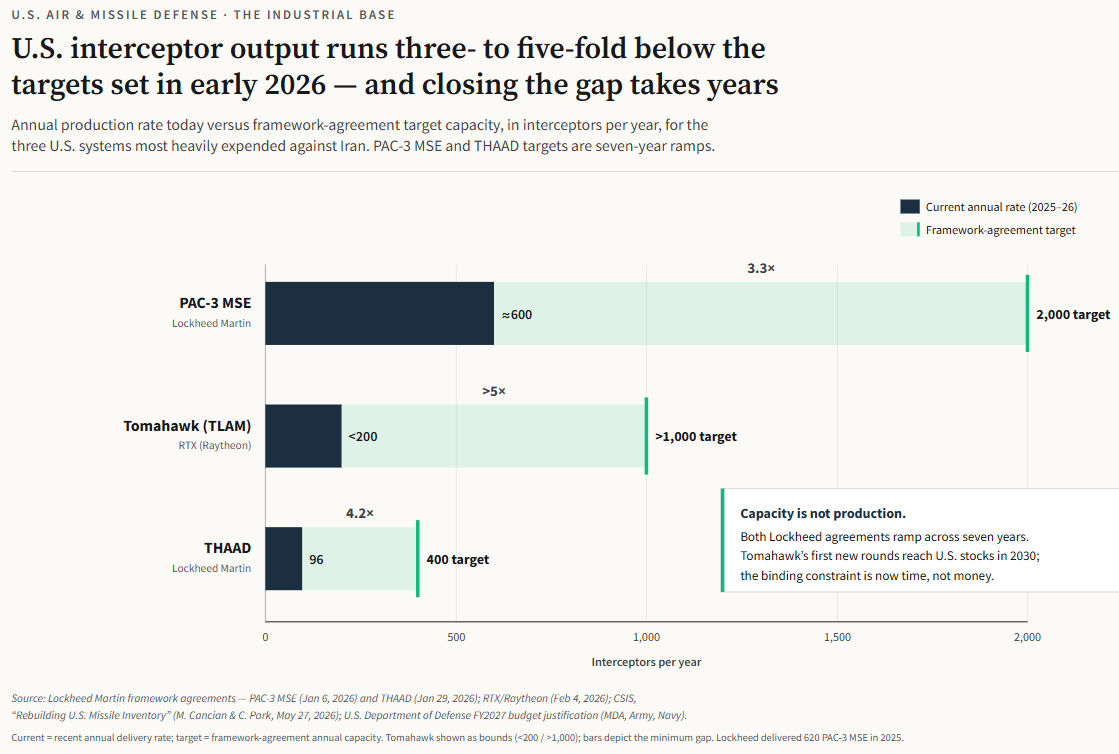
Funding arrived fast, and its speed is precisely what exposes the constraint. The 2025 reconciliation law routed roughly $25 billion to munitions and their supply chains. The fiscal 2027 budget request, built on a $1.5 trillion topline, seeks — by one analysis of the request — some $22 billion for the munitions consumed against Iran, up from $4.5 billion enacted for fiscal 2026. A separate $87.6 billion war supplemental was requested in June 2026, $21 billion of it for munitions. Money — appropriated or requested — moves in weeks.
The capacity does not. A Patriot PAC-3 interceptor takes the better part of three years to build, paced by its solid rocket motor: the motor alone runs about thirty months, and a new supplier — of propellant, of a single component — faces a qualification process measured in years. Replacement timelines now run system by system, and none is short:
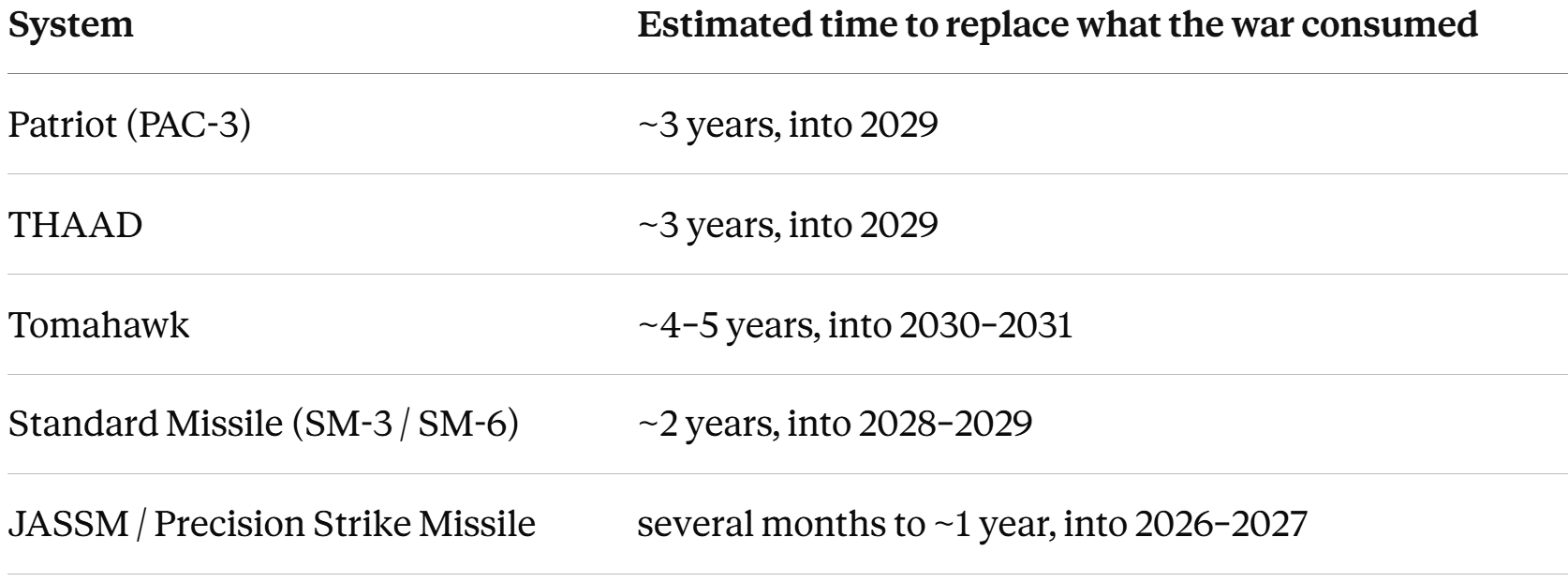
Estimated replacement of Operation Epic Fury expenditure at projected production rates; CSIS estimates. Actual inventories are classified.
THAAD stocks are the most depleted: production has run at roughly ninety-six interceptors a year, and even the accelerated buys now under contract are not projected to restore the expended inventory until the end of 2029.
The constraint cannot be relieved by writing larger checks to the prime contractors, because the binding limit sits below them. A second domestic source of ammonium perchlorate takes years to qualify, whatever the budget. Northrop’s effort to become that source reached laboratory qualification only in 2021 and remained years from production scale in 2026 — and a lab-qualified source is not a production-grade one. The single existing oxidizer plant is itself expanding capacity by more than half, a project scheduled to finish in 2026.
Washington understands the diagnosis, and the response is now visible. The Pentagon’s central move is to fix the one variable it controls — the demand signal — through multiyear “framework agreements” that commit to tripling Patriot interceptor output and quadrupling THAAD. Those commitments are beginning to convert into contracts: Lockheed Martin received a $4.7 billion award for accelerated PAC-3 production in April 2026 and, on June 24, 2026, a seven-year contract worth up to $35 billion to quadruple THAAD output — both undefinitized, with final pricing still to be set. RTX’s five parallel munitions frameworks remain pre-contract, awaiting appropriations. And on June 11, 2026, the administration invoked the Defense Production Act over the munitions base, using its Section 708 authority to let suppliers coordinate production through voluntary agreements, with officials pointing to solid rocket motors as the central constrained subsystem. The world’s largest defense budget is reaching for emergency industrial tools because it cannot build its own missiles fast enough.
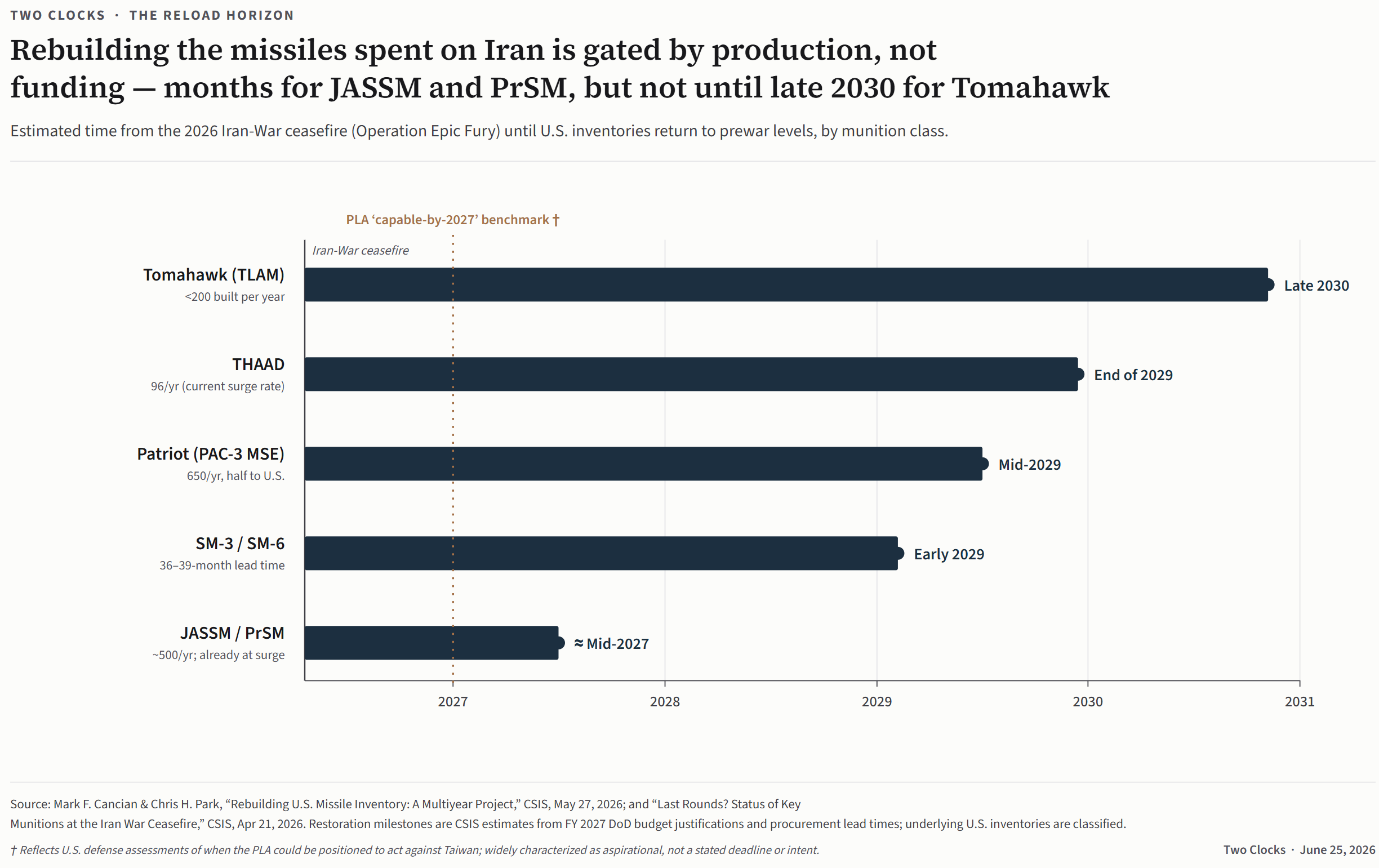
What follows maps the constraint to the publicly traded companies positioned as primary commercial leverage on the reload. It spans the prime integrators consuming the demand, the two incumbent motor makers — one of them carving its propulsion business into a separately listed company through a government-anchored offering — the sole domestic source of the oxidizer that gates the chain, the specialist suppliers a tier deeper, and the venture-backed entrants challenging the incumbents. It closes with the catalysts that warrant monitoring and the risks that cut against the thesis.
Comments
Nothing yet. Say the first thing.
Sign in to join the conversation.