
This installment converts the six that precede it into a usable analytical instrument. It assigns probability ranges to each of the seven scenarios across three horizons — the next twelve months, the next five years, and the run to the 2049 centenary — states the reasoning and the principal counter-evidence behind each range, resolves the seven into a single base case per horizon, maps how the major asset-class and operational exposures change scenario by scenario, and delivers a monitoring matrix of twenty-four leading indicators the reader can track independently to update the assessment as evidence accumulates. Where Part 6 catalogued what is, this installment specifies how to read what comes next.
The synthesis of six installments yields one organizing judgment: across every horizon that matters to a capital allocator, the modal cross-strait outcome is the continuation and intensification of coercion short of war, and the catastrophic scenarios that dominate analytical attention are a minority of the probability mass — concentrated, expensive to insure against, and the correct object of tail-risk management rather than base-case planning. That judgment is the Conviction of this assessment, and it follows directly from the ledger Part 6 built: on the rational-cost calculus the frictions outweigh the lubricants, and the configuration of stakes is one in which the rational-cost preference of most parties points away from the disruption a kinetic scenario would unleash — a cost-ledger reading that is the base case’s load-bearing assumption and also its chief vulnerability, since autocratic leaderships have repeatedly subordinated economic cost to regime survival, nationalism, and legacy, as Russia’s 2022 war showed.
The probability architecture that follows expresses this. Over the next twelve months, the assessment places the two non-kinetic resting states — sustained managed coercion and intensified gray-zone pressure — together at roughly 80 to 90 percent of the horizon-end mass, and puts the probability that any kinetic episode occurs at all — quarantine, blockade, outer-island seizure, or invasion, treated as overlapping rather than additive pathways — in the low double digits at most, with full invasion at the bottom of that band, consistent with the Office of the Director of National Intelligence’s March 18, 2026 judgment that Chinese leaders “do not currently plan to execute an invasion of Taiwan in 2027 nor do they have a fixed timeline for achieving unification.” Over five years the mass spreads as the 2027 capability milestone matures and the 2028 Taiwanese election approaches, lifting the probability of any kinetic episode — the union of those pathways, not a sum of them — into the mid-to-high teens and the gray zone into the modal position. Over the run to 2049 the assessment widens to its least certain estimates: a roughly even split between indefinite pressured coexistence and the occurrence of some kinetic episode across a quarter-century, with full invasion the dominant single risk inside that tail at approximately 15 to 30 percent — the widest range in the assessment, and the one on which reasonable analysts most legitimately differ.
Three facts discipline the ranges. The first is that the most rigorous unclassified wargaming, under its stated assumptions about warning time and allied participation, repeatedly finds a Chinese amphibious invasion defeated at catastrophic cost to all parties, against a high command freshly hollowed by the January 2026 purge of its two most senior operational officers, while the Pentagon’s December 23, 2025 assessment holds that the People’s Liberation Army “expects to be able to fight and win a war on Taiwan by the end of 2027” — a capability claim that raises the ceiling on what is possible without establishing that it will be attempted. The second is that the initiator itself would absorb a depression-scale shock — an 11 percent first-year contraction on Bloomberg Economics’ February 10, 2026 modeling, against an oil lifeline through a strait it does not control — in a war it would have started, while the Taiwanese economy it would target grew 14.55 percent in the first quarter of 2026 on the precise artificial-intelligence demand a conflict would extinguish. The third is that the equilibrium is unstable in two places that move independently of Beijing’s preferences: the durability of the United States commitment, left ambiguous by the May 14–15, 2026 Trump-Xi summit and the $14 billion arms package still unsigned and under review in late June, and the management of the 2027–2028 window in which the PLA centennial and the capability milestone converge on a Washington whose Pacific munitions inventory the Iran war has drawn down. Two restraining forces are eroding and warrant the closest watch — mainland public opposition to the use of force, which the Carter Center measured falling from 51 percent to 38 percent across 2025, and the silicon-shield deterrent, slowly diluted by TSMC’s overseas build-out and China’s grinding substitution progress. The base case is continuation. The work of this installment is to specify precisely what would move it.
How To Read the Probabilities
The Seven Scenarios With Probability Ranges
The Base Case Across Three Horizons
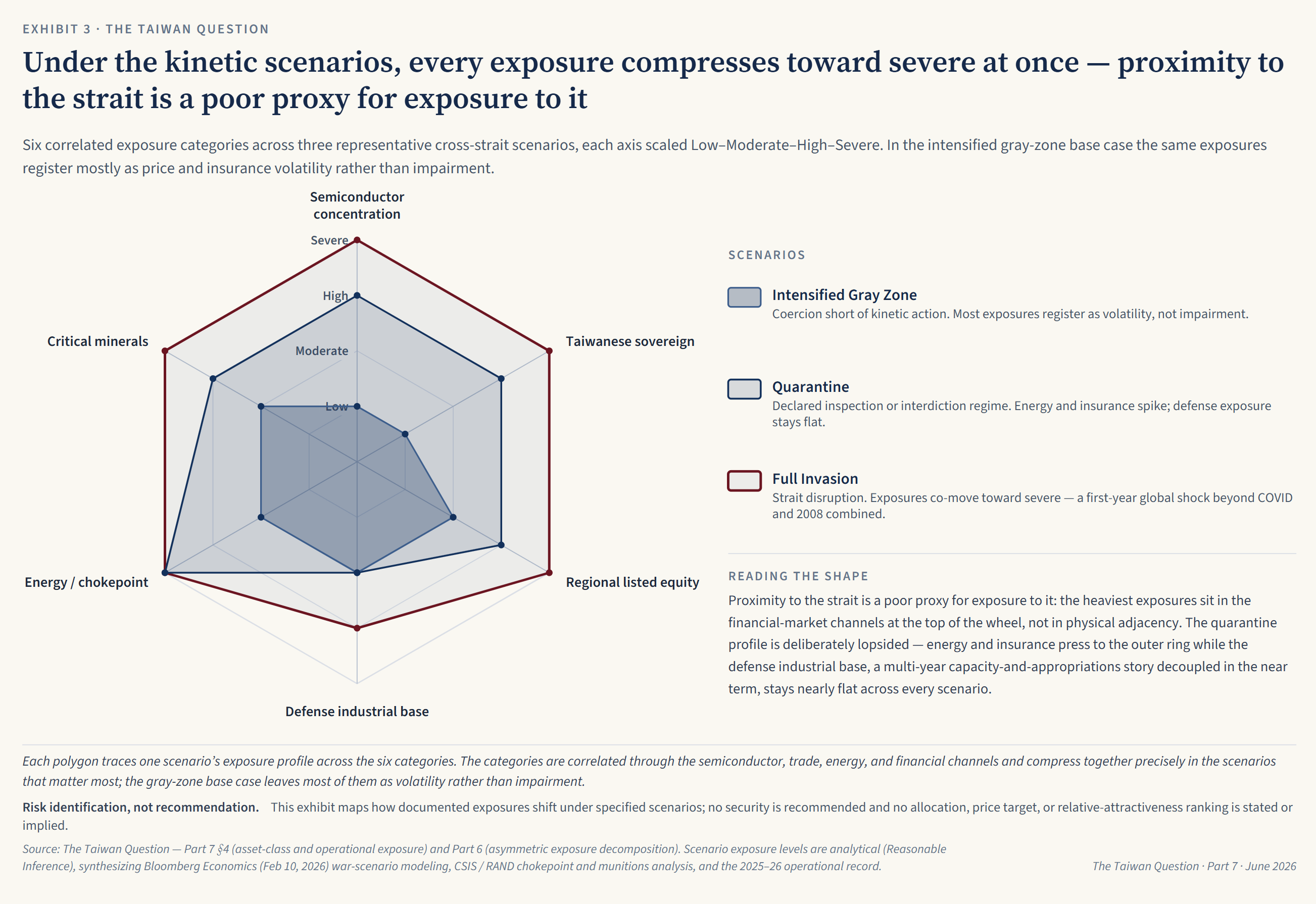
Asset-Class and Operational Exposure, Observationally Framed
The Monitoring Matrix
What Would Change the Base Case
Comments
Nothing yet. Say the first thing.
Sign in to join the conversation.