
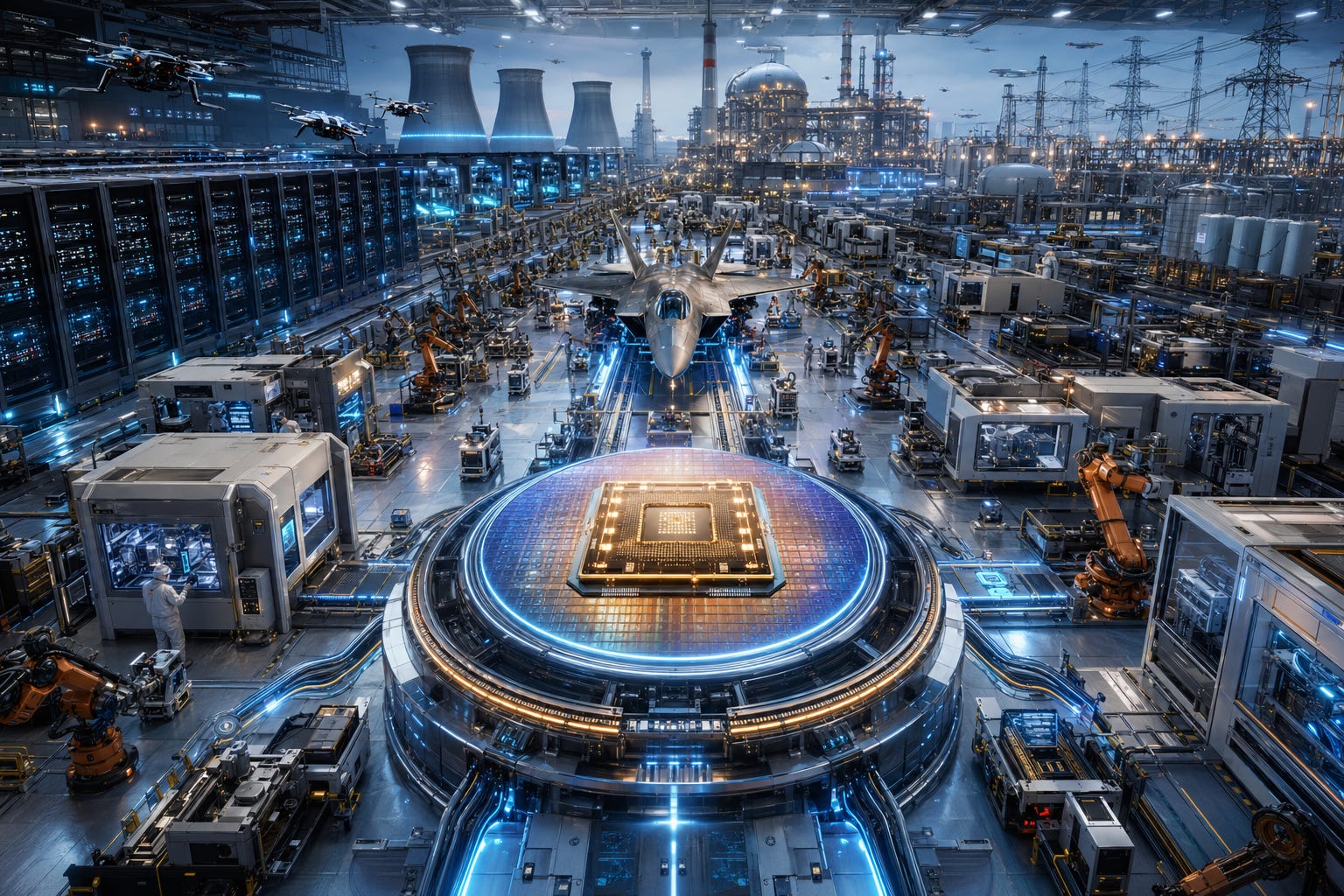
The capital arrived first. By the spring of 2026 the four largest U.S. hyperscalers had signed more than 10 gigawatts of nuclear power agreements to feed their data centers — restarts, plant offtake, and reactor-development deals, not all of them binding. Oklo alone, a developer still without commercial revenue, carried a customer pipeline near 14 gigawatts — almost all of it non-binding — and $2.5 billion in cash and marketable securities. In April it added NVIDIA and Los Alamos National Laboratory as partners on fuel and reactor validation. Then the permission arrived. On June 4, 2026, a microreactor built by the startup Antares became the first new reactor design in more than fifty years to reach criticality — a sustained chain reaction, not yet electricity — at Idaho National Laboratory, the opening result of a federal program racing to bring at least three test reactors to that milestone by July 4. What has not arrived is the fuel. As of the end of 2025, the United States had commercially enriched just over one metric ton of the high-assay fuel most of these reactors are designed to burn. This is the Physical Renaissance thesis in a single fuel assembly: capital is abundant, permission is loosening, and the physical input that gates the entire sequence will not arrive on the buildout’s clock.
Most of the advanced reactors drawing capital and headlines cannot run on the fuel the existing American fleet uses. The commercial reactors operating in the United States burn uranium enriched to between 3 and 5 percent uranium-235. The new non-light-water designs — sodium-cooled fast reactors, high-temperature gas reactors, molten-salt reactors, and many of the microreactors aimed at data centers and military bases — require high-assay low-enriched uranium, or HALEU: uranium enriched above 5 and below 20 percent, fabricated into forms such as TRISO — uranium kernels wrapped in carbon and ceramic to contain fission products at high temperature — or the metallic fuel that fast reactors burn. By the World Nuclear Association’s count, HALEU is needed for many advanced power reactors and about two-thirds of the small modular reactor designs under development; TerraPower’s Natrium, X-energy’s Xe-100, Oklo’s Aurora, Kairos Power’s Hermes, and Radiant’s Kaleidos all need it before they can produce a watt. The light-water small modular reactors (SMRs) racing alongside them — NuScale’s modules and GE Vernova’s BWRX-300 — run on conventional fuel and sidestep the HALEU constraint.
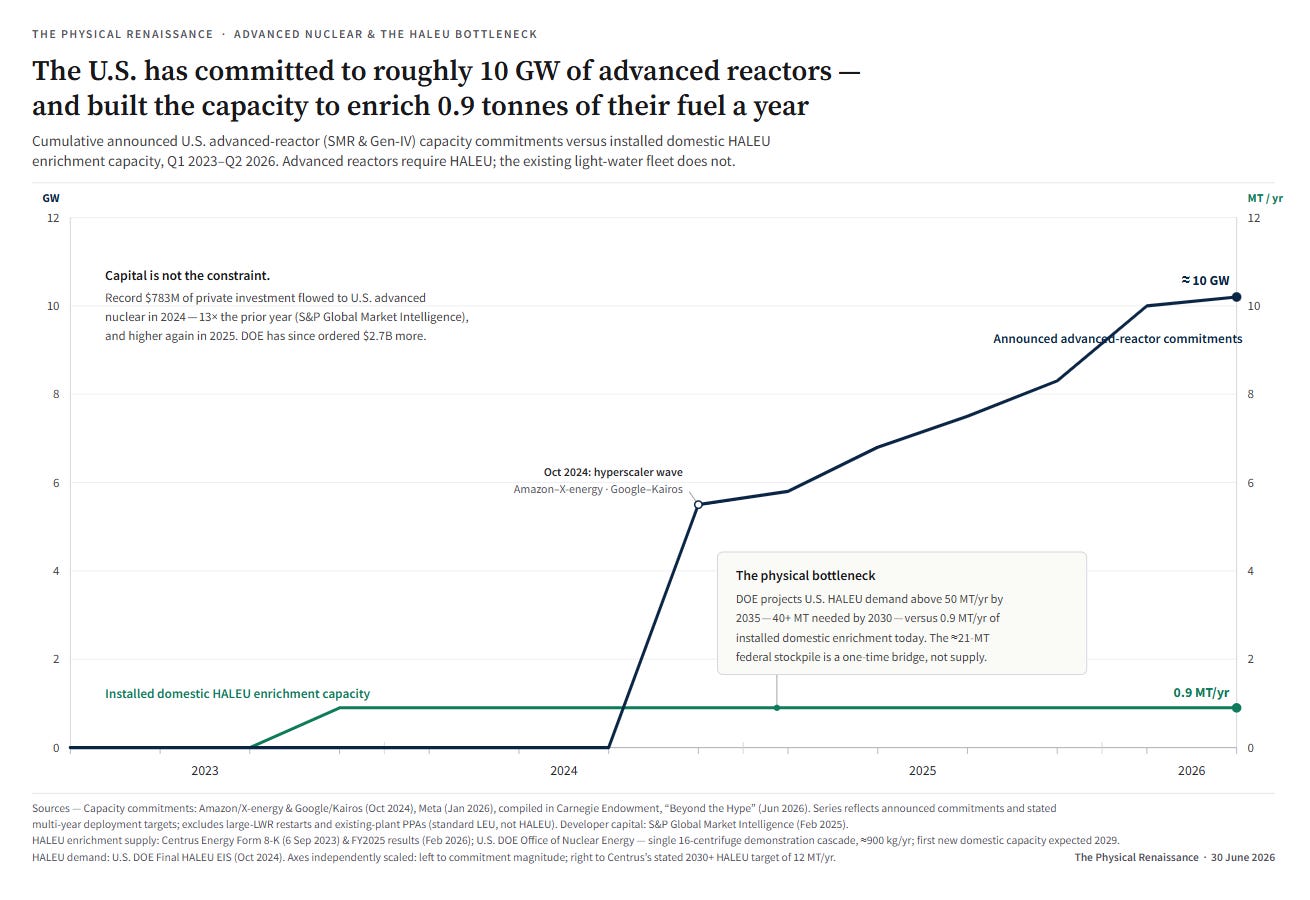
The reason the fuel is scarce is geopolitical, and recent. Until 2024, the only company selling HALEU at commercial scale to Western buyers was Rosatom’s TENEX, the Russian state enrichment arm; no Western ally enriched it at commercial scale, and China produced only for its own programs. In May 2024 the United States banned imports of Russian enriched uranium through 2040; that November, Moscow retaliated by restricting exports to the United States. The ban, and Moscow’s counter-restriction, cut that source off for the United States and left a domestic industry — one that had spent a generation outsourcing enrichment — with little to fall back on. One American company, Centrus Energy, has produced HALEU from a demonstration cascade at Piketon, Ohio, since October 2023; by the end of 2025 it had enriched just over one metric ton. That is the domestic commercial HALEU enrichment base as of the middle of 2026: a single pilot line now contracted to produce about 900 kilograms a year, supplemented by a national stockpile of surplus weapons material that the government rations.
Two of the three things a nuclear renaissance requires have changed, and the change is real. The financing has inverted. An industry that survived on federal demonstration grants now draws private capital at a scale that reorders its priorities: Meta has lined up as much as 6.6 gigawatts of nuclear capacity, and Microsoft has contracted for twenty years of output from a restarting reactor at Three Mile Island. Amazon and Google have taken positions in reactor developers — Amazon with an equity stake in X-energy, Google with a power-purchase deal for Kairos Power. In January 2026 the Department of Energy (DOE) awarded $2.7 billion in ten-year enrichment task orders, selecting Centrus for one of two $900 million HALEU awards.
The regulation has loosened. Among the four executive orders President Trump signed on May 23, 2025, one directed the Nuclear Regulatory Commission (NRC) to rule on new-reactor license applications within a fixed eighteen-month ceiling — against review cycles that once ran three to five years — and another opened a parallel DOE pathway that can authorize test reactors outside the commission’s licensing process altogether, short of licensing a commercial plant. That pathway has already produced two zero-power criticalities — Antares’ Mark-0 on June 4, and Valar Atomics’ Ward 250 on June 18, the first reactor cleared under the program to be built outside a national laboratory. And in March 2026 TerraPower received the first construction permit the NRC has ever issued for a commercial reactor that is not a conventional water-cooled design.
The fuel has not changed, because fuel does not move on a policy timeline. Enrichment capacity is built from centrifuge cascades that take years to design, license, and bring to qualified output. Centrus is scaling its Piketon plant toward a full 120-machine cascade producing roughly six metric tons of HALEU a year — a target it places within forty-two months of a funded order, not within the year — with a stated build-out goal of twelve metric tons, perhaps two cascades, after 2030. Against that, the Department of Energy projects domestic HALEU demand approaching fifty metric tons a year by the mid-2030s: a single cascade would cover roughly a tenth of it, the full build-out roughly a quarter. Urenco’s HALEU line at Capenhurst in Britain is aimed at 2031, and General Matter’s Thiel-backed HALEU plant in Paducah at the early 2030s, alongside Orano’s Oak Ridge LEU project on the same horizon.
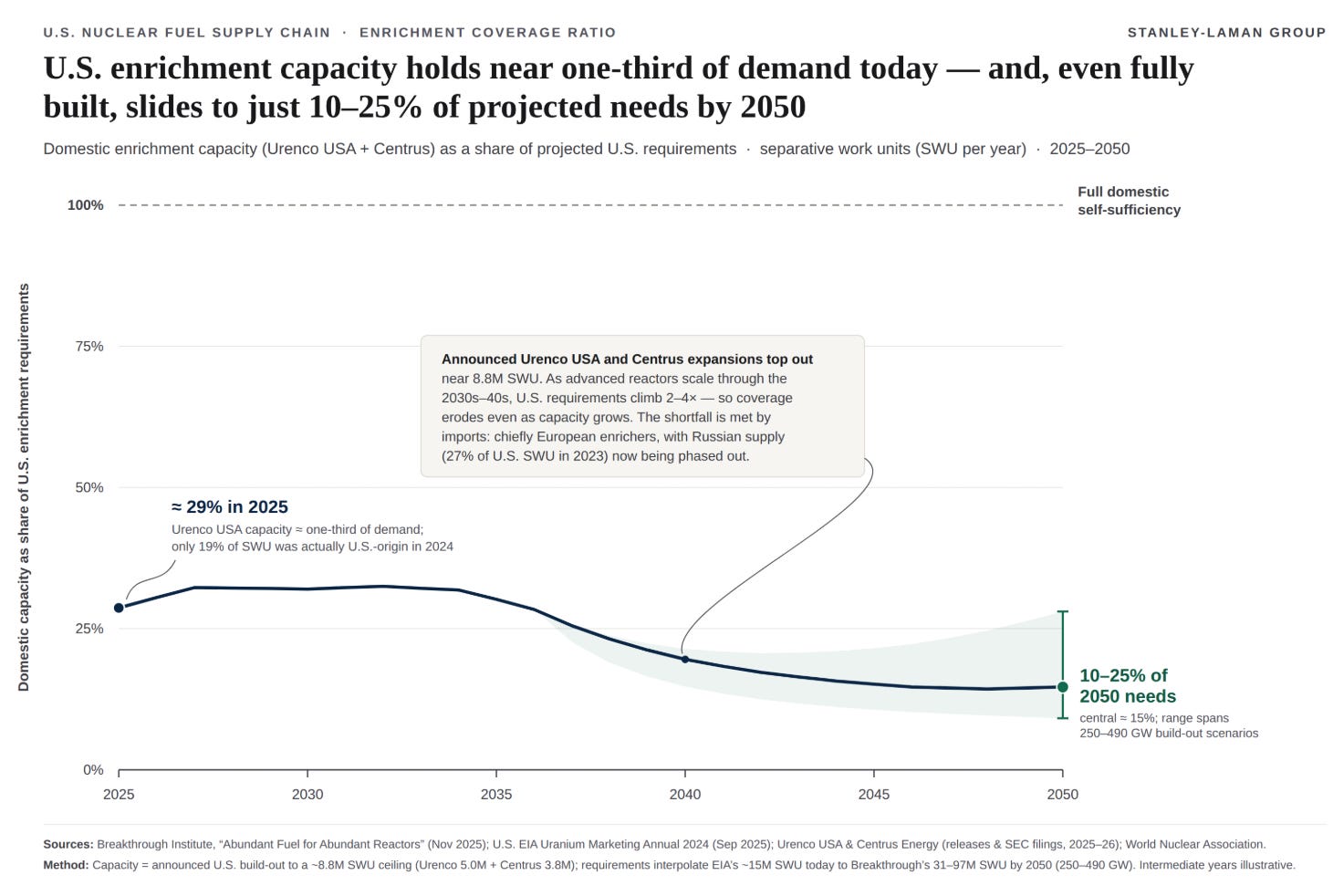
To bridge the interval, the Department of Energy is making a congressionally mandated twenty-one metric tons of HALEU available to developers through staged allocations by the middle of 2026 — drawn largely from downblended weapons material and demonstration-scale output, not new commercial enrichment. The structural shortfall outruns any single project: one Breakthrough Institute analysis finds that current and near-term U.S. enrichment capacity, measured in separative work units — the standard gauge of enrichment effort — covers only 10 to 25 percent of projected 2050 needs, a gap implying four- to tenfold growth in capacity that does not yet exist.
The economics reinforce the timeline rather than relieving it. In overnight capital cost, new nuclear runs $6,400 to $12,700 per kilowatt against roughly $1,290 for a natural-gas plant — five to ten times as much, by Deloitte’s figures, and arithmetic that favors reactors only where round-the-clock carbon-free power commands a premium the buyer is prepared to pay. Goldman Sachs has estimated that meeting all of the data-center demand growth expected by 2030 with nuclear would require 85 to 90 gigawatts of new capacity — and that well under a tenth of it will be available globally by then. The result is a sequencing problem the market is still absorbing: the data centers under construction in 2026 cannot be powered by reactors that will not generate electricity until the 2030s, and the near-term gap is being filled, against the operators’ own carbon commitments, by natural gas. The nuclear-for-AI thesis is sound. Its delivery date is later than the headlines imply.
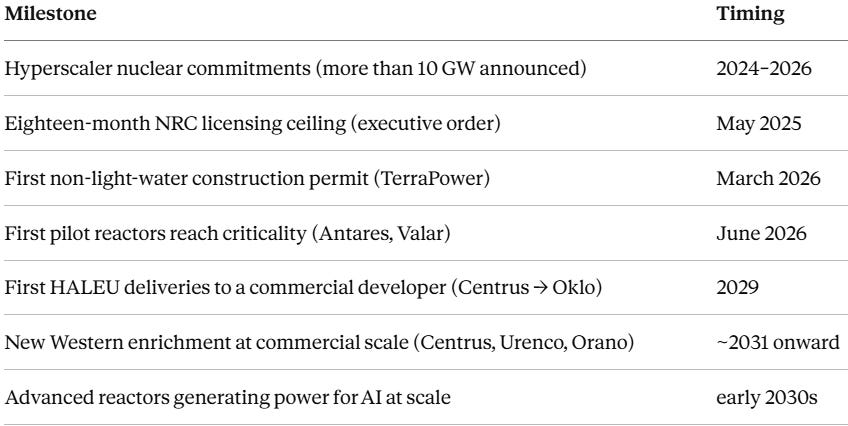
The sequence stacks against itself:
What follows maps the constraint to the publicly traded companies positioned as primary commercial leverage: the fuel-cycle enrichers and component makers that capture the nearest-term certainty, the reactor developers that carry the upside and the execution risk, the specialists working the fuel-logistics layer, and the incumbent already pouring concrete. It closes with the catalysts and risks that warrant monitoring through 2026.
Comments
Nothing yet. Say the first thing.
Sign in to join the conversation.