
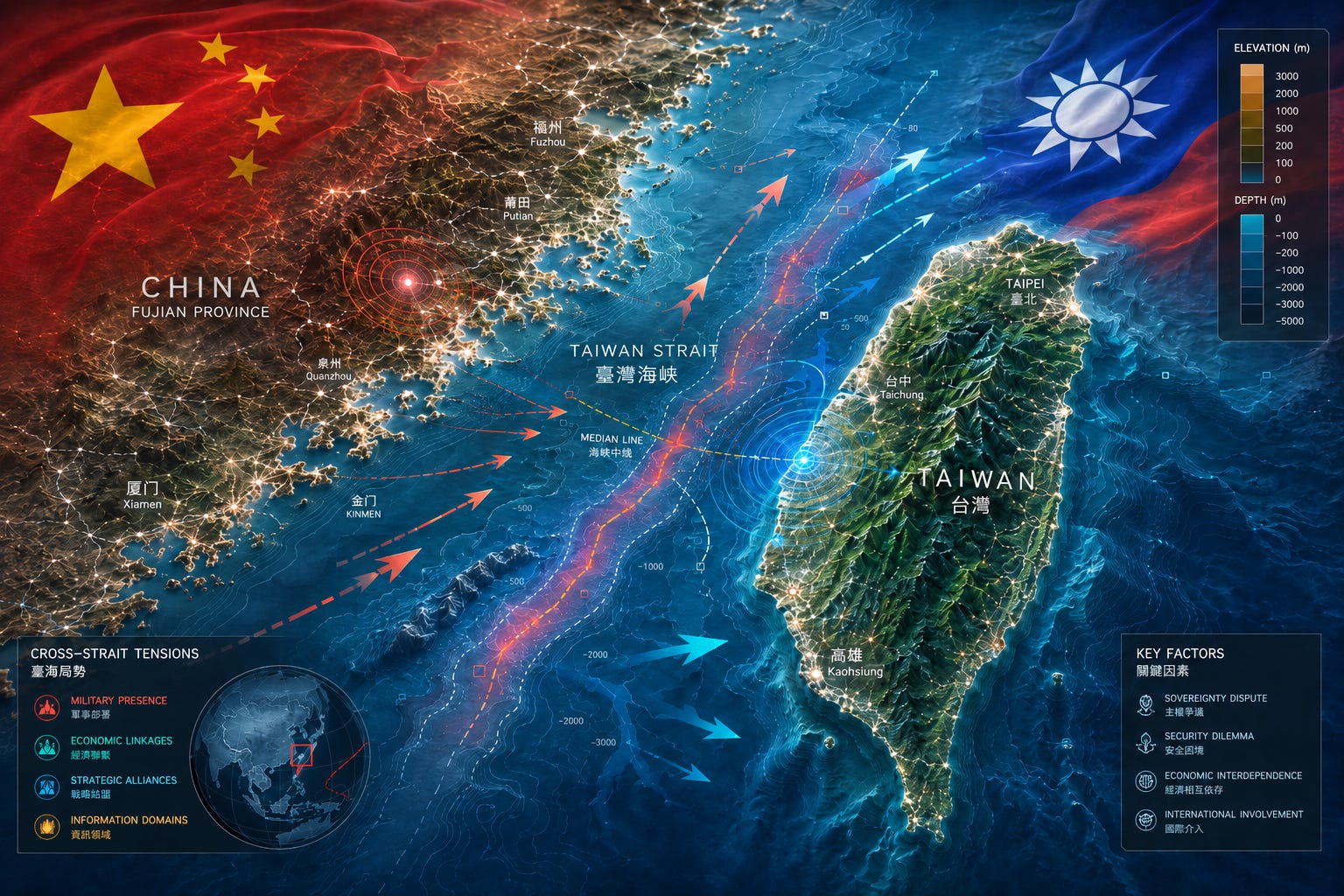
An assessment of whether China’s indigenous semiconductor program constitutes a viable substitute for the economic and technological objectives that animate the Taiwan question — and of what the answer does and does not change about cross-strait risk.
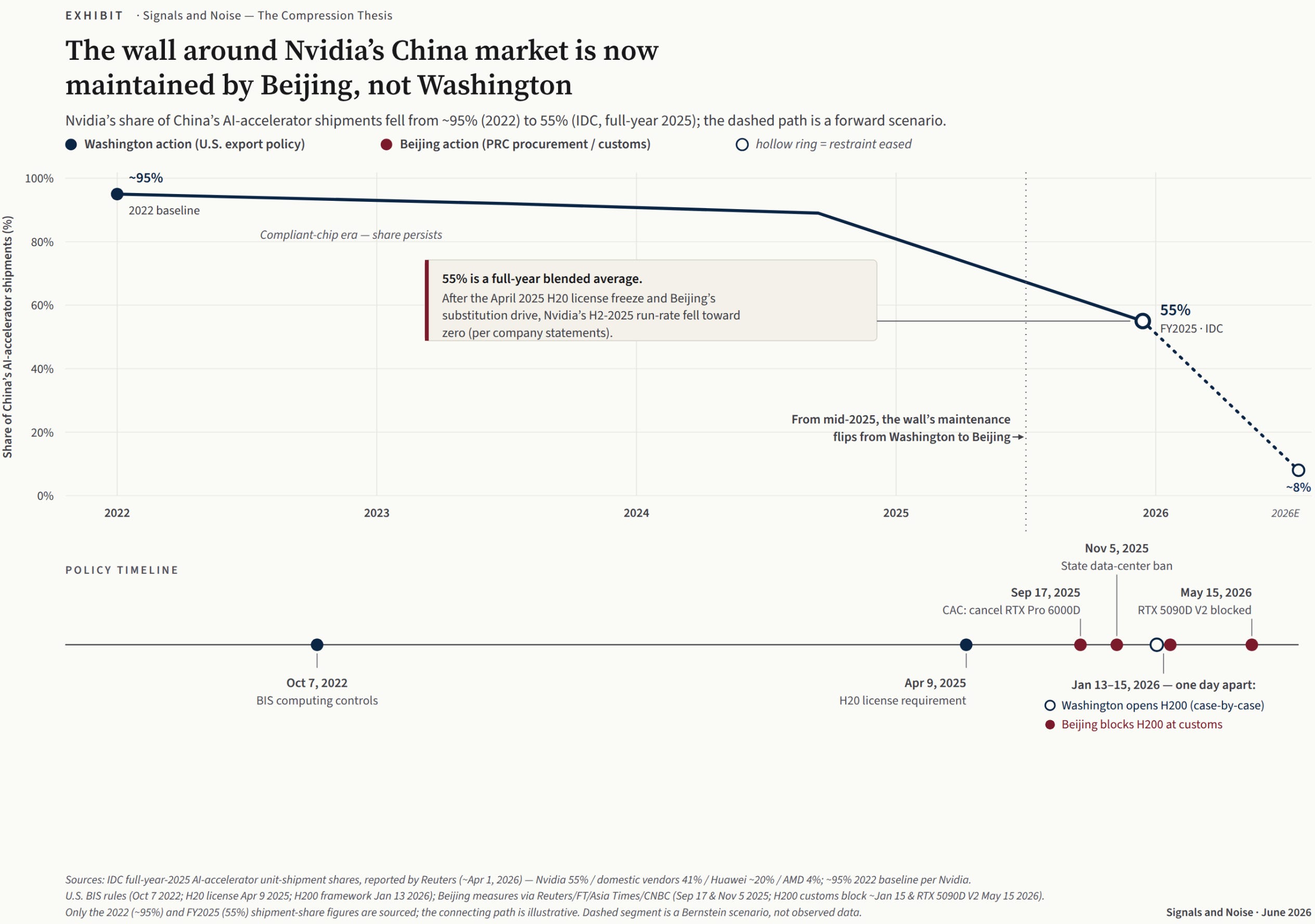
This installment tests a hypothesis that has run beneath the first four parts of this series: that China can build, rather than seize, the semiconductor capability that makes Taiwan an object of strategic desire — and that the indigenous path is so much cheaper than war that it should dominate any rational cost calculus in Beijing. The assessment finds the hypothesis substantially correct on the economic-technological pillar, and finds something the hypothesis did not anticipate: over the twelve months ending June 2026, Beijing stopped treating indigenization as a sanctions-imposed necessity and began enforcing it as a chosen strategy. When the Trump administration licensed Nvidia H200 sales to roughly ten Chinese firms in early 2026, Chinese customs blocked the imports; in November 2025 Beijing banned foreign artificial-intelligence chips from state-funded data centers outright; in May 2026, on the day the U.S. delegation departed Beijing, Chinese authorities blocked Nvidia’s RTX 5090D V2 at customs. The wall around advanced AI compute is, as of mid-2026, being maintained from both sides, and the side that first built it is no longer the side enforcing it most aggressively. That inversion converts the substitution hypothesis from an analyst’s inference into observed, if still reversible, state behavior, and it is the single most consequential development for this installment’s question since the series began.
The capability record supports a disciplined version of the optimistic case. Huawei’s Ascend 950PR launched on schedule in the first quarter of 2026 on SMIC’s N+3 process with Huawei’s own high-bandwidth memory; SMIC plans to roughly double its advanced-node capacity in 2026; CXMT is moving toward HBM3 at a cadence that has compressed the memory gap with South Korea to roughly three years; and a domestic extreme-ultraviolet lithography prototype, built with salvaged ASML components and recruited former-ASML expertise, generated EUV light in laboratory testing during 2025. The gap nonetheless remains structural. TechInsights’ December 2025 teardown of the Kirin 9030 confirmed that SMIC’s best process is a stretched 7-nanometer-class node whose logic density matches or marginally exceeds TSMC’s N6 yet falls well short of the 5-nanometer technology TSMC commercialized in 2020. Independent analysts place its yields near 20 to 33 percent on that node, with its mature 7-nanometer line higher at around 60 to 70 percent, against TSMC’s mature-node yields above 90 percent — even as TSMC itself entered 2-nanometer volume production in the fourth quarter of 2025. On the public-domain consensus trajectory, China reaches 5-nanometer-class density around 2031 while the frontier advances to A14 and beyond, so the node gap — already two to three generations — does not close.
The substitution math is unambiguous at the level of orders of magnitude: cumulative Chinese state investment in indigenous capability through 2030 plausibly totals $200–400 billion, against a Bloomberg Economics-modeled first-year cost of war of approximately $10.6 trillion globally and roughly $2 trillion to China itself. The silicon alternative is five to ten times cheaper than China’s own first-year cost of war, and a larger multiple still against the global cost; Beijing’s revealed preference strongly corroborates that it has internalized that arithmetic on this pillar. The honest counterweight is twofold. First, the silicon alternative addresses one of the five motivational pillars established in Part 2; nationalist identity, strategic geography, and regime legitimacy operate independently of fab capacity. Second, and less comfortably for the consensus, the same substitution that reduces Beijing’s economic motive for seizing Taiwan also erodes the deterrent that Taiwan’s semiconductor indispensability and Western sanctions leverage have supplied. The silicon shield restrains Beijing only while Beijing still needs what the shield protects. The most material uncertainty in this installment is therefore not whether China closes the gap, but what the closing does to the balance between removed motive and removed restraint — a balance this assessment judges to favor stability through the late 2020s and to become genuinely ambiguous in the early 2030s.
The Question and Its Stakes
The Starting Point: Building the Substitution Apparatus, 2000–2024
Where China Stands: The Capability Map as of June 2026
The Gap That Remains
The Wall Built from Both Sides: The Political Inversion of 2025–2026
Three Capability Scenarios
The Substitution Math
The Deterrent Paradox: What the Silicon Alternative Does Not Solve — and What It Removes
The Arizona Dimension
What Would Change This Assessment
Part 2 of this series decomposed Beijing’s motivation for resolving the Taiwan question by force into five pillars: regime legitimacy, nationalist identity, strategic geography, economic and technological competitiveness, and Xi Jinping’s personal ideological project. Part 4 priced the cost side of the ledger — approximately $10.6 trillion in first-year global GDP destruction in Bloomberg Economics’ full-war scenario, roughly $2 trillion of it borne by China itself, before counting the regime-survival risk that CSIS wargaming identifies as the deepest cost of all. This installment interrogates the fourth pillar directly: whether China’s indigenous semiconductor capability development constitutes a viable substitute path to the economic and technological objective, such that the pillar weakens or collapses as a motivation for action.
The pillar deserves the scrutiny because of its scale. Taiwan accounted for over 60% of global foundry revenue and more than 90% of leading-edge chip manufacturing as of 2024. Its share of total semiconductor output by value, which counts the memory and integrated-device production concentrated elsewhere, runs materially lower. The concentration has intensified rather than diffused: TSMC alone captured 69.9% of the global foundry market in 2025, generating $122.54 billion against a record $169.5 billion top-ten industry total, per TrendForce’s March 12, 2026 rankings — up from 64.4% in 2024, and holding more than 90% of the foundry market for chips manufactured at 7 nanometers and below. In the first quarter of 2026 TSMC reported revenue of $35.9 billion, up 40.6% year-on-year, with advanced nodes at 7 nanometers and below contributing 74% of wafer revenue. Bloomberg’s February 2026 modeling identifies the semiconductor channel as the single largest driver of the modeled global GDP loss in the war scenario. If China could replicate that capability domestically, the economic logic of coveting the island’s fabs would dissolve; if China cannot, the fourth pillar retains its weight and the world’s most valuable industrial asset remains parked on the world’s most contested real estate.
Two framings of the stakes compete, and the distinction organizes everything that follows. The first framing treats Chinese capability as a measure of motive: the closer China gets to self-sufficiency, the less it needs Taiwan, and the lower the probability of action on economic grounds. The second framing treats Chinese capability as a measure of restraint: Taiwan’s indispensability — to China’s own technology sector, among others — functions as a shield, and Western chokepoint leverage over China’s chip supply functions as a deterrent, so the closer China gets to self-sufficiency, the less either mechanism binds. Both framings are correct, they point in opposite directions, and most commentary on the “silicon shield” selects one and ignores the other. Sections 7 and 8 hold both in view simultaneously, because the analytical value of this installment depends on it.
A note on evidentiary discipline before proceeding. Chinese semiconductor capability is among the most propaganda-saturated subjects in the global information environment: Beijing has an interest in overstating progress for deterrence and domestic-legitimacy purposes, Washington has an interest in overstating progress to justify controls and understating it to claim their success, and equity markets amplify whichever narrative is moving prices that week. This installment anchors every load-bearing capability claim to independent reverse-engineering (TechInsights’ teardown program, which China placed on its unreliable-entity list in October 2025 — itself a datapoint about how much the findings matter), to disclosed corporate financials, or to reporting from primary-source journalism with named methodology, and it labels the residual uncertainty explicitly. Where the only available source is a Chinese state-aligned claim, the claim is reported as a claim.
Comments
Nothing yet. Say the first thing.
Sign in to join the conversation.