
I’m at the edge of welcoming our second baby, and this newsletter may be entering a quieter season alongside me - I have no idea, actually. I’m letting this season unfold as it wants to. If you are a paid subscriber, you’re always welcome to pause or cancel your paid subscription. If you choose to stay, thank you. Your support allows me to tend to my family and this new life while keeping this space alive in a gentler way. This work has always been shaped by real life. It feels right to let it reflect this moment too.
With love,
Becca
When we pulled the moving truck up the long gravel drive at our new farm two and a half years ago, I thought the difficulty would be practical. I braced for snow removal and septic systems, well water quirks and long drives for anything specific. I expected the land to humble me. What I didn’t expect was how completely the move would rearrange me; not my schedule or my routines, but the story I’d been telling about who I was.
When you move to a small town, you don’t just change geography. You lose the buffer of anonymity. You lose the illusion of infinite social options and the ability to pivot quickly when something feels awkward. And, perhaps most destabilizing of all, you lose the version of yourself that made sense in a faster, more anonymous world.
In a city or large suburb, you can be socially saturated and invisible at the same time. If a room doesn’t feel aligned, you leave and find another. If a friendship feels strained, you widen your circle. The social ecosystem is broad and flexible. In a rural community, the ecosystem is dense. There may be three restaurants, one hardware store, one school, one volunteer firehouse, and everyone’s long memory. People know each other’s histories. They know who married whom, who had a falling out fifteen years ago, who carries influence quietly, who shows up when it matters. When you arrive, you are not simply another face in the crowd. You are noticed. You are evaluated. And, whether spoken or not, people are wondering: Are you staying?
That question alone can unravel you.
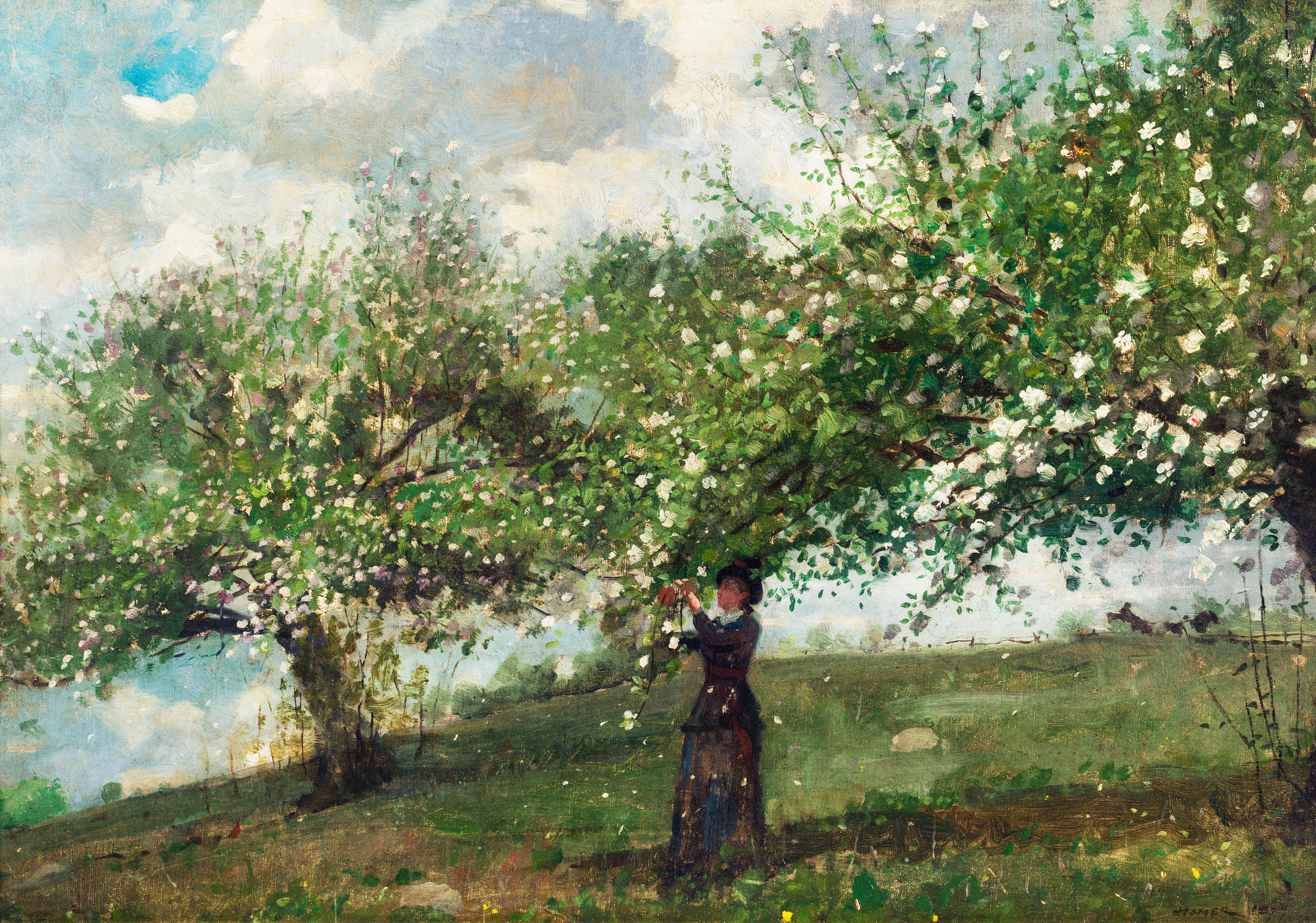
Girl Picking Apple Blossoms, 1879 by Winslow Homer
I remember feeling it viscerally at my child’s school. I would watch the other parents move through the morning drop-off with the easy fluency of people who had known each other for years - the inside jokes landing in real time, the shorthand, the way they’d fall into step together without effort. People were pleasant to me. There were smiles, pleasantries, genuine warmth even. But there is a particular ache in being treated kindly without being pulled close. I was visible in that space. I just wasn’t woven into it. And in a small community where the web of relationships is dense and old, the gap between known and welcomed felt enormous.
Alongside the loneliness came an uncomfortable self-reckoning. In an environment with a higher population density, my speed and ambition felt appropriate, even rewarded. I was used to building quickly, launching initiatives, generating momentum. In a small town, that same energy can feel destabilizing. I had to confront how much of my identity was built around being efficient, articulate, proactive. Here, those qualities are not inherently suspect, but they are not enough. Trust is not built through ideas. It is built through seasons endured. Through showing up in winter. Through staying when things are inconvenient. Through demonstrating that you are not extracting from the community but committing to it.
This is where many newcomers suffer quietly. There is a romantic narrative about rural life that centers simplicity, beauty, and wholesome connection. What is less discussed is the apprenticeship required to earn your place. Small towns are not automatically idyllic. They are relational ecosystems shaped by history. There are unspoken alliances, old wounds, protective instincts. If you barrel in with disruption energy, you may unknowingly activate decades-old tensions. If you assume openness without understanding context, you may misread restraint as rejection.
I found this out in the most humbling way possible. Early on, I clung to the first people who offered me real support - families who had been here for generations, who knew the land and the community in ways I could only begin to imagine. I felt so grateful for their openness that I stopped paying attention. We did share values around regenerative land stewardship, around care for this particular place. But I made the foolish assumption that our agreement there meant agreement everywhere. So I got a little mouthy. I aired opinions about immigration, about community care, about methods of economic growth in small towns, as if I were speaking to people who saw the world the way I did.
I wasn’t.
I didn’t find out through a direct conversation. There was no confrontation, no clearing of the air. Instead, there was a slow and painful backing away. The communication became more stilted. The warmth cooled. And then came the Instagram stories - political posts pointed enough that I understood exactly what I was being told. I had read the relationship completely wrong, and now I was watching it quietly dissolve in real time. The sting of that was not just social. It was a reckoning with my own assumptions, my own entitlement to be met halfway before I’d earned it.
Each misstep like that one required a humbling recalibration. Less talking. More listening. Fewer assumptions. More questions.
Over time, I began to see that rural belonging operates on a different clock. It is not transactional. It is not accelerated by charisma. It is tested through continuity. People watch to see if you endure the hard parts. They watch how you handle conflict. They watch whether your enthusiasm survives a failed crop, a budget strain, a community disagreement. They are not looking for perfection, they are looking for steadiness.
The land itself has been teaching me this, slowly, in its own way. This past winter felt like it would never end. Bitterly cold temperatures arrived in November (the kind of cold that usually comes in January) and they stayed, well into late March. I was praying for spring with every ounce of my body. Pining for it.
And somewhere in that long, grey waiting, I recognized an old lesson I keep having to learn: I cannot make things move faster than they want to move. The land is not linear. It does not follow anyone’s plan. The agricultural community around here likes to say “this weather isn’t normal,” comparing every season to some idealized past. But I’ve come to think an animate earth doesn’t owe us consistency. Each season has its own expression. The work is learning to be present in the one you’re actually in, rather than the one you expected.
What helped me most was accepting that integration would take years, not months. That I would feel out of place for longer than my ego preferred. That loneliness was not proof of failure, but evidence of transition. I started approaching the place itself as a teacher. I let myself be new, without rushing to redefine the social landscape.
And then, finally, something shifted.
A few weeks ago, a group of folks gathered at my home for a mother blessing ahead of the birth of my second child. In the days before, I kept convincing myself it would be smaller than expected. That people would cancel. That they were coming out of politeness, not love. But nearly everyone came. A few people showed up who I hadn’t even been sure opened their invitation, and they told me with complete sincerity that they were so glad to be there.
We sat in a circle, about thirty of us. And we went around, and each person said a blessing or a reflection for me. I wanted to wave it off, to say don’t worry if you have nothing, really, it’s fine. Instead I just held still and let them speak. And what came back to me (from people I’d stood beside at school drop-off, shared dinners with, volunteered with, sat with over tea) was so deeply nourishing I didn’t know what to do with it. I felt loved. I felt seen. I felt known, not as the woman who moved here with her ambitions and her assumptions, but as someone who had stayed. Someone who had endured a few winters. Someone who had shown up, and been shaped by showing up.
It was one of the best days I have had since we moved here.
If you are considering a move like this, ask yourself why. If the move is primarily aesthetic - slower mornings, prettier views - the friction may feel disproportionate to what you gain. But if there is a deeper longing beneath it, a desire for thicker relationships, for accountability, for interdependence that cannot be curated away, then understand: the discomfort is part of the initiation.
You are not just relocating, you are surrendering to a different relational pace. You are choosing to be known over time rather than instantly. You are choosing a web that you cannot easily exit when it feels inconvenient. That choice will surface your impatience, your need for validation, your habits of mobility. It will also, if you stay, offer something rare.
There is a particular kind of belonging that forms only after winters shared. After small-town misunderstandings repaired. After your name becomes associated not with your origin story, but with your presence. It is quieter than metropolitan belonging, less performative, less expansive. But it is dense. It holds weight. It asks something of you, and in asking, it shapes you.
We did not just move to the country. We surrendered to it. And in doing so, we have been slowly, imperfectly, woven into something we could never have built alone.
How We Come Back: Field Notes on Returning to What Matters is a reader-supported publication. To receive new posts and support my work, consider becoming a free or paid subscriber.
Comments
Nothing yet. Say the first thing.
Sign in to join the conversation.