
Good morning from Mexico. I’m on vacation this week, so my publishing schedule and topic selection will be different than usual, starting with the long essay below that I typed out late last week.
Substack launched a new tool that readers can use to detect whether posts are written by AI. Something like this is needed. There are a lot of AI slop newsletters out there that are not just bad, but hurting the overall writing ecosystem. There is more than one newsletter I’m aware of that takes things that I write here at the Latin America Risk Report and uses AI to rewrite and publish as their own.
The thing is, even though the detector says all of my Substack posts are 100% human-written (as will other AI detectors if you copy and paste my writing into them), I admittedly use AI a whole lot. So I felt that I should include that in my disclosure about AI writing.
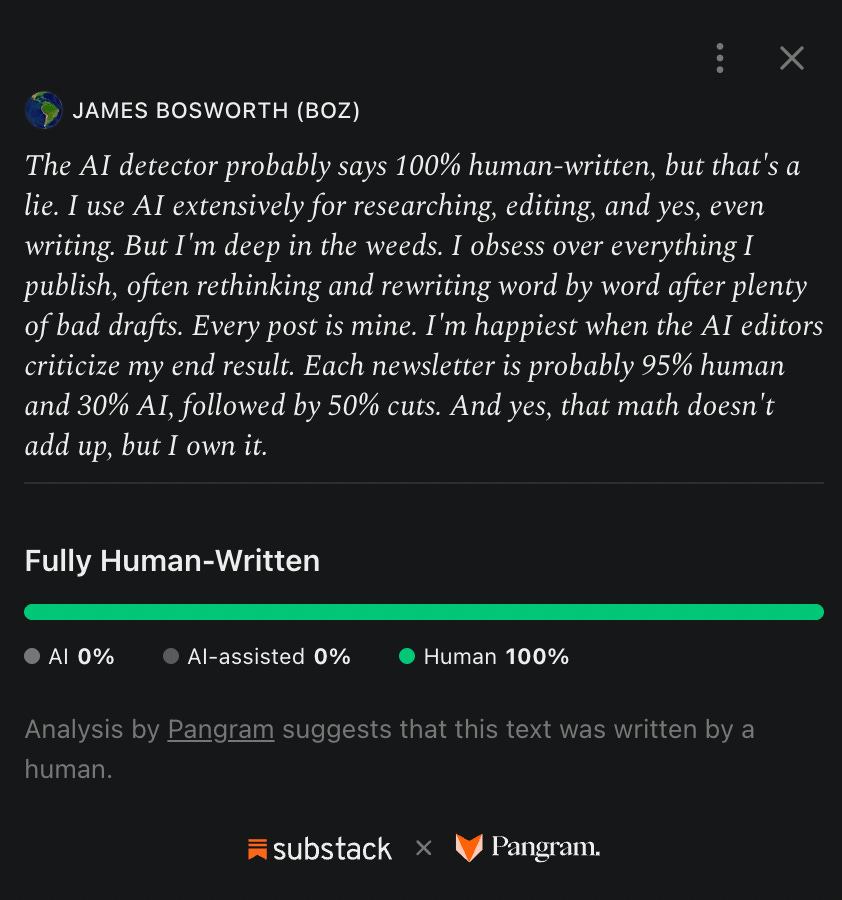
Using AI has become a part of my writing process. Most weeks, it does far more than grunt work. For research and monitoring the news, it is faster and better than Google ever was.1 However, it takes effort to get AI to work as well as I have it working now. If you just jump into a fresh AI tool and say, “tell me about Latin America news,” you’re going to get slop. But if you work with it every day, are specific about your requests, and follow up with smart questions to dive deeper, it delivers a lot of value. Knowing what questions to ask AI, how to follow up, and what to ignore is a key 2026 skill.
For writing, AI is even more useful but also requires more work to use correctly.
In case nobody has told you, the secret to writing is “words on paper,” or as Anne Lamott said, “shitty first drafts.” This means if you’re working correctly with AI (not publishing AI slop), you have essentially two choices: the human writes a bad first draft and then has the AI help make it better, or the AI writes a bad first draft and the human works to make it better. There are middle-ground ways to co-create between those extremes, but you’re always doing some variation of that writing process and then rewriting and then editing. I’ve tended towards one of the following four workflows:
Most common2: I write a full first draft myself. I pass it to an AI to edit. I go back and forth a few times with the AI, sometimes doing big restructuring of the piece and sometimes nitpicking a few words. Then it’s ready to publish. Unsurprisingly, this is often the quickest way to get to a finished product and the most useful way to come up with original analysis about an issue.
Second most common: I write the beginning of a first draft and an outline of how I hope to finish it. Then I have the AI fill in the blanks to complete the first draft. Then I rewrite into a second draft (often with more placeholders I need AI to fill in). Then a third. Then a fourth. I often cut most or all of what the AI writes, but it’s useful to have it write out the bad drafts of sentences or paragraphs that I can then rewrite. Then we edit. This is a slow process. It’s useful for when I’m uncertain about how I want to structure an argument, and I need to ping-pong back and forth for a while before I’m sure of what I want to say.
Third most common3: I tell AI to write a full first draft. Then I give it some thoughts and have it rewrite a second draft. I then (admitting this is a lot of wasted effort), discard the entire AI draft and go back to the first process, starting with a blank page and rewriting the whole thing from scratch as my own in a third draft, but now having seen and worked with the AI draft before I start. Reworded and restructured, it reads completely different, but includes some of the facts and ideas that the AI generated in its drafts. Often when I take this approach, I have a mental idea of what I would want my draft to look like before I ask AI to write the first draft. So I’m already primed to rewrite it differently when I see whatever the AI writes. Also, while doing research, I start this process and then kill the drafts very often. I probably had AI write two dozen first drafts last week on various topics that I ended up not publishing anything about. For me, having AI write drafts to read, ponder, edit, and argue with is a way to think, learn, and stay updated on a lot of issues.
Less common: I write a short outline on a piece of paper. I then open up a voice chat and lecture at the AI for about 5-10 minutes on a topic. The AI takes the transcription of what I said and cleans it up into a first draft of a column. I then rewrite it into a new and better second draft. Then I go back and forth with edits. This is really useful for doing a verbal brain dump about a topic and turning it into something more structured and written.
A few other notes:
You’ll notice that except for when I write the first draft, there is always a big rewrite. The AI drafts are helpful as bad first drafts, but never capture my tone and structure as I would actually want them. Those rewrites are how my writing remains human and original.
Back before AI, I probably wrote 50% more than I published with each essay. These days, AI is writing probably 500% more than I’m publishing, and it’s far more noise than signal.
AI hits an uncanny valley as it learns my style. The various AI tools, particularly Claude, know how I write and analyze things. Claude has access to every single newsletter I’ve written over the past eight years. Further, it has analyzed everything I’ve drafted and built a few different skill files that include my preferred styles, tones, and writing tics. So while it still doesn’t quite capture my voice, it does now get a lot closer to what I want compared to a “generic” AI that has no memory of what I’ve written. One big risk in this is some form of sycophancy, in which it produces things that I like because it knows what I like. However, given how much I hate my own first drafts, it’s impossible for a first draft to sound like me and be one I like.
Key lesson I’ve learned: To co-write with AI, you must actively fight the sycophancy, and you must cut what it writes ruthlessly.4 If you don’t find yourself doing both those things, you’ll end up with garbage. It takes time, thought, and effort to get good results.
Randomness and human judgment are needed. The AI wants to impose structure. Claude takes my style skill file and then criticizes me when I fail to include some writing tic that I overuse but that every English teacher in the world knows is wrong. It sees that I like predictions and then asks every damn day why I didn’t include a prediction in my post (it even pushed for a prediction during this essay while referencing this paragraph!). And it lacks the ability to realize that “today is the day I’m writing about random country or second-tier issues because it needs to be covered.” It would write the same five topics every time if you let it choose the editorial agenda.
I worry about what happens to journalism. Commenting on news is easier than reporting on it. So much of the AI-assisted research depends on human journalists doing the hard work. AI can write some stories when the data is available5, but it can’t yet initiate the big investigative piece, develop sources, and conduct interesting interviews. That sort of journalism has long been the most important (and too often the lowest paid) link in the information chain, but as AI eats the internet, I worry that journalism slop will encroach and ruin some of what is making AI research work well right now. Paying for good journalism and intelligence is going to become critical to getting good analysis, and those who rely on the free stuff are going to end up with the worst and most generic info.
If you’re not trying to use AI, you’re falling behind. You don’t have to use it my way, but every writer and analyst should be experimenting with AI in some way. Because it’s coming whether you are an early technology adopter or a human-writing purist who never wants the computer to do anything.
Yet, as useful as AI is, break the loop often enough to remain original. Grab some pen and paper and write by hand.6 Draw diagrams or your own maps. Type out a bold, stupid, and completely wrong draft for fun. You can’t just have one workflow, and you can’t have AI go first every time, or else the writing ends up conforming to something generic that nobody wants to read.
My views on this keep evolving. My use of AI ebbs and flows. There are weeks when half my drafting time is spent back and forth with AI, and weeks when I write and edit nearly everything myself and the AI is a glorified grammar checker if I use it at all. The odd thing is, the more I use AI, the longer the process takes. I’m using it to think through my ideas and refine my writing. And I like to hope that time I spend is what continues to differentiate what I’m publishing from AI slop. To use the most AI-sounding formulation I possibly can (though I 100% wrote this sentence myself), for better writing and analysis, AI is not a shortcut, it’s a tool. I’m using it to improve my writing and analysis, not as a way to do less work to get the newsletter published.
Is what I write now 100% written by me as a human? I don’t even know what that means anymore. Humans have always built on the research and thoughts of others, mixed our ideas, debated hard issues, and worked with editors of some sort. Computers have been infiltrating our writing since before that first annoying red underline appeared to let me know I misspelled yet another word. And you shouldn’t be able to tell how much AI I used at any given point because, as I wrote in my disclaimer, I own every sentence. I spend a lot of time writing and editing, no matter how I include AI in the process, so by the end, everything I publish is fully mine.
Thanks for reading.7
meanwhile, Google has gotten worse
A version of this is also what I use when I write for publications outside of this Substack where I agree not to use AI for writing. Even when I draft totally on my own, I still use some version of AI for a grammar check and some fact-checking capabilities, because it’s 2026.
This was the process for this essay. Three weeks ago, before the Substack announcement, I had Claude type out a draft on how I use AI because I was planning on discussing it. That AI first draft was wrong in so many ways, insightful in others, and helpful to read. Then I did nothing with it for two weeks. Last week, after the Substack announcement, I started writing this on a blank page, all my own thoughts, but mindful of what I had learned from the AI draft.
An AI editor with a sense of humor would have called me out on this comment while I’m writing a 2,000 word essay that should probably be shorter.
Bland sports or stock market stories are easy when built on the data. Boring to read, but they give the basic facts.
I’m burning through more paper notebooks today than I did two years ago. My handwriting is atrocious, especially when I’m writing quickly, so I write a lot of stuff that I can’t read later. But the process of writing is helpful anyway.
So much more I want to say about this topic. Whether I publish more depends on the response this essay receives. I know most of you are here to read about Latin America, not AI.
Comments
Nothing yet. Say the first thing.
Sign in to join the conversation.