
Still on vacation. Took the Tren Maya from Cancun to Bacalar yesterday, which means readers are stuck with a travelogue that I wrote on the train for today’s newsletter.
The entire system is overbuilt and used way under capacity. The station in Cancun is enormous. Eight tracks, multiple entrances. They built this thing to be a major passenger railway hub. And it’s not. According to the schedule, nine trains leave each day and I assume a similar number arrive. The route I was on only has two trains each day in each direction. My train was about one-third full at any given moment (probably most full between Playa del Carmen and Tulum). We passed one train going north toward Cancun and it appeared more full than ours.
That overbuilding is not necessarily a terrible decision. It’s certainly debatable whether this train was a good idea, but if the Mexican government is going to undertake a massive infrastructure project, it’s better to build something that can easily meet a far higher level of future demand than build minimally and then be forced to expand over and over again. There were signs of ongoing construction for train yards, particularly near Tulum, that suggest they still plan to expand capacity despite the limited number of users.
The experience and feel are very similar to the Amtrak Acela. I mean that in all ways good, bad, and in-between. It’s a modern train and smooth ride on par with probably the best passenger rail system you would find in the US. Understandably, European and Asian readers just laughed at that comparison, because the US is not even close to the top global standard for this sort of thing. But it’s very nicely done by US standards and feels solid. At no point did I worry about the construction or safety.
The wifi was spotty and didn’t work for most of the trip. There was very limited cell service outside of the moments when the train was in the station. Surprisingly, it was worse in the northern part of the route where there is more population (probably because of how the track was built further from the tourist areas). This would seem to be an easy fix with Starlink or another satellite provider. The Mexican government could also contract with its major cell phone providers to improve service along the route.
The train stations aren’t easily accessible in most locations. They are a few miles away from the main downtowns and tourist areas. The one in Cancun is on the back side of the airport away from everything else. There are some shuttles and public transportation, but not much. We took a taxi (which cost 700 pesos) from the hotel in Cancun, about the same amount as it would have cost to go to the airport. Add that on to the ticket price.
I was surprised how many people were traveling with no luggage. I know locals get cheap rates, and it suggests people use this for short day trips or local commuting in some capacity.
There is a Tren Maya gift shop in Cancun. The items were nice and also overpriced. Why does Tren Maya need swag? Probably an interesting amount of politics and nationalism around that answer.
Security and security theater are done by Mexico’s National Guard.1 About an hour before departure, they had everyone with luggage line up to have a dog run past it. There was a metal detector and xray scanner system similar to the airport. Only one was running because that was all that was needed given how few passengers were there. Most of the security efforts felt like a lot of show. At the same time, the system felt safe, though I can’t be sure how much of that was security and how much of it was the low traffic. There were no unofficial vendors. Nobody who looked out of place. Not a single person tried to sell me something or scam me the entire time I was in or around the train system. We left our luggage at the front of the car, as did many of the other passengers, and weren’t concerned anyone would walk off with it.
The entire system is, in the words of my older son, “absurdly overstaffed.” Between the National Guard, the train employees, the various construction workers and train operators we saw along the line, and the contract cleaning staff, it sometimes felt that the number of workers was close to the number of passengers. That’s great as a government jobs program, bad for the potential future profitability.
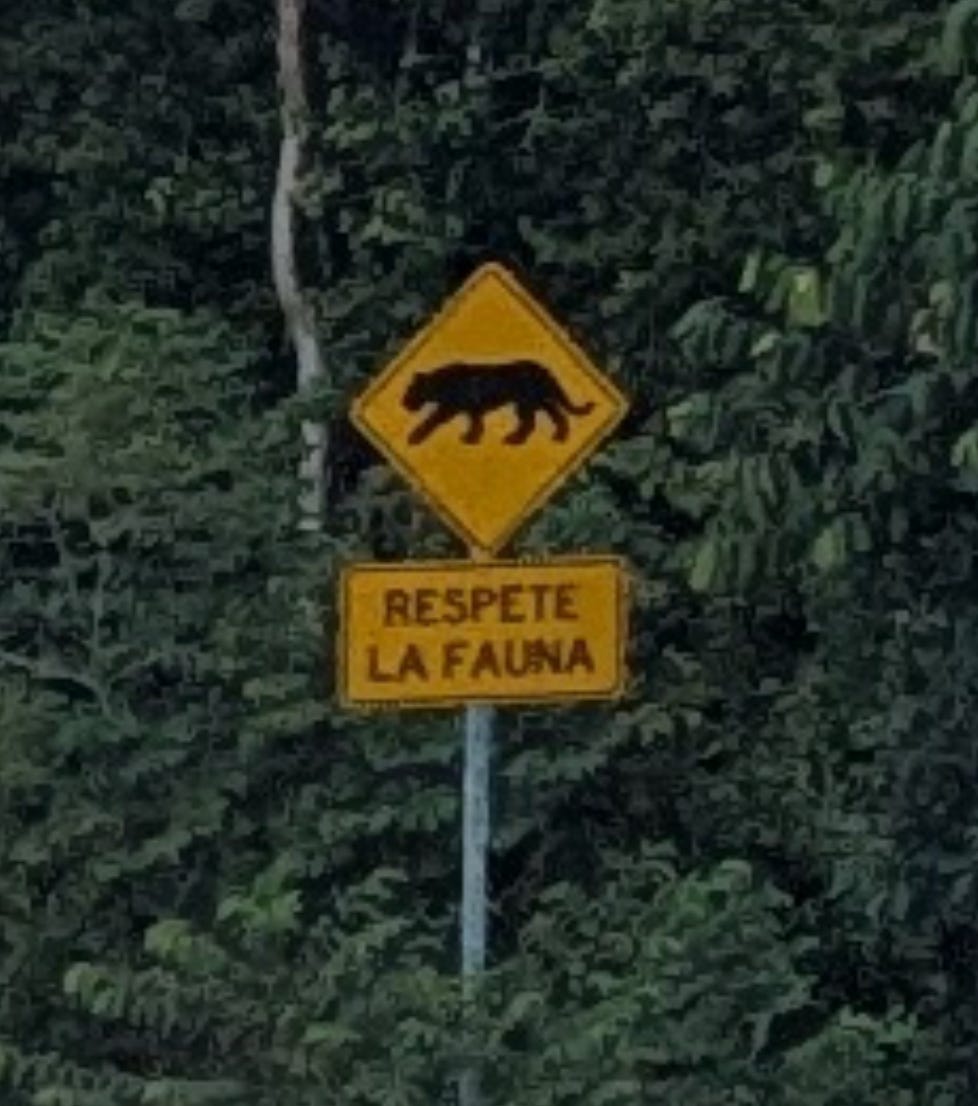
The scenery is both beautiful and not much to look at after a while. It’s lots of trees, as if they clear-cut a 100 foot wide path through the forest (because that’s what they did). Most of the ride is just trees on both sides with some wetland and farmland near the southern end. In terms of wildlife sightings, I saw what I think was a large black hawk being harassed by small birds and a bright green parrot snake on the road alongside the tracks. There are some wooden bridges that cross above the tracks, I assume to allow monkeys to cross safely, and some underpasses for the other animals. There was certainly environmental damage, but I have no idea how to measure the extent of it vs the many other infrastructure and tourism projects in the region.
This train isn’t going to pay off in the next five years. But over the next 20? Sometimes there is an “if you build it, they will come” destiny to massive infrastructure projects, and this is a region where economic growth via the tourism and shipping industries can prosper. There is potential it works brilliantly, potential that it falls into ruin, but the strongest possibility is that it gradually grows into one important part of the local transportation system but never fully hits its potential.
Sidenote: In Cancun I asked a cab driver about the security situation in the city. He said he thinks that the National Guard are awful and corrupt but that the security situation in Cancun has improved in the past few years thanks to the Navy and Army, both of which are good at their jobs. Take that single datapoint for what it’s worth.
Comments
Nothing yet. Say the first thing.
Sign in to join the conversation.