
Good morning from Mexico City. Still traveling and partially still on vacation, though working more this week. That said, given how I’ve spent the past week, you’re getting another travelogue newsletter entry today.
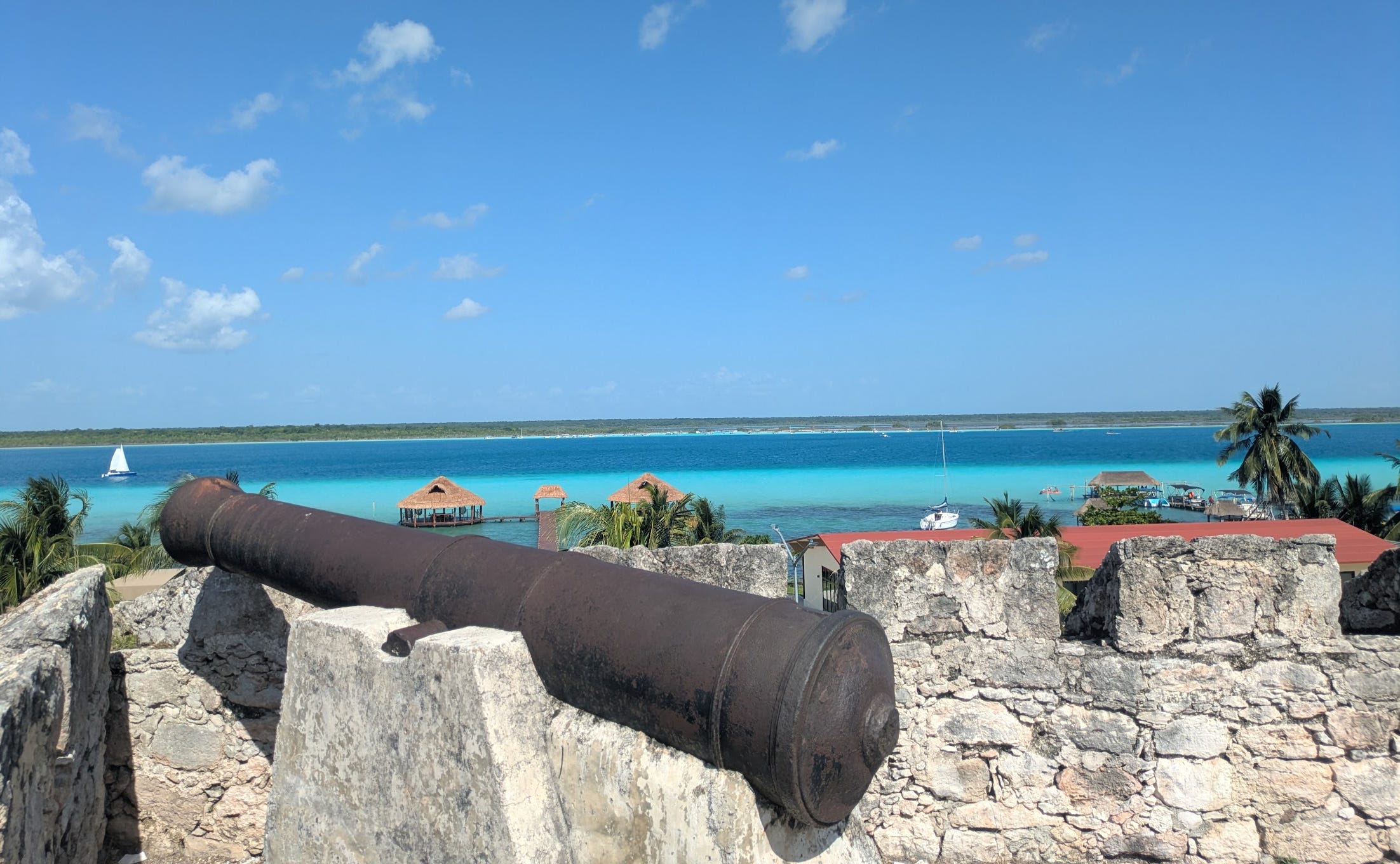
Bacalar, Mexico, is beautiful and amazing. The town built on Mexico’s second-largest freshwater lake is one of Mexico’s Pueblos Magicos; the laguna de los siete colores itself is spectacular. Unlike most lakes, it is not fed by aboveground rivers and runoff, but rather by underground rivers and cenotes. There are some fish and plants, but it’s largely a giant freshwater pool with clear water that reflects different shades of blue depending on the depth at any given point. And being that there are random deep cenotes near the edge and super-shallow knee-deep limestone platforms in the center, that makes it quite a fun place to explore.
Prior to our four nights spent at the Mia Bacalar ecolodge, we spent two nights at a resort in Cancun like typical tourists. Why not? And my impression was that Cancun is fine. Security seemed totally normal. Transportation and restaurants were overpriced for the tourist economy. Most conversations opened in English (though most people transitioned to Spanish once we started chatting, some waiters were really stubborn about sticking to English). The pools at the resort were absurdly large and quite nice.
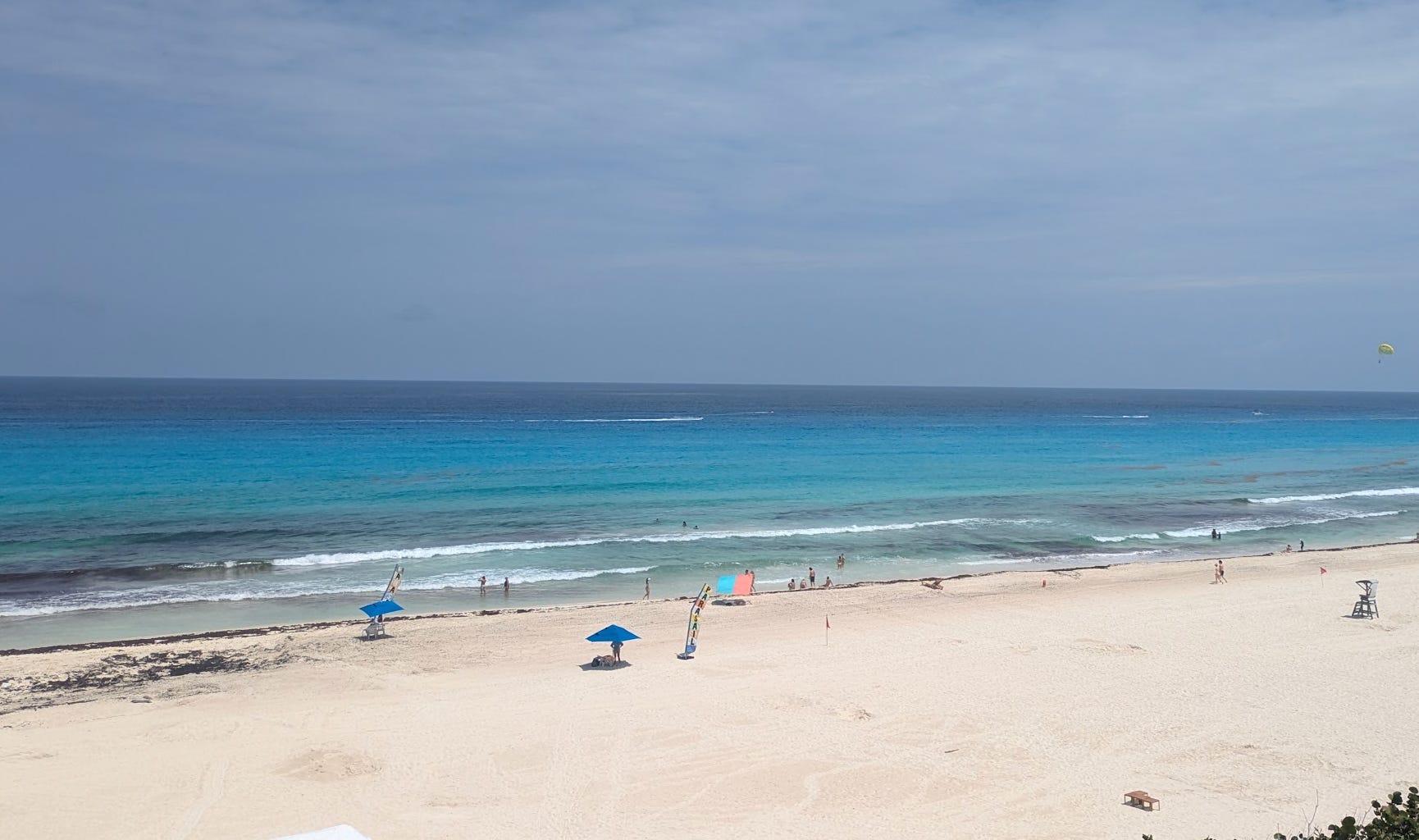
During the morning, we jumped in the ocean. Lots of big waves. And a day later, I was still pulling seaweed out of my swimsuit. Completely coincidentally, I got to experience this on the same week that AP, Reuters, and many others decided to cover the seaweed bloom across the Caribbean. Sargassum is a brown algae that is spreading across the region. It kills fish in the ocean. It stinks as it decomposes on land. Hotels pay big money to clean up their beachlines multiple times per day. And last week, President Sheinbaum announced a $115 million (two billion peso) plan to combat the seaweed that threatens the tourist economy. There will be two seaweed-trawling ships and miles of containment barriers.
Tourism is about 8% of Mexico’s annual GDP; the state of Quintana Roo represents over 40% of Mexico’s international tourism. International tourism to various Pacific Coast resorts has declined due to hurricane damage and the threat (both real and perceived) of cartel violence. On the other coast, Cancun, Playa del Carmen, and Tulum remain places that many foreigners who are otherwise a bit cautious as they travel want to go. That means Mexico’s national government takes any threat to that state’s tourism economy seriously. It’s a concentrated risk. That’s why some stinky brown seaweed can be international news and get the Mexican president’s attention.
Beyond the seaweed is the security question. Cancun felt safe. The roads felt safe. Tren Maya was safe. Bacalar felt safe in a different, small town way. We saw a lot of security personnel and vehicles throughout the trip, particularly as we traveled along the highways. Local police, Army, Navy, and National Guard. Especially National Guard. Having not been to Mexico in a while, I’ve been surprised just how much National Guard presence there is in areas where foreigners are (footnote, and I stress, where the foreigners are. My experience in tourist areas almost certainly does not match what locals see and experience in non-tourist areas). I’m not sure they are doing much actual combating of crime and cartels, but it’s a show of force in the state that is intended to push the violent actors to other areas and create the perception of security. Statistically, the numbers have improved.
Bacalar locals liked to stress that their big advantage over the other resort towns in the state is that their laguna had no salt, sharks, or sargassum. But that doesn’t mean they have no environmental challenges. I heard several people tell a similar story. A few years ago, a hurricane caused a bunch of runoff to enter the lake. For several years, the “laguna de siete colores” was brown in most spots. But combined efforts by the local community, which depends on ecotourism, helped restore the lake’s natural beauty and colors. It’s a success story about community cooperation to overcome an environmental challenge and one that should serve as an example as the coastal parts of the state and the national government fight the seaweed. This is not something that any individual hotel or town can solve on their own.
Gut feeling after spending four nights in Bacalar suggests tourism is going to surge around this laguna. And that is a big fight for local communities, Quintana Roo, and Mexico. Because part of what makes Bacalar amazing is the lack of tourism infrastructure that would hypothetically ruin the ecosystem and destroy the pristine lake. Most of the resorts remain small ecolodges, not giant corporate hotels. The state needs to expand its tourist infrastructure to keep the economy booming. But build up too much too quickly, as Cancun and Tulum have done, and it won’t scale in this town. That will be a real challenge in the years ahead.
Thanks for reading.
Comments
Nothing yet. Say the first thing.
Sign in to join the conversation.