
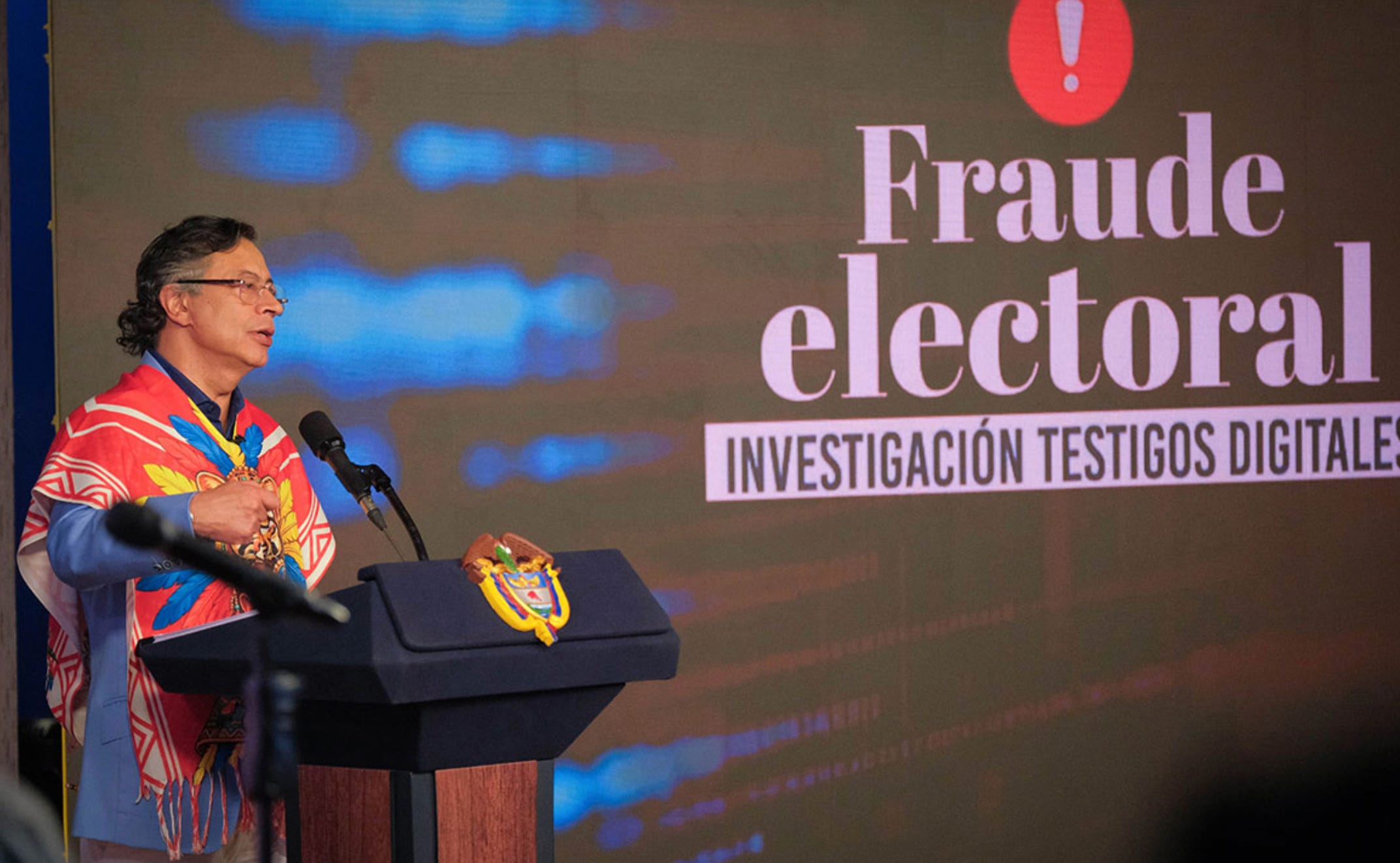
In his final press conference, Gustavo Petro focused on his completely false claims of election fraud. Petro insists that hackers manipulated the vote tallies and Abelardo de la Espriella is not the legitimate president-elect. He blamed foreign interference in the election. He said the country could face a renewed civil war.
Back in March, for World Politics Review, I wrote:
That broader erosion of trust may be part of Petro’s goal as well. Colombia’s president has long wanted to rewrite the entire constitution, and voters are far more likely to support such a rewrite if they distrust the country’s current institutions. Petro would like to see a constitutional assembly convened this year, no matter which side wins the presidency, but he has also expressed his willingness to work toward that goal for years to come. Undermining Colombia’s elections and existing institutions starts to make sense when the goal is not to govern under those institutions, but to remake them completely.
One risk, however, is that the country becomes less governable, with implications for its security and economy. Illustrations of even worse potential outcomes are the 2009 coup in Honduras, which followed an attempt to rewrite that country’s constitution; the violent protests that hit Colombia—and Chile—in 2019, as citizens demanded institutional reforms; and the insurrections in the U.S. and Brazil in 2021 and 2023 following the claims of election fraud in those countries.
While proclaiming himself the future head of the opposition, Petro has called on rural communities to form collectives that can resist military and paramilitary actions that abuse their human rights. Petro has also made comments that could be interpreted as encouraging soldiers to disobey future orders by the next president.
Meanwhile, Ivan Cepeda, who recognized ADLE’s election, has called for a series of protests against the new president once he takes office.
People certainly have a right to oppose the next government, organize, and protest, and yet you should be able to see how Petro’s comments approach the line of encouraging insurrection. That’s a dangerous position in Colombia, with its history of armed guerrilla groups opposing the state. Attempting to delegitimize the incoming president certainly falls outside the lines of normal political opposition. It’s especially disappointing as the Pacto Historico holds the largest bloc of votes in both houses of Congress and has already shown in the Senate that they can exert some leverage against the incoming government. Backing away from institutional opposition before the new president even begins his term feels like an enormous error and a risk to the country’s democracy.
A further concern is that de la Espriella is also itching for a fight. It’s not as if we should expect the next president to react to protests with calm efforts at deescalation. He campaigned as a maverick who will openly go to war. ADLE’s entire career has shown him to be open to dirty political tricks and media manipulation. Petro is handing the next president an easy justification for a crackdown.
There will be a test later this week when de la Espriella takes the presidency as Petro and his allies plan protests across the country. But those protests are likely just round one, with room to escalate in future months.
If there is any good news, it’s that de la Espriella has managed a smart and professional transition and appears to have put a good team around himself to open his administration. It’s almost a cliche in Latin American political analysis that, once elected, the radical populist (from the left or right) opens their administration with a shockingly moderate tone and cabinet. It briefly gives everyone hope. Unfortunately, it rarely sticks.
PS: I really enjoyed reading this La Silla Vacia article about Petro’s economic legacy. Great graphics and a balanced presentation of how the economy improved for many Colombian citizens but how the fiscal situation deteriorated significantly.
Comments
Nothing yet. Say the first thing.
Sign in to join the conversation.