
GROSS is every year’s top-grossing movie, since 1913, reviewed.
Thus, for contemporary man the representation of reality by the film is incomparably more significant than that of the painter, since it offers, precisely because of the thoroughgoing permeation of reality with mechanical equipment, an aspect of reality which is free of all equipment. And that is what one is entitled to ask from a work of art.
- Walter Benjamin, The Work of Art in the Age of Mechanical Reproduction
The final 15 seconds of Grease are among the strangest in popular cinema - a kind of unfolding progress from the ordinary to the profoundly unreal, grafted onto the end of an otherwise pretty conventional musical.
Scrubbing back and forth through the sequence makes your head spin: a series of camera rotations takes us out, from a small-town high school playing field, high into the sky. So what looks at first like a whimsical, fairytale ending resolves - all of a sudden - into a kind of structured step-by-step withdrawal from the film’s social and visual world. By the very end we’re not just up in the sky above the town, we seem to have reached the edge of space. It’s a rush.
It was this delirious moment that brought the Benjamin quote1 at the top to mind. In the 1930s he’s writing about the way films must be made. He marvels, with the perspective of a curious spectator looking at something that is still new - that can still produce awe - at the way the filmmaker must crowd all of the people and equipment needed to get the shot into an area that is not visible to the audience, creating a startling image of the crew, sound equipment, lighting, makeup, props, catering; the whole behind-the-scenes operation of a movie, attached to the back of the camera.
Figuratively but necessarily this whole apparatus must move with the camera, swinging back and forth as it tracks and cranes and dollies around to capture the action. It’s a vivid, absurd image: the whole studio and everyone in it; the entire studio system and its industrial/cultural apparatus and everyone that works in it, clinging limpet-like to the rear of the camera, staying out of view of the audience: a preposterous appendage - like one of the impossible, uncanny inventions in a Studio Ghibli movie.
This 15-second sequence and its very deliberate, almost clunky progress (nothing elegant or sophisticated about this edit) away from its unspectacular high school setting and out into the unreal, brings to mind this illuminating and alienating idea of cinema as a complicated apparatus that must be kept just out of sight of the audience by the industrial contingencies of the form. What happens in front of the camera is hygienically evacuated of the apparatus of production but could not happen without it - without the chaotic assembly of elements immovably fixed to the other side of it. A stark dialectic.
Before the terminal sequence begins, before Sandy and Danny arrive for their big moment, we’re firmly on the ground, in the thick of a fired-up, sugar-rush fairground crowd. The whole cast is here and the Rydell High kids2 form a huge dance troupe for the big finale. I say ‘troupe’ but it’s really a kind of informally-choreographed meleé. Choreographer Patricia Birch was required to put many of the film’s routines together on the spot, on set, ad-hoc. We can see this: I’m no dance expert but there’s no Gene Kelly precision here (there’s a Gene Kelly in the credits but it’s not that one). It’s organised chaos, there’s a fair amount of flailing; trips and mis-steps, awkward movements, uncoordinated enthusiasm (maybe this is part of the film’s charm - it’s an amateur production).
00:00-00:02 - the car
The film rushes chaotically towards its profoundly odd resolution: Danny and Sandy arrive, in a car of course. It’s Kenickie’s hopped-up Ford, Greased Lightning (we’re never told how this precious car has apparently come into gang leader Danny’s possession - maybe he just took it. He’s the boss after all). The car approaches the camera, head on. The flailing, gyrating pastel-toned crowd parts to allow it through. It’s intense. The kids are hyped-up, reaching out to touch the shiny vehicle. It’s the Beatles rocked in their limo as they escape the hysterical crowd after a concert or it’s JFK cruising through Dallas, roof down, to his Ballardian auto-demise. Jaywalking is an offence in the United States: a famous ‘fuck you’ from Detroit, an assertion of the nation’s most iconic industry’s untouchable ownership of the streets. Here, though, the kids can’t help it - they stretch to press their hands on the kandy-flake spray job like keening mourners, like contestants in one of those ‘touch the truck’ competitions. It’s flesh meets metal, a literalisation of commodity fetishism. The car, of course, is the most lavishly overdetermined commodity of them all: deeply economic, aesthetic, emotional and political. Cars are often central in American movies: they’re not just A-B devices but also locations, weapons, symbols of wealth, transgression, status. Signifying escape but also conformity; excess but also poverty. It’s hard to imagine a more richly symbolic device in all of art.
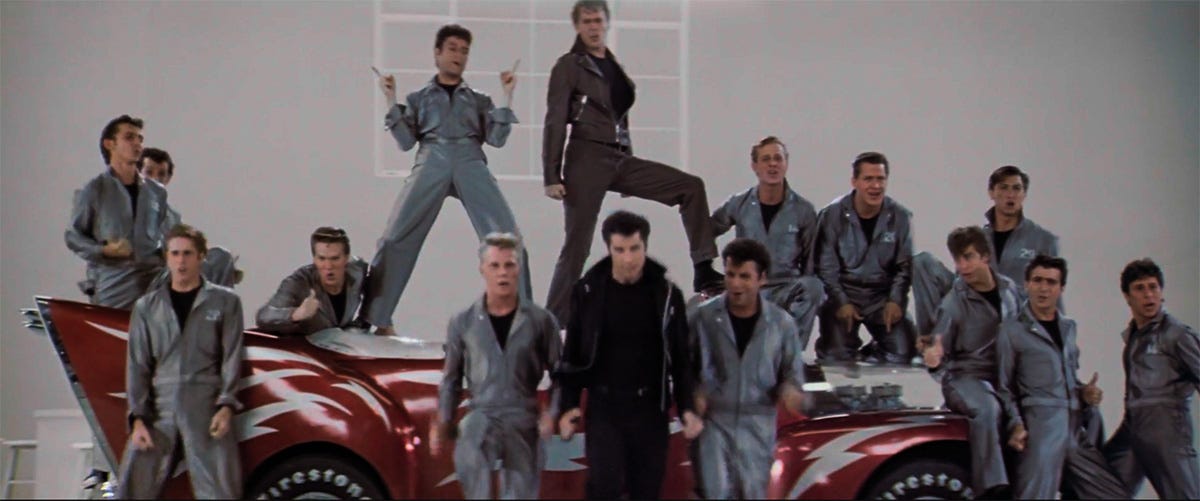
While we’re here we should consider the car itself: it’s ridiculous. It’s been customised, because the Greasers - who are coded blue collar, unruly and approximately ethnic - belong nominally to the American subculture that reveres cars. American machinery like this 1948 Ford De Luxe Convertible, in particular. But this car wasn’t worked on by any actual hod rodders, not by the working class amateur mechanics who did that sort of thing in the 1950s and since. None of the details are right, it’s completely inauthentic, kind of silly in fact.
The sophisticated design culture of custom cars emerged in the USA, the absolute epicentre of the world car economy and of world car culture in this period, because cars were cheap, stamped out by unionised workers who could afford to buy what they built and modify it. In Europe and Asia in this period a car at the kerb outside your house was still a sign of affluence that would attract a crowd of kids and speculation from the neighbours3. In the USA the custom car was a 100% working class invention. The grammar of chopping, dropping, flaring; tuning, turbocharging and drag-racing emerged from the same economy that produced Hollywood itself. From the huge working population that wasn’t wealthy but had enough disposable income to go to the movies twice a week and buy Holley carburettors and Edelbrock intakes for the project out on the driveway4.
So Greased Lightning is not a hot rod. It’s, let’s face it, a fancy New York set decorator’s fully camp take on a hot rod, on a mid-American aesthetic that he didn’t fully understand (it’s got a transparent hood ffs). It doesn’t matter much - so much of Grease is sketchy and approximate - but the car’s bug-eyed headlamps, perched up on top of the front wings, are the dead giveaway. No self-respecting hot rodder would consider such a cartoonish excrescence. The challenge for Hollywood’s bi-coastal elite of truthfully depicting the lives of the workers who live in between is real, of course, and persists.
00:03-00:05 - the music
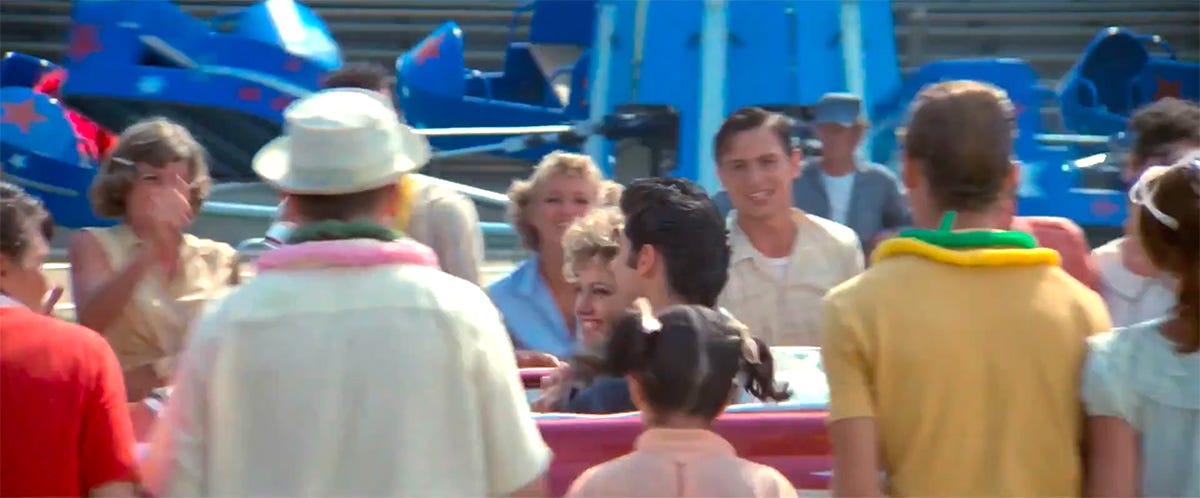
But the hot rod is just one element in this crowded frame. We don’t know this yet, of coure, but this is the last moment in which Danny and Sandy are fully within the communal space of their friends: the two gangs (the Greasers and the Pink Ladies) but also the teachers, waiters, coaches, jocks and nerds, parents, janitors and administrators. Grease has the conventional stylised sociality of a musical: the larger-than-life characters, the archetypes and comic stereotypes, the flat, uncomplicated interactions. The elements that put the form closer in its effect to epic theatre than to the vivid social realism that dominated the New Hollywood in this period. The musical is one of cinema’s oldest genres - essentially exactly as old as the technology that added sound (see The Jazz Singer and The Broadway Melody, blockbusters from the 1920s reviewed here) - and continues to be a source of innovation, despite constant challenges to its relevance and the unshakeable snobbery of various cultural elites.
Its peristence is a puzzle but it seems almost to validate Benjamin’s reading of cinema as an especially artificial form - the most artificial in the whole history of art, in fact - basically an industrial-era oddity that necessarily constantly spins out anomalous works that warp and deform the culture. Even Grease does this: innovating, if weakly, by linking the anodine teen movies of a previous era with the self-conscious transgression of the New Hollywood. It’s superficially bubblegum but we’re constantly surprised by themes and language with a harder edge - and many cringey references to sex. The film is a cousin to Saturday Night Fever (via Travolta and producer Robert Stigwood) so we probably shouldn’t be surprised that it carries forward some of that film’s more grown-up, urban tone and raunchy language.
00:06-00:07 - the departure
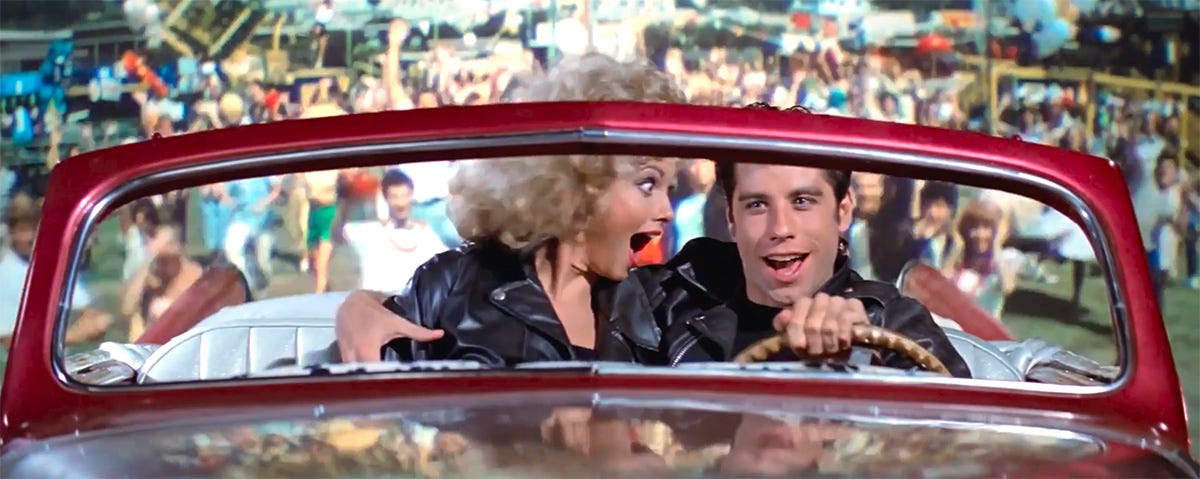
Wham, a 90-degree cut puts us back in front of the car, facing it directly again and this is where things get weird. The hysterical crowd, approaching a climax, has dropped out of frame. Danny and Sandy are moving towards us, smiling, relaxed, Sandy leaning in to Danny, in the way that only a full-width bench seat can permit5. The vehicle takes off, lifts off the ground steaply like an aeroplane, and they lose their composure. It’s a surprise and there’s an orgasmic vibe. It’s vertiginous, the momentary weightlessness of a fairground ride. Sandy and Danny obviously weren’t expecting this any more than we were but after that initial spasm, they’re calm, as if this kind of thing happens all the time, as if flight was in the plan all along. The spatial logic has shifted too: they’re not moving in and through a social environment any more, they’re moving away from the crowd and away from their on-the-ground lives and selves. It’s striking and feels - in these final seconds - like a different movie: the couple decisively leaving things behind, escaping. But why?
00:08-00:10 - the ascent
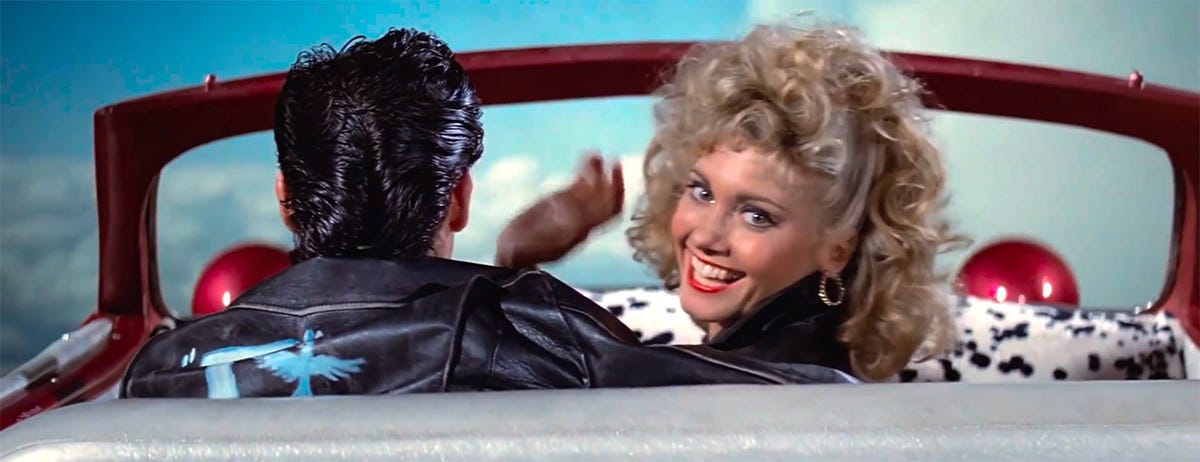
The next cut relocates the camera behind the car - a 180° rotation - and now we’re really climbing. The transition from horizontal to vertical movement occurs abruptly but it’s immediately stabilised: the camera (and the whole of Benjamin’s apparatus) is attached to the rear of the car - so we’re flying too. As the shot begins, Sandy turns and waves. It’s important and it’s one of those cinema gestures: it’s for the crowd on the ground and it’s for us. And this is the final reciprocal gesture in the sequence - the last moment in which the couple acknowledge the social setting they’re leaving behind. See ya!
00:11-00:13 - the crowd
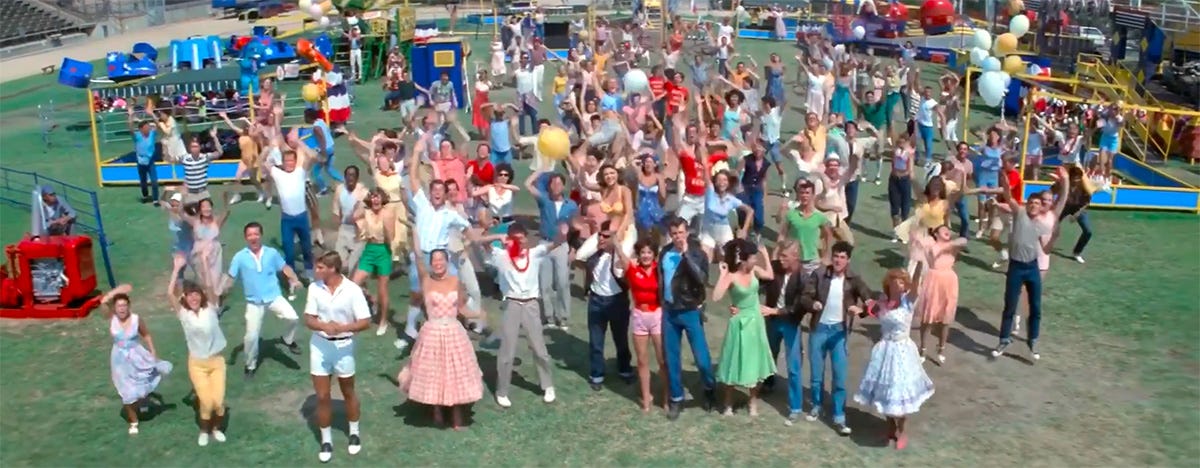
Another reverse, and we’re looking back at the fairground and the happy crowd, also waving but now shrinking as we climb. The technical limitation here is the height of a crane. A helicopter (or in the present, a drone) would have provided additional grandeur but the camera has definitively aligned itself with the ascending car. The complicated, chaotic social field of the town and the high school is flattened, left behind. Grease is precipitously altering its own scale, re-arranging its reality in the final seconds of action. The structures of school, friendship, and social hierarchy that have governed the narrative fall away, somehow now irrelevant. The more I think about this the more obsessed I am with it. Grease is a movie that has an essentially static setting: the deterministic space-time of an American suburban community, but suddenly and at the last possible moment, bleeding directly into the credits - it flips the script, goes vertical and exfiltrates its two young heroes to location unknown.
I’m going to compare this unsettling magic realist conclusion to the darker twist at the end of 2024’s The Brutalist, in which, right at the end, in a starkly different context that’s outside the flow of the narrative, we’re given new information that alters our understanding of everything that precedes that final scene (wrote about this here). It’s not an unusual device - more common in literature, though, where the idea of the plot twist is as old as story - but I’m going to assert that it’s a genuine rarity in the teen musical genre.
00:14-00:15 - the clouds
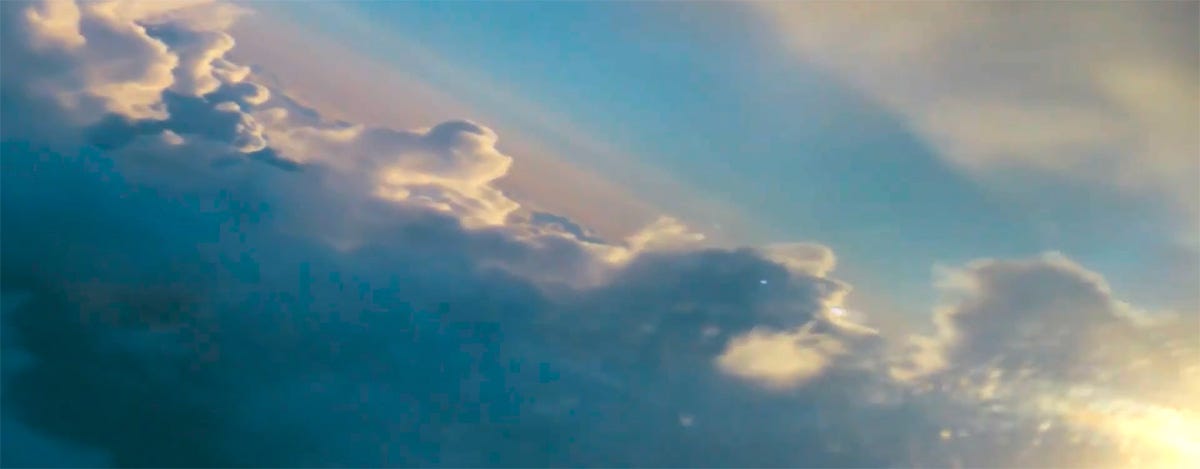
The final edit removes the car entirely. The frame fills with slow-moving cloud, viewed from a very high altitude (I’m going to bet this is library footage or something left over from another project6). We’re flying, of course, in Greased Lightning. It’s not the DeLorean, it’s not Chitty Chitty Bang Bang but it could be the final scene of Blade Runner, where Deckard and Rachael head out, in his flying car, to an uncertain future. The two scenes are connected in the way they fail to resolve their stories and in the awkwardness of their relationship to what precedes them. Both feel grafted on, both depart from the tone and even the meaning of the texts they belong to. Both essentially undermine the films they end.
Everyone’s gone, there’s no human action. Nothing is happening: the camera turns slowly. The story has been paused, suspended. It just hangs there. This final location couldn’t be more different from what precedes it, couldn’t be less social - it’s such an odd place for a musical to end. The sequence (and the film) ends with an image of space emptied of social and narrative content all together. We’re left with questions, of course, as we file out of the cinema: will they marry? Will they set up home in town or move to be close to Sandy’s family in Australia? Will Danny stick to the straight-and-narrow? Will Sandy keep her new look? Have they been abducted by aliens? Are they aliens?
I just re-read Walter Benjamin’s The Work of Art in the Age of Mechanical Reproduction (from the Illuminations collection) for the first time in decades because I’ve been attending Catherine Liu’s fascinating seminar seies in which she’s been applying Benjamin’s luminous, mystical Marxism to contemporary politics and culture.
Average age of the cast members playing the high school kids: 25.
Search for photos of working class streets in any European city in the 1950s. What you won’t see is cars. Car ownership among ordinary people was less than a fifth of what it is now. Even in the 1970s, the decade in which Grease was made, less than half of working class households owned a car.
All of this eventually happened everywhere, of course: there’s a unique and advanced car modification culture in Iran, for instance, shaped by decades of sanctions and by the strange survival of a British-Iranian joint venture from before the revolution.
The last time a front bench seat was fitted to an American car was in the 2013 Chevrolet Impala.
The awkward final scene of the studio edit of Blade Runner makes use of spare footage shot for another project - landscape scenes shot from a the air in Montana for The Shining.
Comments
Nothing yet. Say the first thing.
Sign in to join the conversation.