
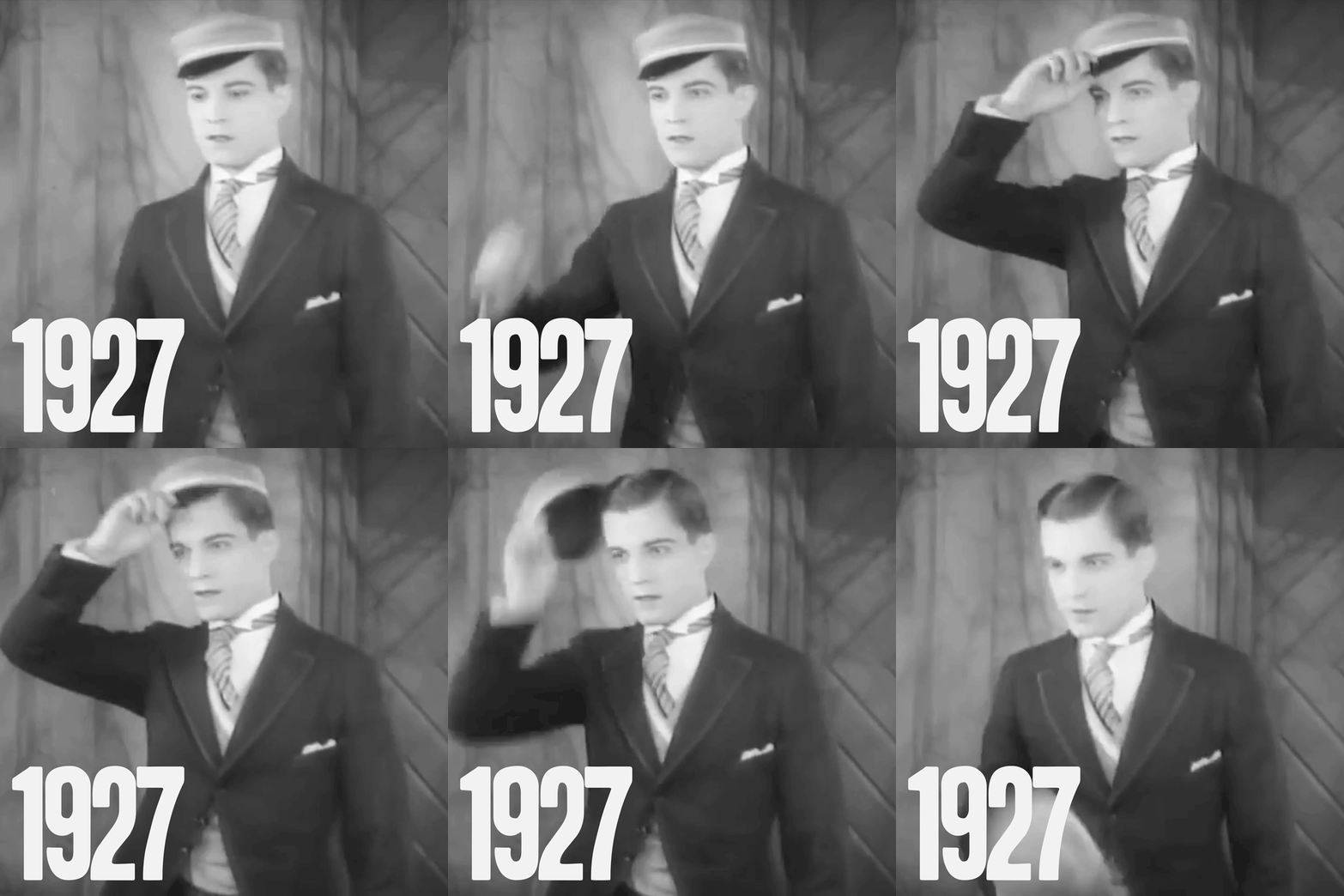
THE STUDENT PRINCE IN OLD HEIDELBERG, director ERNST LUBITSCH; cast RAMON NOVARRO, NORMA SHEARER; production METRO-GOLDWYN-MAYER, 1927, 105 MINUTES. Wikipedia, IMDb, Letterboxd.
The House of Windsor is in crisis - thanks to a prince who is no longer a prince - but the British monarchy has a Hollywood branch office. Will Harry’s House of Sussex seize the opportunity for a relaunch, perhaps a reverse takeover of the firm? Here’s a short piece about Ernst Lubitsch’s vast 1927 Hollywood interpretation of a European aristocratic fable, first published on my Letterboxd…
It’s an old story, a tale lifted from European tradition and given an epic treatment. An aristocratic kid becomes crown prince, he’s sent off to college to acquire some refinement but he falls in love with a commoner, then the old king dies and it’s time for the prince to step up and marry an aristocrat - someone chosen for him. The end. But it has the pace and wit of Hollywood in the 20s. It’s just before sound but the creative-industrial complex in Los Angeles is essentially all in place. It was shot on the largest lot in existence - in Culver City, which became a town in the Palatinate for the 108 days of the shoot: a cast of hundreds in German costume milling around for weeks. It cost a record-breaking $1.25M and the shoot took three times longer than for an ordinary film. All the Hollywood drama and extravagence is already present - a huge amount of footage shot in Heidelberg for realism was never used because it didn’t arrive in time (feel like I need a gag about the bandwith of an ocean liner vs a Dropbox transfer here).
Support GROSS before the end of February and get an annual subscription for half price - that’s a whole year of materialist film criticism for £25
We’re pre-code so the commoner - Norma Shearer as Kathi, a waitress at an inn frequented by Heidelberg’s famously dissolute student population - is allowed to be worldly. When she’s showing the prince his room at the inn she bounces on the bed to illustrate how comfy he’s going to be and it’s so suggestive. He blushes. Crown Prince Karl Heinrich is played by Ramon Novarro, a very modern star (he’d fit right into the Marvel universe). Until this point he’d mostly been playing Latin lover types so audiences might not have believed in his innocence in 1927, though.
The prince’s enabler in his coming of age is his tolerant old tutor, Dr. Jüttner (Jean Hersholt), required to travel with the prince and keep an eye on him. But he’s obviously a modernist: permissive and impatient with the up-tight aristocratic elite that he’s working for and that he knows the prince will have no choice but to rejoin soon enough (Jüttner’s obviously a socialist - there’ll be a Rosa Luxemberg pamphlet tucked into that dusty old book he’s reading - and he looks just like Walter Benjamin. I’m just saying). We’re in Germany at the absolute fin de siècle peak of intellectual and social experimentation. Heidelberg is a party town - but also a centre of humanism and scientific curiousity since the 14th Century. In the story it stands for liberal ideas, loose morals, free thinking. The tutor lets the boy have his fun and mix it up with the rowdy students (presumably taking on all sorts of radical ideas while he’s at it - although it does seem to be mostly about the beer).
The sad ending is a very Hollywood downbeat: an individualist resolution to a European fable about duty and tradition. In older versions of this tale it’s heartbreaking that the lovers are parted but ultimately it’s good news, a re-assertion of the correct authority: the prince’s adolescent adventure is over and he now assumes his glorious throne to the adulation of his people and all that. I suspect a contemporary remake wouldn’t permit any of this. The prince would be allowed to reject the slow-witted princess, chosen for him and shipped in from another kingdom, and the loving couple would elope in a battered old car and go into exile where they’d open a podcasting studio or something.
I saw the movie at the BFI’s Film on Film festival. Kevin Brownlow, the movie historian who restored Abel Gance’s Napoléon, was present, there was so much love for the man. He gave a great introduction and told us that the allies had avoided bombing Heidelberg during WW2 because someone in authority had seen this movie - but I read that this is an urban myth :-(
The Student Prince in Old Heidelberg is on YouTube.
Comments
Nothing yet. Say the first thing.
Sign in to join the conversation.