
GROSS is every year’s top-grossing movie, since 1913, reviewed.
STAR WARS, director GEORGE LUCAS; cast MARK HAMILL, HARRISON FORD, CARRIE FISHER, PETER CUSHING, ALEC GUINNESS; production TWENTIETH CENTURY-FOX, 1977, 121 MINUTES. Wikipedia, IMDb, Letterboxd.
Before you read this one, add these earlier sci-fi posts to your queue: the political economy of the Villeneuve Dune movies; Working in Space: Kubrick’s 2001 vs Bong’s Mickey 17 and 20,000 Leagues Under the Sea: a disquisition on underwater storytelling. And here’s part one and part two of the Star Wars series.
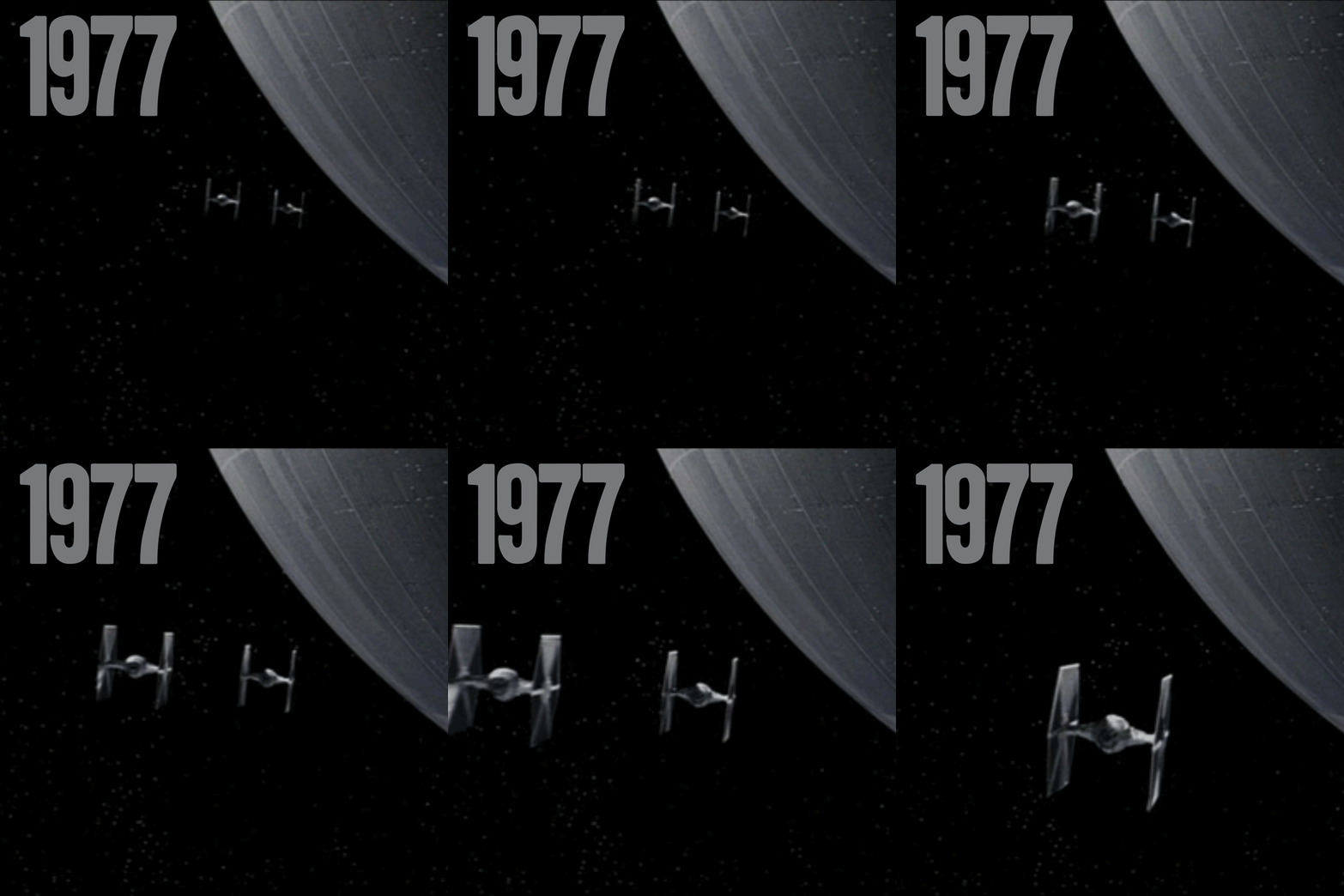
Star Wars, 1977’s top-grossing movie, landed after Vietnam, late in the era of détente and shuttle diplomacy and what looks from here like the weird hiatus of Jimmy Carter’s presidency. Brezhnev, Giscard d’Estaing, Callaghan, Schmidt and that guy who succeeded Mao whose name you’ve forgotten (Hua Guofeng).
Star Wars. Era: anti-colonial struggle. Non-Aligned Movement, PLO as secular nationalists, some Western nations actually supportive of independence struggles (Wind of Change), optimism about independence in Africa, Che Guevara as worldwide icon, Nasser and pan-Arabism, Bolivarist revival…
In Star Wars - which is a throwback to the serials (and to the Mediaeval hero stories), in geopolitical terms we’re in approximately the mid-20th Century, at the end of the colonial era: so much hope, so many actual independence ceremonies (attended by apologetic Western premiers). Considered in this way the Rebellion is obviously an unproblematically good thing.
This post is free to all subscribers - if you’d like to read everything, the GROSS Valentine’s sale continues: 50% off an annual subscription until 14 February. That’s £25 to support this project to give a materialist account of Hollywood, from its very beginning until the present day.
The fighters in the movie are universally saintly, self-sacrificing and plucky. They’re directly modelled on the acceptable freedom fighters of the period: their weapons are a generation or two behind the Empire’s, so they rely on improvisation, on the exaggerated courage of the oppressed and on something resembling belief (it’s a kind of secular restatement of faith called ‘the Force’ - a religion apparently emptied of church, sacrement and tradition). The only thing that’s missing is any kind of doctrine. Lucas explicitly excludes it. These rag-tag warriors are not evidently nationalists or communists or developmentalists. Just happy freedom-lovers with blasters: people with no apparent ideology fighting people with a one-dimensional ideology of domination1.
Star Trek. Era: rules-based order. The urgency of peace and ‘never again’, a profusion of treaties and agreements, the dawn of the NGO and the UN’s cosmopolitan elite of under-secretaries general, special representatives and consultants. Multinational governance, Security Council resolutions and peacekeeping forces…
Governance in science fiction is always weird and unresolved - I mean it’s always the whole planet, right? Never a nation or a collectivity smaller than that2. So all the pan-galactic bodies in the stories - the alliances and federations - are always vague agglomerations of planets and planetary systems3. In Star Trek the federation starship wanders the galaxy like a giant warp-speed NGO, shows up in a troubled region and makes a finger-wagging, ‘values-based’ intervention, all official-like. The crew of the Enterprise is empowered to make these interventions by a resolution passed in a vast horseshoe council chamber back in the galactic metropole decades or centuries earlier. Hostile, non-compliant, ‘rogue’ peoples who are not signatories (Borg, Romulan, Klingon…) may be vaporised but there’ll be some agonising and hand-wringing beforehand (and, of course, the whole thing is designed to shield absolute American hegemony from scrutiny).
Dark Forest. Era: post-liberal realism. States act exclusively in their own interests. International order overturned, ignored/disdained, rendered irrelevant. Weak polities crushed or marginalised. Reassertion of Mutually Assured Destruction as principle of great state stasis. Revival of legal asymetry: power over-rides legality. Rival hegemons manoeuvre.
Cixin Liu’s novel4 (it’s the second in a trilogy called, in the English translation, Remembrance of Earth’s Past) is an astonishingly bleak account of the universe (the whole universe) figured as an ultra-realist zone of conflict, in which power always ultimately prevails, not unlike our own small corner of the universe. In the Dark Forest universe, periods of peaceful coexistence are permitted but must always end - in violence, destruction and domination. In The Dark Forest, a principle is outlined that’s utterly chilling but would have Mearsheimer and the Realists nodding in approval. The principle is that any civilisation that makes itself visible to others, even for a second, will, out of the dark necessity of existence in this hyper-pragmatic universe, immediately be destroyed by any other civilisation powerful enough to do so. The only survival strategy, consequently, is to take extreme measures - up to and including altering the laws of physics - to conceal your existence - to hide - thus creating the impression of a bleak, unpopulated universe - a dark forest.
Of these three geopolitical scenarios, it’s obvious which is currently dominant, which will shape the coming decades for us all. And we know the dark forest hypothesis to be popular among the accelerationists and the AI advocates.
I recently watched Andor, a more deliberate, 21st Century restatement of the old idea of the Rebellion. In the series, there’s actually a manifesto, although we learn little about it beyond “freedom is a pure idea.” There are scruffy fighters, hiding out on minor planets, camping in the woods. There’s also a hyper-pragmatic freebooter - Luthen Rael: a charismatic Realist who lives embedded in the Imperial elite, biding his time. In this story The Empire is also ready, just like Grand Moff Tarkin, to destroy a planet, but with the more practical goal of taking its natural resources, not simply pour encourager les autres.
Ursula K. Le Guin never abandoned planetary territories. In her Hainish books, the planet Gethen has two distinct states (although the inhabitants of each state belong to different species, which is a twist).
I guess the argument is that once inter-stellar travel is possible and once we begin to encounter other species and civilisations, our attachment to the silly old nation-state will just fall away and we’ll suddenly be all planetary. I doubt this.
There are, so far, two TV adaptations of the first part of the trilogy, The Three Body Problem (a weak Netflix one and a terrific, complicated Chinese one) and, I read, an unreleased 3D movie.
Comments
Nothing yet. Say the first thing.
Sign in to join the conversation.