
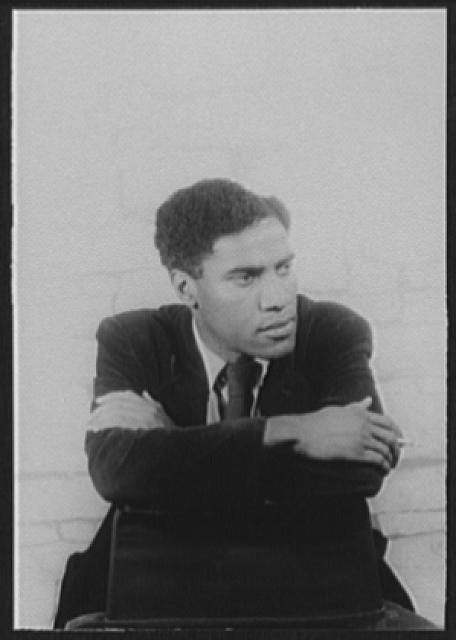
Portrait of George Lamming by Carl Van Vechten, 1955

When I first read George Lamming’s 1972 novel, Natives of My Person it made a great impression upon me. Upon opening my battered old copy, I discovered the words “Edinburgh, January 1980” on the inside cover. So it has been more than forty-five years since my first encounter with Natives of My Person. Revisiting it to introduce it for a new edition, I was after only a few pages taken aback by Lamming’s stately sentences, which move with a deliberate Conradian insistence.
A bar of sunset struck across his brow. He made an arch with his hands above his eyes and followed the tedious journey of the trees into the somber zone of the Aberlon forest. In the distance, beyond the final spire of the hills, he could detect a castle go into hiding. The mouth of a cannon closed behind a pearl-gray wall of mist.
When Lamming switches from an omniscient narrative voice to first-person diary entries and journals, his tone—rather than becoming more intimate—remains consistently imperial.
This river was of the substance water, and that is the only certainty my eyes would verify, but for the general properties of life and motion I could not describe its true nature.
How, I wondered, was Lamming going to hold a reader’s attention for three hundred and fifty pages with this relentlessly grave tone?
George Lamming was born in 1927 in Barbados and attended the elite Combermere School on a scholarship. He fell under the influence of his teacher, Frank Collymore, who was the founding editor of BIM, the most important Caribbean literary magazine. In 1950, determined to become a writer, Lamming left for England. Initially, in common with many Caribbean migrants, he found employment in a factory, but after a short time he became a broadcaster for BBC radio’s Colonial Service. In 1953, Lamming published his first novel, In the Castle of My Skin, an autobiographical coming-of-age story featuring a narrator named G who is growing up on a Caribbean island riven with difficulties that are a legacy of its colonial past. He published a sequel to The Emigrants in which G leaves Barbados for England, and then two novels set on a fictional Caribbean island called San Cristobal, as well as a 1960 collection of essays, The Pleasures of Exile, that considers Shakespeare’s The Tempest through the experience of West Indian society. His fifth novel, Water with Berries (1971), revisits Shakespeare’s play, and was followed by Natives of My Person.
Natives of My Person traces the journey of a ship, the Reconnaissance, on a difficult expedition toward the fictional island of San Cristobal. The Commandant and crew of the ship owe some kind of allegiance to the “civilized” nation of Lime Stone, while the ship’s pilot, Pinteados, is a former distinguished resident of Lime Stone’s traditional enemy, Antarctica. The Reconnaissance lingers for a while on the Guinea coast before striking out across the Atlantic, but there is very little realistic detail of geography to anchor the novel in a recognizable world, and characterization is scant. Most of the characters are referred to only by their titles—Boatswain, Surgeon, Commandant. It soon becomes apparent that the Commandant’s purpose is to set up a new, more just colony on “the Isles of the Black Rock, more recently known as San Cristobal.” We learn about those involved in this enterprise through sporadic journal or diary entries; some characters appear in dramatized passages that can resemble the text of a play.
As I revisited Natives of My Person, I found a novel that presents the reader with great challenges. It is forged in a crucible of intellectual meditation suggesting that thought, as opposed to empathy, will be rewarded. Do we care what actually happens to the Reconnaissance? The characters have their fears, their loves, their ambitions, yet we are forever being encouraged to muse upon the broader implications of the adventure as opposed to their individual destinies. The novel is replete with fine set pieces in which Lamming takes his time (he always takes his time!) as he carefully paints finely wrought word pictures, seldom adding to the novel’s forward momentum.
He lay full length on the bed and watched the pyramid of fruit that rose from the silver platters on the chest. The orchards had made their harvest ready for his return. The apples were red and fresh as blood. A peach had split open at the stem; she must have arranged the peaches in the same crystal bowl his mother had used for apples. He saw the delicate udders of the pears breathe and swell with sap. A soft, sweet stain of pear skin clung to his teeth. He was chewing slowly on the tissue of the pear, feeding carefully as a child on the fruits he had seen his parents plant. He was learning to eat again.
The Conradian tone suggests that Natives of My Person is in conversation with Heart of Darkness (1899), a work of fiction that also wished to comment upon the social and psychological damage at the core of the colonial project. However, as I read further, I was at times also reminded of Hardy’s The Return of the Native (1878), whose opening chapter resists a traditional investment in character and turns instead to an almost willful engagement with landscape and scenery. Clearly, only a writer steeped in poetry could produce the kind of graceful prose that permeates Natives of My Person, prose that makes a virtue of language over action.
Sixteen years after I first read the novel, in October 1996, I was able to sit with George Lamming in his hotel room in St. Croix in the Virgin Islands and ask him questions about his life as a writer and, more specifically, about the writers who had influenced him.
I remember a poet that I loved very much was Walter de la Mare. And then a little later, Wilfred Owen … and a writer then that had that kind of influence that is more conscious was Thomas Hardy. Especially Hardy the poet. And what I discovered then … was that I had a peculiar fascination with the word—with the word as sound, with the word as component of rhythm, removed now from actual meaning. The arrangement and pattern of words was really my major preoccupation, so that the accuracy of the ear became more important than the clarity of exposition, which may have been intended. Then a little later … I “met” Conrad. And this was then a reinforcement of that relation to the word, the word as instrument of exploration. The word as visual guide, the word as aural guide.
It struck me that linguistic virtuosity had been, to some extent, a feature of his work from the beginning, but Natives of My Person stood out for the bravura of its fictional construction. When I asked him about his “restless concern with form” Lamming was clear.
There is a sense in which nearly all of my novels are dramatic poems … I’ve never been too happy with the novel in its traditional sense, and in most of my work you will notice that there is a breaking up, really, of the forms, an attempt to fuse a number of different genres … especially in Natives of My Person.
The experimentation of Natives of My Person will always challenge the reader, but this outstanding novel moves with musical elegance across different genres of narration, creating a kaleidoscopic vision of a journey that is ostensibly outward and across water but is finally inward and concerned with space, time, and ideas of domination, subjugation, and terror. Half a century after its original publication, we can’t fail to recognize that Lamming’s concerns in Natives of My Person are the same that trouble us today.
Caryl Phillips is the author of thirteen novels, most recently Another Man in the Street, as well as several plays and collections of essays.
This post is drawn from his introduction to a new edition of Natives of My Person from the inaugural season of Outsider Editions, a new reprint series from Doubleday. Outsider Editions revives works in many genres—fiction, memoir, essay, history—that live outside the traditional canon and were overlooked or forgotten in their time.
Book Post is a by-subscription book review delivery service, bringing snack-sized book reviews by distinguished and engaging writers direct to paying subscribers’ in-boxes, as well as free posts like this one from time to time to our followers. We aspire to grow a shared reading life in a divided world. Become a paying subscriber to support our work and receive straight-to-you book posts. Some Book Post writers: Ian Frazier, Joy Williams, Jamaica Kincaid, Lawrence Jackson, John Banville, Marina Warner, Álvaro Enrigue, Mona Simpson, Nicholson Baker, Jason Mott, Colin Thubron, John Guare, Michael Robbins, more.
Whose Books in Dallas, Texas, is Book Post’s Summer 2026 bookselling partner! We partner with independent booksellers to link to their books, support their work, and bring you news of local book life across the land. We send a free three-month subscription to any reader who spends more than $100 at our partner bookstore during our partnership. To claim your subscription send your receipt to info@bookpostusa.com.
Comments
Nothing yet. Say the first thing.
Sign in to join the conversation.