
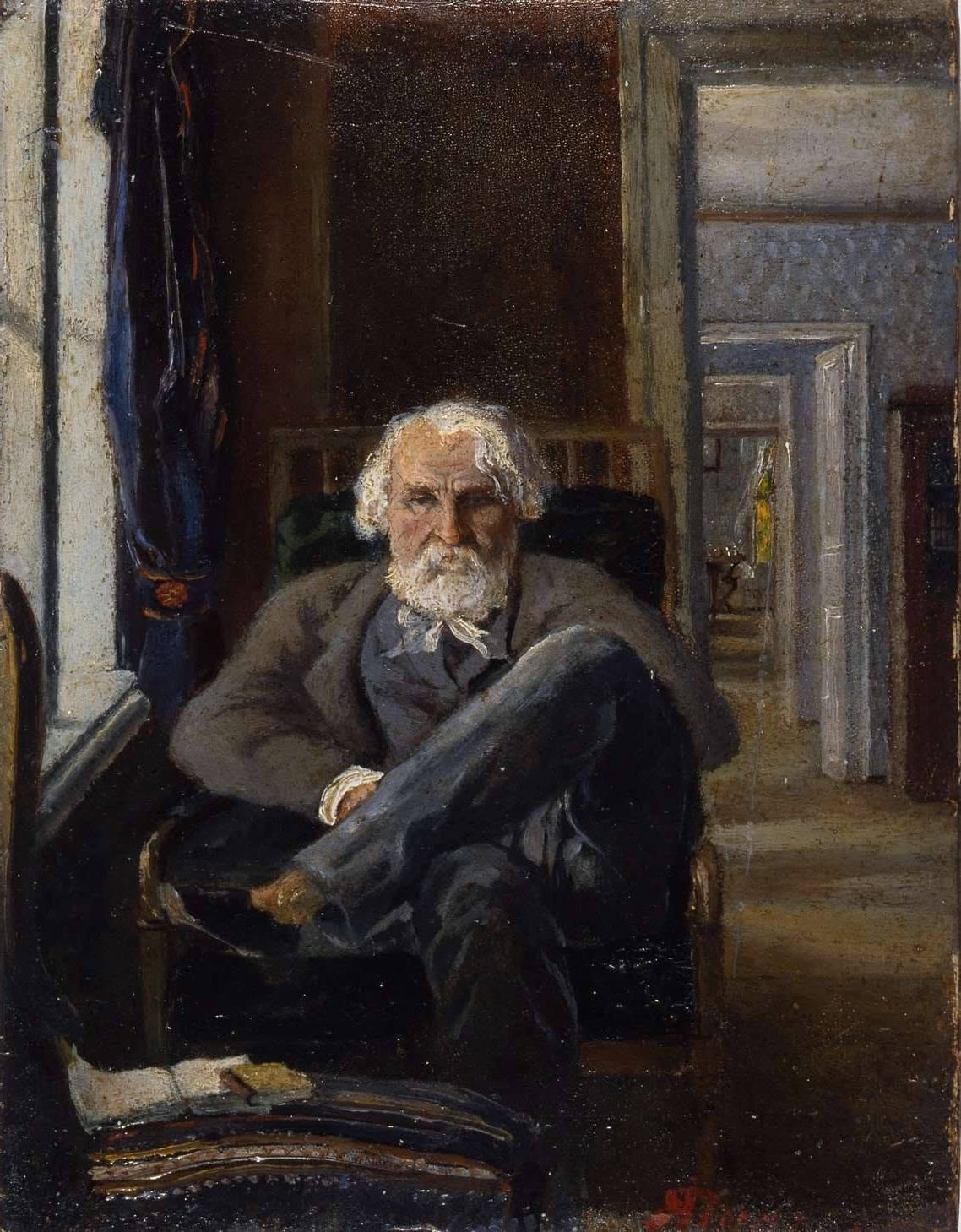
Portrait of Ivan Turgenev in his study at his family estate at Spasskoye-Lutovinovo, now a museum, by his friend the poet Yakov Petrovich Polonsky (1881). Literary Museum, Pushkin House, St. Petersburg

Hello Readers! In the midst of a wee summer pause we notice that Ivan Turgenev’s novel Smoke has recently appeared in a new translation, inviting us to revisit our Turgenev reflection of a while back by Padgett Powell. Isaiah Berlin wrote that Turgenev “responded to the faintest tremors of Russian life … he faithfully described them all—the talkers, the idealists, the fighters, the cowards, the reactionaries, and the radicals, sometimes, as in Smoke, with biting polemical irony.” And as four states, out of twenty-nine that brought suits, are arguing in court this week that Meta deliberately ensnares users we revisited our Editor’s Note of a few weeks back on the implications of these cases for writing and reading. Like what you see? Subscribe for more! Our paying subscribers once a week receive a thoughts on a book from one of our rogues’ gallery of writers and an Editor’s Note from me on the vicissitudes of the reading life—AKj
This is about Turgenev, specifically a new translation of what was once called Fathers and Sons, now called, apropos of the times, Fathers and Children, but we will have to suffer through some germane ungermane before we get to him, Turgenev. In the tenth grade in the marvelous backwater of Jacksonville, Florida, I was enjoying one of the putatively ironic perks of being in an academic backwater: I was a sophomore taking Latin, third-year Latin, reading Virgil, in a small class of five students, three of whom were seniors and one a junior fellow who was an even odder duck than I. Two of the seniors were girls, one of whom, a redhead, had her eye on me but was, I presumed, thinking it unseemly to advance. Her business is not even ungermanely ungermane. The third senior was Bert King, who was the Star Student of the State of Florida, which was a thing then and for all I know is still a thing. I am using Bert’s real name because I am looking for him and cannot find him. More than the amber lucidity of the Virgil, more than the possibly imaginary lascivity of the redhead without the courage to pull a trigger, what caught my eye in this venture was Bert King, Star Student of the State of Florida.
Bert had gone to inspect the situations at Harvard, Yale, and Columbia, to my knowledge on them. He told us he was going to go to Columbia to study comparative literature, namely the Russians. Bert King became at that moment my immediate model for attending to one’s intellectual fundament, a mission I had been on tacitly and perhaps not quite consciously to that point. I was already committed to becoming a smart-ass of some sort and here was a sane, smart, ambitious older fellow becoming smart. He was eschewing Harvard and Yale. My God.
When you set about attending to your intellectual fundament, obstacles—beyond the innate restrictions of your intellect—befall you. Let me touch the fast-forward a bit here. I fell into an academic backwater even shallower than the one I had been in (piedmont South Carolina), where there would be no Latin and where I got so angry about it that I called my underground newspaper, obligatory in 1970 if you were not inclined to go to Vietnam, Tough Shit (and not The Free Press after the fashion of the day). I was arrested for obscenity and would need to amuse the concerned elder statesmen at the college where I matriculated, with the college’s largest scholarship, with my peradventures. Meanwhile Bert King was reading and speaking Russian at Columbia and probably involving himself in real campus demonstrations—though the boys at the high school where I was arrested bravely protested my arrest by yelling “Pigs off campus!” at the detectives and officers who’d come to get me (political protest and naughty words were serious business in Florence, SC, in 1970). In college I took Russian as soon as I could.
The five-student, third-year Latin class had become a two-student, first-year Russian class at the College of Charleston in 1970. This level of interest foretold the end of Russian there. The professor was a hard-core drinker whom I never saw impaired and came to love. He did marvelous extracurricular activities, like marrying a bosomy blond student on a Friday and having the marriage annulled on a Monday, and he spent not much time actually teaching us Russian. What he did spend time on was what I will call etymological archaeology. A word or a sound or a syllable would come up, and Dr. Cook would fall upon the blackboard with a piece of chalk and chart the evolution of the word or sound back through the English or Russian where we found it to its forms in the Middle Ages and thence to its origins in Persia or who knew where else two or three or five thousand years ago. It was mesmerizing and we were completely happy with not learning precisely any Russian. Once Dr. Cook told us he’d learned his Russian from a Russian woman at UVA who taught him in her back yard, and there may have been a suggestion that they did this seminar in a depression in the ground or a hole of some sort. This was intellectual-fundament acquisition at its finest in my view.
Vernon Cook assigned us some reading on top of the extraneous archaeological etymology we did, and it was a brown clothbound book by, I think, Turgenev. “I think” because I cannot even remember now if it was in Cyrillic or English and because I cannot figure out how we would have read Turgenev even in a simplified version—I can see only the cover in my mind and I remember feeling that this book somehow was as real or as good or “original” as the Caesar and the Virgil I’d seen to that point. The book one way or another announced to me that this Turgenev was some kind of real deal. We had Dr. Cook and his wayward enthusiasms and his red whiskey nose and his not caring what we did and did not learn and I had notebooks filled with my practicing the Cyrillic alphabet and I had this weird, quiet, loud, brown book and the sense that this Turgenev was as authentic as Virgil. It was a tiny step in my own pilgrimage into comparative literature very far from the real thing at Columbia.
At about this time Bert King paid me a visit. We were both home in Florida from college. Bert looked like the ur heavy hippie, somewhere between Jerry Garcia and William Kunstler. My father saw him before I did and was civil to him letting him in the house. This surprised me. Bert looked exactly like an intellectual revolutionary who could single-handedly stop Vietnam. Everything about him firmed my resolve to get to Columbia. I must have told him of the somewhat haunting Turgenev experiences I’d had, and he told me of a brilliant classmate of his who had gone on an acid trip and not returned. I checked the No Acid box on the procuring-intellectual-fundament rules sheet.
Read more Padgett Powell in Book Post! on Donald Barthelme, Peter Taylor, William Trevor, Charles Willeford, Known Pulpist, a film about Flannery O’Connor, and effing the classics
My pilgrimage unto Columbia intellectual fundamentalism ended when my mother refused to fill out financial-disclosure forms to secure the aid that would be necessary for my transfer. I’d have been moving from that full grandiose small-pond scholarship where I was to whatever the damages were at big-pond Columbia in 1972. My mother’s argument was customary laissez-faire Republican—we make too much money to be given money but not enough of course to pay outright for whatever it is that must be paid for. I suggested we let Columbia decide the matter but that was met with the fiscal certitude that would, if it could, eliminate, say, Social Security. I divorced my mother, ended my quest for intellectual fundamentalism, decided to head for the other end of the spectrum by writing some cartoons that would become a novel. These cartoons featured a fictive son of Norman Mailer and a cousin to Joe Frazier in Beaufort, SC—the woman was singing jazz in New York—beating up faculty members of the English Department at the College of Charleston, where I felt my hopes for intellectual sophistication had come to a premature detumescence. (My biracial chimera, possessed of Mailer’s rhetorical gifts and Frazier’s toughness, could pass in both races; I named him Scruff Taurus and he became the necessary, absurd center to my novel Edisto.) I was not on course to intersect with Ivan Turgenev academically again. But I would in time see him on literary radar, locate him in Pierre Bayard’s “collective library.”
Here is Hemingway’s tepid, understated estimate of Turgenev:
Turgenieff to me is the greatest writer there ever was. Didn’t write the greatest books, but was the greatest writer. That’s only for me of course …. Chekov wrote about 6 good stories. But he was an amateur writer. Tolstoi was a prophet. Maupassant was a professional writer, Balzac was a professional writer, Turgenieff was an artist. (Hemingway to Archibald MacLeish, 1925, SL, 179)
Here is Turgenev from the new Fathers and Children, the book I’d like to remind us is under review even if I deign not actually review it, my prerogative as an early detumesced intellectual:
The next morning Bazarov woke first and went outside. “Oh dear,” he thought, looking around, “this isn’t much of a place.” When Nikolai Petrovich shared the estate out with his peasants he had been left with ten acres of perfectly flat bare ground for his new residence. He built a house, offices, and farm buildings, laid out a garden dug a pond and two wells. But the young trees failed to take, and not much water collected in the pond, and the well water was brackish. Only a single arbor of lilacs and acacias had flourished, and they sometimes had tea and dinner there. In a few minutes Bazarov had explored all the garden paths, looked into the cattle yard and the stable, and rounded up two peasant boys with whom he instantly made friends. He got them to take him to a little patch of bog about half a mile from the house, to catch frogs.
“What do you want frogs for, mister?” asked one of the boys.
“I’ll tell you what for,” replied Bazarov, who had the knack of inspiring confidence in his social inferiors, though he never indulged them and always treated them in an offhand way. “I’ll cut it open and have a look at how it’s put together, and then, since you and I are just like frogs except that we walk around on two feet, I’ll know how we’re put together as well.”
“But what for?”
“So I don’t get it wrong, if you’re taken ill and I have to cure you.”
“Are you a doctor then?”
“Yes.”
“Hear that, Vaska? Gentleman says you and me are just like frogs. That’s funny.”
A suggestion of many directions and no direction, the invisible hand remaining invisible—and people on the page as they are. Hemingway went to school on this, maybe as much as he did on Gertrude Stein.
And here is Turgenev from the earlier Sketches from a Hunter’s Album:
The longer I observed Radilov, the more it seemed to me that he belonged to such a category of person. He would talk about running his estate, about the harvest, about the haymaking, about the war, about the provincial gossip and forthcoming elections, he would talk quite freely, even with a sense of involvement, but suddenly he’d give a sigh and sink into an armchair, drywashing his face like a man worn out by hard work. It seemed his entire spirit, kindly and warm though it was, was penetrated, permeated through and through, by a single feeling. I was struck by the fact that I couldn’t find in him any passion for food or wine or hunting or Kursk nightingales or epileptic pigeons or Russian literature or trotting horses or Hungarian jackets or cards or billiards or going dancing in the evening or paying visits to the local town or the capital or paper and sugar-beet factories or brightly decorated gazebos or tea parties or trace-horses driven into bad ways or even fat coachman with belts right up to their armpits, those magnificent coachmen whose every movement of their necks, God knows why, makes their eyes literally pop out of their heads … “What sort of a landowner is this?” I thought.
I can see Earnest Hemingway as a young man reading this, clogging on a sheet of plywood in tall grass. Vernon Cook, whatever he was not telling us precisely about Russian, when he was showing us a syllable on the move in Iran, was showing us this. One is, I am not unaware, supposed to read Turgenev politically, just as one is supposed to read Flannery O’Connor religiously. But it is possible in her case and in Turgenev’s case for the detumescent intellectual to read innocent, to take one’s instruction from an early character of the late Donald Barthelme: “Some people run to conceits or wisdom but I hold to the hard, brown, nutlike word. I might point out that there is enough aesthetic excitement here to satisfy anyone but a damned fool.”
Padgett Powell is the author of six novels and three books of short stories, most recently Cries for Help, Various, as well as a volume of essays, Indigo: Arm Wrestling, Snake Saving, and Some Things in Between.
Editor’s Note (reprise)
Hello Readers! Yesterday a jury in Los Angeles found YouTube and Facebook/Instagram parent Meta guilty of designing products that are purposefully harmful to children, developing systems to keep them scrolling in spite of known potential damage to their mental health and safety. The meagerness of the decision’s $3 million award in compensatory damages provoked a scoff in the direction of the suit from Meta’s communications director, but the jury is still deliberating on punitive damages. A decision earlier this week in New Mexico found Meta guilty of failing adequately to safeguard children against sexual predators, imposing $375 million in damages. The cases are the first of more than a thousand based on similar reasoning that threaten the tech giants with unprecedented legal exposure and potentially a reconfiguration of their algorithm-based social platforms comparable to the industry-altering effects of the rulings in the nineties against the tobacco industry. The social media and tobacco cases share a similar strategy—demonstrating that companies deliberately overlooked internal evidence of the harms of their products in pursuit of maximizing gain. (Similar lawsuits against the oil industry are facing a Supreme Court test this year.) Growing recognition of the threats to children from social media platforms has led to an outright ban in Australia (after the prime minister’s wife urged him to read Jonathan Haidt’s The Anxious Generation), with similar legislation under consideration in other countries, and widespread removal of cell phones from schools, already showing evidence of improved test scores and anecdotal accounts of strengthened classroom focus and revived social life among kids. But the significance of these rulings for the adult information system is also profound. The big tech companies had been protected from liability in what is published on their platforms by a widely cited regulation, Section 230 of the Communications Decency Act, which treats the companies as conduits like telephones rather than publishers like newspapers (the provision actually springs from a defense of the rights of bookstores to sell potentially “obscene” material). In recent years political pressure to abstain from moderating content has also protected the platforms.
The current round of suits, however, does not rely on responsibility for individual posts, but rather the platforms’ structural design—the ways the apps were developed to hold readers’ attention to the point of compulsion and to feed them inflammatory information or whatever else worked to boost engagement. As the testimony of Facebook whistleblower Frances Haugen in 2021, and others since, has indicated, the tech companies suppressed evidence of harms beyond those to children—like the role of the platforms in spreading mass atrocities and election manipulation and fraud. Facebook has recently faced mounting pressure to address the sizeable profits it continues to rake in from advertising scammers.
Algorithmic distribution has wielded the knife in the evisceration of traditional media under digitization: substantive writing and other engaging forms of reflection present, to the encoded priorities of the platforms, nothing but competition for the attention they have promised to their own advertisers and crave for their own data harvest. Cheap and addictive distraction is more to the platforms’ purpose. Subscriber-driven models like this one, even physical books and magazines, have gained strength in recent years as readers have learned to distrust—or have just grown weary of—what the algorithms feeds us. And now these suits promise to go where legislation has faltered. Says Verge editor Nilay Patel, “The platform internet is coming to one kind of end, slowly but surely.” Kevin Roose and Casey Newton recently asked Jonathan Haidt himself whether he was fighting the last battle, as AI takes over the attention of young people and everyone else and draws readers away from search results and the open internet. Jonathan Haidt replied that if we can’t win with the social media platforms, where there now is an established body of evidence and research, we don’t stand a chance with the onset of AI, ominously similar in its automated, black-box decision-making power and its channeling of profit and authority to a few tycoons. (AKj, March 20, 2026) As the “platform era” draws to a close, consider how you are using your attention, and the resources you lay down on its behalf. What forms of attention are more nourishing, more reflective, more expansive, and how to cultivate them? One idea:
Book Post is a by-subscription book review delivery service, bringing snack-sized book reviews by distinguished and engaging writers direct to paying subscribers’ in-boxes, as well as free posts like this one from time to time to our followers. We aspire to grow a shared reading life in a divided world. Become a paying subscriber to support our work and receive straight-to-you book posts. Some Book Post writers: Ian Frazier, Joy Williams, Jamaica Kincaid, Lawrence Jackson, John Banville, Marina Warner, Álvaro Enrigue, Mona Simpson, Nicholson Baker, Jason Mott, Colin Thubron, John Guare, Michael Robbins, more.
Whose Books in Dallas, Texas, is Book Post’s Summer 2026 bookselling partner! We partner with independent booksellers to link to their books, support their work, and bring you news of local book life across the land. We send a free three-month subscription to any reader who spends more than $100 at our partner bookstore during our partnership. To claim your subscription send your receipt to info@bookpostusa.com.
Comments
Nothing yet. Say the first thing.
Sign in to join the conversation.