
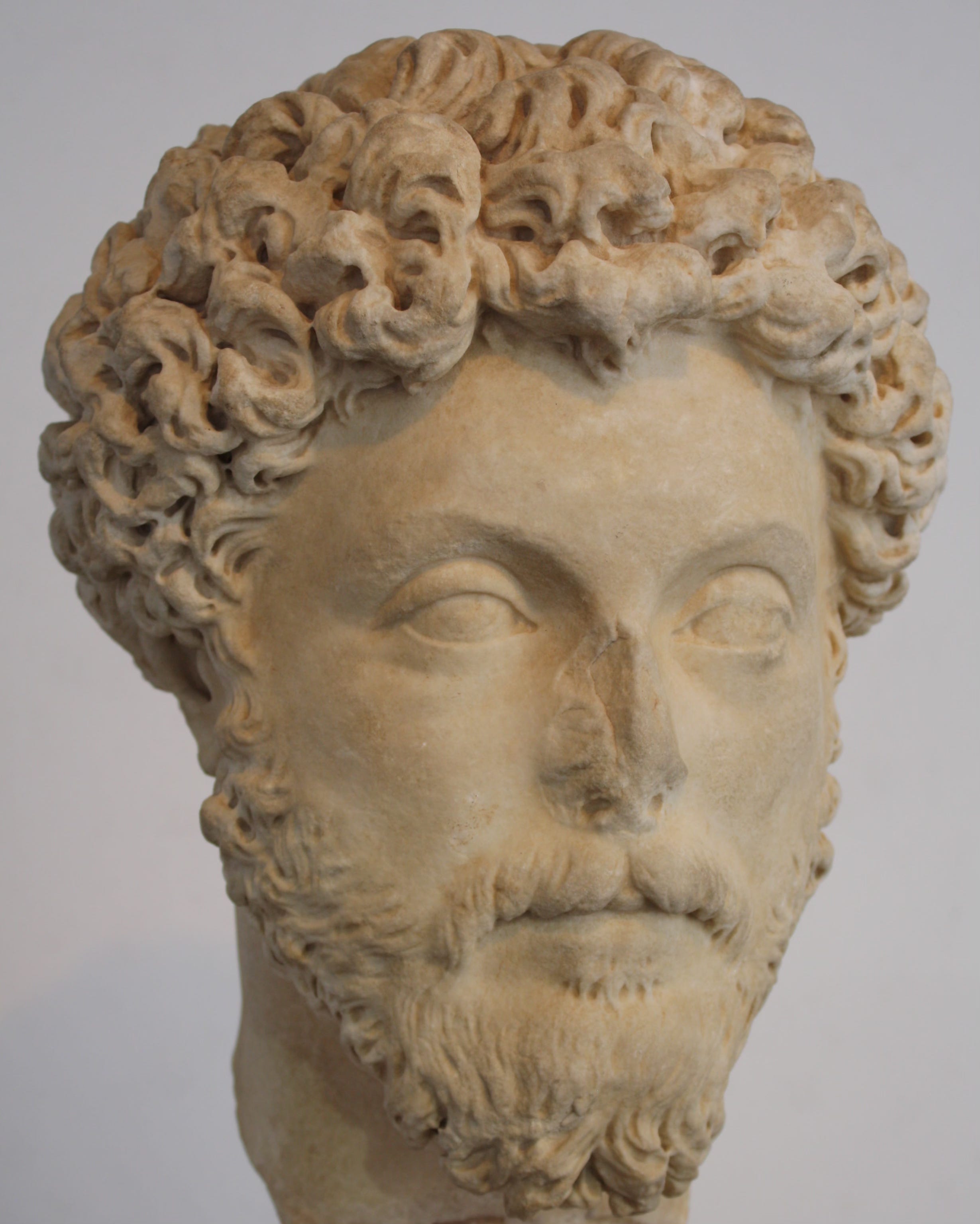
Marcus Aurelius (121–180 CE), from the Villa Adriana, Tivoli (ca 160-169 CE). Palazzo Massimo, Rome

According to my father, the boy I used to be had a pretty bad temper. When he was alive, my father would delight in reminding me of the days when, angry at my older sisters, I would yell and rage or jump on my bike and ride off into the humid, sun-drenched Carolina afternoon. I would be gone for hours, off in the forest, calming down, and would return home in the evening exhausted, hungry and, usually, apologetic. “I was worried about you for a long time,” he once told me. I don’t remember this boy that I was, but my father was always straight with me so I took him at his word and I have filed his version of me into the Personal Lore & Legend section of the well-manicured hero’s tale that I, like all of us, keep stored in my head.
Fast forward to nineteen-year-old me—whom I have some memory of—wandering through the philosophy section of a musty bookstore in the hopes of solving the riddle of mankind—amongst other nineteen-year-old arrogant dreams—and that’s when I first came across Meditations by Marcus Aurelius. And it is not an overstatement to say that this world of Stoicism changed my life

Jason Mott’s latest novel, People Like Us, is out this week in paperback! Pick up a copy from our summer partner bookseller, Whose Books!
My first introduction to the text was via the 1964 Penguin Classics translation by Maxwell Staniforth. It was, and still is, a direct, terse interpretation of a text in which we are given access to the personal thoughts and musings of one of Rome’s greatest emperors. Meditations is not a philosophical treatise. It was never intended to be. In fact, for those who don’t know, it was never meant to be read by anyone other than the emperor himself.
This work, which has persisted through the ages is, in fact, simply a diary. Simply the quiet-moment-musings of a man trying to remind himself of the important things he had learned over the course of his life. It is honest and sincere, self-critical yet self-forgiving. It is even esoteric at times because, as with all of us, diaries are meant for our own eyes so there is no need to explain the identities of people or the history of places.
But even with all of this, Meditations has become an enduring work that has guided generations of thinkers from of all classes and strata of numerous societies. The work has become something of a textbook for the philosophy of Stoicism, which, by the way, was never Marcus’s intention. If the emperor were to be asked for guides to the school he had studied, he probably would have steered readers away from his diary and into the texts of Seneca and Epictetus. He had no idea that he had, quite accidentally in his rhythmic scribblings, writ the superego of a moral person and philosophy large on the walls of history. A voice of temperance and love, self-discipline in order to avoid the pitfall of excess. It is, without a doubt, a wonder.
And it has been translated many, many times.
Over the years I’ve read more translations of Meditations than I can remember. If someone has translated it into English, there’s a pretty good chance that I’ve read their attempt. And as with all translations, they are not all created equal. I’ve seen Marcus Aurelius presented as cold and robotic—something which I feel stems from pop culture’s misconstrual of Stoicism as a punitive or austere discipline—and, more recently, I have seen the great emperor’s words distorted and injected with hints of homophobia and even xenophobia.
Which brings us to the most recent entrant into the list of translations: a new one for Norton by Aaron Poochigian. I’m delighted to say that he has done a wonderful job in working as a conduit for the original ideas and tone of Marcus’s Aurelius’s accidental great work. In Poochigian’s hands Meditations is what it was always meant to be: personal and profound, inquisitive and demanding, grounded and transcendent all at once. Poochigian handles the nuances of both time and language very well. He has returned reading Meditations to the sensation of moving into a new home and finding the journal of the previous owner buried in the far corner of the attic. And, in spite of yourself, you can’t help but sit down and read it—the voyeur in us all too curious to look away. And, as you sit and read this found diary, you are reminded that the core challenges of life are not simply your own to solve and to endure. You learn that someone else in this world has been overwhelmed and afraid, has thought themselves not good enough, has berated their mistakes and sighed heavily at the cruelty and chaos of an unfathomable world.
You also learn that the person who wrote this diary you found endured. And you learn how they endured. You watch them think through the hardships of self-doubt, of feeling powerless, of all the things that keep you up at night. And, by learning how this person met the world, you begin to realize that you too are capable of meeting this world. You realize you’ve found a friend in these diary pages. A mentor. A sage.
Aaron Poochigian is the latest to offer you the diary of the man I have come to call “The Mentor Emperor” and he has created one of Meditations’ most meaningful and profound renditions.
Jason Mott is the author of two books of poetry and five novels, most recently Hell of a Book, which received the National Book Award for fiction, and People Like Us, which appears in paperback this week.
Editor’s Note
Hello Readers! I was struck yesterday to see in a post by the novelist Rabih Alameddine, whose social media feed is full of wonderful and unexpected art, a 1936 photomontage by the German antifascist artist John Heartfeld called “Normalisierung”—normalization. The image depicts cheerful carpenters energetically sawing off pieces of the Austrian cross to make a swastika. Until I saw it I had understood our contemporary, and, it seems to me, still rather improvisational use of the word “normalize” to be a bit of an innovation. Traditionally “normalize” means to return to normal something that has been destabilized, like physiological systems or relations between nations. In 2016 the word began widely appearing in the sense of making something not normal appear normal, as Merriam Webster duly noted, citing for example this John Oliver segment which aired on November 13. (On November 17 Mark Peters discovered that the Oxford English Dictionary did find a reference to “attempts to normalize despotism” in a Times article from 1864.) Language writer Nancy Friedman surveyed the suddenly crowded “normalization” terrain on November 14. She and Merriam Webster reference a New Yorker essay by Hua Hsu of the same week, “What Normalization Means.” Hua Hsu cautioned that ready recourse to such a word obscures the question of “who qualifies as ‘us,’” as in, normal to whom?, given that much of the triumphant rhetoric of 2016 had been pretty normal to many who had been on its receiving end for generations. “Who, in newsrooms and on TV, decides what is normal?,” he asks. “Increasingly,” he predicts, “our everyday lives will require us to consider … questions of complicity.”
The issue that puzzles me is that “normalize” is a transitive verb—people, usually journalists in the contemporary usage, do something to something when they normalize it—but normalizing is something affects the environment around a thing, not the thing itself. Journalists, when they “normalize” something by describing it, perform a mysterious deed that alters a thing by altering (only) the way it is perceived, usually the domain of the indirect object; normalizers act on an object other than the object of the verb. One normalizes a degree away from the object of attention. What is this mysterious, alchemical act? How does one wield one’s normalizing powers?
One way to normalize, critics argue, is by recasting nonsensical things as sensical. Here we verge into another new usage, “sanewashing,” a term popularized, Nancy Friedman explains, by independent journalists Parker Molloy and Aaron Rupar. “Sanewashing” more specifically refers to misleadingly rendering garbled expression as coherent. It turns out the first uses of “sanewashing,” in the 2020s, was aimed at left-wing expression that rendered radical ideas in, by the speaker’s estimate, a deceptively anodyne light.
Other forms of “normalization” include repeating untruths without identifying them as untruths, or allowing them to be aired without challenging them. Another is depicting them without registering appropriate alarm or distress. Gauging where alarm or distress shades into editorializing seems to be the hard work of avoiding being a normalizer. Media critic Margaret Sullivan condemns the temptation journalists encounter at this juncture to pivot to polling and “the horserace”—describing not “what happened” but how a newsworthy body of people is measurably reacting to it (even as the the thing itself is being communicated). In 2016 John Oliver (among many) thought airing Donald Trump’s speeches in their entirety was “normalizing”; by 2024 Margaret Sullivan was not so sure. Mark Peters quotes linguist Ben Zimmer distinguishing “normalize” from “legitimize”: “Legitimize sounds like it has to do with bestowing official, legal acceptance, while normalize makes a broader social statement.” Do we agree that something—Donald Trump, gay marriage—should be accepted as “a normal part of our cultural and political landscape” or not?
This week’s shooting at the White House Correspondents’ Dinner, which was touched on in our last Editor’s Note, brought forth a new round of “normalizing” discourse, as when Republican National Committee Chair Joe Gruters characterized the shooting as “the inevitable result of a radicalized left that has normalized political violence.” CNN anchor Dana Bash asked Representative Jamie Raskin if people (“Democrats”) should “think twice” about using “heated rhetoric” to characterize the President when he becomes the target of political violence. Representative Raskin replied that he regarded criticism of any politician’s policies to be the right and even the responsibility of not only their fellow politicians but also the press, and he, unlike the President, defends the press’s obligation to be critical.
We seem to have reached a vertex here, where either criticism of the powerful or refraining from makes one a normalizer. Greg Sargent, writing for The New Republic, argues that questions like Dana Bash’s seemed to position the press as antagonistic to criticism itself, signaling an open field for malfeasance and forfeit of the terms of pluralist liberal democracy. Congressman Raskin told Greg Sargent that the President’s attacks on journalism for doing its work create “awkward situation” for the press, because it “puts them on the field of contest, in a place that they don’t want to be.” Yet he expressed the expectation that they nevertheless “take their own side in the fight for constitutional freedom.”
Startled by the idea that “normalization” might be a word with a history, I remembered an Atlantic article from late 2017 by Despina Stratigakos, responding to a controversial New York Times profile that portrayed the daily goings on of a right-wing extremist. She contrasted the article with the work of German Alltagsgeschichte scholars, “historians of the everyday,” who labor to reveal “the complexity of human agency” and “consider the impact of specific social ties, institutions, and living and working environments” to shed light on “why one person might condone or participate in hateful acts, while another resists.” She recalled that in the 1930s Hitler retained a PR staff who successfully placed profiles in the Western and domestic press depicting him in his various homes as a “friendly, relatable guy.” Like the photographer Lee Miller, who photographed Hitler’s destroyed apartment in Munich right after visiting liberated Dachau, the Alltagsgeschichte historians strove to unearth disquieting truths beneath the relatable exterior—to de-normalize it. I remembered Daniel Goldhagen’s 1996 book Hitler’s Willing Executioners, about the thousands of “normal” Germans who consciously took part in the Nazi’s extermination project, a book that was dismissed by establishment historians before it was eagerly embraced by the German public.
Historian Josef Joffe wrote that Daniel Goldhagen’s book allowed German readers, especially those born after 1945, at last to “discover for themselves the evil their elders inflicted on the world; they could unearth the repressed knowledge that is the necessary step toward liberation and even redemption.” It reminded me of Hua Hsu in 2016 reflecting on how quickly the abnormal, such as the election of a Black man as president, becomes possible, then normal, that “the true magnitude of this moment will not be felt until people who today are too young to vote come of age—people who will enter into life with a different vision of what was possible than those who came before.” That would be, now.
To me “normalize” is a sneaky word, cloaking within an easy reprimand a very serious challenge adequately to articulate grave social threats, and within that, a lurking enigma, of how “normal” people come to accept very abnormal—even inhuman—things as normal, and how to stop that before it’s too late. —AKj [April 27, 2026]
Book Post is a by-subscription book review delivery service, bringing snack-sized book reviews by distinguished and engaging writers direct to paying subscribers’ in-boxes, as well as free posts like this one from time to time to our followers. We aspire to grow a shared reading life in a divided world. Become a paying subscriber to support our work and receive straight-to-you book posts. Some Book Post writers: Ian Frazier, Joy Williams, Jamaica Kincaid, Lawrence Jackson, John Banville, Marina Warner, Álvaro Enrigue, Mona Simpson, Nicholson Baker, Colin Thubron, John Guare, Michael Robbins, more.
Whose Books in Dallas, Texas, is Book Post’s Summer 2026 bookselling partner! We partner with independent booksellers to link to their books, support their work, and bring you news of local book life across the land. We send a free three-month subscription to any reader who spends more than $100 at our partner bookstore during our partnership. To claim your subscription send your receipt to info@bookpostusa.com.
Comments
Nothing yet. Say the first thing.
Sign in to join the conversation.