
Welcome to Bohring. Here, we look at the universe, life, and science education through a physicist’s lens. If you’re new here, consider joining our community of curious minds:
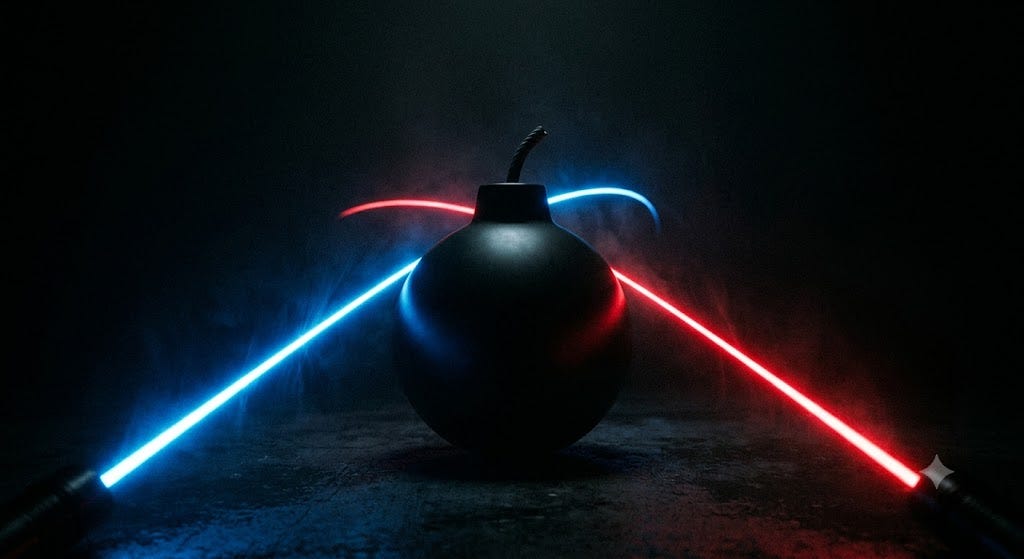
Imagine you are handed a box containing bombs. You are told the bomb is triggered by a mechanism so sensitive that if even a single photon (a particle of light) hits its sensor, it will instantly detonate. Furthermore, some of these bombs are duds. The duds look identical, but their sensors are broken—light passes right through them without triggering anything.
Your goal: Find a functional bomb without exploding it.
In a classical world, this is impossible. To verify if a sensor works, you must interact with it. If you send a photon to test it and it’s a live bomb, it explodes. If it doesn’t explode, it was a dud. You can never successfully identify a live, working bomb without destroying it.
Quantum mechanics, however, offers a loophole using a device called an Elitzur-Vaidman (EV) bomb tester. It is one of the most beautiful and unsettling thought experiments in quantum mechanics. Proposed by Avshalom Elitzur and Lev Vaidman in their 1993 paper “Quantum Mechanical Interaction-Free Measurements”, it proves that quantum mechanics allows for interaction-free measurement: the ability to verify the existence of an object without ever interacting with it.

An EV Bomb tester is an application of an arrangement known as the Mach-Zehnder interferometer, which consists of optical devices called Beam Splitters. So let’s start from there.
A beam splitter is an optical device that splits an incoming light beam into two separate paths. Quantally, when a single incident photon enters a beam splitter, it is placed into a quantum superposition of two distinct spatial paths (or modes).
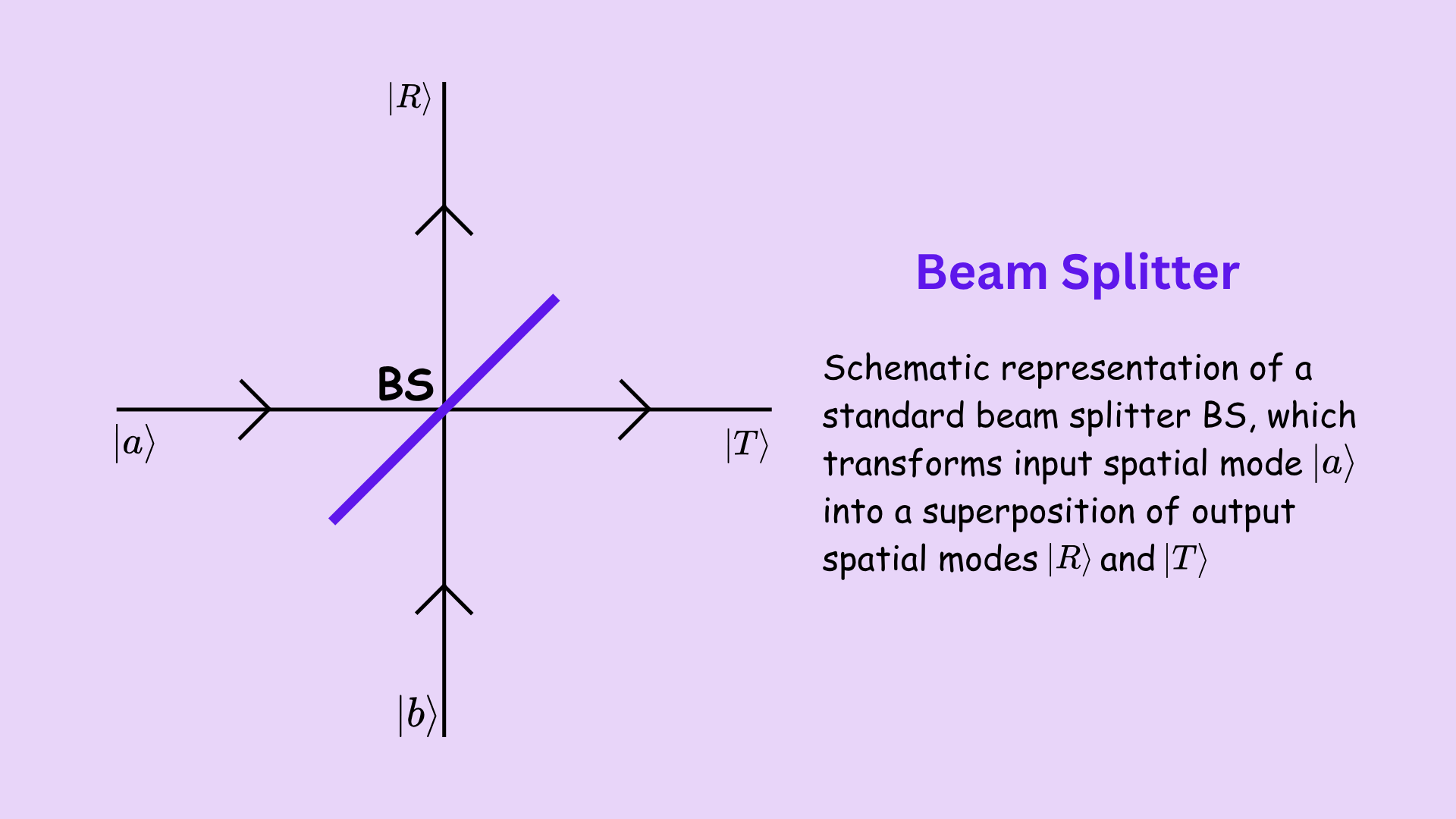
The probability amplitude of the photon (how much of its wave function) taking either path depends on the angle (θ) of the beam splitter.
\(|\psi\rangle = \cos\theta\,|T\rangle + i\sin\theta\,|R\rangle\)
where ∣T⟩ denotes the transmitted path, and ∣R⟩ denotes the reflected path, with the factor i capturing the phase shift acquired upon reflection. For a symmetric beam splitter oriented at an angle of 45∘, a photon incident from input mode ∣a⟩ is split equally between transmission and reflection, creating a 50–50 equal superposition state:
\(\vert{}\psi\rangle = \frac{1}{\sqrt{2}}\vert{}0\rangle + \frac{i}{\sqrt{2}}\vert{}1\rangle\)
The phase factor is given by eiθ. When a photon reflects off a fully reflecting mirror, it undergoes a phase shift of π/2, which corresponds to multiplying the spatial mode amplitude by the phase factor:
\(e^{i\pi/2} = i\)
Thus, whenever a path component hits a mirror, its state vector gets scaled by the imaginary unit i.
A balanced Mach-Zehnder Interferometer (MZI) consists of:
Two 50–50 beam splitters (BS1 and BS2).
Two fully reflecting mirrors (M1 and M2).
Two photon detectors (D0 and D1).
The setup forms two distinct optical paths—often labeled Path 1 (transmitted through BS1, reflected by M2) and Path 2 (reflected by BS1, reflected by M1). Both paths recombine at the second beam splitter BS2 before reaching detectors D0 and D1.
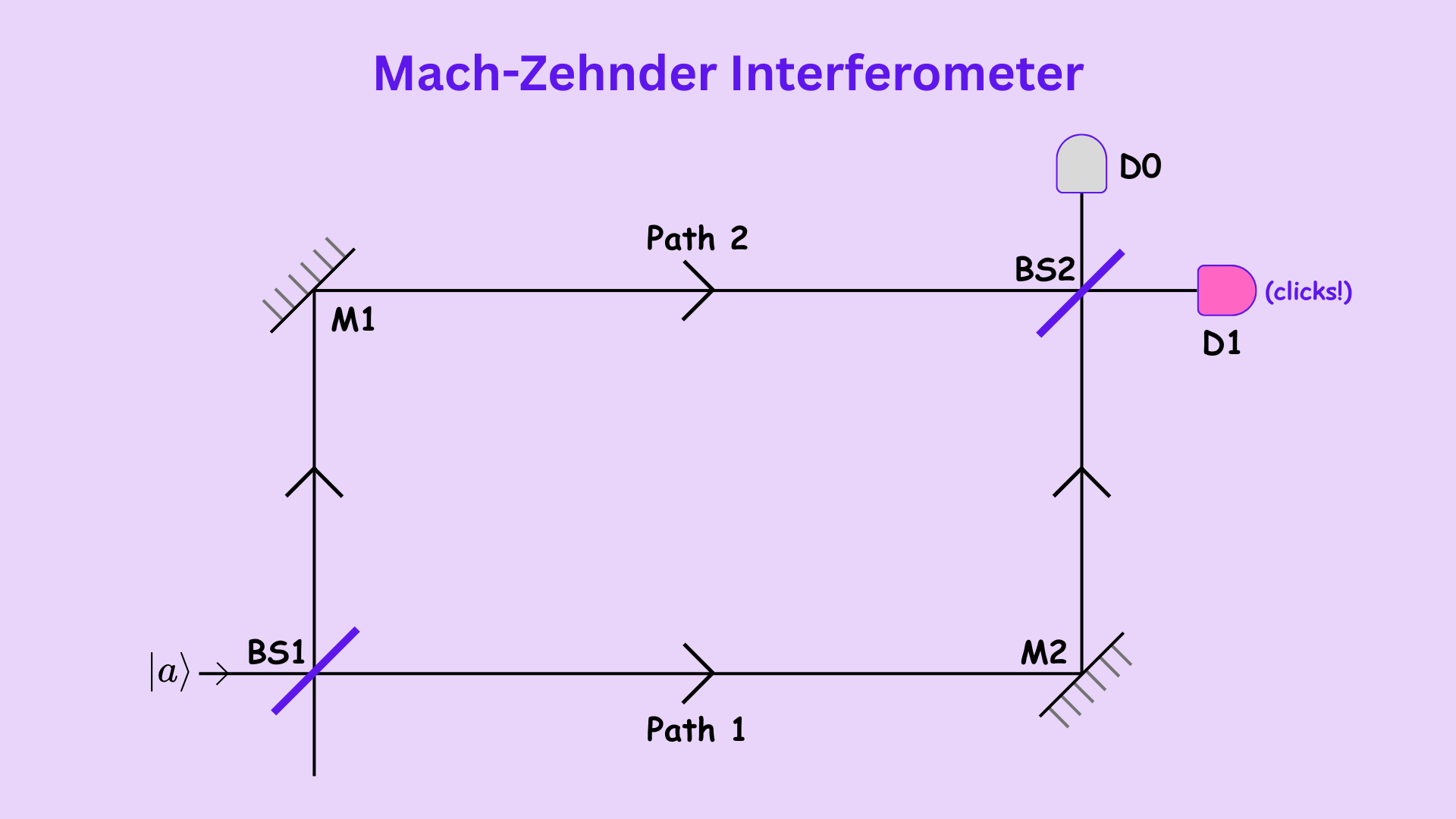
In a balanced MZI, a photon input via mode |a⟩ is always detected at D1 due to complete destructive interference along the path to D0 and complete constructive interference along the path to D1.
For mathematically inclined readers, I’ve included the derivation of this result at the end of the article. Do check it out! The rest of you, continue with me. Let’s test some bombs!
Bohring is entirely reader-supported. The deep-dive physics series and philosophical essays are made possible by the “Deep Divers”—the paid community members who value independent science communication.
If you’re currently on the free tier, consider upgrading to a paid subscription to unlock exclusive deep dives, archives, and chat:
In this setup, we take a standard MZI configuration and place the bomb in the middle of Path 1.
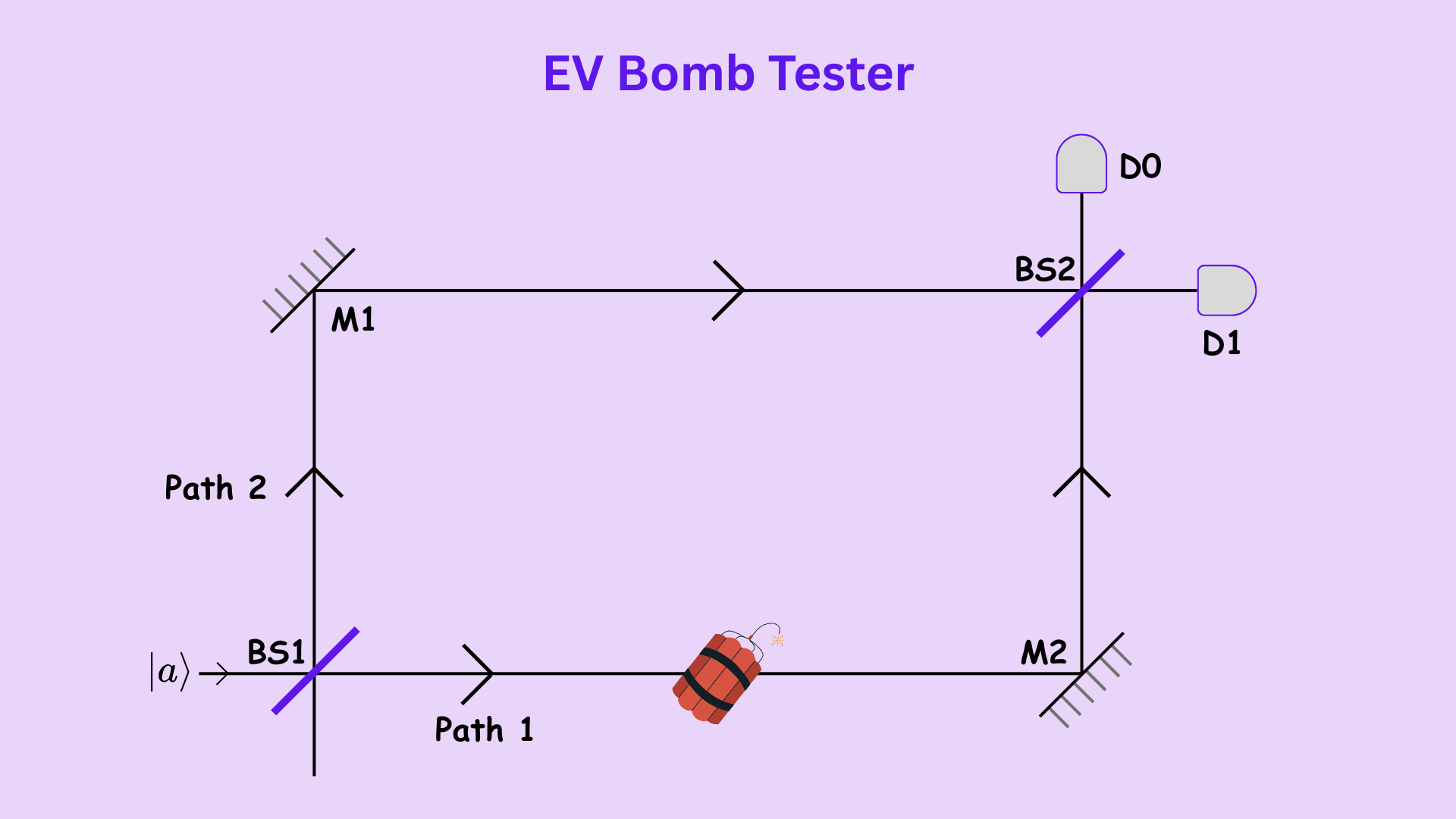
When a dud is placed, the photon passes right through it as if nothing is there. So the setup works as a standard MZI. D1 clicks 100% of the time, and Detector D0 clicks 0% of the time. So if you fire a photon and D1 clicks, all you learn is that the interference was undisturbed.
Now, we place a live bomb in Path A. The bomb’s live sensor acts as a measuring apparatus. It forces the universe to make a choice. The superposition can no longer exist because the bomb constitutes an environment that extracts “which-way” information. The moment the photon hits the first beam splitter, the quantum wave function collapses into one of two real histories:
History 1: Path 1 (50% chance)
The photon travels down Path 1, hits the bomb’s ultra-sensitive live sensor, and BOOM! The bomb explodes. You have failed.
History 2: Path 2 (50% Chance)
The photon travels down Path 2, completely bypassing the live bomb. It reflects off M1 and arrives at BS2. But remember: because the bomb “blocked” Path 1 by being ready to measure it, there is no second wave component coming from Path 1 to interfere with it. The photon arriving at BS2 from Path 2 is alone. Therefore, at BS2, it has a completely random choice:
It has a 50% chance of going to D0.
It has a 50% chance of going to D1.
Because this second split happens after the photon has already taken Path 2, we multiply the probabilities (0.5 × 0.5). This gives us two distinct sub-outcomes:
A 25% chance that D0 clicks.
A 25% chance that D1 clicks.
Let’s look at what the clicks actually tell you after you fire a single photon into the system with an unknown bomb:
Bomb explodes (50%): You know it was a live bomb, but it’s gone.
D1 clicks (25%): This result is ambiguous. D1 clicks 100% of the time for a dud and 25% of the time for a live bomb. You cannot be sure what kind of bomb is in the chamber. You have to run the test again.
D0 clicks (25%): Remember, if the bomb is a dud, D0 can never click because of destructive interference. The only way D0 can ever fire is if there is no interference. And the only thing that makes this happen is the presence of a live bomb blocking Path 1.
When D0 clicks, you know with 100% certainty that the bomb is functional. Yet, tracing the history of that photon, it took Path 2. It never interacted with the bomb’s sensor. You have successfully detected a live bomb through the sheer potential of an interaction that never actually took place!
In the basic setup, your success rate is only 25%, while your explosion rate is 50%. The ratio of good bombs found to exploded bombs is 1:2. This is highly inefficient. Fortunately, we can exploit the Quantum Zeno Effect to make the success probability arbitrarily close to 100%.
Recall that the beam splitter angle θ determines how the photon’s probability amplitude is divided between the two paths. For a very small θ, the transmitted amplitude is cosθ ≈ 1, while the reflected amplitude is sinθ ≈ 0. Thus, almost the entire wavefunction remains on the safe path (Path 2), while only a tiny component enters the bomb path (Path 1).
Now replace BS1 and BS2 with a sequence of N weak beam splitters, each having the same small angle
\(\theta = \frac{\pi}{2N}\)
At each BS stage:
almost all amplitude is transmitted to Path 2,
only a tiny amplitude is reflected to Path 1, where the bomb is.
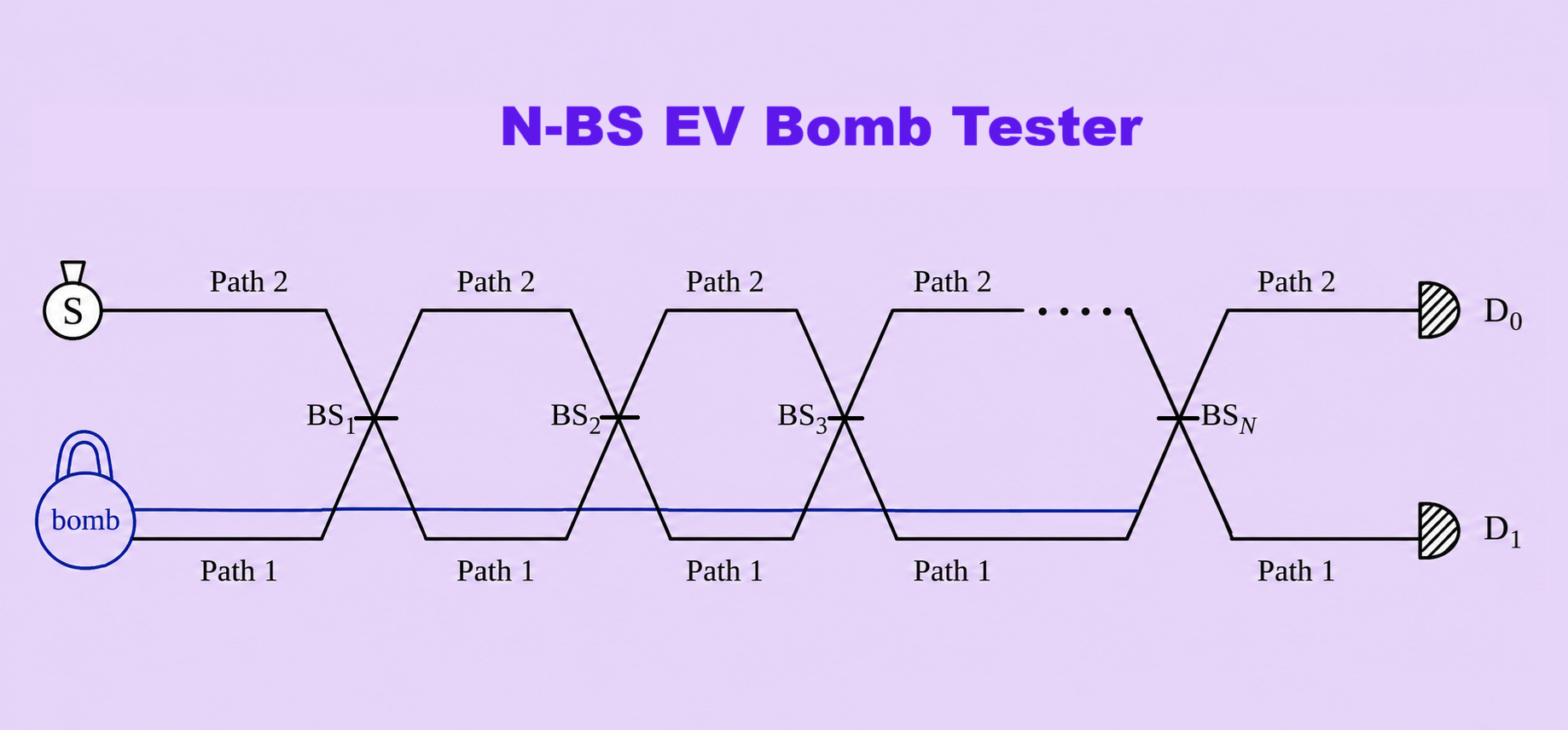
Nothing interrupts the photon's evolution. So the tiny rotations produced by each weak BS accumulate,
\(\lvert \psi \rangle = \cos{(N \theta)} \lvert D_0 \rangle + i \sin{(N \theta)} \lvert D_1 \rangle\)
Since Nθ = π/2, the final state becomes
\(\lvert \psi_{final} \rangle = i \lvert D_{1} \rangle\)
The photon has been completely rotated from D0 to D1, reproducing the same final evolution of a standard MZI. This is just like applying one large 90∘ rotation, but in many tiny steps.
At BS1, the probability that the photon enters Path 1 and detonates the bomb is only sin2θ, which is extremely small.
If the bomb does not explode (the overwhelmingly likely outcome), the tiny amplitude in Path 1 is removed, and the photon’s state is projected back onto ∣ψ⟩ = ∣D0⟩.
At BS2, the same thing happens. Again, a tiny amplitude attempts to enter Path 1, and if no explosion occurs, the state is projected back to ∣D0⟩.
This process repeats at every BS stage. As a result, the gradual rotation that would have transferred the photon to Path 1 never gets a chance to build up. Instead, after all N stages,
\(\lvert \psi_{final} \rangle = \lvert D_{0} \rangle\)
The photon stays on the safe path. This is precisely the Quantum Zeno Effect: continually measuring a quantum system freezes it in its initial state. As the number of beam splitters N increases, the probability of detonating the bomb approaches zero, while the probability of identifying a live bomb without triggering it approaches 100%.
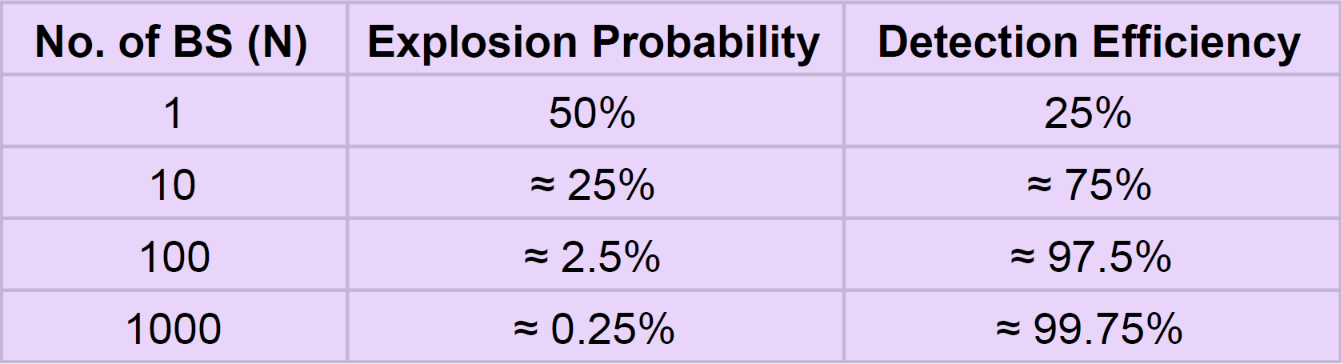
EV bomb tester forces us to confront what physicists call counterfactual definiteness.
In classical logic, we say that something that didn’t happen cannot cause an effect in the macro-world. But here, the fact that the photon could have gone down Path 1 and exploded the bomb is precisely what alters the physical behavior of the photon on Path 2, allowing Detector D0 to click. It tells us that in the quantum realm, unfulfilled possibilities—things that might have happened but didn’t—leave an indelible mark on the reality we ultimately observe.
Isn’t that amazingly philosophical? How do you interpret this strange behaviour of the quantum world? Let me know in the comments below.
Let us trace a single photon entering the interferometer through one input mode ∣a⟩, while the other input mode ∣b⟩ remains empty.
BS1 splits ∣a⟩ into Path T (transmitted) and Path R (reflected):
\(\vert{}\psi_1\rangle = \frac{1}{\sqrt{2}}\vert{}T\rangle + \frac{i}{\sqrt{2}}\vert{}R\rangle\)
Both paths head toward their respective mirrors. Reflecting off a mirror introduces a factor of i to each component:
Path T component:
\(\frac{1}{\sqrt{2}}\vert{}T\rangle \xrightarrow{\text{Mirror } \text{M}_2} \frac{i}{\sqrt{2}}\vert{}T\rangle\)
Path R component:
\(\frac{i}{\sqrt{2}}\vert{}R\rangle \xrightarrow{\text{Mirror } \text{M}_1} \frac{i \cdot i}{\sqrt{2}}\vert{}R\rangle = -\frac{1}{\sqrt{2}}\vert{}R\rangle\)
So the state just before entering the second beam splitter BS2 is:
\(\vert{}\psi_2\rangle = \frac{i}{\sqrt{2}}\vert{}T\rangle - \frac{1}{\sqrt{2}}\vert{}R\rangle\)
Now both arms recombine at BS2. Each path splits again toward Detectors D0 and D1:
For light coming from Path T:
Transmitted to D0:
\(\vert{}T\rangle \to \frac{1}{\sqrt{2}}\vert{}\text{D}_0\rangle\)
Reflected to D1:
\(\vert{}T\rangle \to \frac{i}{\sqrt{2}}\vert{}\text{D}_1\rangle\)
For light coming from Path R:
Reflected to D0:
\(\vert{}R\rangle \to \frac{i}{\sqrt{2}}\vert{}\text{D}_0\rangle\)
Transmitted to D1:
\(\vert{}R\rangle \to \frac{1}{\sqrt{2}}\vert{}\text{D}_1\rangle\)
Substituting these transformations into ∣ψ2⟩:
\(\vert{}\psi_3\rangle = \frac{i}{\sqrt{2}} \left( \frac{1}{\sqrt{2}}\vert{}\text{D}_0\rangle + \frac{i}{\sqrt{2}}\vert{}\text{D}_1\rangle \right) - \frac{1}{\sqrt{2}} \left( \frac{i}{\sqrt{2}}\vert{}\text{D}_0\rangle + \frac{1}{\sqrt{2}}\vert{}\text{D}_1\rangle \right)\)
Expanding the terms:
\(\vert{}\psi_3\rangle = \frac{i}{2}\vert{}\text{D}_0\rangle - \frac{1}{2}\vert{}\text{D}_1\rangle - \frac{i}{2}\vert{}\text{D}_0\rangle - \frac{1}{2}\vert{}\text{D}_1\rangle\)
Grouping the coefficients for each detector mode:
For Detector D0:
\(\left( \frac{i}{2} - \frac{i}{2} \right) \vert{}\text{D}_0\rangle = 0 \cdot \vert{}\text{D}_0\rangle\)
(Destructive Interference)
For Detector D1:
\(\left( -\frac{1}{2} - \frac{1}{2} \right) \vert{}\text{D}_1\rangle = -1 \cdot \vert{}\text{D}_1\rangle\)
(Constructive Interference)
Thus, the final state simplifies to:
\(\vert{}\psi_{\text{final}}\rangle = -\vert{}\text{D}_1\rangle\)
The probability of detecting the photon at D0 is ∣0∣2 = 0, while at D1 it is ∣−1∣2 = 1. The photon is always detected at D1.
Thank you for reading. Writing these essays takes me hours of research and distillation. If my reflections on life or physics resonated with you today and you’d like to support my independent writing without committing to a monthly subscription, you can drop a small tip in my digital jar. It keeps me motivated.
Comments
Nothing yet. Say the first thing.
Sign in to join the conversation.