
Welcome to Bohring. Here, we look at the universe, life, and science education through a physicist’s lens. If you’re new here, consider joining our community of curious minds:
Note: I’ve included the definitions of all keywords as footnotes.
Look up at the constellation Orion on a clear winter night, and your eye is immediately drawn to its shoulder. There sits Betelgeuse, a red supergiant so immense that if placed at the center of our solar system, it would swallow Jupiter whole. Like many stars in its evolutionary death throes, Betelgeuse dims and brightens in complex cycles.
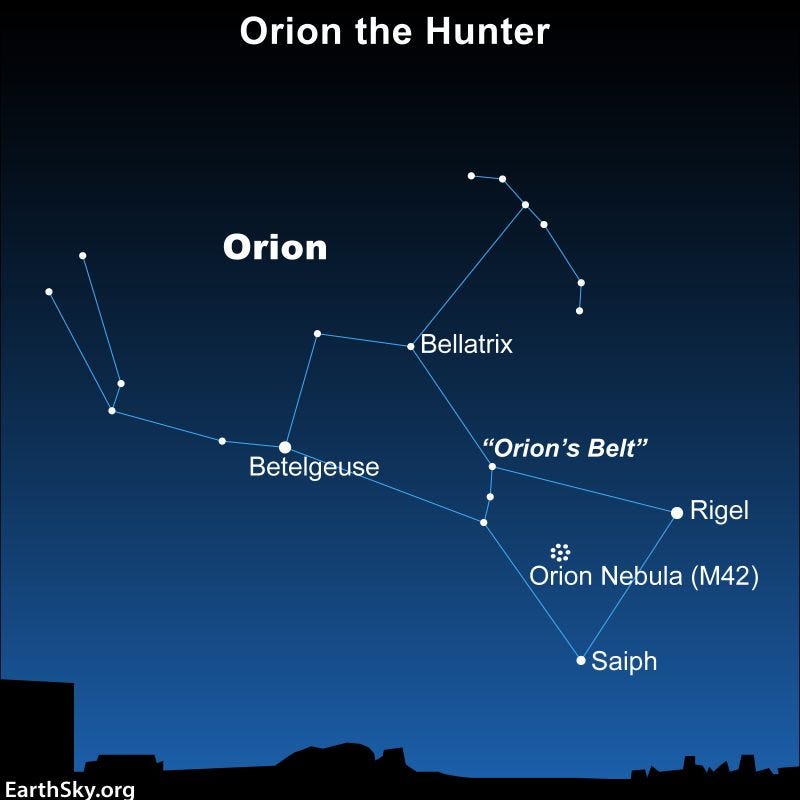
For decades, astrophysicists understood its rapid flickers (180 to 420 days) as radial pulsations of its outer convective layers1. But beneath those quick beats lay a deeper, slower rhythm: a massive cycle spanning roughly 2,200 days (over six years). About a third of all red supergiants exhibit these Long Secondary Periods (LSPs)2, serving as one of observational astronomy’s most persistent cold cases.
In 2024, theoretical astrophysicists re-examined archival data and made a bold claim that the 2,200-day LSP wasn’t an intrinsic stellar heartbeat at all. It was the orbital dance of an unseen companion star modulating circumstellar dust3 along our line of sight. Models predicted a specific window, December 2024, when this hypothetical companion would reach its maximum separation from the supergiant.
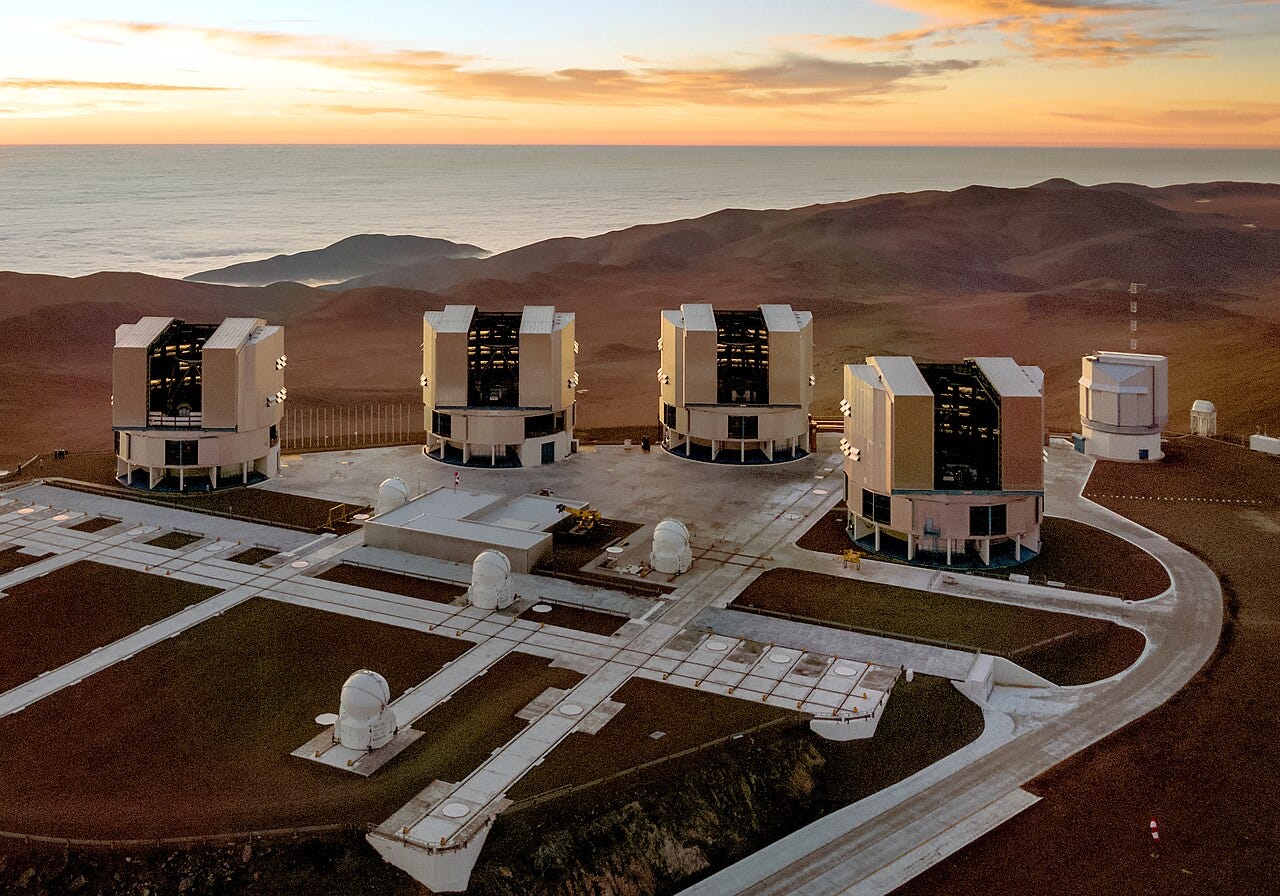
In December 2024, Miguel Montargès and an international team trained the SPHERE4 instrument aboard the European Southern Observatory’s Very Large Telescope (VLT)5 directly on Betelgeuse. Using optical pupil-tracking modes6 without an occulting coronagraph7, they gathered raw intensity frames.
When processed through advanced signal-processing algorithms, specifically PACO ASDI8 (Patch Covariance Angular and Spectral Differential Imaging), the blinding glare cleared. Emerging from the halo, precisely 52.32 milliarcseconds (mas) away, was a sharp point source at a 6.1σ confidence level9. The century-old cold case was closed: Betelgeuse has a companion.
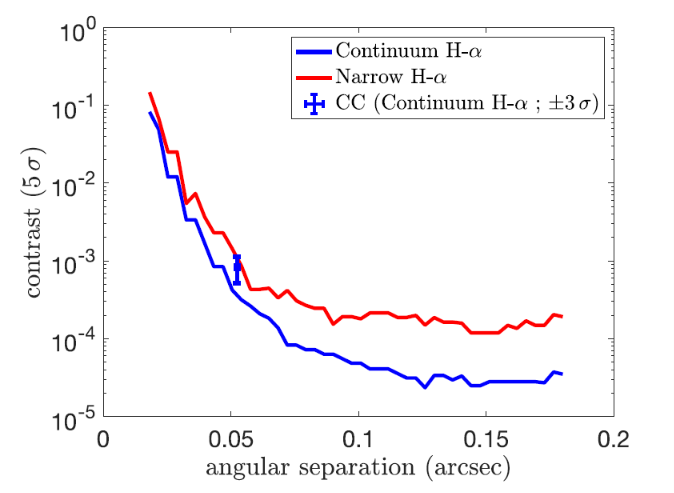
Directly imaging a companion star orbiting a red supergiant is one of the most brutal high-contrast challenges in observational astronomy. Betelgeuse A is a physical titan. Located roughly 168 parsecs (∼550 light-years) away, its angular diameter spans 40–42 mas10.
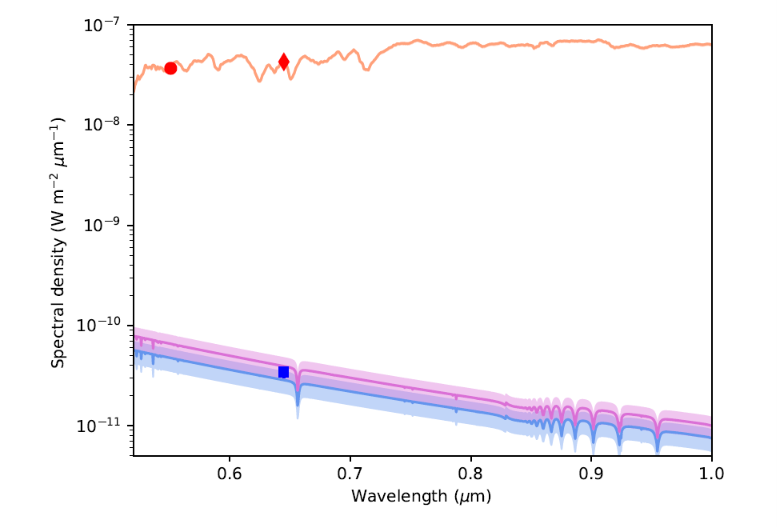
The candidate companion, Betelgeuse B, sat at a projected separation of just 52.32 mas—barely outside the physical limb of the giant star itself. Crucially, Betelgeuse A is roughly 1,200 times brighter in optical light than Betelgeuse B (FB/FA ≈ 8.24 × 10⁻⁴)11. Imaging it was equivalent to spotting a firefly inches away from a stadium searchlight miles in the distance.
To isolate the signal, Montargès’ team relied on SPHERE’s ZIMPOL12 subsystem in the optical spectrum, backed by extreme adaptive optics to correct atmospheric turbulence thousands of times per second.
They captured images across two adjacent narrow filters:
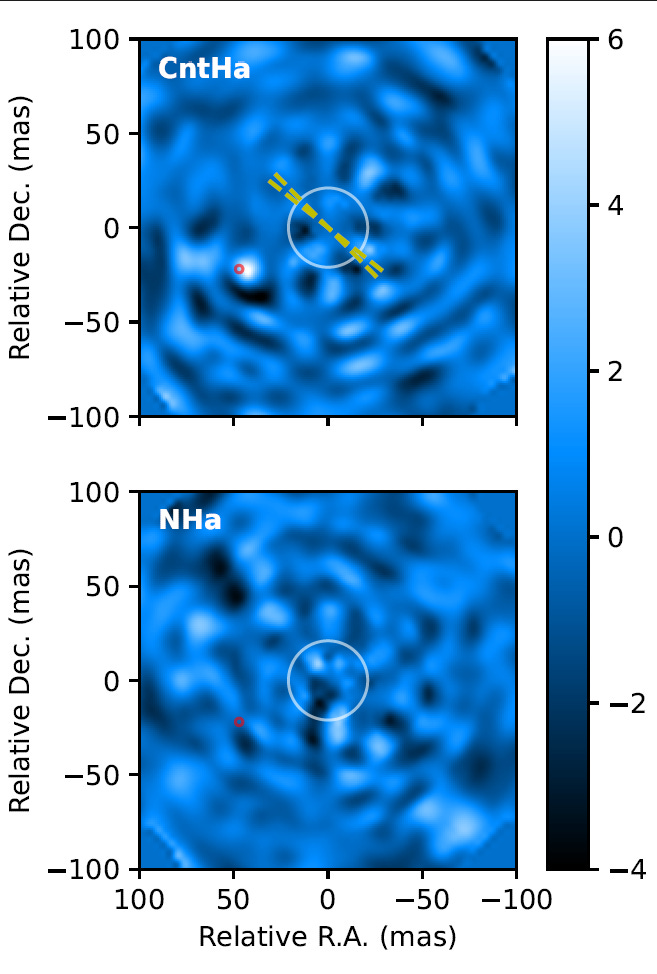
Betelgeuse B appeared clearly in the continuum filter but vanished completely in the Hα filter. Active, accreting protostars glow intensely in Hα due to shock fronts. Its absence rules out ongoing accretion or a circumstellar disk, confirming Betelgeuse B is not a glowing protostar, but a clean, fully formed main-sequence star.
The optical photometry yields a mass estimate between 2.6 and 3.1 M⊙, categorizing Betelgeuse B as a late B-type main-sequence star17 (B8.5V–B9.5V).
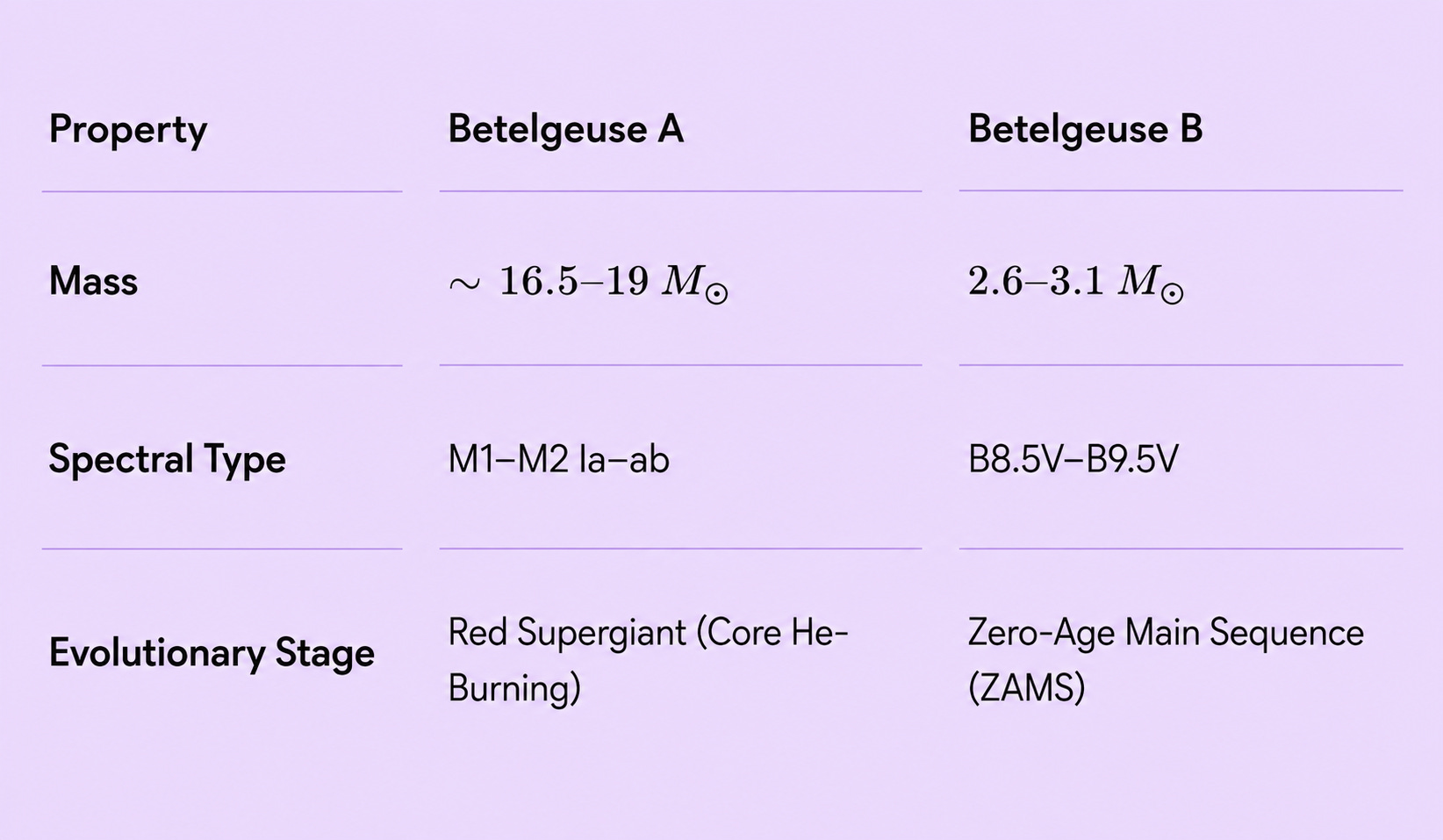
Assuming co-formation 8 to 10.5 million years ago, the system illustrates mass-dependent stellar evolution (L ∝ M3.5):
Betelgeuse A (∼17 M⊙) burned through its core hydrogen in a few million years, expanded into a red supergiant, and is nearing core collapse.
Betelgeuse B (∼3 M⊙) evolved far more slowly, recently reaching the Zero-Age Main Sequence (ZAMS)18 with hundreds of millions of years of fusion ahead.
Earlier hydrodynamic models assumed the companion was a dim 1 M⊙ solar-type star (flux ratio ∼10−5), which would have been buried deep within instrumental noise. The detection succeeded because nature delivered a companion nearly three times more massive than expected, bringing the flux ratio into the reachable 10−4 regime.
💻 A note for my free community:
Below, we transition from the core astronomical discovery of Betelgeuse B to the exact hydrodynamic models and Keplerian orbital mechanics that prove it. In the rest of this premium deep dive for paid Bohring members, I discuss:
Step-by-step Keplerian calculations demonstrating how a 52.32 mas separation settles the long-standing 168 pc vs. 222 pc distance scale debate.
How Bondi-Hoyle-Littleton accretion triggers localized dust condensation scaling with ρ2 to drive the 2,200-day extinction cycle.
Analysis of Mn I, Fe II, and Mg I absorption features confirming the trailing gas cloud.
To unlock the rest of this deep dive and support Bohring, consider upgrading to a paid membership!
Comments
Nothing yet. Say the first thing.
Sign in to join the conversation.