
Welcome to Bohring. Here, we look at the universe, life, and science education through a physicist’s lens. If you’re new here, consider joining our community of curious minds:
Alright, what are you made of? What is everything made of? Atoms, yes. You know it, and I know it because today we have powerful colliders that are trying to dissect particles (quarks) that make up the particles (baryons) that make up atoms.
But imagine yourself as a physicist at the turn of the 20th-century, when all these tools were not available. If someone told you that atoms were real and had observable physical effects, would you believe them? Or would you treat atoms merely as a convenient mathematical trick that could somehow explain heat and chemistry?
Even in your daily life, do you choose to believe something you can’t see? Do you believe in ghosts? Atoms were the 20th-century equivalent of ghosts. Why would anyone want to believe something they can’t directly see or measure?
This was the primary argument of leading skeptics. They believed physics should stick strictly to macroscopic thermodynamics, things we can directly measure, like temperature, volume, and pressure.
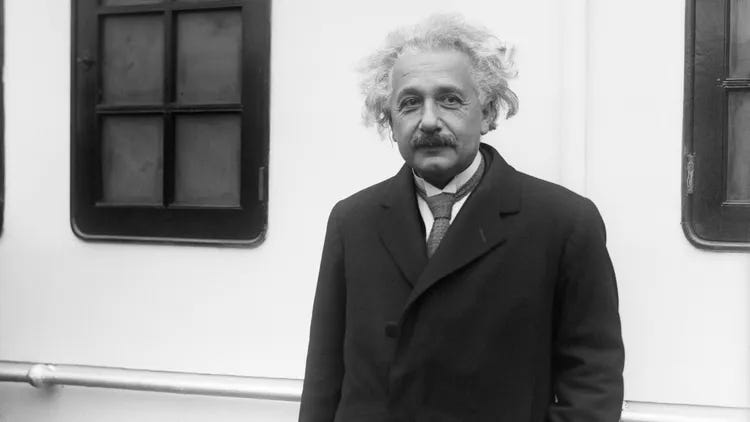
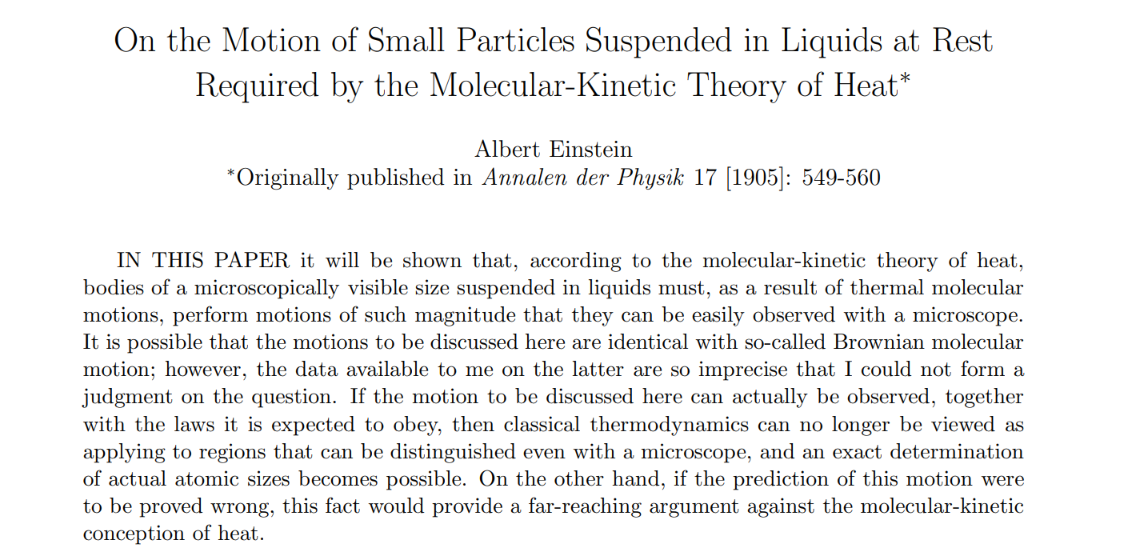
Einstein broke this deadlock with his 1905 paper, On the Movement of Small Particles Suspended in Stationary Liquids Required by the Molecular-Kinetic Theory of Heat.
In this article, I will break down the key results from the paper.
Kinetic Theory of Heat (KTH) posits that heat is the invisible, frantic jiggling of microscopic molecules.
Einstein realized that if KTH is correct, then that jiggling shouldn’t just remain hidden at the subatomic scale. If you drop slightly larger, microscopically visible particles into a liquid, those invisible water molecules will constantly smash into them. Because these collisions happen randomly from all sides, the larger particle will execute a perpetual, erratic motion.
Einstein noted that if this motion could be observed and measured under a microscope, two monumental things would happen:
Classical thermodynamics would prove incomplete for microscopic regions because statistical heat fluctuations actually do real, observable work.
We would have definitive, measurable proof of the existence of real atoms, allowing us to accurately count them for the first time.
Interestingly, Einstein was predicting this phenomenon purely from theoretical principles. He mentions in the introduction that his predicted effect might be what scientists had previously called “Brownian motion” (the jittery motion of pollen grains observed by botanist Robert Brown in 1827), but the experimental data available to him in Bern in 1905 was too imprecise for him to say for sure.
Traditionally, osmotic pressure (p) was understood as a property of dissolved substances (like salt or sugar dissolved in water). If you separate salt water from pure water with a membrane that lets water through but blocks salt, pressure builds up across the membrane. Standard classical thermodynamics assumed this only applied to tiny, dissolved molecules, not to larger solid particles hanging in a liquid suspension (like dust or pollen).
Einstein challenged this boundary. From the perspective of the molecular-kinetic theory of heat, a dissolved sugar molecule and a microscopic suspended sphere differ only in size, not in fundamental physics. He mathematically demonstrated that if suspended particles are free to move around, thermal energy will force them to move randomly. If you confine these suspended particles to a specific region using a barrier, their constant collisions with that barrier create an osmotic pressure identical to that of dissolved chemical molecules.
The osmotic pressure (p) of suspended particles depends on the temperature (T), the number of particles per unit volume (ν), and two basic physical constants: the universal gas constant (R) and Avogadro’s number (N, the number of actual molecules in a mole):
\(p = \frac{RT}{N} \cdot \nu\)
This proved that thermodynamics and kinetic theory govern everything on a continuous spectrum from individual atoms to visible microscopic grains.
Einstein then asked: how do these suspended particles spread out over time?
If you have a higher concentration of particles in one area and a lower concentration in another, two opposing processes occur:
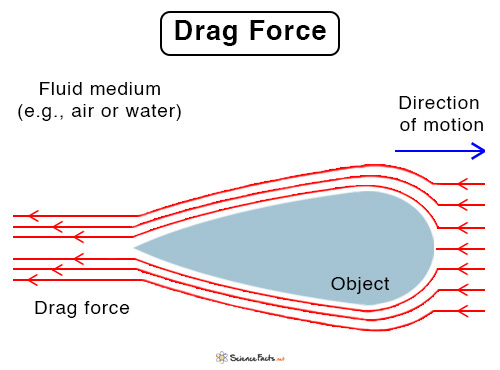
Bulk Drag / Resistance: A spherical particle of radius (P) moving in a fluid of viscosity (k) experiences a drag force (F) that is directly proportional to the particle’s velocity (v):
\(F_d = 6πkPv\)
This is Stokes’s law. The resistance offered by the fluid per unit velocity is called the friction factor (b):
\(b = \frac{F_d}{v} = 6πkP\)
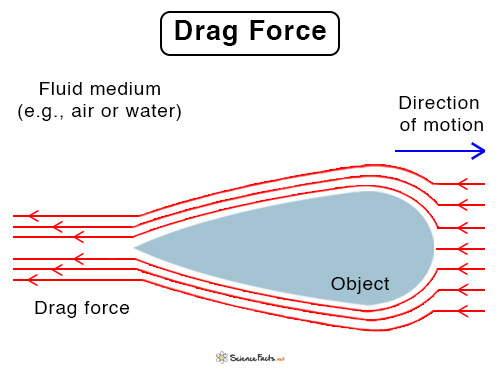
(Image Credit: ScienceFacts.net) Thermal Diffusion: At the same time, the random, chaotic kicks from thermal molecular collisions cause the particles to naturally spread out from crowded regions to empty regions. This gives rise to the osmotic pressure (p) we just discussed.
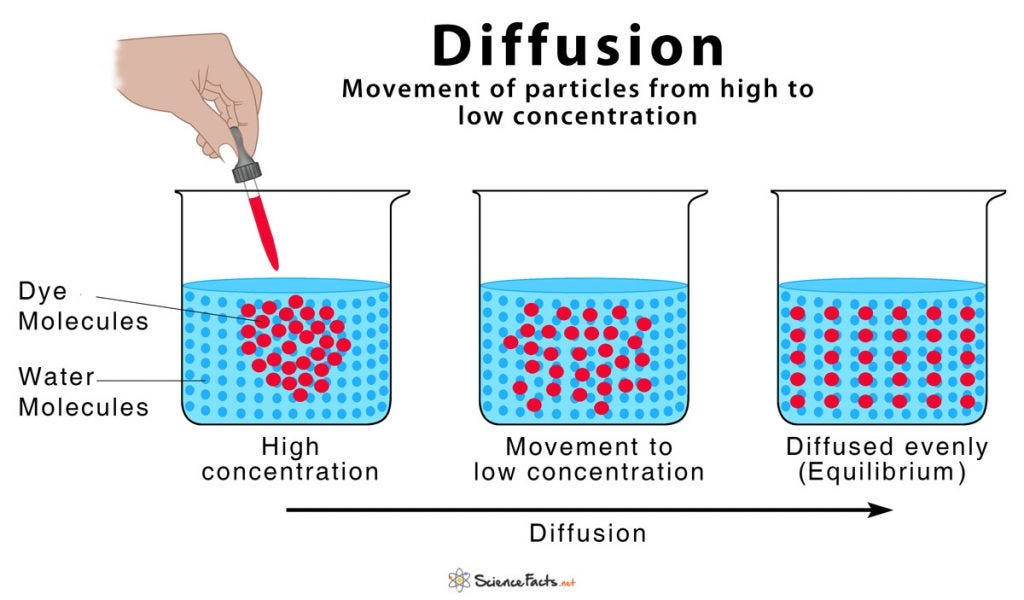
An example of diffusion. (Image Credit: ScienceFacts.net)
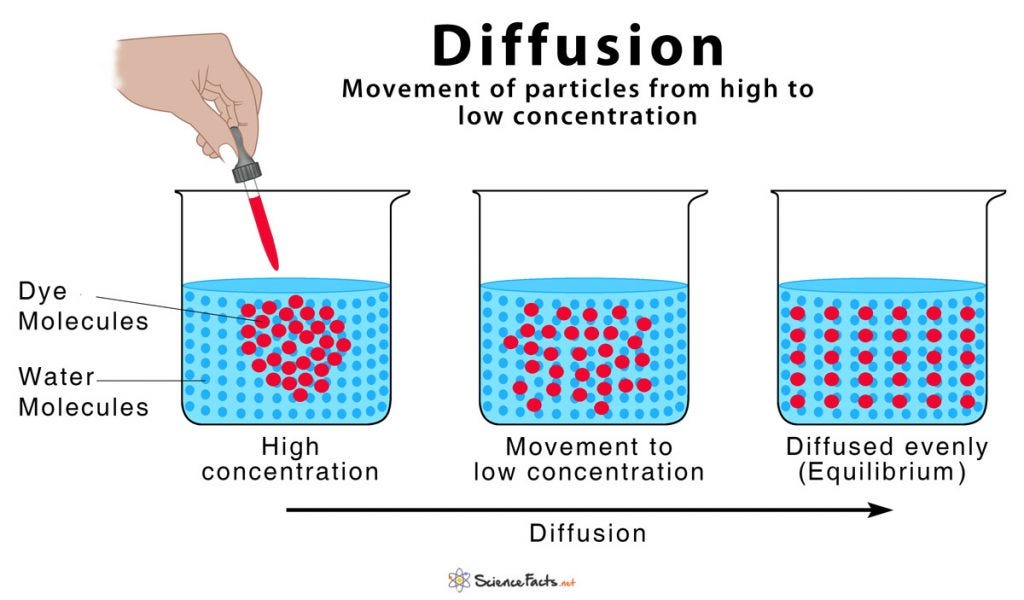
By balancing the force of osmotic pressure against fluid resistance in a state of dynamic equilibrium, Einstein derived a precise formula for the diffusion coefficient (D) of suspended spherical particles:
\(D = \frac{RT}{N} \cdot \frac{1}{6\pi k P}\)
This equation bridges two completely different worlds: the microscopic thermal world (RT/N) and the macroscopic hydrodynamics of fluid drag (6πkP).
💻 A note for my free community:
Below, I discuss Einstein’s most significant result that proved the existence of atoms. In the rest of this premium deep dive for paid Bohring members, I discuss:
How Einstein modeled the jittering of molecules as a Random Walk problem.
How his formula for mean displacement connected the microscopic and macroscopic realms.
The experimentalist who won the Nobel Prize for proving right Einstein’s theoretical predictions.
To unlock the rest of this deep dive and support Bohring, consider upgrading to a paid membership!
Comments
Nothing yet. Say the first thing.
Sign in to join the conversation.