
Across the U.S., cyclospora infections are rapidly accelerating. The uptick of infections relates to three key issues: government-driven cuts in scientific research, public health policies and communication, and the impact of outbreaks on people with chronic illnesses.
This column will explore the cyclosporiasis outbreak, what we can all do to protect ourselves, and addresses infection through the lens of Ehlers-Danlos Syndrome, or EDS.
First, what’s going on with Cyclospora, and why aren’t we hearing about it widely?
Cyclosporiasis is an infection of the gut lining, particularly the small intestine, by the parasite Cyclospora. The parasites burrow into the gut and reproduce, triggering inflammation and debilitating periods of watery diarrhea, cramps, and bloating.
Cyclospora parasites spread most readily through food or water contaminated with human feces. They shed in stool, and take 1-2 weeks to mature before they can infect someone else.
Common sources of Cyclosporiasis include:
produce with hard-to-wash crevices, such as fresh herbs (basil, cilantro) or fresh berries, especially raspberries
frozen berry and fruit mixes, particularly if packaged after an outbreak
boxed or bagged lettuce and pre-packaged salad mixes (including vegetable trays and coleslaw)
onions
snap and snow peas
contaminated water, including swimming pools, lakes, splash pads, and water parks
The U.S. typically sees 4,000 cases of Cyclosporiasis in a year. The outbreak is now the largest of its kind in U.S. history. According to the Health Security Operations Center, an independent public health NGO, cases topped 5,000 on July 13 and continue to accelerate.
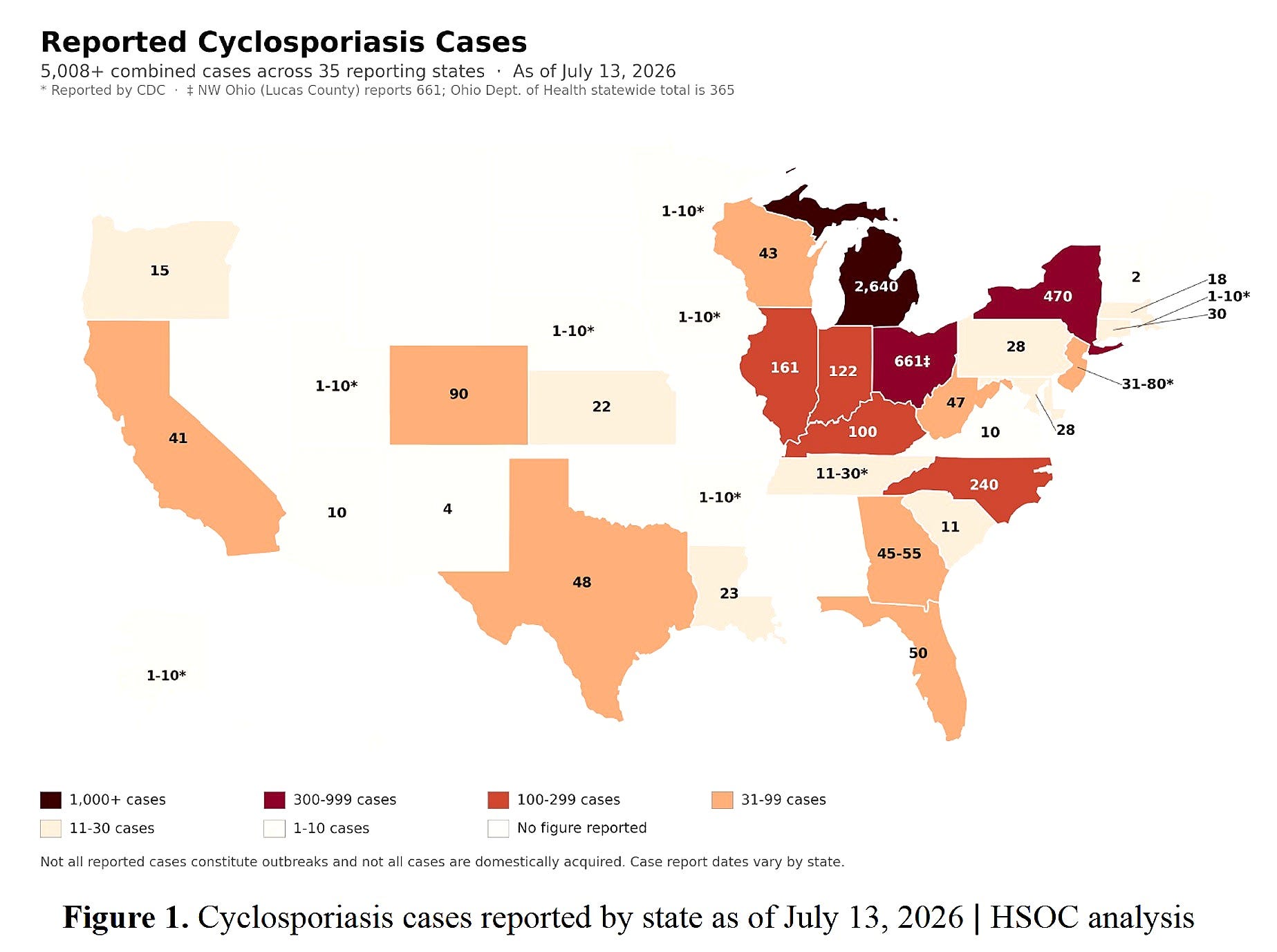
Why hasn’t the U.S. government pinpointed the origins of the outbreak more quickly? Likely reasons for the delay include the lack of centralized coordination by the federal government, our siloed health systems—for example, internal medicine is sequestered from epidemiology, and both are distinct from gastroenterology. State and local health departments have lost personnel and funding, further exacerbating the delays. Public health in the U.S. is chronically under-resourced forcing already-burdened local public health departments to track cases and conduct interviews while also monitoring other diseases on the rise, like measles.
Normally, when doctors are looking for the cause of a stomach bug, they test patients’ stool with a single lab test that tracks multiple pathogens simultaneously.
But those stool panels do not include Cyclospora.
A positive diagnosis requires a special stool test with a stain that turns the parasite ova bright pink or orange so that a microscope can identify them.
The Texas Department of State Health Services advises that because the infected eggs shed from the body inconsistently, doctors may need to conduct as many as three tests spaced 24 hours apart to make a firm diagnosis of Cyclosporiasis.
Katelyn Jetelina publishes Your Local Epidemiologist on Substack. In her July 5 newsletter, Jetelina documented Michigan’s health officials’ announcement of their preliminary finding. Lettuce and packaged salad greens are the most likely source of the Michigan outbreak, which has surpassed 3,000 cases. The investigation has not pinpointed a particular manufacturer or ruled out other foods.
Outbreaks in the other states shown on the map above may have different food or water sources.
For now, avoid the foods on the list above, particularly boxed or bagged lettuce and salads. Washing your food carefully helps, but will not fully eliminate the parasite; when possible, lean toward foods you can peel or cook.
If you develop symptoms that are severe or last longer than two days, or that ebb and flow in severity, contact your doctor or clinical care team. Severe or chronic cases can be treated successfully with antibiotics, usually Bactrim or Septra. However, these antibiotics are sulfonamides, which contain sulfa and work by preventing bacteria from producing a substance they need to grow and multiply.
Many people are allergic to sulfa, and can develop skin rashes, hives, throat swelling, or shortness of breath. For people with sulfa allergies who contract Cyclosporiasis, fluoroquinolones are the second-line treatments.
And that’s where Ehlers-Danlos Syndrome comes into play. Fluoroquinolones are linked with adverse side effects in musculoskeletal and connective tissue, including:
tendon rupture and tendonitis
aortic aneurysm and dissection
damage to joints, muscle, and connective tissue, including tears
peripheral neuropathy
autonomic dysfunction
gastrointestinal issues
Fluoroquinolones can harm any place that connective tissue vulnerabilities can impact, including blood vessels, gut lining, etc.
The FDA has issued warnings about these risks, particularly for individuals with EDS (particularly the hypermobile and vascular types), Marfan Syndrome, Loeys-Dietz Syndrome, or vascular diseases.
If you have EDS (or don’t have a diagnosis but suspect that you might) and contract Cyclosporiasis but can’t take sulfa medications, talk with your healthcare provider about the best alternatives to fluoroquinolones.
Another note of interest: People with EDS and hypermobility frequently experience local anesthetic resistance, in which local anesthesia wears off more rapidly than expected. This happen during awake procedures: in my recent two colonoscopies and endoscopies, the numbing medication wore off early. (The same can be true of general anesthesia as well. During a complex hip osteotomy years ago, I came fully awake in the midst of the procedure. I still remember the anesthesiologist, eyes widening in alarm, shouting at the doctor to stop so he could put me back under.)
Ehlers-Danlos Syndrome encompasses a grouping of 13 inheritable connective tissue disorders in which genetic mutations disrupt the synthesis and processing of collagen and the stability of the extracellular matrix. Present within all tissues and organs, the extracellular matrix (ECM) scaffolds the cellular constituents and ignites vital biochemical and biomechanical cues or cell regulation and other key functions.
EDS mutations may be best known for causing joint hypermobility, frequent joint dislocations, soft tissue and tendon injuries, and skin fragility and excess elasticity.
But EDS extends far beyond hypermobility to affect multiple biological and neurobiological systems in the body, including:
the gut barrier, gastrointestinal functioning, and the gut-brain axis
the immune system, including mast cell activation syndrome (MCAS) and autoimmune issues like rheumatoid arthritis and Sjogren’s Syndrome
the integrity of the blood vessel lining and therefore vascular issues
the autonomic nervous system (causing disorders of the ANS, postural orthostatic tachycardia syndrome (POTS) and more
esophageal lining issues and cervical instability, which can cause difficulties with swallowing, speech, and breathing
central nervous system issues, including complex regional pain syndrome
challenges with the eye microbiome/barrier, causing visual issues
challenges with sensory integration (including interoception, proprioception, body agency, body ownership, vestibular awareness, and peripersonal space)
frequent damage to the vagus nerve, one of the body’s main pathways for conveying sensory information from the organs (think the gut, heart, and esophagus—all issues involved in EDS—to the brain)
an overlap with chronic fatigue syndrome/myalgic encephalomyelitis (CFS/ME) and Long Covid
Why does this happen? To address these overlaps with more clarity, let’s take a quick look at the last one on the list: the strong overlap between Ehlers-Danlos Syndrome and Long Covid.
One of my research areas of focus is post-viral illnesses like Long Covid. These are known as RNA viruses, which “edit” not the DNA itself, but gene expression or suppression.
These viruses also attack many of the body’s barrier sites—that is to say, tissues of the body that form boundaries between different compartments, such as the gut lining and the gut lumen, the GI tract and the bloodstream, or the blood and the brain.
A 2025 study examined data from 23 million patients across the U.S. The researchers looked at correlations between h-EDS (the hypermobile type of Ehlers-Danlos Syndrome), Covid-19 infection, Long Covid, and related chronic conditions like CFS/ME.
Importantly, people with h-EDS had rates of Covid infection similar to matched controls. But they were far more likely to develop Long Covid. And the risk of Long Covid was highly elevated in h-EDS patients who had overlapping conditions such as postural orthostatic tachycardia syndrome (POTS), dysautonomia (autonomic nervous system dysfunction), immune system dysregulation that encompassed GI and systemic mast cell-related symptoms, and CFS/ME.
Almost all the conditions with which EDS overlaps—gut, bloodstream, brain, autonomic and central nervous systems, esophageal, immune, and blood vessels disorders—are boundary or barrier issues.
They involve the way the body and brain negotiate the border between parts of the body (like the gut and bloodstream or the bloodstream and the brain) or between the body and the outside world (like viruses and bacteria).
One way of understanding Ehlers-Danlos Syndrome and its overlap with so many illnesses like Long Covid and CFS/ME is to see them as vulnerabilities or anomalies in the vital barriers between the body, brain, and world around us.
I’ll add that anomalies in our barrier systems also extend to our emotional and social worlds. Ehlers-Danlos/hypermobility syndromes often go hand in hand with interpersonal (and often intrapersonal boundary challenges). It can be difficult to know where we leave off and others begin, or which of our feelings belong to us and which we intuit from others. We can be emotionally and socially porous or hyper-empathic. We often receive a vast amount of information about others and the world (as do people who are neurodivergent—and there’s a big overlap here). We have high levels of “sentinel intelligence,” which can be thought of as the capacity to intuit danger on behalf of our community. Sentinel intelligence can, of course, extend into vigilance
All this vulnerability to barrier disruption may make it more likely for people with EDS and hypermobility to contract Cyclosporiasis—the invasion of the gut/small intestine lining by a parasite. This doesn’t mean that you need to live (or eat!) in fear. But knowing this vulnerability in biological, emotional, and social “outbreaks” helps us be more proactive about taking wise precautions when choosing what foods to purchase and how to prepare them, as well as how gracefully to navigate and quiet the emotional and social situations that trigger “allergic” reactions.
Cyclosporiasis is an infection of the gut lining, particularly the small: July 7, O. published in C. H. on & 2026. (n.d.). What to know about cyclospora, the gut-churning parasite causing illness in several states, and how to avoid it. Retrieved July 16, 2026, from https://healthcare.msu.edu/news/2026_07_08_what_to_know_about_cyclospora.html
According to the Health Security Operations Center, an independent public health NGO: HSOC Situation Report July 13 2026.pdf | Powered by Box. (n.d.). Retrieved July 14, 2026, from https://georgetown.app.box.com/v/HSOCSitReps2026/file/2346484326305
Likely reasons for the delay include the lack of centralized coordination: Jetelina, K. (2026, July 11). Explosive foodborne outbreak [Substack newsletter].
https://yourlocalepidemiologist.substack.com/p/explosive-foodborne-outbreak/comments
A positive diagnosis requires a special stool test with a stain: July 7, O. published in C. H. on & 2026. (n.d.). What to know about cyclospora, the gut-churning parasite causing illness in several states, and how to avoid it. Retrieved July 16, 2026, from https://healthcare.msu.edu/news/2026_07_08_what_to_know_about_cyclospora.html
The Texas Department of State Health Services advises that: Health Advisory: Test patients with symptoms consistent with Cyclospora infection | Texas DSHS. (n.d.). Retrieved July 16, 2026, from https://www.dshs.texas.gov/news-alerts/health-advisory-test-patients-symptoms-consistent-cyclospora-infection
In her July 5 newsletter, Jetelina wrote that Michigan’s health officials announced: Cyclospora keeps climbing, a bad West Nile season, truck spraying, and good news. (n.d.). Retrieved July 15, 2026, from
However, these antibiotics are sulfonamides, which contain sulfa and work by preventing: Do you have a sulfa allergy? (n.d.). Cleveland Clinic. Retrieved July 16, 2026, from https://my.clevelandclinic.org/health/diseases/25131-sulfa-allergy
Ehlers-Danlos Syndrome encompasses a grouping of 13 inheritable connective tissue:
Pearson, M. L., Laraway, B. J., Elias, E. R., Bilousova, G., Haendel, M. A., & National Clinical Cohort Collaborative (N3C) Consortium (2025). Understanding Comorbidities in Hypermobile Ehlers-Danlos Syndrome: Could a Viral Infection Lead to a Diagnosis?. medRxiv : the preprint server for health sciences, 2025.10.22.25338573. https://doi.org/10.1101/2025.10.22.25338573
The extracellular matrix (ECM) is present within all tissues and organs: Frantz, C., Stewart, K. M., & Weaver, V. M. (2010). The extracellular matrix at a glance. Journal of cell science, 123(Pt 24), 4195–4200. https://doi.org/10.1242/jcs.023820
The researchers looked at correlations between h-EDS: Pearson, M. L., Laraway, B. J., Elias, E. R., Bilousova, G., Haendel, M. A., & National Clinical Cohort Collaborative (N3C) Consortium (2025). Understanding Comorbidities in Hypermobile Ehlers-Danlos Syndrome: Could a Viral Infection Lead to a Diagnosis?. medRxiv : the preprint server for health sciences, 2025.10.22.25338573. https://doi.org/10.1101/2025.10.22.25338573
Fluoroquinolones are linked with adverse side effects in musculoskeletal and connective tissue: FDA: Certain antibiotics may bring serious risks. (2019, March 1). Harvard Health. https://www.health.harvard.edu/healthy-aging-and-longevity/fda-certain-antibiotics-may-bring-serious-risks
People with EDS and hypermobility frequently experience local anesthetic resistance: Bourne, K. M., Thai, S., Lei, L. Y., Siddiqui, T., Black, B., Peltier, A., Paranjape, S., Shibao, C. A., Biaggioni, I., Diedrich, A., Gamboa, A., Okamoto, L., Sheldon, R. S., & Raj, S. R. (2026). Patients with Ehlers-Danlos syndrome experience reduced effectiveness of lidocaine local anesthetic: A randomized cross-over clinical trial. Regional Anesthesia & Pain Medicine. https://doi.org/10.1136/rapm-2025-107416
Comments
Nothing yet. Say the first thing.
Sign in to join the conversation.