
Hi Friends!
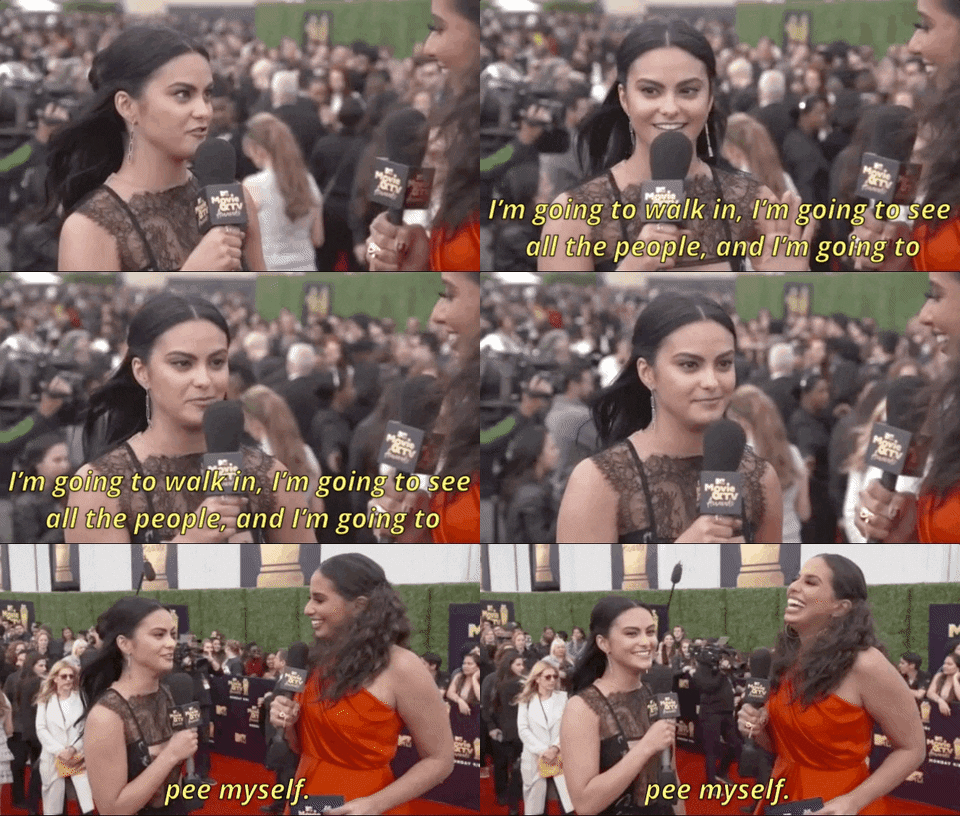
Back in the day, when I used to tour the world as a performer, a friend told me that what I did for a living would absolutely make her puke. She could not fathom how I could go out in front of thousands of people, night after night, and not absolutely die of stage fright.
“Oh, I do puke,” I said. “I just call it excitement.”
We laughed, but it landed like a little revelation for me. The experience of being in front of a crowd made both our bodies do very similar things: lurching in the stomach, shaking hands, pounding heart… the pukes.
And for both of us, the raw data coming from the environment was the same: nameless faces with ambiguous expressions, stage lights, sounds, the smell from spilled alcohol and fog machines.
But there’s what our senses receive, and there’s what we make it mean.
For her, that situation meant danger: the crowd was unfriendly and unsafe. For me, the crowd was a challenge, a puzzle to crack (“How can I make these people go nuts?”) Same raw data, two completely different worlds. Both interpretations were true and untrue. And neither of us consciously chose which one to live inside.
This happens for all of us, in every situation. Our meaning-making machines are chugging along, shrink-wrapping the total ambiguity of the present moment with our narratives and labels. And that’s ok. That’s what it means to be human. We are meaning-makers who dream in story, both privately and collectively.
The problem is that we don’t realize we’re doing it. We take our meaning-making to be absolute and objective reality and then get trapped inside those rigid structures. We want to change, but all we see are old truths that feel unchangeable.
The contemplative traditions point toward a lucidity about this: that if we’re the ones tying meaning to experience, we can be the ones to loosen it. We can experience meaning as malleable. We can slip below the narratives, below the labels, down to the raw sensation itself, and discover that it’s not fixed. It’s alive, and it’s ours to play with.
“We don’t see the world as it is, we see it as we are” — Anaïs Nin
All month we’ve been practicing with this kind of dreaming. What it means to wake up inside the collective nightmare, how to claim joy in the middle of it, and what it feels like to dream from the centre of your own aliveness instead of from the chaos.
The practice I’m sharing today is a way to start dreaming on purpose.
It has tantric, alchemical bones and moves in 3 acts:
1. Find what you’re carrying. Land in the body and locate whatever’s been waiting for your attention. Fear, grief, rage, exhaustion. Get curious about it.
2. Strip it down. Get underneath the label of the emotion into the raw, preverbal experience of it. What does it actually feel like when you stop calling it by its name?What’s left is just aliveness. Unnamed, unclothed, fizzing around somewhere in the body like electricity with no outlet. Neither good nor bad. Just going.
3. Dream. We use this nameless aliveness like a fuel cell for dreaming anew. We give it a new name and let our experience of the world reorganize around that quality. First through the body, then through the environment and further into the world. Like a pebble dropped in a lake, the dreaming starts in the centre and ripples outward as far as we can imagine.
Give it a try and let me know in the comments what comes up.
Happy dreaming!
❤️ Lama Tasha
Bodhisavage is reader-supported. If you like your practice playful, your dives deep & your wisdom a little weird, come along for the ride!✌️
New Goodies…
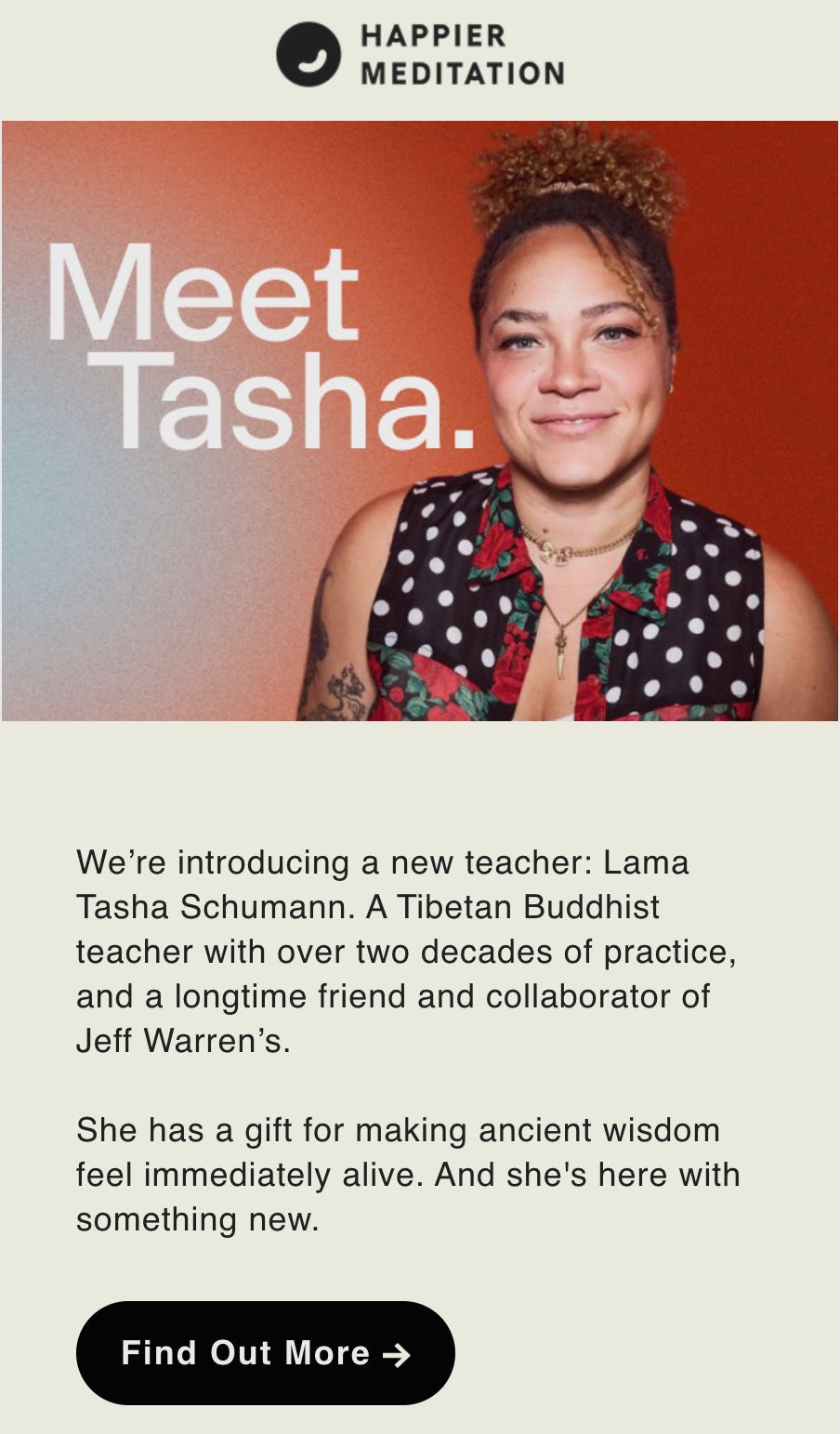
Tada! I’ve joined the fabulous roster of teachers on the Happier App.
We’re kicking it off with a 5-week exploration of The 5 Knots, starting with the knot of Aversion.
Comments
Nothing yet. Say the first thing.
Sign in to join the conversation.