

It was a bright hot July day in Algonquin Park sixty-five years ago. I was on a #Camp Ahmek canoe trip. Our 20-year-old camp counsellor warned that there was known to be a patch of poison ivy beside our upcoming portage trail. This was particularly important information for my cabin mate, Billy who was known to be “allergic” to poison ivy.
Donning our fifty-pound backpacks was easier for Billy, a much larger kid than me who only weighed slightly more than my backpack. As Billy walked across a slippery log over the muddy low point on the trail, he swatted at a wasp circling his head and lost his balance. Yowling, Billy fell directly into the poison ivy.
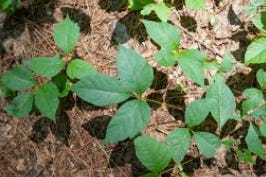
I don’t remember much of the aftermath. This likely involved hustling Billy to the end of the portage, stripping off his clothes and washing Billy down with “sunlight” soap in the lake water at the other end of the trail, then washing the plants oils out of his clothes for good measure. These portage launch points were typically full of mosquitoes feasting on the boys as Billy blubbered over his untimely misfortune.
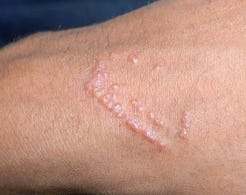
Poison Ivy “Swipe” Rash
We didn’t carry much in the way of first aid, but a few antihistamine tablets would be dispensed over the three days it took us to get back to the camp infirmary where Billy’s angry blistering rash was treated with compresses to draw the fluid out of the blistered skin before the application of calamine lotion and hydrocortisone cream.
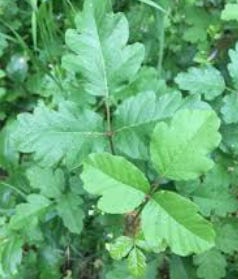
Poison Oak
Not much had changed thirty years later when my 15-year-old son, wearing loose fitting shorts, sat down on a woodland trail log, the bark of which must have harboured poison oak. Two days later, the rash in his crotch erupted, by which time he had managed to inoculate several other spots on his body with the plant’s oil. By this time, five days of oral steroids were added to the treatment, but it still took well over a week for the rash to resolve.
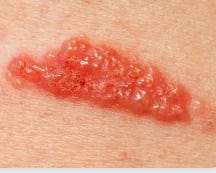
Poison Ivy Blisters
These early lessons on contact dermatitis have stayed with me throughout my medical training and years pediatric practice. These lessons are:
1. Poison ivy and poison oak are examples of contact dermatitis
2. The symptoms of intense itchy blistering rash are due to an “allergic reaction” in the skin area “contacting” the plants’ oils.
3. Some people have a stronger allergy to the oil’ than others.
4. The oil causing the reaction can be transferred to other parts of the body
5. The first step in treatment is to wash the oil from the area of contact, the fingers and fingernails to minimize transfer to other delicate areas which I will leave to your imagination
6. The mainstay of treatment is the application of medical strength steroid cream. In most cases a short course of prednisone taken by mouth will also help damp down the allergic reaction
7. If you don’t have access to steroid cream, you can spray a steroid asthma inhaler on the affected area
8. A hint to the poison ivy, poison oak is that the leaves leave a linear” track mark” as they brush across bare skin.
9. This is another good reason to wear ankle high boots and/or long pants when walking across fields or in the woods.
10. Nowadays physicians generally recommend the use of second-generation antihistamines such as loratadine (Claritin) or Cetirizine (Reactine/Zyrtec) which work just as well as Benadryl without the common side effects.
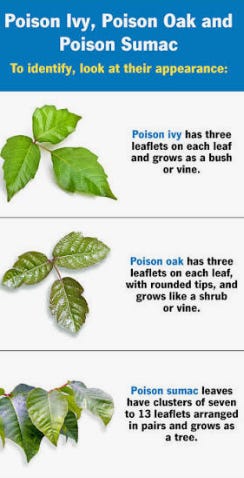
Courtesy of the Cleveland Clinic
Prevention is always better than treatment. This starts with being able to recognize the plants. Poison ivy is described as having three leaves on a stem. Before the berries come out, you can distinguish poison ivy from the wild blackberry which it resembles by the prickles on the stem. This wisdom is captured in the short poem: “If it’s three, let it be” If it’s hairy, it’s a berry.” If you prefer technology to poetry, you can also do a picture search in Google ap on your I-Phone
Once the blistering rash appears, the absence of a story about a walk in the woods or fields raises the possibility of a sun rash. In certain people with more sensitive skin can develop a blistering sun rash as a symptom of “sun burn”. While this is not an allergic rash, it can also be treated with antihistamines, the rash is due to release of histamine from what are known as mast cells in the skin. The clues to a sun rash are its presence in exposed areas of skin which often outlines the pattern of the clothing worn the day of the sun exposure.
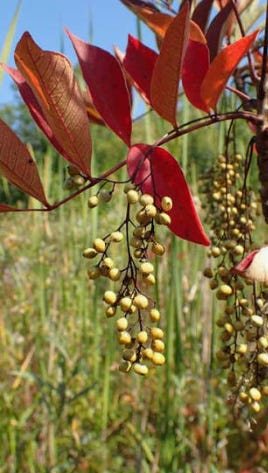
We haven’t talked much about #Poison Sumac which typically occurs in the southern United States but is occasionally encountered in wooded areas and bogs in the warmer areas of southern Ontario and southern areas of Quebec. It is generally recognized by having 7-13 smooth edged leaflets that have pointed tips and reddish stems connecting the leaves. While poison ivy is bad enough poison sumac is said to be worse because it has higher concentrations of urushiol, the oil that causes allergic reactions in poison ivy and poison oak exposure.
Remember the caution against trying to burn fields with poison ivy as folks can develop severe pneumonitis by inhaling the oil form the smoke of burning plants.
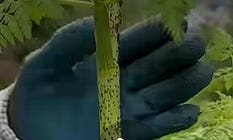
Poison Hemlock
Lastly, poison hemlock is reputed to be the deadliest plant in North America, but this only occurs if you make tea out of the leaves. It has a long smooth stem which looks like it’s been splattered with purple paint which also causes contact dermatitis.
No posts
Comments
Nothing yet. Say the first thing.
Sign in to join the conversation.