
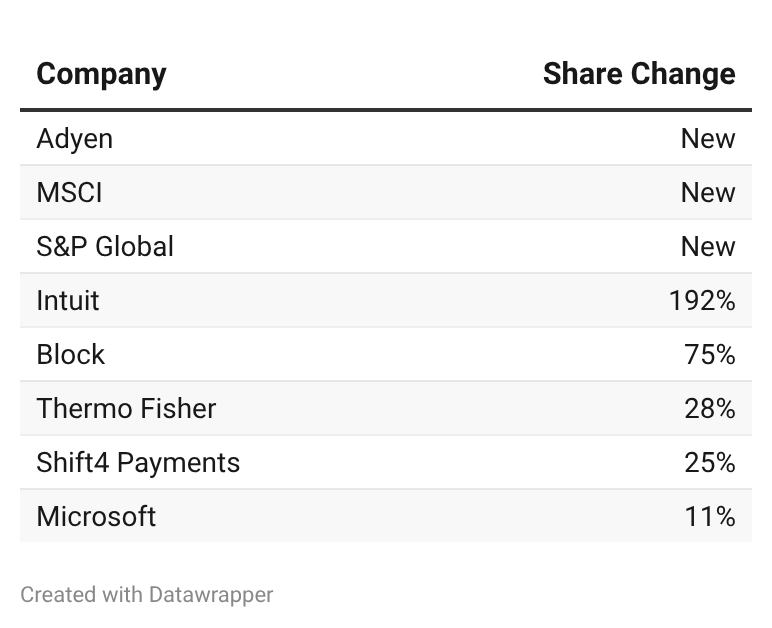
There’s no sugarcoating it. My performance has been dreadful since I began sharing this portfolio last July. For the quarter, my portfolio was down 11%, 7-points worse than the S&P 500. Even though nine months is an exceedingly brief period of time in my investing lifespan—which started as a teenager, and is likely to go decades more, fingers crossed—this stretch has been particularly brutal. Despite the results, the first quarter was more exciting than others, as I got the opportunity to buy some high-quality businesses [Adyen, Intuit, MSCI and S&P Global] at reasonable prices, which, after all, is the goal. I was more active than usual during the quarter, selling out of five positions completely, and opening three new ones, reducing total positions to 19, down from 21.
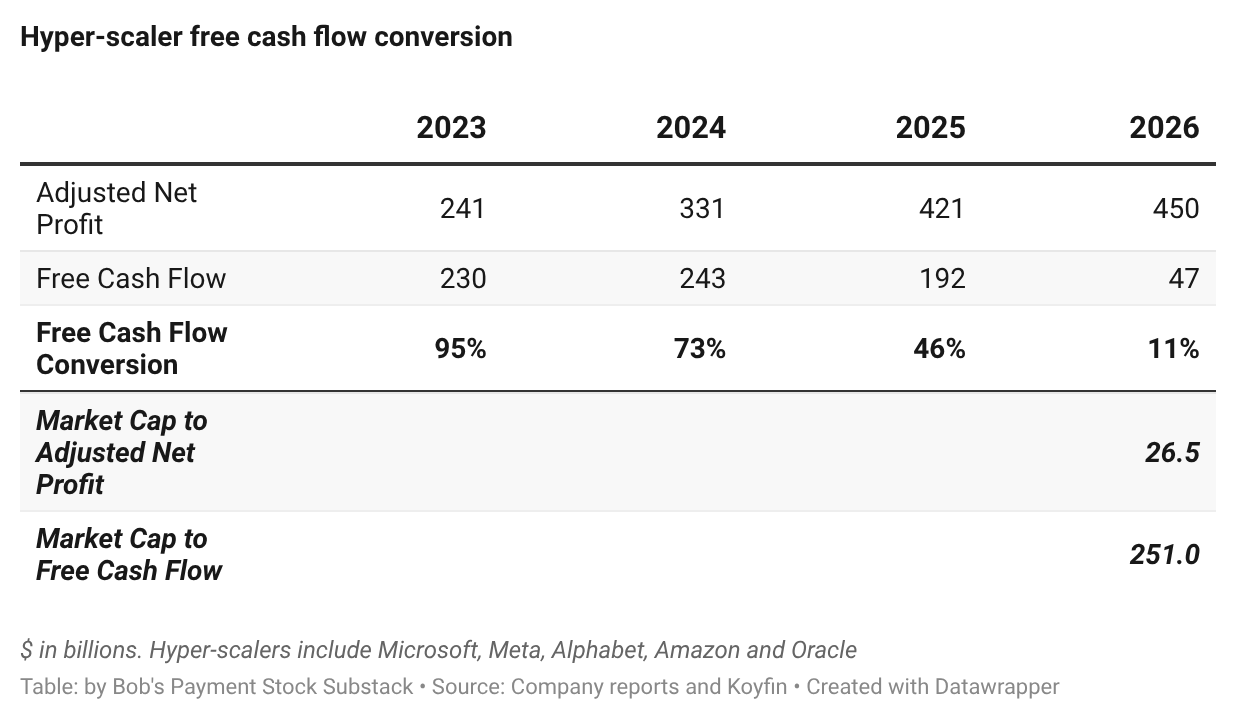
As of today, 2026 hyper-scaler [Alphabet, Amazon, Meta, Microsoft, and Oracle] capex is expected to be $687 billion, up an incredible 345% over 2023. Further, the 2026 hyper-scaler capex forecast has moved from $467 billion as of September 30, 2025, to $687 billion today, a nearly 50% increase in just six months. Simply incredible. While there are several ways to play the AI and data center capex super-cycle—energy, construction, electrical products, semiconductors, semiconductor capital equipment, memory, and networking equipment—I continue to have minimal direct exposure [Arista Networks (networking equipment) and KLA Corp (semiconductor capital equipment) make up approximately 5% of my total portfolio], which has been a significant headwind to performance. I continue to believe the valuations of hyper-scalers and technology hardware companies are incompatible—either the market will begin to discount the hyper-scalers based on their capital intensive future, or it will sell-off technology hardware companies when signs emerge that the AI and data center capex super-cycle has peaked, or is set to grow much more slowly, supporting the current hyper-scaler valuations. As of right now, the hyper-scalers are set to generate just $47 billion of free cash flow in 2026 against $11.9 trillion of market, a yield of about 40-bps (251x):
My existing payments holdings continued to perform poorly during the first quarter, consistent with the broader group: Visa (-14%), Global Payments (-13%), Shift4 Payments (-31%), and Block (-8%).
I would describe it as a one-two-three punch for payments and fintech stocks from: (1) increased regulatory and legislative scrutiny; (2) AI disruption fears; and (3) the Iranian conflict.
President Trump kicked off the year by proposing a one-year cap of 10% on credit card interest rates, and throwing his support behind the long-stalled Credit Card Competition Act. While little-to-nothing has come from the president’s utterances so far [and nothing likely will, as I wrote about it here], it was enough to weigh further on an already beaten down group.
Up next were AI disruption fears, which knocked down a broad swath of stocks, including software, information services, and payments and fintech, among others. I believe there are two primary concerns regarding AI’s impact on payments and fintech: (1) the proliferation of more affordable software for SMBs; and (2) agentic commerce disrupting the payments value chain. I take these risks seriously, but believe there are strong, and logically sound, arguments against disruption. For the sake of brevity, the link to where I wrote more about this topic is here.
Finally, the Iranian conflict, which started at the end of February, placed further downward pressure on payments and fintech stocks as investors worried spiking energy prices may curtail consumer spending, drive up delinquencies among lower income cohorts, and reduce global travel and the corresponding high-value cross-border transactions. Although there are signs of a detente between the U.S. and Iran, energy prices remain significantly elevated, and are likely to stay that way for a while even if there is an immediate cessation of hostilities, which is by no means guaranteed. Now, it’s important to note the U.S. consumer has remained extremely durable in the face of several challenges over the past handful of years. Assuming strength in perpetuity is a fool’s errand, but all indications—including first quarter payment card data from the major banks—suggest they are weathering this latest storm just fine…so far.
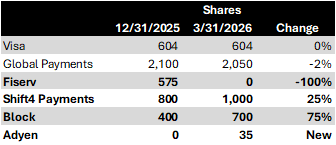
I made noteworthy changes to my payments holdings in the first quarter: I exited my Fiserv position, started a new Adyen position, and added to Block and Shift4:
Long Adyen
Unlike legacy peers that have cobbled together systems, products, sales and distribution from a long list of acquisitions, Adyen has built a modern payments engine entirely from scratch complete with local acquiring licenses and banking charters to control its own destiny, enabling a merchant to sell anywhere, across any channel, and accept virtually any payment method, all from a single low-cost platform backed by powerful insights derived from Adyen’s extensive data. The result is a best-in-class combination of organic growth and profitability for Adyen, rivaled only by Visa and Mastercard. I have a high level of confidence in Adyen’s ability to achieve mid-to-high teens organic net revenue growth over the medium-term through growing, and further expanding, with existing customers, adding new customers in new verticals, and thoughtfully monetizing additional products and services, including its embedded finance offerings. I estimate a fair value for Adyen of between €1,150 and €1,435 per share, implying upside of 20% to 50% from current prices. Adyen is one of my favorite ideas, not only in payments, but the entire market. I’ve written about Adyen here, here, and here.
I exited my smaller ServiceNow and Adobe positions during the first quarter, and added significantly to Inuit, and also upped my position in Microsoft. I simply have more conviction, and a greater comfort level, around Intuit than ServiceNow or Adobe, prompting the changes.
Adding to Intuit
SMBs are weighed down by the large number and disparate nature of their service providers and technology applications, costing them money and trapping their data. Platform companies like Intuit offer key advantages, giving SMBs the opportunity to consolidate vendors, save money, and gain a holistic view of their data, allowing them to use it effectively. Although other platform companies exist, none have what Intuit has: QuickBooks, the dominant accounting suite for SMBs, making Intuit the ultimate SMB platform and giving it a clear right to win across other service offerings, where it is still not significantly penetrated. To demonstrate, in fiscal 2025, Intuit generated more than $3.6 billion of revenue across payroll and HCM and payments, growing 24%, placing it in rare company among publicly traded peers, in terms of both scale and growth.
Additionally, the cost of failure is high when it comes to preparing, filing and paying taxes. Although TurboTax has long dominated the do-it-yourself (DIY) category, where lower and no-cost options are widely available, it is moving aggressively to disrupt the much larger assisted category where human interaction is required. During the last tax season, TurboTax Live, Intuit’s assisted offering, represented 41% of total TurboTax revenue, growing 47%. To support its TurboTax Live offering, Intuit has opened 600 offices across the U.S., finding a customer is five times more likely to convert knowing there is a human being that can help within 50 miles.
My fair value estimate for Intuit is between $475 and $625 per share, implying upside of 20% to 60% from current prices. I wrote about Intuit here.
During February, in the midst of the AI-induced sell-off across information services stocks, I started positions in MSCI and S&P Global.
MSCI divides its business into four segments. In the Index segment, its largest and most profitable, MSCI creates and licenses indexes, generating subscription fees for data access and royalties based on assets under management, or AUM, for products linked to MSCI indexes. The company’s indexes can be market-cap weighted, thematic or customized. Outside of the Index division, MSCI provides a suite of analytical tools and ratings across equity, fixed income and private assets that aid in the construction of portfolios, management of risk and performance attribution. MSCI leads an attractive market, generates a significant percentage of its revenue from recurring sources where it holds pricing power, uses its extensive free cash flow and a moderate amount debt to consistently repurchase shares, and is led by a long-tenured CEO with substantial skin in the game. I wrote about MSCI last July here.
S&P Global generates nearly 60% of its adjusted operating profit from credit ratings and indices, highly attractive businesses that face minimal competition and benefit from regulatory lock-in. Simply put, S&P may not rate bonds or construct indexes better or worse than anyone else, including other companies, humans, or AI models, but their ratings and popular benchmark indexes are required before a company can raise debt or launch a new index-based mutual fund or ETF. S&P Global should benefit from increased global debt issuance—including a significant maturity wall coming due over the next few years—and a continued shift toward passive investing over time, resulting in attractive revenue, earnings and free cash flow growth.
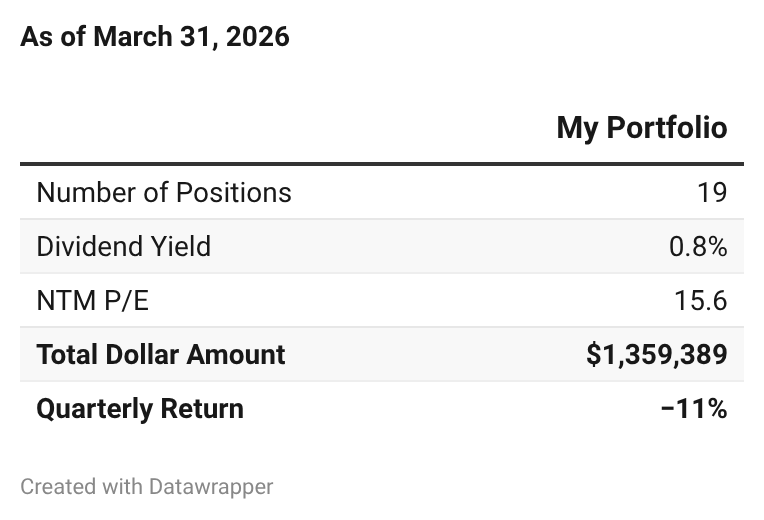
Please note, this is the stock portfolio I actively manage for capital appreciation, which complements my investments in equity and bond index funds, high-yield dividend and dividend growth stocks, money market accounts, and certificates of deposit.
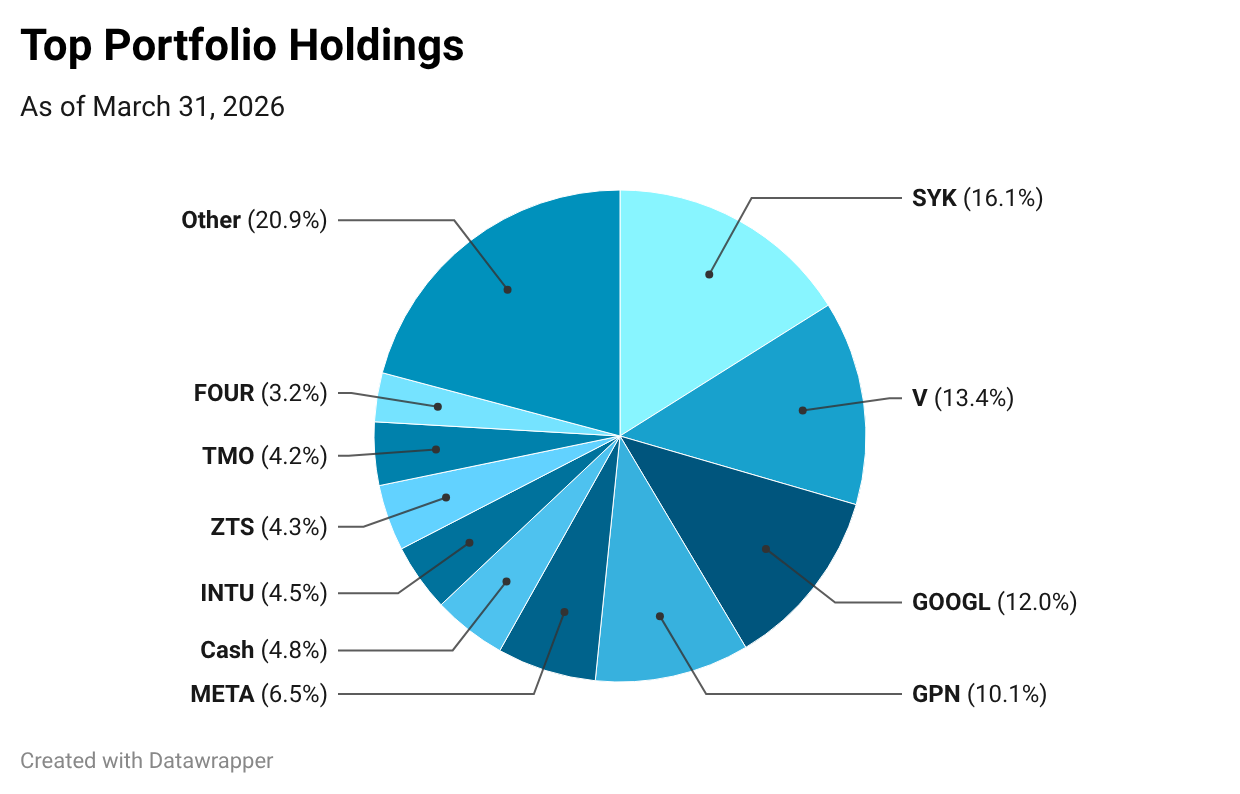
As I’ve mentioned in the past, I impose no constraints on myself when assembling the portfolio. My primary goal is to find high-quality companies selling at reasonable prices. I maintain a shopping list of about 50 companies as portfolio candidates. One of my objectives is to consolidate positions. In the first quarter, I exited five positions and initiated three new positions, resulting in 19 holdings total, down two from the fourth quarter of 2025. Reasons for exiting include favorable valuations, positions that are too small, or better opportunities elsewhere. My goal is for 15-20 portfolio companies.
Purchases during the quarter:
And sales:
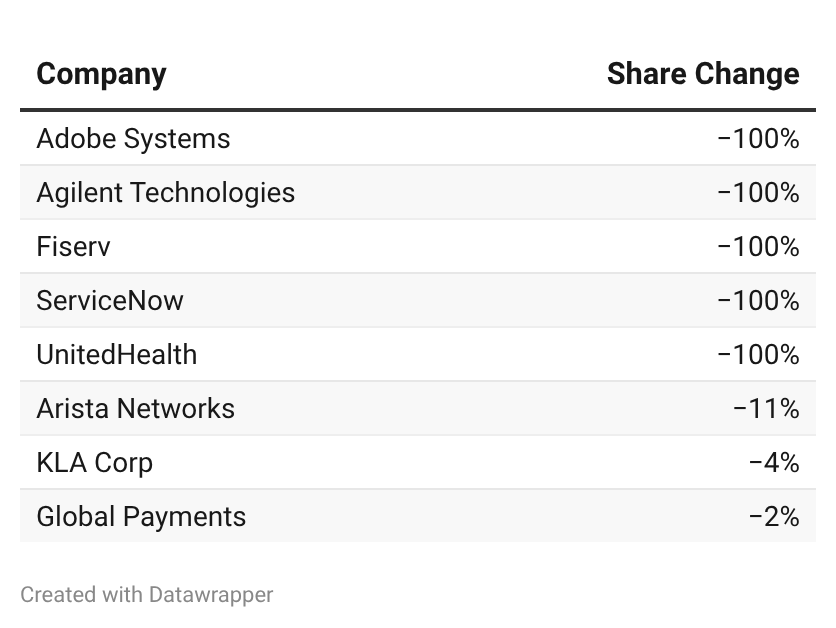
I reduced three positions and exited five positions during the first quarter. My goal remains a smaller number of larger positions. In software, I sold Adobe and ServiceNow to fund additional purchases of Intuit—where I have greater conviction—and Microsoft. Similarly, in healthcare, I sold Agilent Technologies and used a portion of the proceeds to increase my Thermo Fisher position. Although not exactly the same, Agilent and Thermo are similar in the sense they both provide equipment, consumables, and services for companies participating in the life science, diagnostic and chemical markets. I sold UnitedHealth because I no longer have confidence in my ability to accurately forecast their financial performance over the long-term, given government and other outside influences on the health insurance industry.
Below is a full list of my portfolio holdings as of March 31, 2026:
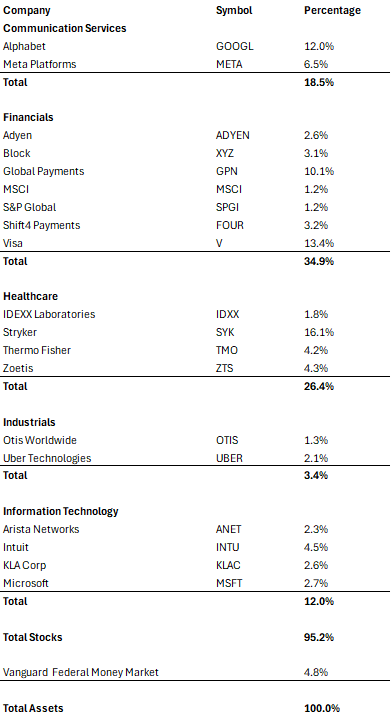
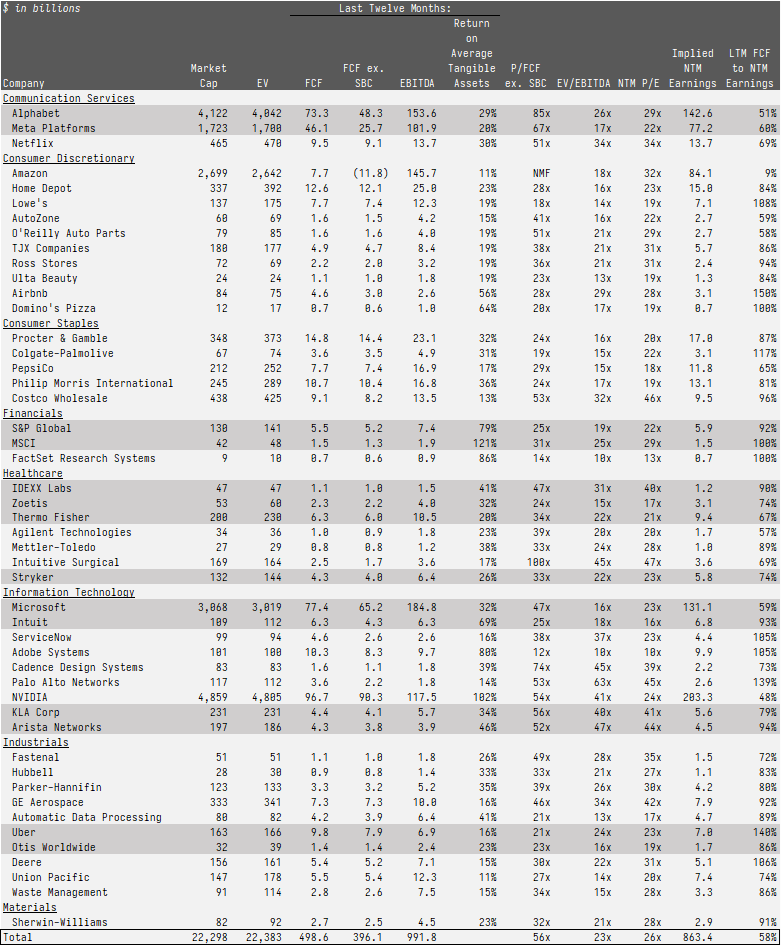
This is the group of companies I look at outside of payments and fintech. All of the payments and fintech names I follow are fair game for inclusion in my portfolio.
Increasingly, I see the market as being segmented into four distinct categories: AI beneficiaries [expensive]; companies perceived to be at risk from AI disruption [previously expensive, now cheap(er)]; companies neither at risk nor benefitting from AI, but susceptible to other factors, both positive and negative [a mix of expensive and reasonable valuations], and hyper-scalers [a no man’s land]. Here are a couple examples from each category:
AI Beneficiaries: NVIDIA, KLA Corp, Arista Networks, Parker-Hannifin, and Hubbell.
AI Disruption: Airbnb, Uber, S&P Global, FactSet, Adobe Systems, Intuit, and ADP.
AI Neutral—Expensive: Fastenal, GE Aerospace, O’Reilly Auto Parts, TJX, Ross Stores, Costco Wholesale, Waste Management, and Sherwin-Williams.
AI Neutral—Reasonable: Lowe’s, Ulta Beauty, Domino’s Pizza, and Phillip Morris International.
Clearly, my eye is drawn to AI neutral names with reasonable valuations [Lowe’s, Ulta Beauty, Domino’s Pizza, and Phillip Morris International] and names I view as unjustly cheap based on misplaced AI disruption fears [Airbnb, Uber, S&P Global, Intuit and ADP]. That’s where I’ll continue to look for new ideas, and to add to existing positions. I’ll continue to wait on AI neutral names where valuations are expensive.
As always, thank you for reading, and if you’ve enjoyed this, please consider sharing, liking, commenting or subscribing!
Disclosure: In addition to all of the stocks listed in my full holdings table, of the stocks mentioned in this report, I also own Home Depot and Lowe’s. This report is for informational purposes only and is not a recommendation to buy or sell any stock. Finally, while I rely on the information in this report to guide my investment decisions, you should not, because I cannot guarantee its accuracy.
No posts
Comments
Nothing yet. Say the first thing.
Sign in to join the conversation.