
My full report on Toast published last August: Toast, Inc. (TOST)
At just 17.5x the high-end of its 2026 Adjusted EBITDA guidance, Toast now trades at a reasonable valuation, especially considering its status as category leader in U.S. SMB restaurants, and top-tier growth profile—low-20% recurring gross profit growth is expected for 2026 based on initial guide:
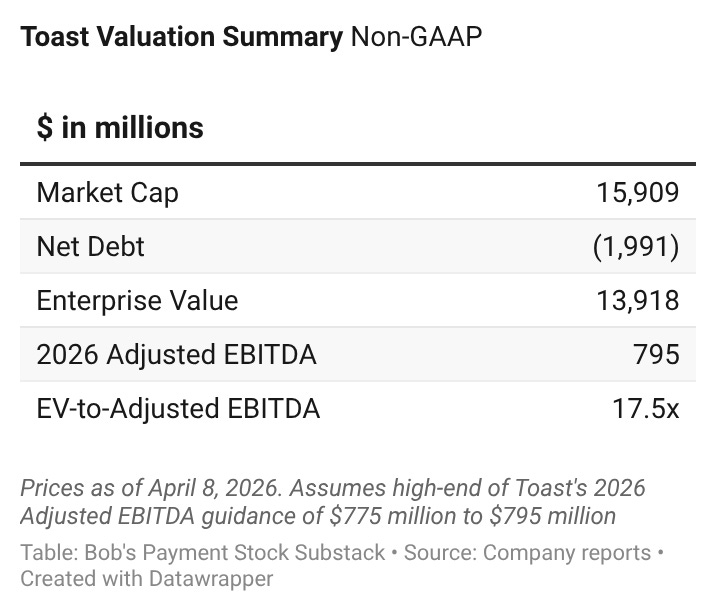
However, there are two important caveats. First, Toast adds back stock-based compensation and related payroll tax [SBC+RPT] to arrive at adjusted EBITDA. Although it has been trending down over time, SBC+RPT still represents a significant percentage of recurring gross profit for Toast:
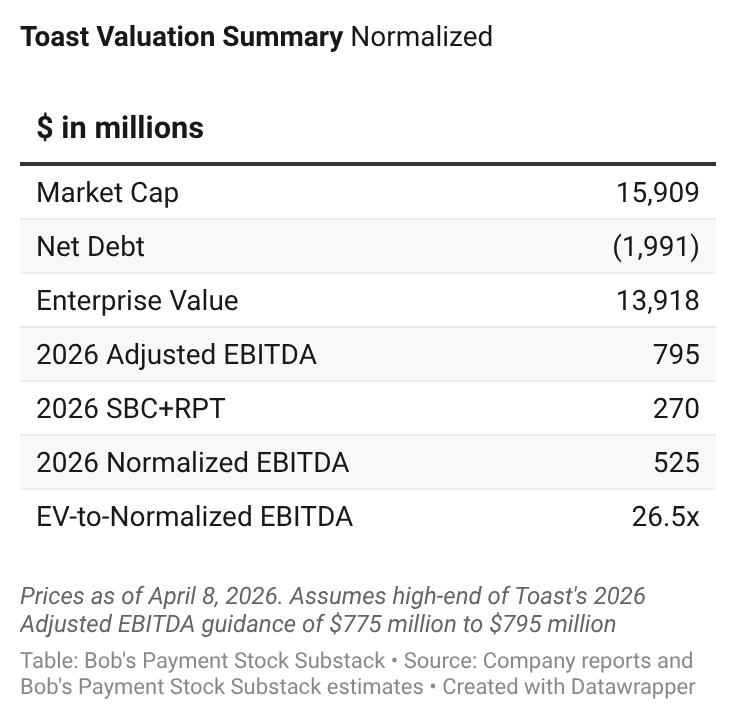
For 2026, assuming $270 million of SBC+RPT [11.5% of recurring gross profit— Toast’s medium-term target laid out at its 2024 Investor Day was for SBC+RPT to reach a low-teens percentage of recurring gross profit], implies $525 million of normalized EBITDA. On this basis, Toast trades at 26.5x, a more demanding valuation:
Relative to its closest peers—Adyen and Block—Toast trades at roughly double the valuation on an EV-to-EBITDA basis, despite the fact top-line growth is expected to be relatively similar for the three in 2026 [Toast 21% recurring gross profit growth at midpoint of guidance, Adyen 21% constant currency net revenue growth at midpoint of guidance, Block’s guidance for 18% gross profit growth]:
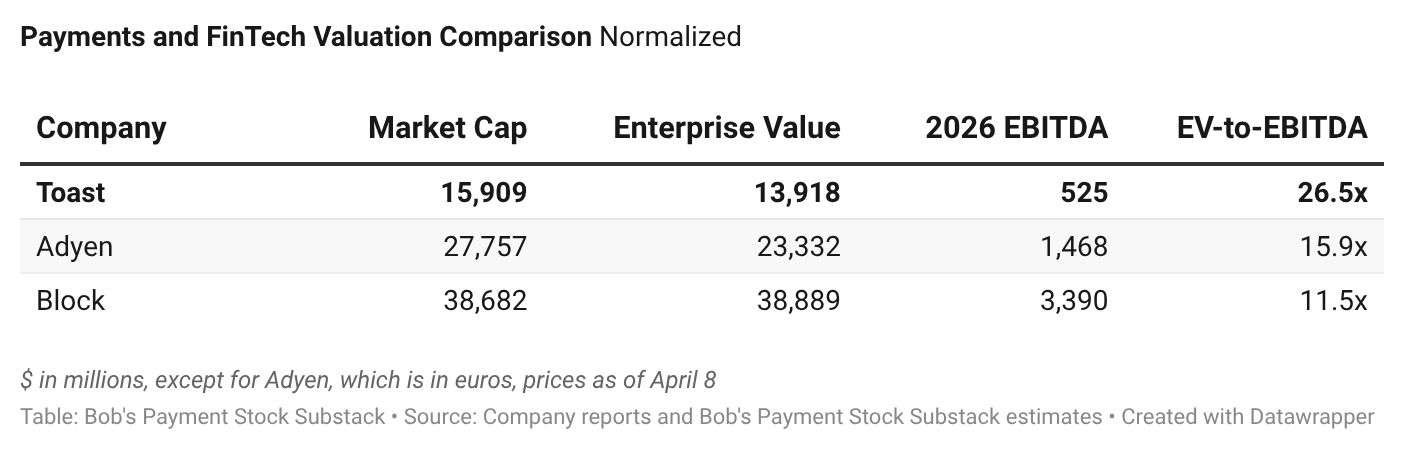
I think there are good reasons for why Toast should trade at a premium to Adyen and Block, but double the valuation seems out of bounds. Reasons for a Toast premium include:
Toast is relatively simple to understand. There are only a handful of KPIs to follow with Toast: locations, GPV, payments net take rate, SaaS ARR, and SaaS ARPU. Adyen also has a small number of KPIs. However, recent share of wallet shifts among large volume customers has made assessing Adyen’s underlying performance trickier, but not impossible. Block, on the other hand, is definitely more complex, with shifting, incomplete, and selective disclosures making it difficult to know exactly what’s happening across its varied businesses.
Toast has limited credit exposure, exclusively in the form of merchant lending. In 2025, about 10% of Toast’s recurring gross profit came from Toast Capital and other financial technology products. Although Adyen plans to to move into lending eventually, it has de minimis exposure today. Block has more significant consumer and SMB lending exposure across BNPL, Cash App Borrow, and Square Capital. Over the trailing twelve months, I estimate 26% of Block’s gross profit came from lending products.
Toast is nearly all U.S. The Iranian conflict and resulting spike in energy prices poses greater economic risks to continental Europe than the U.S. Europe, the Middle East, and Africa [EMEA] represented nearly 60% of Adyen’s 2025 net revenue. After excluding Bitcoin revenue, I estimate international markets represent a low double-digit to mid-teens percentage of Block’s revenue, with its most significant exposure likely being the U.K.
Toast consistently outperforms expectations [more on that later]. Although putting up solid results on an absolute basis, Adyen has struggled recently to exceed its own expectations, often coming in at the lower-end of net revenue growth targets. Block lowered expectations following last year’s first quarter, but has exceeded guidance since, and lifted its 2026 gross profit growth outlook—provided initially at its November Investor Day—following fourth quarter results.
Toast may have pent-up margin expansion capability or dry powder to sustain attractive top-line growth if it is able, or willing, to generate internal productivity gains from AI. Adyen has hired the most since COVID among fintech peers [Toast is in the middle of the pack], and Adyen’s and Toast’s efficiency ratios [net revenue or recurring gross profit per average employee] sit at the bottom of the group. Block recently slashed its workforce by 40%—due to AI advancements—and is poised to generate almost $2 million of gross profit per employee in 2026, multiples of Adyen and Toast.
The second caveat is that while Toast has historically produced healthy top- and bottom-line beats…
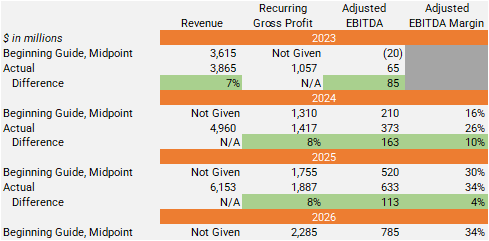
It has signaled a current bias toward reinvesting top-line upside into emerging growth opportunities—international restaurants [Canada, U.K., Ireland, and Australia], U.S. enterprise restaurants, and U.S. food and beverage retail.
Toast ended 2025 with an ARR of $2,047 million. ARR from Toast’s emerging growth opportunities passed $100 million during the fourth quarter, suggesting a 5% contribution to Toast’s total ARR. According to Toast, its core business [U.S. SMB restaurants] has already reached a 40% Adjusted EBITDA margin. Assuming Toast’s core business generated 95% of recurring gross profit [$1,793 million]—leaving 5% from emerging growth opportunities, matching its ARR contribution exit rate—and a 40% adjusted EBITDA margin [$717 million of adjusted EBITDA], implies an adjusted EBITDA loss of $84 million on $94 million of recurring gross profit for Toast’s emerging growth opportunities.
Previous discussion focused on high-end of Toast’s Adjusted EBITDA guidance. This discussion is focused on what I actually believe will happen.
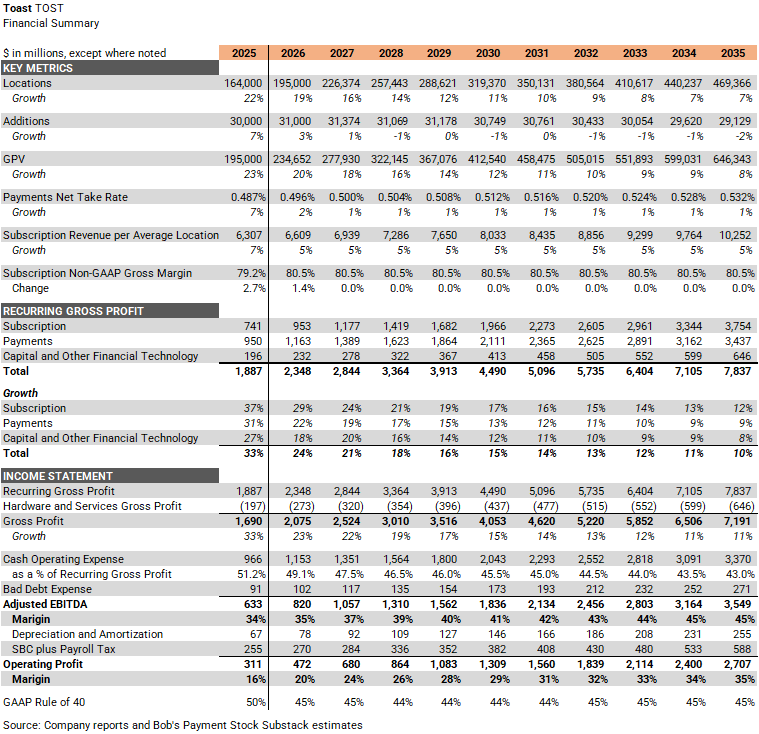
My 2026 outlook for Toast is relatively straightforward. I assume: 31,000 location adds [up slightly versus 30,000 in 2025]; flat GPV per location; a continuation in seasonal patterns for the payments net take rate; and a 4% increase in SaaS ARPU on an ARR basis. The end result is recurring gross profit of $2,348 million, about 3% upside to the midpoint of Toast’s guidance. I assume hardware and professional services generate a $273 million loss on a gross profit basis in 2026, up 39% from 2025, and primarily reflecting the impact of tariffs and significant increases in memory prices on hardware costs. I assume operating expenses—excluding bad debt—fall by about 2-points as a percentage of recurring gross profit [to about 49%], much smaller than the more than 7-point decline in 2025. This results in Adjusted EBITDA of $820 million, upside of about $35 million or $4.5% to the midpoint of guidance. So, not necessarily reflecting a complete reinvestment of top-line upside, but significantly less than the $120 million of adjusted EBITDA outperformance averaged over the last three years. Under this scenario, Toast trades at 25.3x on an EV-to-EBITDA basis.
My long-term assumptions for Toast remain largely unchanged, and continue to push the envelope of reasonableness—in my opinion. One meaningful adjustment I’ve made is lowering my long-term Adjusted EBITDA margin target to 45%, from 49% previously:
My model assumes continued significant share gains in U.S. restaurants [a 40% market share for Toast by 2035—double its current 20% share—including 54% of SMB restaurants and more than 12% of enterprise restaurants] and strong success in the company’s initial international markets [20% market share by 2035] and U.S. food and beverage retail [16% market share by 2035]. Again, I believe these are very healthy assumptions, and by no means conservative.
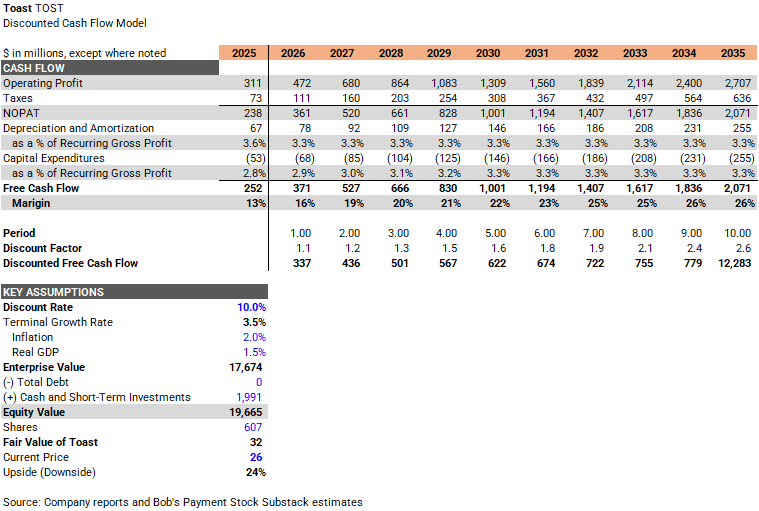
My DCF model yields a wide range of fair value outcomes, depending on the discount and terminal growth rates used. Under the most favorable scenario—a 9% discount rate and 4% terminal growth rate—my fair value estimate for Toast is $41, implying nearly 60% upside. If I use a 10% discount rate and 3.5% terminal growth rate, my fair value estimate for Toast is $32, still nearly 25% upside:
Shares of Toast are now definitely more reasonably priced [even more so after today’s drop]. However, I still (much) prefer Adyen and Block over Toast. The internal debate I’m having is whether I want to ‘throw in the towel’ on Global Payments and Shift4 Payments in order to fund more purchases of Adyen and Block, and start a position in Toast. I’m not at that point yet—as I believe strongly that the market is materially mis-pricing both Global and Shift4—but I’m certainly watching Toast, and the rest of the group, intently.
As always, thank you for reading, and if you’ve enjoyed this, please consider sharing, liking, commenting or subscribing!
Disclosure: As of April 9, 2026, of the stocks mentioned in this report, I am long Adyen, Block, Global Payments, and Shift4 Payments. This report is for informational purposes only and is not a recommendation to buy or sell any stock. Finally, while I rely on the information in this report to guide my investment decisions, you should not, because I cannot guarantee its accuracy.
No posts
Comments
Nothing yet. Say the first thing.
Sign in to join the conversation.