
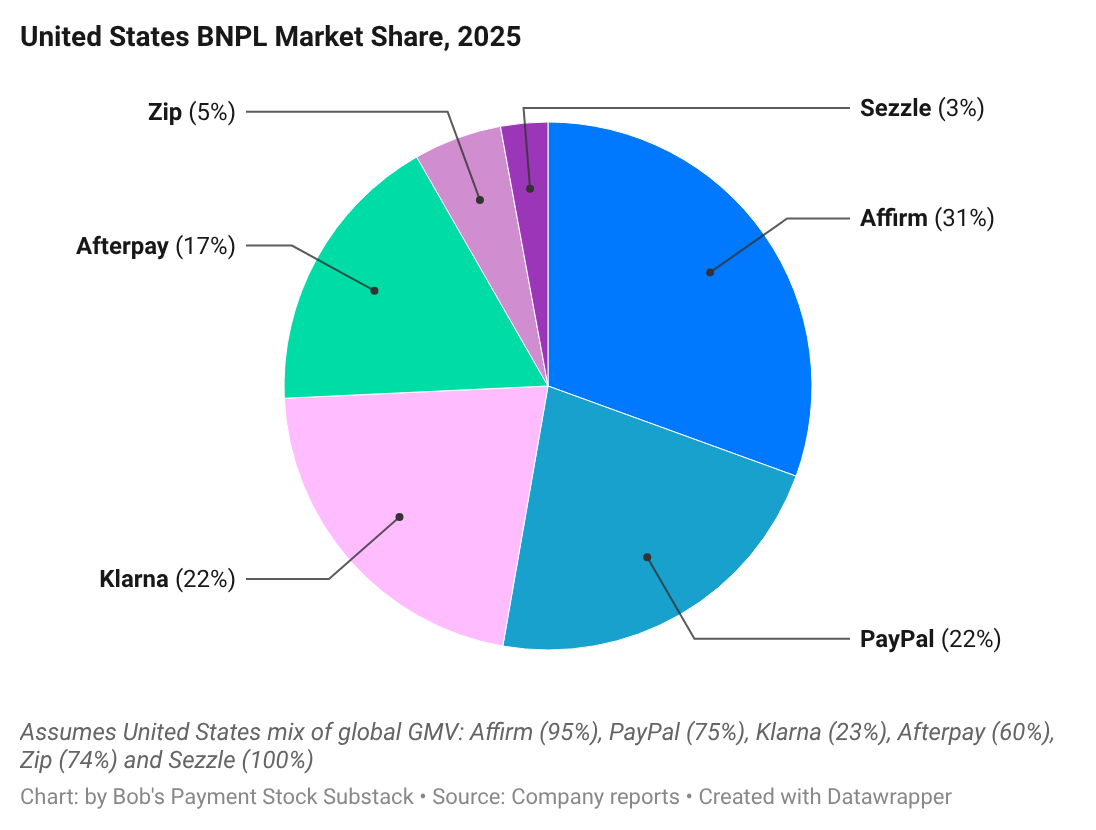
Affirm has effectively unbundled the credit card, allowing consumers to finance major purchases with an individual installment loan decisioned at the point of sale. More importantly, Affirm provides transparent and fixed repayment terms, helping consumers avoid excessive high-cost debt and punitive fees, positioning Affirm as a viable alternative to an open-ended revolving credit card limit. Reflecting its success, Affirm has become the largest provider of buy now pay later (BNPL) loans in the United States:
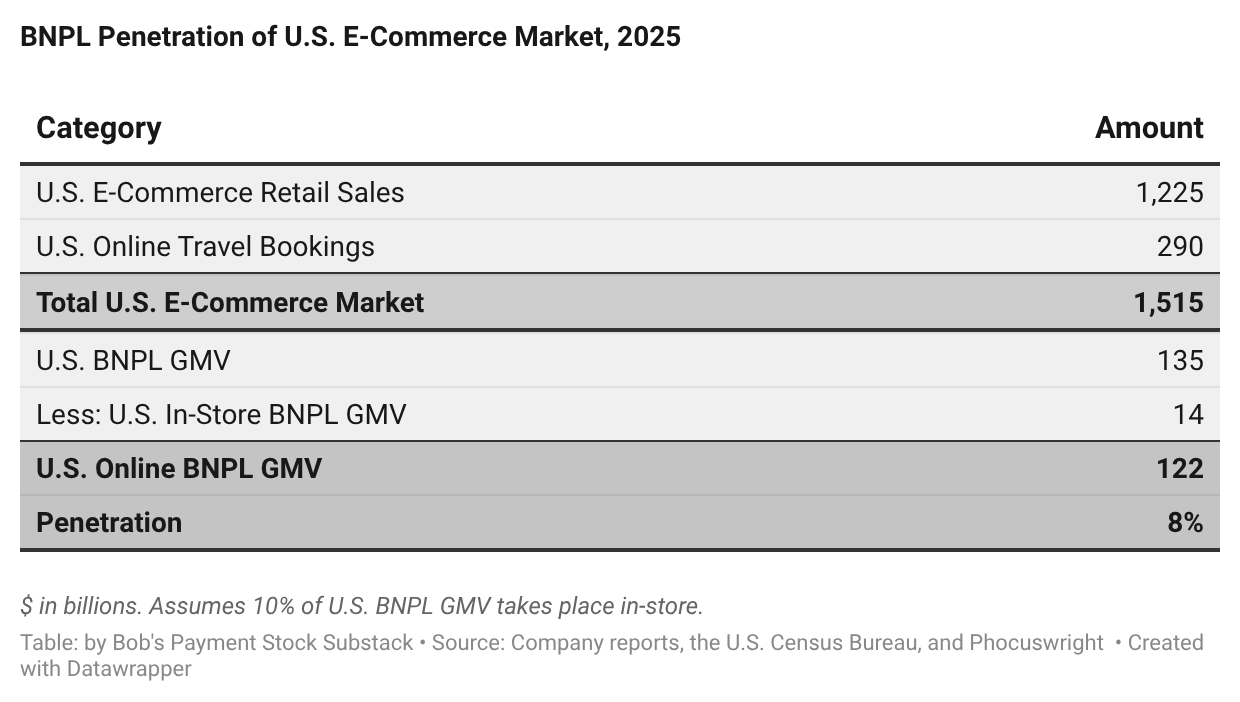
Although BNPL loans have grown significantly in the United States, they represent only a small portion of e-commerce volume, their most natural use case:
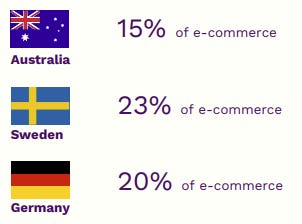
Relative to other developed markets, the United States trails significantly on BNPL penetration of e-commerce, implying further adoption runway ahead:
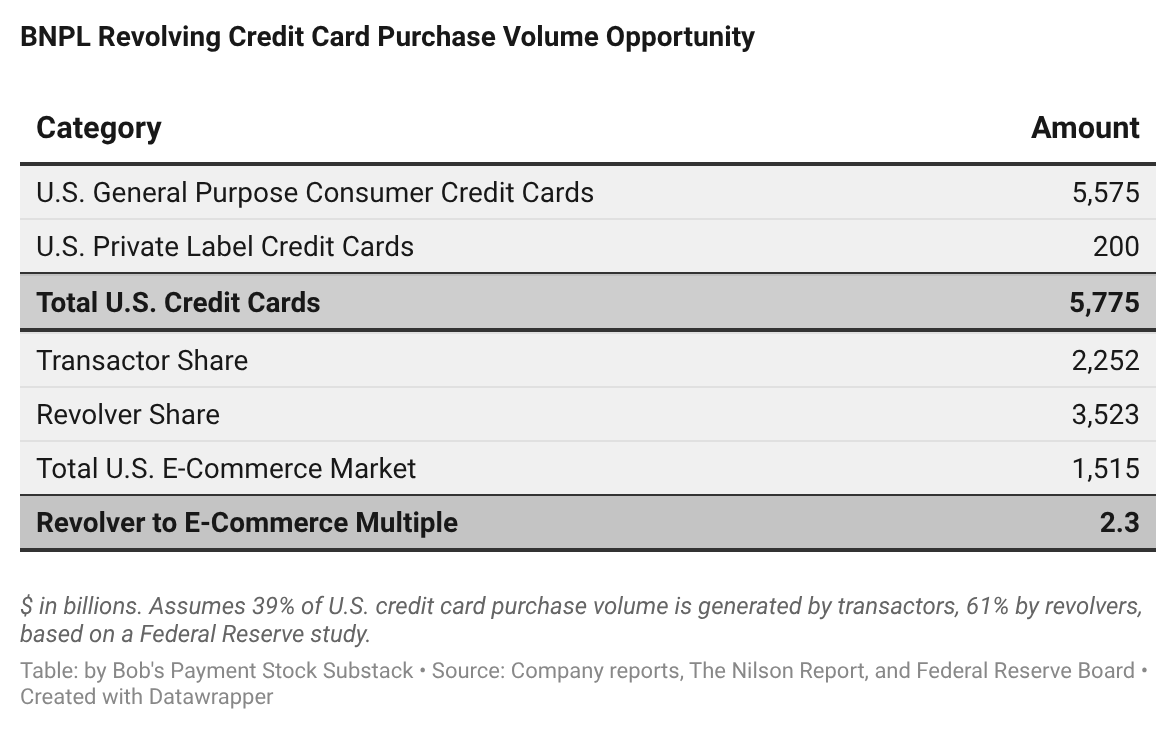
If the opportunity is extended to all revolving credit card spend, both online and in-store, which the Affirm Card (and others like it) seek to target, the addressable market increases significantly:
Affirm’s blue-chip partners (including Shopify and Amazon) enable acceptance where a majority of United States e-commerce is conducted, attracting tens of millions of consumers to Affirm’s platform, which in turn makes Affirm more appealing to merchants, creating a virtuous cycle commonly referred to as a network effect.
The company uses proprietary technology to evaluate each transaction, leveraging data accumulated from the hundreds of millions of loans it has originated to continually improve its underwriting models. Affirm believes its advanced underwriting techniques and shorter loan durations will combine to limit credit losses, especially during dynamic and weaker economic environments.
Affirm utilizes multiple funding sources (asset-backed securitizations, warehouse loans, and forward flow agreements) to support its growth while maintaining an asset-light balance sheet. At the beginning of 2026, Affirm applied for an industrial bank charter. Securing it could eliminate the need for banking partners, enabling Affirm to offer more financial services, capture better economics (by becoming the issuer of the Affirm Card), and lower funding costs (by gathering low-cost deposits).
Not all is sunshine and rainbows though. From my perspective, there are logical reasons to be skeptical of the BNPL model, and Affirm in particular:
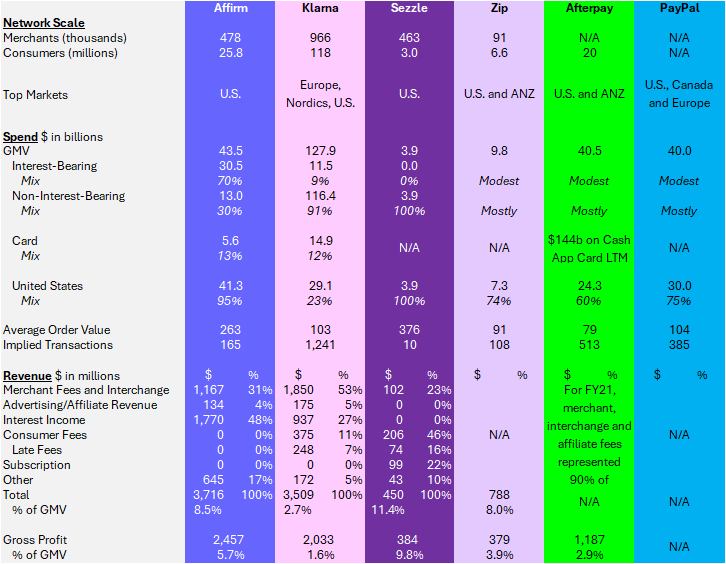
Across publicly traded BNPL providers, average order value (AOV) was $110 during 2025, more than double U.S. debit average ticket size ($50) but approximately equal to U.S. credit average ticket size (>$100). One of the key (but not only) arguments in favor of BNPL is that its availability significantly increases average order sizes, supporting merchant fees that are higher than card interchange rates. Based on the available information (not all BNPL revenue, or its sources, are publicly disclosed), my best estimate is that merchant fees represent at least 3% of BNPL gross merchandise volume (GMV), higher than the aggregate U.S. credit card interchange rate of 2.35% for Visa and Mastercard. Given the similarity between BNPL AOV and credit card average ticket size, BNPL is a more costly option for merchants, all else equal. Of course, there is an argument that BNPL brings in new customers that may not necessarily be able (or willing) to access (or use) traditional credit products, making the premium worthwhile for merchants. However, according to surveys and company disclosures, smaller ticket non-discretionary items (like the famous BNPL burrito) are making up a greater portion of BNPL GMV, contributing to a decline in AOV. There are two explanations for this, neither positive in my opinion: either low-to-middle income consumers (the primary user of BNPL loans) are under enough financial distress that short-term funding is required to purchase basic necessities; or certain consumers have become so fond of these products they are choosing them even when it is not financially necessary. In that case, merchants are footing a needlessly high bill for a purchase that could have been completed with a debit card, where the cost of acceptance is comparatively (much) lower. Based on this analysis, I believe it is likely merchant fees as a percentage of GMV will trend lower over time, placing further pressure on an industry that is only marginally profitable today despite being significantly scaled.
Of the four publicly traded pure play BNPL providers (Affirm, Klarna, Sezzle, and Zip), combined GMV, revenue, and GAAP (IFRS) operating profit over the last twelve months were $185 billion, $8.5 billion, and approximately $275 million, implying an operating margin of just 3%-4% industry-wide. Why is this? Because the industry’s original, most popular, and most consumer-friendly product, the interest-free Pay in 4 loan, does not appear to be all that profitable. Consider Klarna. Despite significant GMV ($128 billion) and a 49% reduction in headcount over the last three years, Klarna failed to deliver an operating profit on an IFRS basis in either 2024 or 2025, prompting an aggressive pivot to fair financing, Klarna’s interest-bearing monthly installment loan. While I do not doubt the ability of the BNPL industry to become more profitable over time, they are likely to do so by becoming less consumer-friendly and more like the traditional credit card issuers they vilify, potentially limiting the popularity of BNPL in my opinion. Affirm acknowledged recently that “monetizing the consumer side” allows them to meet the requirements of merchants that are pushing back against Pay in 4 loans based on acceptance costs:
“Some of our largest merchants are very, very cost of acceptance focused and driving an interest-bearing program allows us to monetize the consumer side of the equation and craft a program that allows us to get that prominence at the point of sale with a large merchant and make it cost effective and help them reach both their cost and their conversion targets in their business.”
“And so I think it can be difficult to penetrate some of the more cost of acceptance focused large retailers in the U.S. if Pay in 4 is your only product offering”
Rob O’Hare, Affirm CFO at the Affirm Fireside Chat on March 17, 2026
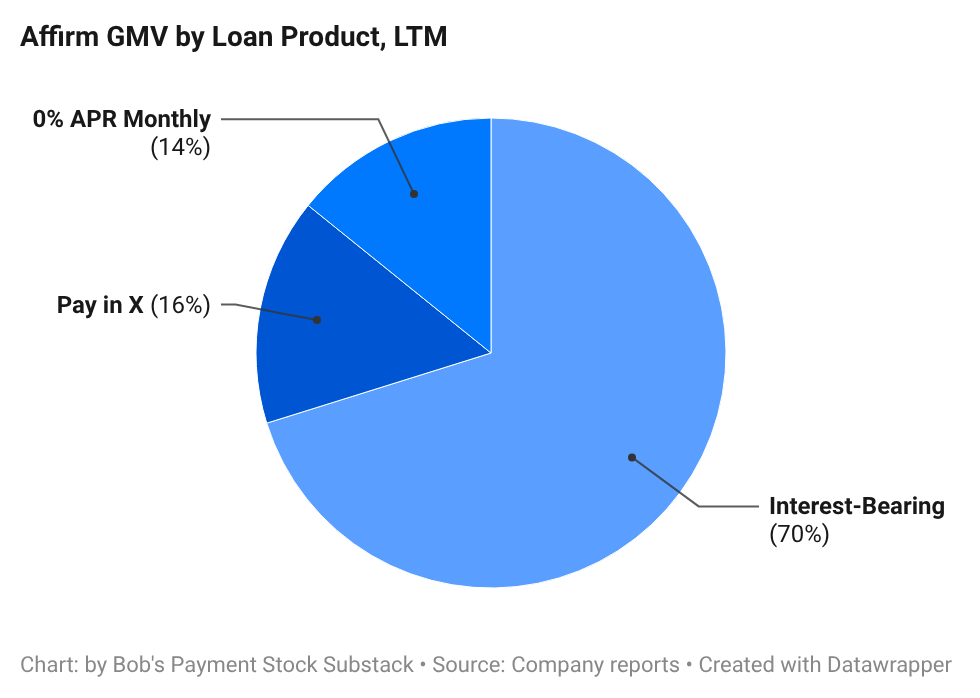
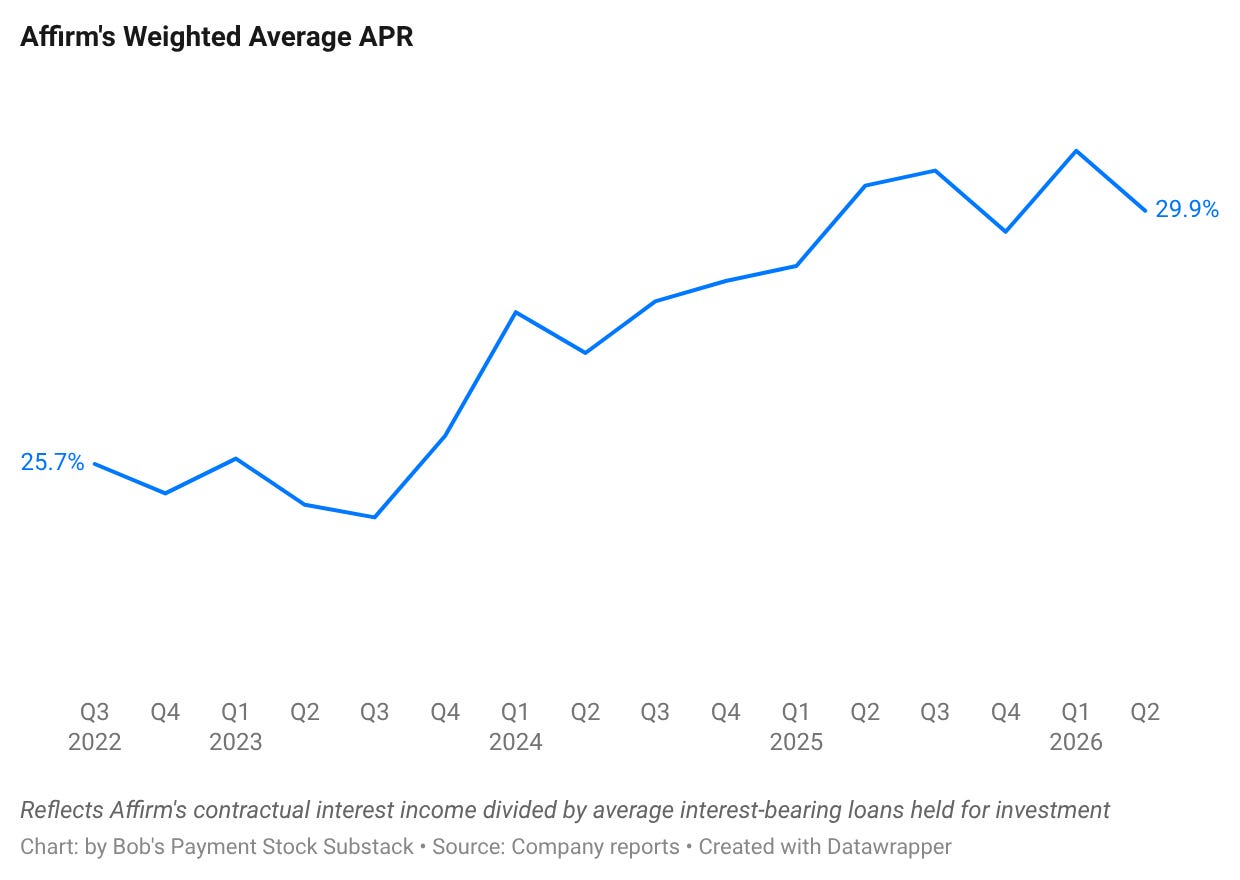
Although Affirm does not charge late fees, uses simple interest calculations as opposed to compounded interest, and clearly discloses the amount a borrower must repay at the time of a loan’s origination (all improvements over a traditional revolving credit card), Affirm’s interest-bearing loans carry significant annual percentage rates, or APRs. By my estimate, the weighted average APR on Affirm’s interest-bearing loan portfolio (which made up 70% of Affirm’s GMV over the LTM) was more than 30% as of December 31, 2025. Although some argue President Trump’s proposed interest rate cap on credit cards could be a positive development for BNPL and other short-term liquidity products, given Affirm’s heavily reliance on high APR monthly installment loans, it would likely be negative for Affirm. Although this effort has gone nowhere, it could be renewed at any time, including under a Democrat-controlled White House or Congress, which is less friendly to the BNPL industry in my opinion.
Despite assurances from Affirm (and other BNPL providers) that its underwriting capabilities and shorter loan durations will limit credit losses during an economic downturn, it is not at all clear that will actually happen, and many investors are unwilling to give them the benefit of the doubt, myself included. Additionally, even under a scenario where cyclical factors (higher unemployment) drive a modest uptick in credit losses, it may be enough to erase what little profits Affirm and the BNPL industry currently generate. Varying calculations of default rates and unique credit scoring make it difficult to precisely assess the health of BNPL users. Although recent credit performance has been comparatively strong, there are contributing factors that may not be durable: minimal unemployment and extraordinary consumer support (stimulus and a moratorium on student loan repayments). To be fair, I am not an expert on credit, limiting my ability to confidently weigh-in on one of the key bull-bear arguments for Affirm and the broader BNPL industry.
Other risk factors for Affirm include:
Affirm generates a significant amount of GMV and revenue from a small number of large customers. The loss of one of these customers would have a significant negative impact on Affirm’s financial performance. Even if they do not lose any of their large customers, their significant importance to Affirm may provide them leverage during contract renewals, placing downward pressure on merchant fees or increase the cost to retain them.
Affirm relies on third-parties to support its growth and profitability. The ability of Affirm to sell its loans to third-party investors at attractive prices is a key part of the company’s financial model. While there is no indication of an imminent turn in the financing market, if one does occur in the future, Affirm may be forced to originate less loans, keep more loans on its balance sheet, requiring more capital, pay higher funding costs, and/or realize lower gains on the sale of its loans.
The BNPL market is likely to become more competitive. Affirm faces competition from other BNPL providers, including pure plays like Klarna (who is moving aggressively into interest-bearing monthly installment loans in the United States) and those inside larger companies (Afterpay, a part of Block, and PayPal). Block and PayPal already have significant user bases that are a natural fit for BNPL. A wider range of services may attract consumers to Block and PayPal over Affirm. In the case of PayPal, it has tens of millions of online sellers as customers, making it an easy lift to build a significantly scaled two-sided BNPL network. Although PayPal recently raised its merchant fees for Pay Later transactions, it is spending to fund rewards for its BNPL users and improve its BNPL presentment at checkout. Banks have the capacity to become more aggressive in BNPL if they choose, but there are technical and cultural obstacles to overcome. Finally, Affirm’s short-term loans compete not only with other BNPL providers, but also earned wage access (EWA) and other short-term liquidity products like Cash App Borrow by Block and ExtraCash by Dave.
Historically, I’ve been hesitant to invest in companies with lend-centric business models, whether they be banks, consumer finance companies, or fintechs, due to my lack of confidence in accurately forecasting credit cycles (their timing and extent) and assigning a durable competitive advantage to what is arguably still a commoditized activity, lending money. Although some may look at my recent decision to buy Block as running counter to that tendency, I did so because Block’s non-lending gross profit streams (which still make up a significant portion of Block’s total) are accelerating. At the risk of being accused of ‘talking my book’, I do believe Block is among the best positioned on the fintech lending side given Cash App’s massive, and increasingly engaged, customer base of younger people that are open to non-traditional financial products. After all, who better to lend money to than someone you see both deposit and spending activity for.
Regarding Affirm, there is no question it has established a leadership position in one of the most attractive (and profitable) areas of BNPL: interest-bearing monthly installment loans. The questions for me are: (1) how durable that leadership position is; and (2) what cost am I paying to access it.
On the first point, I believe it is only logical to assume that one of the most profitable areas of BNPL will attract greater participation over time, increasing competition. Moreover, while Affirm compares favorably to other BNPL providers and credit cards by abstaining from late and other ‘junk’ fees, its heavy reliance on interest from high APR loans makes it much more like a traditional consumer finance company than a high-growth fintech in my opinion.
On GAAP numbers, which incorporates Affirm’s significant stock-based compensation, Affirm trades at a premium to other fintechs on an EV-to-2026 EBITDA basis: Affirm (36x), Toast (28x), Adyen (18x), and Block (13x). For all of these reasons, I am taking a pass on Affirm. My preference remains Adyen and Block, and being opportunistic with Toast, Visa, and Mastercard, should better opportunities present themselves.
Originally, the BNPL market consisted primarily of interest-free Pay in 4 loans offered exclusively for online purchases through a provider’s direct integration with a merchant’s checkout flow. Typically, at the time of purchase, one-fourth of the transaction amount was required as a down payment, with the remaining 75% to be repaid over a six-week period, with a quarter due after two weeks, four weeks, and six weeks. BNPL providers generated most of their revenue from merchant fees with a modest contribution from consumer-based fees, primarily in the form of late fees, which are assessed by some (but not all) BNPL providers.
Over time, the BNPL market shifted to include additional products, revenue sources, and distribution methods:
Products. In addition to traditional Pay in 4 loans, most BNPL providers now offer: interest-bearing monthly installment loans; a single-use virtual card that allows a consumer to make a purchase at any merchant; and a physical card supporting pay now (by linking to a checking account) and pay later features, with both pre- and post-purchase decisioning.
Revenue Sources. With the introduction of interest-bearing monthly installment loans, interest income is becoming a more prominent revenue source for BNPL providers. For Affirm in particular, interest income contributed 48% to total revenue over the LTM in comparison to 37% for the fiscal year ended June 30, 2020. Other sources of revenue include:
Merchant Fees. When merchants integrate a BNPL payment option directly into their website or checkout flow, BNPL providers charge a fee for each completed transaction. The fee is typically calculated as a percentage of the total purchase amount, and in some cases, a fixed fee may also apply. The specific percentage is determined by several factors, including the type of loan product, the merchant’s category, and the item purchased. As a general rule of thumb, interest-bearing loans carry a lower percentage fee compared to interest-free Pay in 4 loans.
Interchange. For purchases completed with a virtual or physical card, the merchant pays a default or mutually agreed upon interchange rate to the issuing bank, which shares a portion of the interchange fee with their BNPL partner. The interchange rate is dependent upon the merchant’s category, the type of funding method (a checking account or credit line), and the item purchased.
Advertising or Affiliate Revenue. Merchants pay a fee to BNPL providers when they direct customers to the merchant’s website and a transaction is completed. Typically, BNPL providers provide exclusive deals or merchant-specific offers on their website or app.
Late Fees. Many BNPL providers charge late fees either immediately after a payment is past due, or after a grace period has expired. Late fees are typically a fixed dollar amount up to a certain percentage of the purchase amount. Based on my knowledge of the industry, only Affirm and PayPal do not charge late fees.
Other Consumer Fees. In addition to late fees, select BNPL providers charge fees for: unsuccessful payments or insufficient funds; using a certain payment type to repay a loan; rescheduling a loan payment; using a virtual card at select merchants; or creating a post-purchase BNPL loan.
Subscriptions. Some BNPL providers offer perks like exclusive discounts, higher spending limits, enhanced customer service, and waived fees in exchange for a monthly subscription fee.
Other Fees. BNPL providers may generate revenue by selling loans at a gain to third-parties after origination, or by servicing loans (collecting and remitting payments) for third-party holders.
Distribution. Historically, BNPL providers built acceptance by establishing direct connections with online merchants. In order to accelerate the pace of adoption, BNPL providers have partnered with payment service providers (PSPs) and commerce platforms to increase acceptance among their customer bases, which includes many small and mid-sized businesses that are difficult to effectively reach with a direct sales approach. Additionally, BNPL providers offer both virtual and physical cards to achieve ubiquity of acceptance online and in-store. On the consumer side, BNPL providers embed their lending products inside digital wallets, significantly expanding their reach.
Below is an overview of leading BNPL providers:
Consumers can initiate transactions with Affirm in a handful of ways: (1) by navigating to an online merchant integrated with Affirm, and completing a purchase with either an existing or new Affirm account; (2) by starting a shopping journey on Affirm’s website or app, being directed to an online merchant integrated with Affirm (based on the consumer’s selection), and completing a purchase with either an existing or new Affirm account; (3) by requesting (and being approved for) a payment plan with Affirm, receiving a virtual card, and completing a purchase by either entering the virtual card account information at checkout for an online purchase, or by storing the virtual card in a digital wallet (Apple Pay) to shop in-store; and (4) by using the Affirm Card online or in-store.
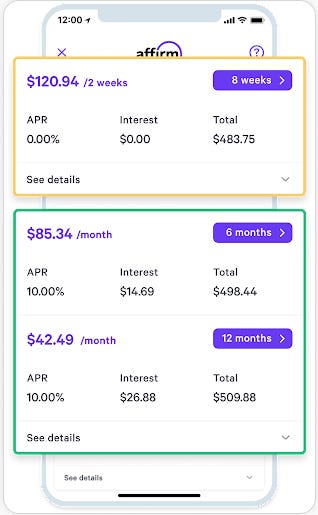
Affirm offers Adaptive Checkout, a feature that displays different loan options and repayment terms at the time of purchase, providing flexibility for consumers and boosting conversion, a key selling point for merchants:
Partnerships. Affirm has various partners to expand its reach and support its growth, including PSPs (Stripe, Adyen, Worldpay), commerce platforms (Shopify), digital wallets (Apple Pay), and investors (banks, insurance companies, private credit). Affirm recently announced a partnership with Fiserv (and FIS in 2025) to bring its BNPL products to community bank and credit union debit programs.
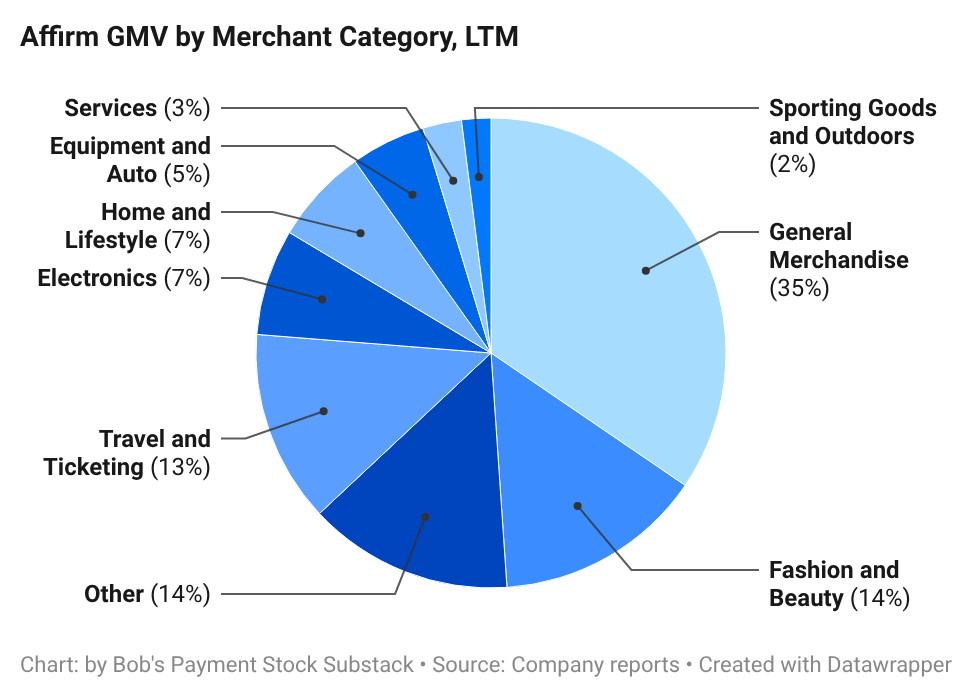
Over the LTM, Affirm generated GMV of $43.5 billion. Affirm discloses GMV by loan product and merchant category:
Affirm’s Funding Model. Once a transaction is completed, either Affirm or one of its banking partners sends the amount of the purchase (less a fee) to the merchant. Over the LTM, approximately $35.5 billion (or 83%) of Affirm’s GMV was originated by its banking partners, which include Cross River Bank, Celtic Bank, and Lead Bank. Even if a loan is originated by one of its banking partners, Affirm is required to purchase the loan for a price that is equal to the amount of a loan plus a fee and any accrued interest. In some instances, Affirm recognizes a loss on the purchase when the price is higher than the loan’s fair value. After Affirm has originated a loan themselves, or purchased it from one of its banking partners, Affirm chooses whether to hold it on its balance sheet or sell it to a third-party investor.
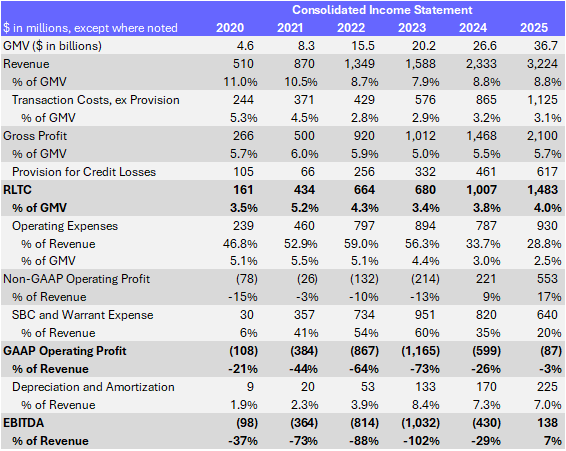
Affirm’s Revenue Model. Over the LTM, Affirm generated $3.7 billion of revenue. Below is a breakdown:
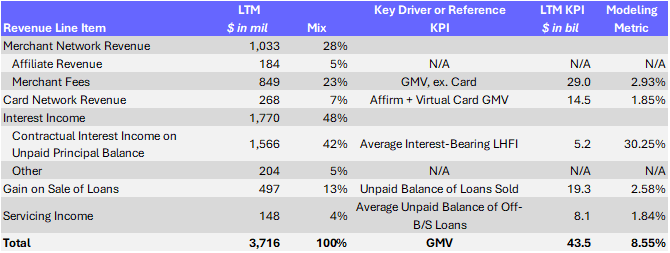
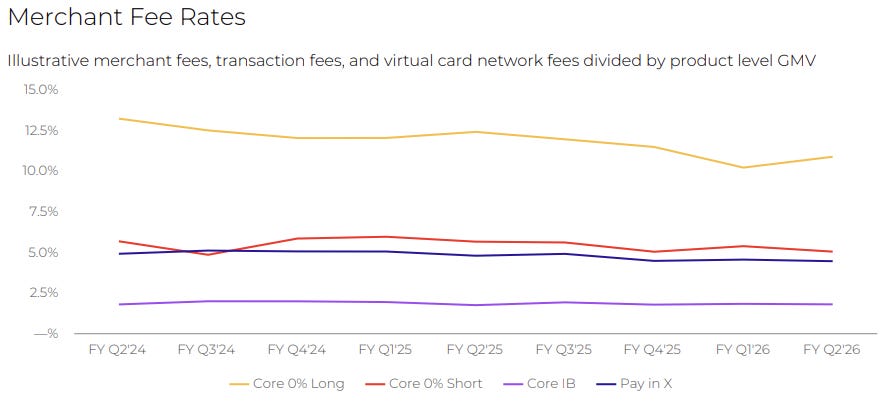
Merchant Network Revenue. Affirm generates affiliate and transaction fees from integrated merchants. Affiliate fees occur when an Affirm user makes a purchase on the merchant’s website after being directed there by an advertisement on Affirm’s website or app. Transaction (or merchant) fees are charged when an Affirm user completes a transaction on an integrated merchant’s website, whether or not they were directed there by Affirm. The fee typically represents a percentage of GMV and is dependent primarily on the type of loan product. Over the LTM, merchant fees represented 2.93% of Affirm’s integrated merchant GMV. Based on the chart below, Affirm’s interest-bearing loans (70% of GMV over the LTM) carry the lowest fee as a percentage of GMV (~2%), long-term (>12 months) 0% APR loans have the highest (>10%, but falling), and interest-free short-term loans (Pay in X and 0% APR loans with three-to-12 month terms) are in the middle (~5%):
Card Network Revenue. GMV from the Affirm Card and Affirm’s virtual card generates interchange fees for the issuing bank, which shares a portion with Affirm. Over the LTM, card network revenue (interchange fees) represented 1.85% of Affirm’s card-based GMV.
Interest Income. The biggest component of Affirm’s interest income is contractual interest on interest-bearing loans held on Affirm’s balance sheet. At the beginning of 2023, Affirm raised its APR cap on interest-bearing loans to 36% and progressively moved more customers to the higher limit. As a result, Affirm’s weighted average APR increased from the mid-20% to approximately 30%. Over the LTM, Affirm’s weighted average APR was 30.25%. Also included in Affirm’s interest income is the difference between the amortization of discounts (a positive) and premiums (a negative) on loans receivable purchased from its bank partners or originated by Affirm.
Gain on Sale of Loans. Affirm recognizes gains on the sale of loans to third-party investors and unconsolidated securitizations. The gain is equal to the proceeds from the sale less the carrying value of the loan held on Affirm’s balance sheet. Over the LTM, Affirm’s gain on the sale of loans equaled 2.58% of the unpaid balance of loans sold.
Servicing Income. Affirm services loans held by third-party investors and unconsolidated securitizations, generating fees based on a contractual percentage of the outstanding principal balance. Over the LTM, Affirm’s servicing income represented 1.84% of the average unpaid balance of off-balance sheet loans, generally consistent with the prior three fiscal years.
Transaction Costs. Affirm incurs the following transaction costs, which it deducts from revenue to arrive at revenue less transaction costs, or RLTC:
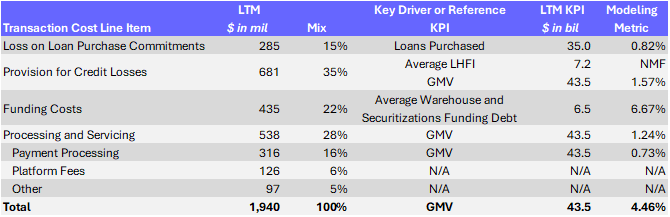
Loss on Loan Purchase Commitments. On certain occasions, Affirm is required to purchase loans from its originating bank partners for a price in excess of the fair market value, which results in the recognition of a loss. The losses are influenced primarily by the amount of long-term 0% APR loans purchased. In other words, the significant merchant fee for a long-term 0% APR loan compensates for the lack of interest income and the loss recognized when the loan is purchased. Over the LTM, loss on loan purchase commitments equaled 0.82% of total loans purchased and 5.19% of 0% APR installment loans purchased.
Provision for Credit Losses. Affirm’s provision for credit losses is influenced primarily by the amount of loans held on the company’s balance sheet, and subject to estimates for future losses and loans charged-off during the period. Admittedly, this is one of the more challenging aspects of Affirm’s business to understand and model. For a bank or consumer finance company, where nearly all loans are held on the balance sheet, a standard measure of credit performance is the net charge-off rate, which is calculated by taking net charge-offs (charge-offs less recoveries), dividing them by the average loan balance, and annualizing it. Performing a similar calculation for Affirm results in an above-average net charge-off rate (about 7.7% for the December 2025 quarter). However, Affirm is responsible for certain losses on loans sold to third-party investors, making my calculation not representative. Another measure of credit performance is delinquency rates, typically calculated by taking loans that are more than 30-days past due and dividing them by total loans outstanding. On this measure, Affirm performs better than other non-prime lenders like Bread Financial, Synchrony Financial, Discover and Capital One and only moderately worse than prime lenders like J.P. Morgan and American Express.
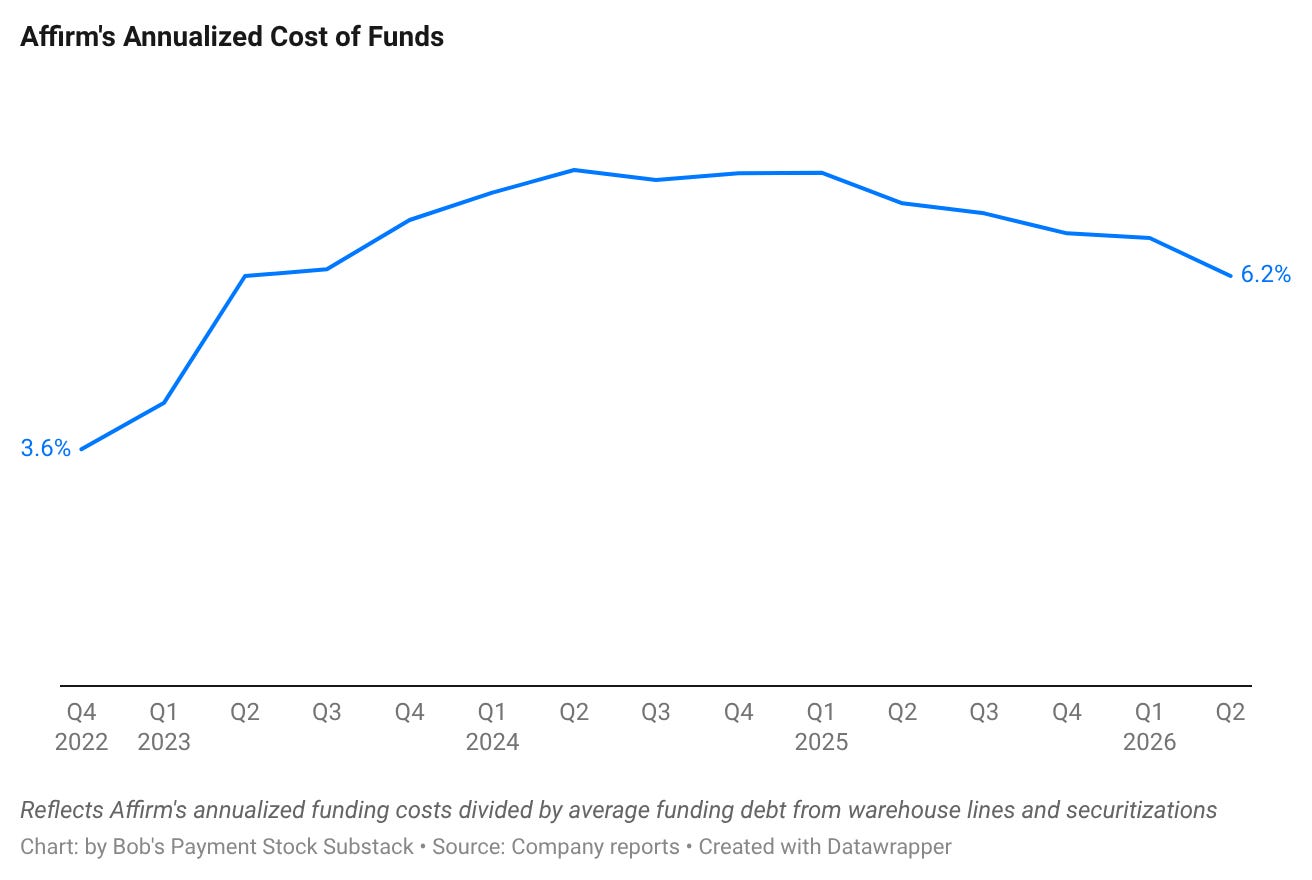
Funding Costs. Affirm’s funding costs represent interest expense associated with total funding debt from warehouse lines and securitizations. For the most recent quarter, Affirm’s annualized cost of funds was 6.15%, down from the high water mark of about 7.7% reached at the end of 2023, but higher than the mid-3% range during the middle of 2022, before the Fed began to hike:
Processing and Servicing. Affirm’s processing and servicing costs consist of payment processing fees, platform fees, and other expenses associated with customer service and support. Payment processing fees, the largest component of processing and servicing costs, incurred primarily when a customer repays a loan, were $316 million over the LTM, equal to 0.73% of GMV.
As always, thank you for reading, and if you’ve enjoyed this, please consider sharing, liking, commenting or subscribing!
Disclosure: As of April 27, 2026, of the stocks mentioned in this report, I am long Adyen, Block and Visa. This report is for informational purposes only and is not a recommendation to buy or sell any stock. Finally, while I rely on the information in this report to guide my investment decisions, you should not, because I cannot guarantee its accuracy.
No posts
Comments
Nothing yet. Say the first thing.
Sign in to join the conversation.