
Broadridge Financial (Broadridge) is a significant and direct beneficiary of increased participation in financial markets. Its largest business—delivering proxies and interim reports [interim(s)] and tabulating shareholder votes—earns revenue based on the number of stocks, mutual funds, and ETFs held by retail investors, primarily in ‘street name’ at broker-dealers and banks. Each position, whether one share or one million, requires an annual proxy or interim, generating revenue for Broadridge. Since fiscal 2006, Broadridge’s equity and fund positions have grown at compound annual rates of 7% and 8%, respectively, with only two annual declines in the last 19 years:
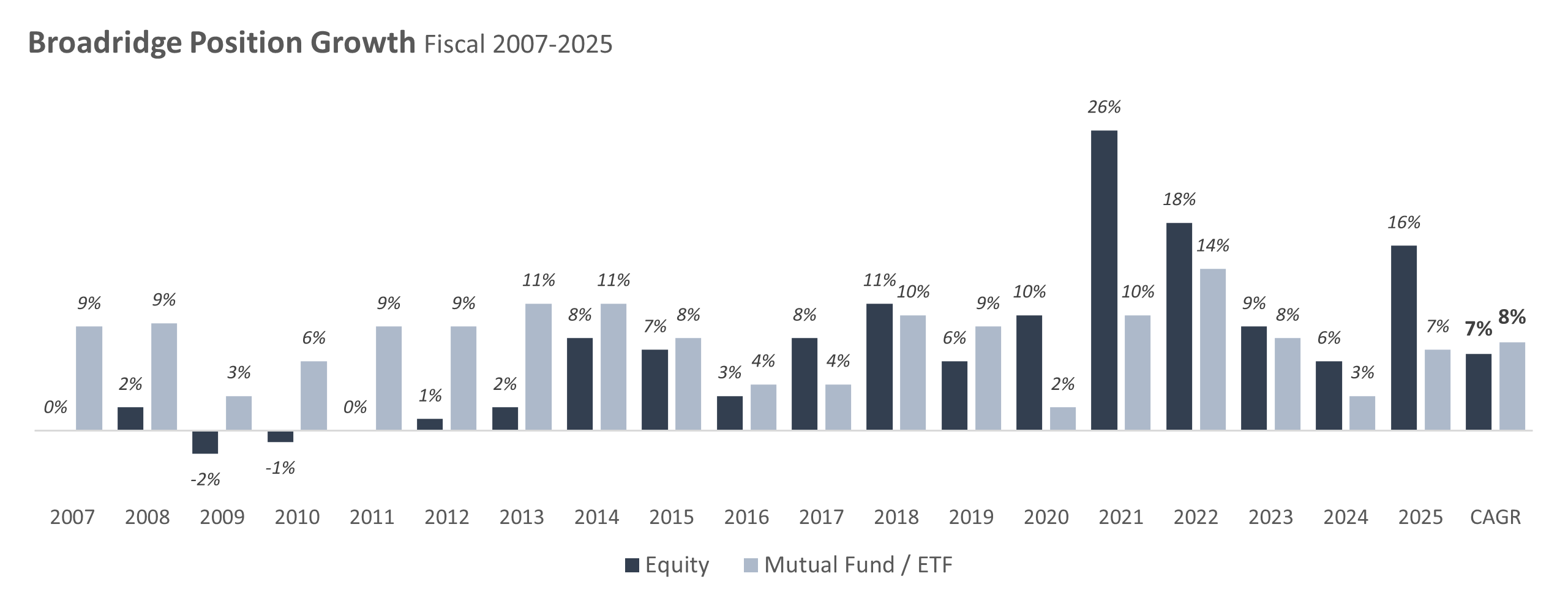
Financial product innovation and other developments have contributed to robust position growth over the past decade: the proliferation of zero commission trading in the mid-to-late 2010s, stimulus payments in 2021 and 2022 that provided discretionary funds for investment, and more recently, the rising popularity of managed accounts and direct indexing. Tokenizing private market and other illiquid assets, like equity, debt, real estate, and fine art, represent opportunities for future position growth, requiring equal or greater disclosures.
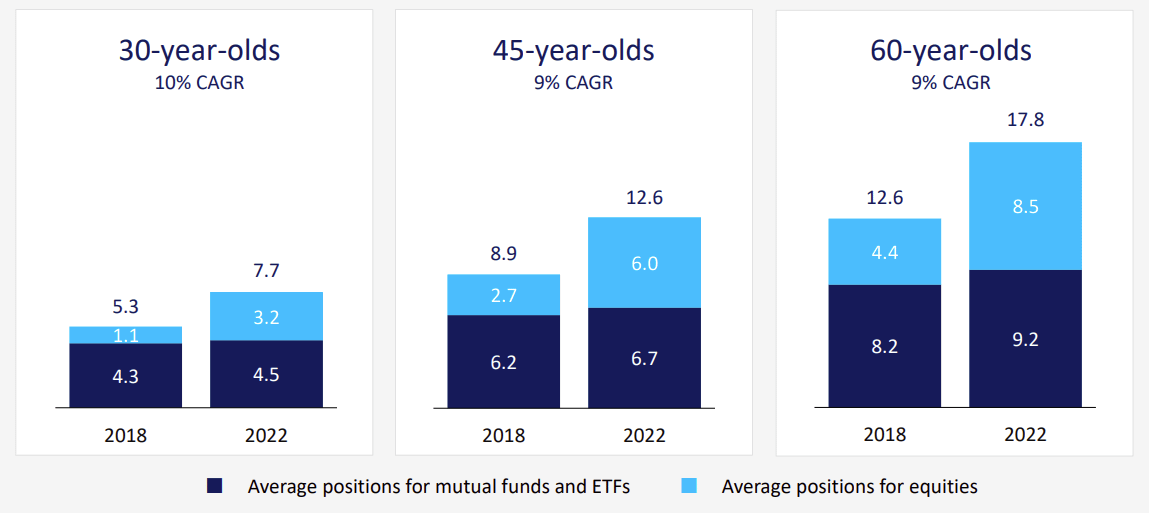
Broadridge holds a virtual monopoly in proxy and interim delivery, with reports suggesting a market share between 75% and 90% of total U.S. positions. On one hand, delivering proxies and interims is regulatorily mandated, making it mission critical. On the other hand, broker-dealers, banks, corporate issuers, and fund companies, individually, lack the scale and expertise necessary to perform the function effectively, making outsourcing to a third party like Broadridge ideal.
Imagine a scenario where every corporate issuer or fund company must interact with thousands of broker-dealers and banks to deliver proxies and interims. Or a broker-dealer or bank that must coordinate with several thousand different corporate issuers and fund companies. By working with Broadridge, broker-dealers, banks, corporate issuers, and fund companies simplify a highly complex process, delivering seamless experiences for retail and institutional investors.
Pricing for proxy and interim delivery is regulated by the SEC and NYSE. Although broker-dealers and banks are responsible for distributing proxies and interims to beneficial shareholders, they are reimbursed by corporate issuers and fund companies. As a result, Broadridge typically charges the highest price allowed, keeping a fee for themselves and passing the rest on to their broker-deal and bank customers. Given Broadridge’s significant scale, it is likely the low-cost provider in an industry with very few players, enabling Broadridge to pass on a larger portion of the allowable fee to broker-dealers and banks, strengthening Broadridge’s relationship with their broker-dealer and bank customers and keeping competitors out. The last comprehensive pricing review was concluded in 2014, resulting in a modest 4% reduction in average fees.
Broadridge has established additional attractive businesses in its governance and communications franchise serving primarily corporate issuers and fund companies that leverage and complement the relationships, data, technology, and processes that power proxy and interim delivery. They include shareholder analytics and engagement tools, regulatory document composition, virtual shareholder meetings, and an omni-channel communications platform serving customers across diverse verticals in addition to financial services.
Broadridge’s remaining businesses provide transaction processing and related services to participants in securities markets and software for financial advisors. Broadridge’s acquisition and organic investment activity over the years has focused on building end-to-end platforms across capital markets and wealth and investment management, moving away from a historical focus on performing only back-office and administrative tasks. Although there are attractive aspects of these businesses—recurring revenue, vendor consolidation opportunities, and scale that facilitates cost mutualization—they do not match the favorable dynamics that underly proxy and interim delivery, and typically face greater competition and risks from emerging threats like AI.
Although individual business performance fluctuates moderately from year to year, Broadridge—as a whole—generates incredibly consistent results. Over the past decade, organic recurring revenue growth averaged nearly 6.5% with a range of 4% to 9%. Since the acquisition of DST Systems’ North American Customer Communications (NACC) business in fiscal 2017, Broadridge has generated average annual underlying margin expansion of more than 60 bps. After dipping in fiscal 2021 and 2022 as Broadridge invested heavily in its modern wealth management platform and global post-trade capabilities, free cash flow conversion rebounded to more than 100% in the past two fiscal years and was 92% over the past decade, in aggregate.
At less than 17 times forward earnings, Broadridge trades at a very reasonable price, in my opinion, especially considering approximately 70% of the company’s earnings come from deeply entrenched, and often regulatorily mandated processes, where Broadridge faces little-to-no competition and benefits from secular growth opportunities. While risks to Broadridge’s business model should not be discounted, I believe they are manageable, and the most significant ones impact a smaller portion of Broadridge’s earnings power.
Shares of Broadridge have come under pressure recently as investors assess emerging risks from AI and tokenized securities:
Broadridge’s capital markets and wealth management business units deliver significant components of their offering via software as a service (SaaS). Additionally, a small number of customers make up a significant portion of revenue. Finally, often the primary alternative to a Broadridge solution is building in-house. This is a perfect storm for AI disruption (theoretically)—Broadridge’s customers, utilizing their significant resources and rapidly improving AI tools, will have little trouble creating their own in-house alternatives, effectively ending the cost mutualization advantage for Broadridge. While not exactly applicable to Broadridge, a general example of this potential risk is Goldman Sachs’ recent decision to work with Anthropic to develop agents to perform operational and back-office functions. Pushback: While parts of Broadridge’s capital markets and wealth management solutions are SaaS-based, a meaningful portion involves establishing connections with third-parties to move money—processing and settling transactions—and is unlikely to be disrupted by AI-powered software or agents.
Tokenized securities offer instant settlement and programmable contracts. If trading in them becomes widespread, it could diminish the value of Broadridge’s capital markets business unit, which simplifies the complex trade lifecycle that exists today. Pushback: Many of Broadridge’s post-trade capabilities would still be needed, even in a world of tokenized trading. Additionally, Broadridge has demonstrated an ability to innovate around emerging technologies, with its distributed ledger repo (DLR) platform now processing $380 billion of volume daily, up 5x versus a year ago.
Although tokenized securities will require similar disclosure requirements as traditional securities, the risk for Broadridge is that mass adoption of tokenization upends the traditional broker-dealer model and results in significantly greater direct registration of securities with corporate issuers and fund companies, bypassing Broadridge for proxy and interim delivery. Today, two ownership records exist: one at the Depository Trust Company (DTC)—a central repository for electronic versions of U.S. stock certificates—which aggregates all positions for each broker-dealer; and another at the broker-dealer, which tracks specific customer positions. Corporate issuers and fund companies, unable to see individual holders at broker-dealers, must work with an intermediary like Broadridge to satisfy their legally required obligation to deliver a proxy or interim report to all shareholders, including registered and beneficial. With tokenized securities trading on a transparent blockchain, corporate issuers and fund companies may have the ability to communicate directly with shareholders, as opposed to going through an intermediary like Broadridge. Pushback: This bearish scenario assumes retail investors will move away from a system that largely works today—consolidating all their positions at a single broker-dealer. In a tokenized world, retail investors would likely need a separate wallet for each tokenized security registered directly with a corporate issuer or fund company. Although there could be a company that comes along to make the experience seamless for retail investors, it would likely require significant time and money to match the simplicity of the broker-dealer model and the reliability of Broadridge’s regulatory communications.
Additional risks for Broadridge include:
Although it has not been the case historically, a significant market sell-off could drive retail investors out of financial markets permanently, placing downward pressure on position growth over the medium to long-term.
The combination of a significant—and sustained—sell-off in financial markets is rarer, and could make it more likely positions either fall or grow more slowly.
Regulatory bodies could significantly reduce the maximum allowable fees for delivering proxies and interims, negatively impacting Broadridge’s revenue and profitability.
Even under a scenario where a review of pricing is announced and conducted, it could cause a sell-off in Broadridge’s stock simply by introducing the potential for a significant decline in allowable fees, even if one does not ultimately occur.
The loss of a large customer could negatively impact Broadridge’s financial performance.
Increasing consolidation in financial services may result in customer losses for Broadridge, greater bargaining power for Broadridge customers, or provide customers with the scale necessary to move operations in-house.
Broadridge generates recurring revenue from six business units:
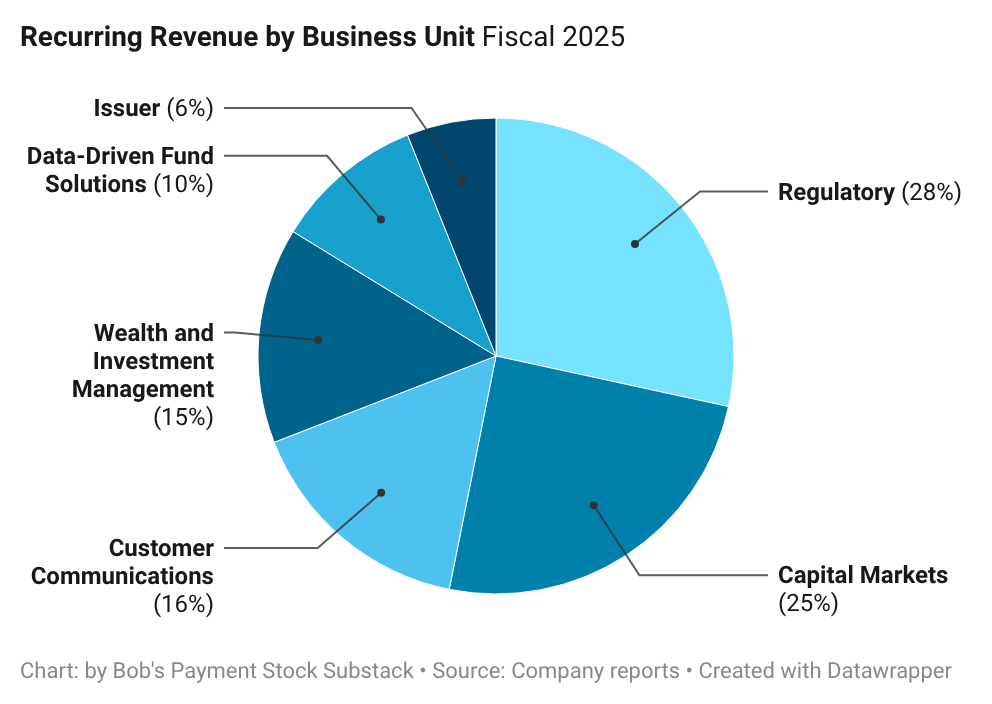
Regulatory represents the fees Broadridge earns from delivering equity proxies and mutual fund and ETF interim reports, which include annual and semi-annual reports and annual prospectuses. Broadridge charges the maximum allowable fee for proxy and interim delivery and recognizes it as revenue on a gross basis, with an agreed upon pass-through to broker-dealer and bank customers reported as an expense.
Data-Driven Fund Solutions represent revenue primarily from two businesses: an analytics platform for fund companies that provides intelligence about their shareholder base and competitors; and mutual fund and ETF processing, and a communications platform, for retirement plan sponsors.
Issuer represents a collection of services for corporate issuers, including vote processing across registered, beneficial and institutional shareholders; virtual shareholder meeting services; shareholder analytics and engagement tools; transfer agency services; and composition, filing, hosting, and printing of SEC required documents, including proxies and annual reports.
Customer Communications represent Broadridge’s omni-channel (both print and digital) platform for customer communications serving companies in financial services, healthcare, telecom, and utilities, and encompasses marketing materials, billing and account statements, and trade confirmations. Broadridge generates recurring revenue from fulfilling communications. The digital portion of Broadridge’s omni-channel platform, although smaller (recently crossing the $100 million mark), is growing faster (double-digits over the past three fiscal years) and carries higher margins than the print portion.
Capital Markets represent Broadridge’s trading platform for equities, fixed income, and exchange traded derivatives, and spans order initiation through settlement, and various post-trade capabilities, including accounting and record keeping, compliance, tax reporting, and asset servicing. Broadridge’s acquisition of Itiviti in 2021 significantly expanded its global front- and middle-office capabilities, including order and execution management, complementing Broadridge’s historical focus on domestic transaction processing and post-trade capabilities. A meaningful portion of Broadridge’s revenue for this business unit is based on the number of trades processed, while the remaining part is subscription-like and dependent on the number of components adopted by customers.
Wealth and Investment Management primarily represents Broadridge’s technology platform for financial advisors and wealth managers, providing tools to acquire and onboard customers, digitize operations, including communications, manage portfolios, process trades, service accounts, and calculate advisor compensation, among others. In 2018, Broadridge began a multi-year journey to update its wealth platform, with UBS as its anchor client. Broadridge is believed to have spent upwards of $1 billion on this effort. The result was a modern, cloud-based technology platform supporting approximately 50 proprietary modules, as well as third-party apps. Broadridge generates subscription-like fees based on the number of modules adopted by customers. Broadridge began recognizing revenue from UBS in fiscal 2024, anticipating an annual run-rate of approximately $70 million, with an expected $20-$30 million of annual closed sales from customer adoption of its modern wealth management platform.
In addition to recurring fees, Broadridge generates event-driven revenue that varies year by year, but typically mirrors equity and fund position growth over the long-term. Events that trigger special in-year communications include:
A change in directors, fee structure, or investment strategy at a mutual fund or ETF, requiring a fund proxy and shareholder vote.
A separate agenda put forth by one or more shareholders contesting a management proposal.
A corporate action, including a proposed sale of the company, that requires a separate proxy and special shareholder vote.
A change in portfolio manager or share class at a mutual fund or ETF, requiring a supplemental prospectus by fund companies.
Over the past decade, annual event-driven revenue averaged $245 million:
Finally, Broadridge recognizes distribution revenue, which primarily reflects reimbursement for the costs of physically mailing communications, and is based on the number of pieces delivered and postage rates. Broadridge earns little-to-no profit on distribution revenue. For comparison purposes, Broadridge’s operating profit should be viewed as a percentage of recurring and event-driven revenue, with distribution revenue excluded.
Broadridge was conceived in 1962 as the Brokerage Services division of Automatic Data Processing (ADP). The business unit’s original focus was processing stock trades for U.S. customers. Over its time with ADP, primarily through acquisitions, the division’s capabilities expanded to include processing fixed income trades and trades for international customers.
Broadridge’s proxy juggernaut can be traced to one man—Richard Daly. ADP’s Brokerage Services division began offering proxy services in 1989 after it acquired Daly’s company. In its first year with Daly as head of the proxy business, ADP signed 31 major clients. ADP significantly expanded its presence in proxy services with the 1992 acquisition of The Independent Election Corporation of America, or IECA, where Daly had worked previously as both CFO and COO.
ADP spun off its Brokerage Services division in 2007, with the new company called Broadridge Financial Solutions.
In its time as a public company, mostly led by Daly, Broadridge has continued to make acquisitions to expand its capabilities. Since fiscal 2008, its first full year as an independent company, Broadridge has made acquisitions and purchases of intellectual property totaling $5 billion. Despite that number, a significant portion of Broadridge’s profits still originate from delivering proxies and interims, and related parts of its governance and communications franchise.
Tim Gokey became CEO of Broadridge in 2019 following the retirement of long time leader Richard Daly. Prior to his turn as chief executive, Mr. Gokey served as COO of Broadridge from 2012 to 2019.
I believe Mr. Gokey has done a good job leading Broadridge, successfully executing a strategy to establish businesses that capitalize on its strengths in proxy and interim delivery, create end-to-end technology platforms in capital markets and wealth management, and further innovation across corporate governance and trading.
Establish businesses that capitalize on its strength in proxy and interim delivery. In fiscal 2025, Broadridge generated $1.45 billion of recurring revenue—or about one-third of its total—from businesses that leverage and complement the relationships, data, technology, and processes that power proxy and interim delivery. Over the past five fiscal years, these businesses generated compound annual organic recurring revenue growth of approximately 7%. While proxy and interim deliveries attract much of the spotlight for Broadridge, investors should consider it part of an overall governance and communications franchise that share many of the same attractive characteristics.
Create end-to-end technology platforms in capital markets and wealth management. Although it came at a high cost—Broadridge paid $2.6 billion to acquire Itiviti and approximately $1 billion to modernize its wealth platform—the strategic rationale for creating end-to-end technology platforms seems clear: develop cross-sell opportunities among existing clients, attract smaller and mid-sized customers with the promise of vendor consolidation, and make switching costs greater for customers that adopt more of Broadridge’s components, improving already high retention levels. If there’s an area to be critical of Broadridge, its been the amount of money spent to modernize the wealth platform, and whether a reasonable return is ever possible. While the company promised $20-$30 million of annual closed sales from its new wealth platform, it has been less forthcoming with actual details about closed sales attributable to it, only referencing sporadic ‘significant customer signings’ and strong pipeline activity.
Further innovation across corporate governance and trading. Broadridge has highlighted a couple areas in corporate governance where it believes it can innovate to create incremental growth opportunities: pass-through voting— allowing retail investors the opportunity to influence how large asset managers vote their shares; proxy advisory services—utilizing Broadridge’s data and technology to guide voting decisions for major asset managers, disrupting a large market (hundreds of millions of dollars) controlled by a small number of players; and standing voting instructions—enabling retail investors to set prearranged parameters on how they wish to vote their shares, creating greater voting participation. In capital markets, Broadridge’s DLR platform, which facilitates intra-day repo transactions, has seen significant adoption, reaching $380 billion of daily volume, and contributing very modestly to Broadridge’s capital markets growth.
For proxy and interim delivery, Broadridge faces minimal competition. Mediant Communications, owned by PE-backed BetaNXT, is frequently cited as a competitor, but is believed to only have a small number of customers. Say Technologies, another competitor, was acquired by Robinhood in 2021.
Broadridge faces more—but still sporadic—competition in other parts of its governance and communications franchise. Computershare is a significant competitor for transfer agent services, shareholder meetings, and investor communications for registered shareholders. Workiva provides a cloud-based platform for public companies to create SEC filings.
In capital markets, wealth and investment management, Broadridge faces more significant competition.
Capital Markets. Broadridge competes with FIS and Fidessa ION in order and execution management systems. According to Broadridge, this is a $6 billion market opportunity, with Fidessa ION controlling 40%, FIS a high-teens percentage, and Broadridge holding a mid-teens share via its acquisition of Itiviti.
For securities transaction processing and settlement, Broadridge’s range of competitors is less clear, but among them is FIS. Additionally, the option of performing the function in-house has been identified as Broadridge’s main competition.
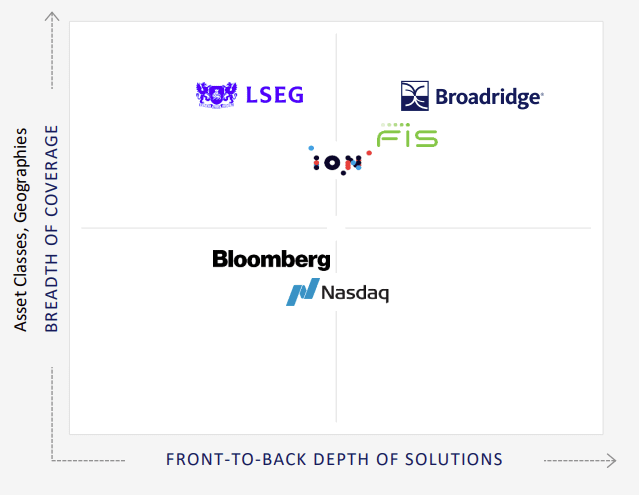
Wealth and Investment Management. Broadridge faces a number of competitors with a range of capabilities in the wealth and investment management space:
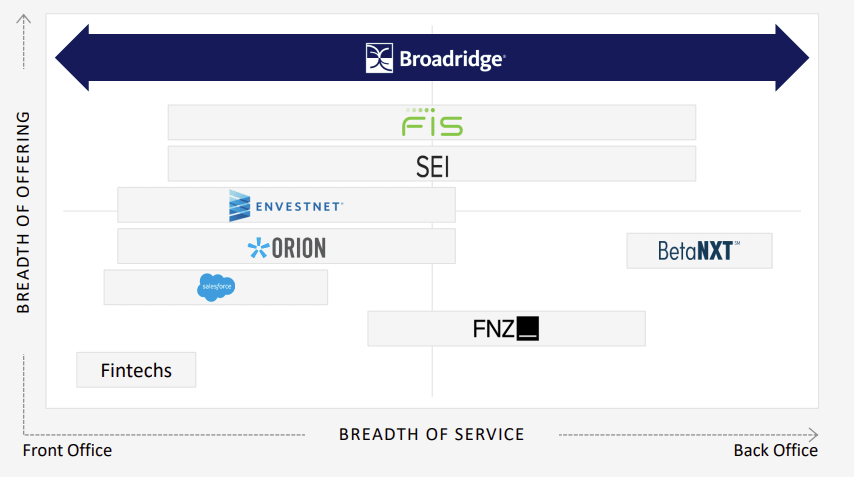
FIS, SS&C Technologies, and SEI Investments are publicly traded competitors. Envestnet was publicly traded until it was acquired by Bain Capital for $4.5 billion in late 2024. Similarly, Orion, AssetMark, BetaNXT, and FNZ are all PE-backed competitors.
Broadridge relies on net new business, internal growth, and acquisitions to drive recurring fee revenue growth. Over the past decade, organic recurring revenue growth averaged nearly 6.5% with a range of 4% to 9%:

Net new business represents revenue contribution from closed sales less client losses. Broadridge discloses recurring revenue closed sales and backlog at the end of each fiscal year. From that, one can calculate an implied contribution to organic recurring revenue growth from closed sales:
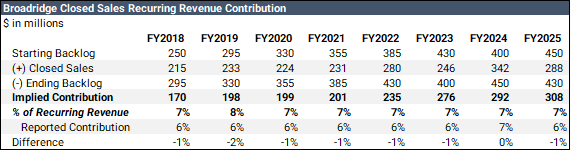
There is a modest difference between the implied and reported contribution, suggesting a small portion of Broadridge’s recurring revenue falls out of its backlog each year. In any case, the contribution from reported closed sales to organic recurring revenue growth has been extremely consistent over the past decade, with nine years at 6%, and one year at 7%, suggesting Broadridge has been highly successful at signing new logos and expanding relationships with existing customers through the adoption of more features, including its expanded governance and communications franchise, and its end-to-end technology platforms across capital markets and wealth management.
Client losses averaged a 2%-3% headwind to organic recurring revenue growth over the past decade, implying a retention rate of 97%-98%, demonstrating the ‘stickiness’ of Broadridge’s customer relationships. In many cases, client losses result from acquisition activity among customers, the most recent example being the loss of E*TRADE in wealth and investment management due to its acquisition by Morgan Stanley.
Internal growth represents the contribution from pricing, equity and fund position growth, and internal trade growth for the portion of capital markets revenue tied to the number of transactions processed. Over the past decade, internal growth contributed an average of 2% to organic recurring revenue growth.
Acquisitions contributed an average of 5% to Broadridge’s recurring revenue growth over the past decade, bringing average reported recurring revenue growth to 11%. Key acquisitions include the $410 million purchase of DST’s NACC business in 2016, the approximately $300 million acquisition of RPM—a provider of wealth management software—in 2019, and the $2.6 billion acquisition of Itiviti in 2021.
Margins. After dipping in fiscal 2017 due to the acquisition of the lower margin DST NACC business, Broadridge’s underlying operating margin—which I define as Broadridge’s non-GAAP operating profit divided by the total of recurring and event-driven revenue [excludes little-to-no margin distribution revenue]—expanded from 24.1% in fiscal 2017 to 29.2% in fiscal 2025, averaging a more than 60 bps annual increase. Broadridge targets 50 bps of annual margin expansion with scale, the conversion from print to digital communications, and expense management and efficiencies more than offsetting investments in the business required to sustain attractive organic recurring revenue growth.
Margins are higher across Broadridge’s governance and communications franchise versus capital markets and wealth and investment management. While not specifically disclosed on an operating basis, I estimate about a 10-point margin premium for governance and communications.
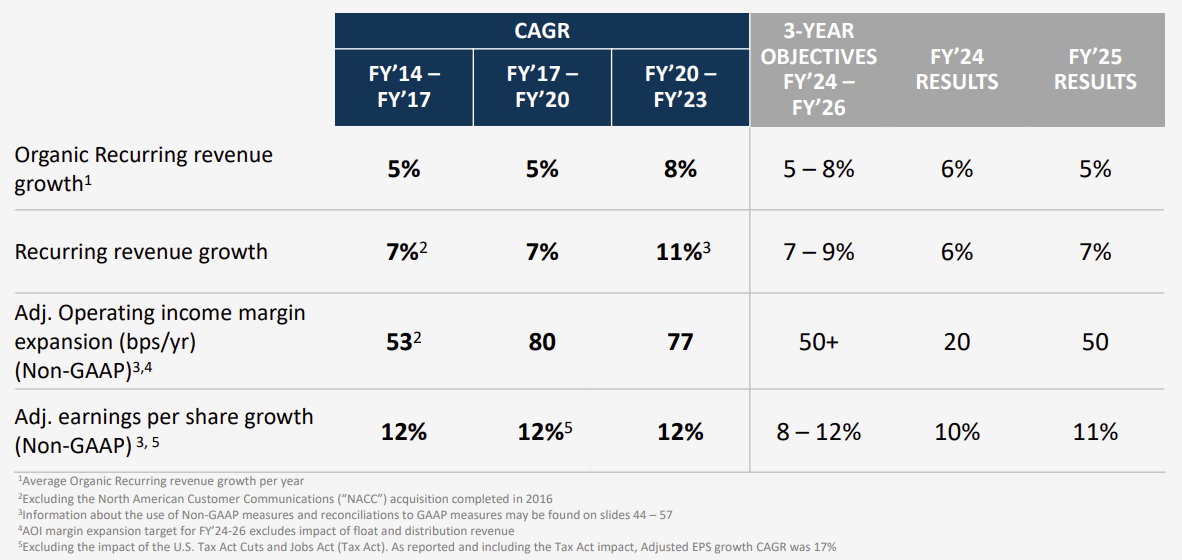
Medium-Term Outlook. Broadridge is targeting 5-8% organic recurring revenue growth over fiscal 2024-2026, similar to past three-year periods. With growth expected at the higher-end of the 5-7% range set for fiscal 2026, Broadridge should land at the middle of the range for the current three-year period. With the added contribution from tuck-in M&A, margin expansion, and very modest share repurchases, Broadridge targets 8-12% EPS growth, which it has typically landed at the higher-end of over the past decade.
Balance Sheet and Cash Flow. Broadridge had total debt of about $3.2 billion at the end of 2025, implying a debt-to-EBITDA ratio of about 2x, down from about 4x following the close of the Itiviti acquisition in 2021. Taking into account Broadridge’s cash position, net leverage is below 2x, a very manageable level and supportive of the company’s tuck-in acquisition strategy. As mentioned previously, Broadridge’s free cash flow conversion dipped in fiscal 2021 and 2022 (more significantly) as it funded significant investments for its modern wealth management platform and global post-trade capabilities. Over the past decade, free cash flow conversion was 92%. Going forward, I expect free cash flow conversion to be close to 100%.
Dividends. I think of Broadridge as a high-quality dividend compounder, and in fact, purchased the stock for accounts dedicated to my dividend strategies. It targets a payout ratio of around 45%. With EPS growth at the low double-digits over the past decade, dividend growth has followed. The current share price offers a yield of 2.4%.
Valuation. There are two ways I look at Broadridge’s valuation. First, based on my DCF model, and the second way, on a sum-of-the-parts (SOTP) analysis.
My DCF model assumes Broadridge grows at the low-end of its typical 5-7% organic recurring revenue growth average over the next decade, expands underlying margins by 50 bps, pays a tax rate in the low-20% range, and spends about 2.5% of non-distribution revenue on capital expenditures, including purchased and internally developed software. I assume no accretive M&A, even though I believe it is highly likely to occur. Using a 10% discount rate and a 3.5% terminal growth rate yields a fair value of around $185, implying about 15% upside from current prices. However, I would argue strongly the stability of Broadridge’s business—especially its governance and communications franchise—demands a lower discount rate. If I instead use a 9% discount rate, which I believe is appropriate, and keep my 3.5% terminal growth rate, it yields a fair value of about $220, implying 35% upside. $220 implies about 22.5x Broadridge’s NTM EPS of around $9.70, a fair valuation for the quality of its business. As a point of reference, over the past decade, Broadridge’s has averaged a NTM P/E multiple of about 24x.
My SOTP analysis attempts to isolate the earnings contribution from the governance and communications franchise from capital markets and wealth and investment management. Even though capital markets and wealth and investment management represent about 40% of recurring revenue, I estimate it generates 30% or less of Broadridge’s earnings power. So, assuming NTM EPS of $9.70 for Broadridge, implies about $2.90 from capital markets and wealth and investment management, and the remaining $6.80 from governance and communications. Even though I believe the capital markets and wealth and investment management business deserves a higher multiple, the market seems to be giving similar companies a low double-digit multiple currently. If I use 12x, it implies $35 of per share value for Broadridge, implying about $128 of per share value assigned to the governance and communications franchise, implying a multiple of less than 19x:

I think that’s too low. In a reasonable scenario, I would give capital markets and wealth and investment management a multiple in the mid-teens (15x) and the governance and communications franchise something well into the 20s. For this example, I use 22x. Under these set of assumptions, it yields a consolidated multiple of about 20x, or $193 per share, implying about 20% upside.

As always, thank you for reading, and if you’ve enjoyed this, please consider sharing, liking, commenting or subscribing!
Disclosure: As of March 31, 2026, of the stocks mentioned in this report, I am long Broadridge Financial. This report is for informational purposes only and is not a recommendation to buy or sell any stock. Finally, while I rely on the information in this report to guide my investment decisions, you should not, because I cannot guarantee its accuracy.
No posts
Comments
Nothing yet. Say the first thing.
Sign in to join the conversation.