
There is no league in world football quite like the 3. Liga. Since its inception as a professional league in 2008/09, becoming a buffer between the 2. Bundesliga (second tier) and the Regionalliga (regional divisions), the league has grown in stature significantly and become a respectable division in its own right, helping to prevent iconic clubs from fading into insignificance and for clubs on the rise to adjust to life as a professional outfit and compete at stadiums nationwide.
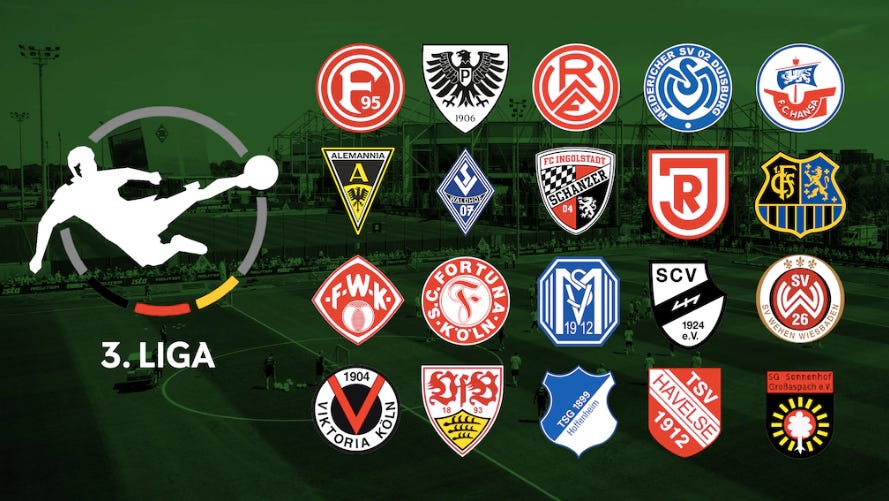
Ahead of the opening match on Friday 7th August between Waldhof Mannheim and Fortuna Düsseldorf, let’s take a comprehensive look at how the league is shaping up. Six new clubs will be competing in the 20-team league, and I will discuss a selection of the clubs, players and managers that are likely to play decisive roles between the first ball being kicked and the season end in May 2027.
The 2025/26 3. Liga season was an intriguing albeit undramatic season by the standards of the third tier. The one thing that followers of the league must anticipate is that surprises happen at both ends, with clubs being capable of vastly exceeding expectations or completely flattering to deceive. The financial disparity between the clubs is much smaller than in the Bundesliga, meaning that the playing field is level enough for almost anyone to be capable of competing.
After removing the Stuttgart and Hoffenheim reserve teams, since the player market values are naturally significantly higher, the average market value of players in the league are extremely close relative to the two leagues above. Alemannia Aachen had the highest average value per player which was 250% of the value of TSV Havelse’s average, which was the lowest in the division. In the 2. Bundesliga, the equivalent figure last season was 360%, and in the Bundesliga it was 1852%, although only 873% when removing the stratospheric giants of Bayern München.
All this is to say that there were several surprises as usual - MSV Duisburg, promoted from the Regionalliga West in 2024/25, missed out on the promotion playoff place by failing to win on the final matchday, but it was a monumental effort nonetheless. At the other end, 1. FC Saarbrücken finished a woeful 15th having come mightily close to being promoted in 2024/25, when they took Eintracht Braunschweig to extra time in the playoff but ultimately lost 4:2 on aggregate.
Ultimately, VfL Osnabrück sealed promotion as champions, eight points clear of Energie Cottbus in second place. The relegated teams were Bavarian newcomers 1. FC Schweinfurt, who looked out of their depth, SSV Ulm, suffering their second consecutive relegation, and Erzgebirge Aue, who sink to the fourth tier for the first time in their history having bounced between the second and third tiers after the collapse of the East German Oberliga in 1991. The final relegation spot should have gone to Havelse, but their 3. Liga status was saved over two weeks after the season ended, as 1860 München were denied a licence to compete in the league after failing to prove liquidity. 1860, who finished a respectable 8th, join Ulm as one of 15 former Bundesliga teams to be competing in the Regionalliga, which you can read all about here.
Let’s look at the six new clubs that will be competing in the third tier for 2026/27. The biggest name is easily Fortuna Düsseldorf, who were shockingly relegated at the end of a disastrous 2025/26 campaign in the 2. Bundesliga. Entering the final matchday, Fortuna were safely in 15th, one point ahead of Arminia Bielefeld and three points ahead of their opponents, Greuther Fürth. Arminia stunned Hertha Berlin with a 6:1 win, and Greuther Fürth secured a 3:0 win to secure relative safety in the relegation playoff with a goal difference of -19 to Fortuna’s -20. Fürth fans were thanking their lucky stars for that third goal, as it literally sealed Fortuna’s fate.
Preußen Münster are the other relegated side after finishing a distant last place, seven points behind the two clubs having a dramatic duel to the death. They return to the 3. Liga after just a two-year absence.
Onto the promoted sides now, we have four familiar faces returning to the league. SV Meppen destroyed their competition in the Regionalliga Nord, scoring 103 goals in 34 games and finishing as runaway champions by 13 points. They return after relegation in 2022/23. SC Fortuna Köln return after seven years down in the Regionalliga West and three years of steady progress under the management of a former player, Matthias Mink. SG Sonnenhof Großaspach played six seasons in the 3. Liga from 2014 to 2020, finishing as high as 7th, but suffered two relegations in three years down to the Oberliga Baden-Württemberg. But promotion out of the fifth tier in 2024/25 was followed by another season with a trophy lift, as they won the Regionalliga Südwest by six points from SGV Heilbronn-Freiberg, who would have been newcomers to professional football.
Lastly, we have our playoff winners, Würzburger Kickers. Despite finishing 2nd in the Regionalliga Bayern, champions 1. FC Nürnberg II were ineligible for promotion as DFL rules stipulate that a reserve side must play at least two divisions below its senior counterpart. As 1. FC Nürnberg remain a 2. Bundesliga outfit for the upcoming season, this prevented the reserves from competing in the 2026/27 3. Liga. After riding their luck in the league, Würzburger Kickers saw off Regionalliga Ost champions 1. FC Lokomotive Leipzig for the coveted final promotion place. Petitions to get the Regionalliga to reorganise its five leagues into four have never been louder.
On the managerial front, we have three changes from last season. Preußen Münster’s Alois Schwartz, who was appointed in March to try save the club from relegation, departed by mutual consent. His replacement, Thomas Wörle, is a two-time champion of the Frauen-Bundesliga with the Bayern München women’s team. He then spent nearly four seasons with SSV Ulm, achieving consecutive promotions from the Regionalliga Südwest to the 2. Bundesliga, before being dismissed as the club faced relegation back to the 3. Liga.
SC Verl have lost Tobias Strobl to VfL Wolfsburg, who were relegated out of the Bundesliga last season. If the name rings a bell, that’s because there was a Tobias Strobl who played for TSG Hoffenheim and Borussia Mönchengladbach, however they are actually two different people. Verl have plucked a manager away from Portuguese third tier side CD Mafra to become Head Coach, a Kosovan-born German named Orest Shala. Shala previously spent time as a youth team manager with Union Berlin and as manager of the U-21 team for Swiss club St. Gallen and his LinkedIn ‘About’ section says he is a proponent of an ‘aggressive, high-pressing, and vertical style of play’.
The last club to go through a managerial alteration is SV Waldhof Mannheim. Luc Holtz, who managed the Luxembourg national team for 15 years, has left to Ligue 2’s FC Metz after a 10th-place finish in his only season with Mannheim. Clearly he’s a fan of that part of the world between Luxembourg, eastern France, and southwest Germany. His replacement is quite the opposite - Portuguese hire Rui Mota started as a coach and assistant manager in his home country before working in Saudi Arabia, Greece, Belgium, Poland, Brazil, Turkey, Iran and Croatia. His first appointment as a Head Coach was with Georgia’s Dila Gori, before quickly moving on to FC Noah in Armenia and Ludogorets Razgrad in Bulgaria. Only natural for Mota to move to one of the few countries he hasn’t yet worked in.
The biggest club in the 3. Liga is undoubtedly Fortuna Düsseldorf. Die Flingeraner (founded in the Flingern area of the city) are one of only two former German champions in the league, having won the title in 1933. They have won two out of seven DFB-Pokal finals they competed in and they still hold the record for consecutive match wins in the competition, with 18 between 1978 and 1981 - their two titles coming in the 1979 and 1980 finals. Despite losing the 1978 final to their historic rivals, 1. FC Köln, Fortuna competed in the 1978/79 European Cup Winners’ Cup since Köln had also won the Bundesliga to qualify for the European Cup. Fortuna reached the final that season but lost 4:3 after extra time to an FC Barcelona side led by Johan Neeskens, Juan Manuel Asensi and Hans Krankl. Fortuna featured in the first 3. Liga season in 2008/09 and immediately won promotion, competing in three Bundesliga campaigns since, most recently in 2019/20. The 54,600 capacity Merkur-Spiel-Arena will become the largest stadium in the league by over 20,000, and you would probably expect them to walk this league. However, their manager Alexander Ende was the one that put Münster in significant danger of relegation before jumping ship to try improve Fortuna’s fortunes. As we can see, he failed spectacularly, so a promotion push shouldn’t be taken for granted.
Another of the big clubs historically that deserve attention is Hansa Rostock. Famous for their “passionate” (read: one of Germany’s most right-wing clubs) fanbase, Hansa always show up home and away in their numbers, even though their shortest away trip this season will be the roughly 660km round trip to Hannover. Despite being only 11th in the all-time DDR-Oberliga table, they finished the era strongly as the last champions of the East German national cup in 1991, also winning the NOFV-Oberliga that season to gain promotion to the Bundesliga in its first season with East German clubs returning. Like Fortuna, they would have their European dreams crushed by Barcelona, this time in the first round of the 1991/92 European Cup despite winning 1:0 at the incredible 29,000 capacity Ostseestadion. The club would go on to have a ten-year spell in the first tier from 1995 to 2005, finishing 6th twice. Hansa are in their third season back in the 3. Liga, and having achieved 5th place in the previous two campaigns, they will be hoping to get over the line this time.
The third club that can be filed under this section is Rot-Weiß Essen. The second of the two clubs in this league that have won the German championship, RWE have fallen on hard times in the 21st century, falling as low as the fifth tier on one occasion. In its heyday, Essen were one of the best in the country, specifically during the 1950s. Having won the DFB-Pokal in 1953, the club would go on to win the Oberliga West and the national championship in the 1954/55 season. Club icon Helmut Rahn scored the winning goal for West Germany against Hungary in the 1954 World Cup final, a proud moment for RWE fans as he was their only representative at the tournament. The club featured in seven Bundesliga seasons across three spells, achieving a highest finish of 8th in 1976 before relegation the following season, by which time financial issues began to mount and prevented the club from ever returning. Inches away from a return to the 2. Bundesliga after 20 years, RWE lost the promotion playoff to Greuther Fürth back in May, and will be praying to go one better this time despite losing two key players to the 2. Bundesliga and one to Le Havre in Ligue 1.
I’ve already touched on the promoted clubs, of which Sonnenhof Großaspach and Würzburger Kickers are definitely on the smaller side both historically and in the size of their fanbases. Kickers achieved an average attendance of just 2,357 last season, despite their stadium having a capacity of 13,000. This stadium does not meet DFL standards, so the club will play 127km away in Aspach, groundsharing with Großaspach and VfB Stuttgart II, which will likely reduce attendances further.
TSV Havelse are undoubtedly one of the smallest teams to have played professionally in Germany. Havelse is a district of Garbsen, a town in Lower Saxony of about 63,000 people, although Havelse is effectively ‘FC Garbsen’ due to its relative success. Nicknamed the Pelikans, due to the club’s founding name of FC Pelikan-Havelse in 1912, Havelse will have to play at Hannover 96 II’s Eilenriedestadion, although this is luckily only 10km away from Garbsen, instead of their regular 3,500-capacity home ground. Havelse’s peak was when they spent the 1990/91 season in the 2. Bundesliga, thanks to the incredible management of future SC Freiburg legend, Volker Finke. Finke left the club after achieving that promotion, and the club was immediately relegated, and then relegated again two years later. The 2021/22 and 2025/26 seasons were the club’s only third tier appearances since that time, and finished in the relegation zone both times, but of course got the reprieve this time due to 1860 München’s calamitous situation. An average attendance of 1,787 last season was the club’s best since that 2. Bundesliga season 35 years ago. The club will need all the support they can get to stay up again this time.
SC Verl are the other club worth mentioning in this section, as last season was their highest league finish as a club since 1994/95 when the third tier they competed in was actually the Regionalliga West-Südwest. Based in Gütersloh in North-Rhine Westphalia, the club is looking to achieve new heights in its seventh consecutive season in the division. The loss of their manager which I mentioned earlier is a gut punch for them, and the fact that it was Wolfsburg picking him up implied to me that his style of play was attractive to Wolfsburg’s decision-makers. The fact that their starting centre-backs and holding midfielder were the top three in the league for successful passes per 90 became my proof. Fans will have to hope that the 34-year-old Orest Shala is as good as his CV looks for someone without a playing background. Verl at least play at their own ground, the Sportclub Arena (how inventive with the name), which holds a maximum of 5,200 but received a record high average attendance of 3,000 last season. Only the two reserve team sides received lower attendances last season than Verl and Havelse.
Mika Schroers - Alemannia Aachen - Striker
There’s no two ways about it, Schroers is the best player in the league right now. Having spent last season on loan at Aachen from Arminia Bielefeld, the clubs agreed a permanent move for the 24-year-old for just €150,000. In my eyes, it’s a complete bargain. He scored 20 goals (zero penalties) and provided eight assists in 2025/26, and his 28 G/A was only bettered by three other players that have moved up to the 2. Bundesliga, including his partner-in-crime, Lars Gindorf. Schroers is perfectly capable of continuing the scoring spree on his own, though, and will be vital to a promotion push that Aachen are likely to mount.
David Preu - VfB Stuttgart II - Left-Back/Left-Winger
After two years trying to break into the Union Berlin side, David Preu appears to have cut his losses and joined Stuttgart’s reserves for the coming season. Understandably so, given that he was never getting ahead of Tom Rothe, the 6ft4, 21-year-old prodigy playing every week for the East Berliners. Preu is also just 21, and has a huge year ahead of him as either a wingback or left-winger in this Stuttgart team. I’m convinced that he will reach the Bundesliga again, but it will take a lot of hard work and consistently strong performances for him to get there. This side is the perfect foundation for him to progress from.
Jorrit Hendrix - Fortuna Düsseldorf - Central Midfielder
Having been relegated with Preußen Münster last season, the Dutch veteran is back for his second spell with the Flingeraner. Now 31 years of age, the midfielder has played 47 times in European competition for PSV Eindhoven, but has suffered from injury over many years which precipitated the downfall of his career. But experience and technical ability does not vanish overnight, and I believe that he will show his pure talent in the 3. Liga and prove himself as one of the best midfielders in the division.
Justin Janitzek - Wehen Wiesbaden - Central Defender
I was under the impression that clubs in the leagues above would have snapped him up already, but there appears to be no risk of Janitzek leaving Wiesbaden this summer. Janitzek is a graduate of the Bayern München academy, and has just finished his second full season as a senior player with Wehen Wiesbaden. Despite their mid-table finish last season, he was a comfortable standout defensively, and if Wiesbaden want to make a push to return to the 2. Bundesliga after their relegation in 2024, they will need the 22-year-old to perform at his highest level under Daniel Scherning.
Johannes Schenk - Preußen Münster - Goalkeeper
Without a doubt the most talented goalkeeper in the 3. Liga, Schenk could easily leave before the first ball is kicked and I wouldn’t bat an eye. Münster may have struggled during their rock bottom finish last season, but the fact that the four clubs directly above them suffered more losses is largely down to Schenk. The club’s failure to score enough goals and drawing games they should’ve won is hardly his fault. It had been floated that the 23-year-old, also a product of Bayern’s academy, was on the verge of a transfer to Arminia Bielefeld recently. However, Arminia’s #1 Jonas Kersken seems to not be on the move anymore due to withdrawal of interest from the clubs targeting him. Perhaps this means Schenk will stay put, which would hugely increase Münster’s chance of immediate bounce-back.
Noah Pesch - Rot-Weiß Essen - Right-Winger/Attacking Midfielder
Pesch is a name I’ve been hearing for years, and he’s finally finding his feet in professional football. Having turned out for 1. FC Magdeburg last season, on loan from Borussia Mönchengladbach, the 21-year-old prodigy has dropped down a level on a permanent basis, and I think he will shine in such a front-footed team. Having recently made his debut with the Croatia U-21s, there could be a future for him in international football if he proves his worth domestically.
Lex-Tyger Lobinger - MSV Duisburg - Striker
The big target man on the most well-balanced team in the 3. Liga, Duisburg fans will be looking to Lobinger to bag the goals they need. Standing at 6ft4, the 27-year-old comes off a season of 17 goals and two assists, having joined Duisburg from Viktoria Köln in the January window. With Dietmar Hirsch now in his third season as Head Coach, and achieving a Regionalliga West title and a 4th-placed finish in the first two seasons, Lobinger is in prime position to fire Duisburg to the title. Also, Lex-Tyger is just a brilliant name, so how could I not root for him?
Dennis Kaygin - FC Ingolstadt - Left-Winger
It’s a miracle that there are no rumours regarding a transfer upwards for this 22-year-old winger that possesses quick feet, a touch of flair, and clinical instincts. The former Germany U-18 and U-19 international has just completed his first season in senior German football, having previously been at Rapid Vienna and on loan at Dutch side Willem II. Perhaps not Ingolstadt’s standout player last season, as more senior players had their say under the trailblazing 35-year-old Sabrina Wittmann, Kaygin has the opportunity this season to guide Die Schanzer further up the table. Keep your eyes peeled for a potential future Bundesliga regular.
Benno Dietze - Hansa Rostock - Central Midfielder
Hansa’s Benno Dietze harks back to a lost era of football. The 23-year-old is equally adept as a 6, 8 or 10 and can also do a job out wide if needed. Somewhat like a young Bastian Schweinsteiger, if you will. A natural leader, Dietze is an elite ground duel winner, equally capable at carrying the ball forward or arriving in the box, alongside his ability to prevent attacks developing with interceptions, tackles and blocks. Dietze is Hansa through and through, and if they achieve the promotion that they’re aiming for, I’d expect him to take over the captaincy from veteran Franz Pfanne.
Florian Pick - Saarbrücken - Attacking Midfielder
Lastly, I couldn’t write this section without mentioning Saarbrücken’s Florian Pick. This guy is arguably the best player in the division, and carried his side to safety with 14 goals and nine assists, playing all 38 league games. Although they ended up nine points clear of safety, things still looked a bit ropey until the last five or six weeks of the season, but Pick dragged them through. A creative number 10, Pick can also play out wide, especially on the right, and now aged 30, he has the experience needed at this level to get Saarbrücken’s lofty aims back on track.
Fortuna Köln vs. Viktoria Köln
The only same-city derby in the 3. Liga this season, Köln is a city used to huge rivalries. The big derby in Köln is of course that of 1. FC Köln and Fortuna Düsseldorf. With the clubs being two divisions apart this season, perhaps Effzeh fans will be happy to see the city taken over on two huge occasions when the other Fortuna (Köln) take on Viktoria. Even Düsseldorfer will be happy to see this derby go ahead, with the old adage of “the enemy of my enemy is my friend” applying here. The clubs have met 12 times so far, but never in the 3. Liga. Viktoria are leading with seven wins to Fortuna’s four, with one draw. Most matchups have come in the regional cup (Mittelrhein-Pokal), the most recent being the 2025/26 final, which Viktoria won on penalties.
MSV Duisburg vs. Rot-Weiß Essen
Certainly the fiercest derby in the 3. Liga, Duisburg and Essen share a long historic rivalry as two big clubs in the northern part of the Ruhrgebiet. Having met 57 times across the Bundesliga, 2. Bundesliga, 3. Liga, DFB-Pokal, Niederrhein-Pokal and the post-war Oberliga West, this is one of the most widely contested derbies in Germany in terms of the variety of competitions it has featured in. Duisburg lead Essen by 22 wins to 19, with the other 16 ending level. However, Duisburg’s last victory was in the 2017 Niederrhein-Pokal final, and are winless in the last seven matchups since, four of which have been losses. Will Essen be able to pull it back to 22-21 by winning both league fixtures this season?
FC Ingolstadt vs Jahn Regensburg
The final derby that will be contested this season is the Donau-Derby between Ingolstadt and Jahn Regensburg, two cities in central Bavaria. Donau is the German name for the Danube River, along which both these cities lie. Having only been founded in its current entity in 2004, Ingolstadt have only faced Jahn on 16 occasions so far. Jahn lead the head-to-head 7-5, with the other four matches ending level. The most recent derby saw Jahn claim an equaliser in the 90+6th minute at Ingolstadt’s Audi Sportpark, so things are finely poised for two more fiercely competitive games in 2026/27.
No posts
Comments
Nothing yet. Say the first thing.
Sign in to join the conversation.