
If you want to reach the Bundesliga, you’re going to have to go through the whirlwind that is the Zweite. In 2025/26, the league had the highest average attendance of any second tier in Europe, and is one of the most fiercely competitive leagues anywhere on the continent. For example, in the 2024/25 season, only six points separated the top seven clubs with two matchdays remaining, meaning that any combination of those seven could have been promoted. And just last season, the teams in 2nd, 3rd and 4th place went into the final matchday on equal points, with an automatic promotion spot and a promotion playoff spot up for grabs.
2026/27 should be no different, with some historically giant clubs vying to return to their “rightful” place in the Bundesliga. Matchday 1 kicks off on Friday 7th August as VfL Bochum take on Hertha Berlin at the 27,599 capacity Ruhrstadion. Let’s look at a selection of the clubs, players, managers, and fiery derbies that you need to be following all season long.
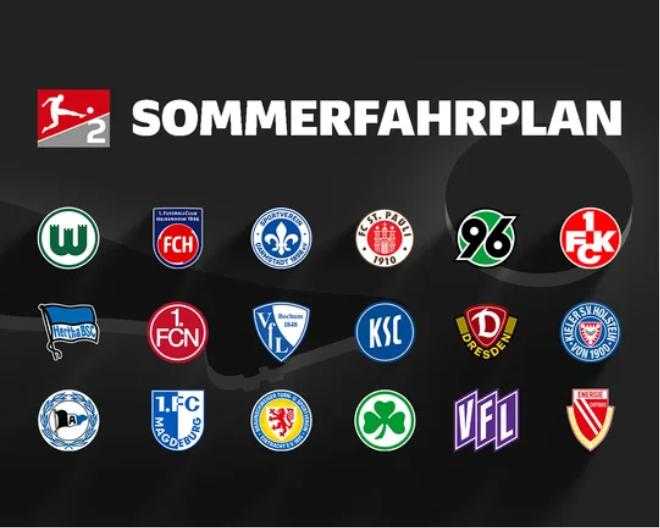
The 2025/26 2. Bundesliga season contained surprises up top and at the bottom which are worth investigating. Schalke 04 romped to the title in the end, finishing eight points clear of SV Elversberg in 2nd. Schalke had finished the prior season in 14th, after severe financial issues and on-pitch failures. The appointment of Miron Muslić as manager last summer signaled an inevitable improvement, although a title charge still seemed far off. Establishing a strong defensive unit, Muslić made his side incredibly tough to beat at the expense of outscoring opponents. Even clubs that finished down in 13th and 14th scored more than Schalke over the course of the season.
SV Elversberg were cruelly denied promotion by a 90+5th minute winner in the second leg of their promotion/relegation playoff in 2024/25, but managed to go one better last season, sealing promotion to the Bundesliga on the final matchday. The villagers will compete in the Bundesliga for the first time in their history. SC Paderborn caused an upset by winning the playoff against VfL Wolfsburg, whose 29-year Bundesliga stint came to an abrupt end.
Amongst the middling clubs, Hannover 96, SV Darmstadt and Hertha Berlin managed to climb up the table but fell short of a proper promotion push. In the other direction, relegated side Holstein Kiel limped along to a 12th-placed finish, while 1. FC Magdeburg ended up 14 points worse off, dropping from 5th to 14th. Greuther Fürth also fell from 13th to 16th, only avoiding automatic relegation by leapfrogging Fortuna Düsseldorf on the final day. Fortuna’s relegation was confirmed as a result of that 3:0 defeat in Fürth, joining Preußen Münster in next season’s 3. Liga.
For the first time since 2019, and the first time following the removal of the infamous away goals rule, three clubs will be switching places between the Bundesliga and the Zweite. The aforementioned promotion/relegation playoff saw Paderborn swap with Wolfsburg, alongside the top two of Schalke and Elversberg.
The other two sides returning from short stints in the Bundesliga are 1. FC Heidenheim and FC. St Pauli. Heidenheim, being a village club, reached the dizzying heights of the UEFA Conference League in their debut Bundesliga season in 2023/24, before the European campaign saw them suffer in the league. After surviving the league phase of their European competition, they were knocked out of the playoff round by FC Copenhagen, and ever the fan of the playoff, they only achieved Klassenerhalt (avoiding relegation) by dispatching Elversberg in the promotion/relegation playoff. Last season was one too many, and despite a late rally to maintain Bundesliga status, a final day loss at home to 1. FSV Mainz 05 sealed their fate.
Hamburg-based St. Pauli ended a two-year stay in the top flight in 18th place, after a true winner-takes-all final match when they hosted Wolfsburg, with the bottom three clubs all level on 26 points. With only 29 goals in the Bundesliga, St. Pauli hardly gave themselves a chance of survival – their joint-top scorers managed just four league goals each.
At the other end, Fortuna Düsseldorf and Preußen Münster have been replaced by the two promoted sides from the 3. Liga – VfL Osnabrück and Energie Cottbus. Osnabrück are something of a yo-yo team between the second and third tiers. Having been promoted to the 2. Bundesliga in 2019 and relegated again in 2021, die Lila-Weißen (The Purple-Whites) managed to regain promotion in 2023 but faced immediate relegation. Two more years on, the fans in Lower Saxony will be hoping that this promotion is the one that sticks.
The return of Energie Cottbus is the one to get excited about. Having spent six years in the Bundesliga during the 2000s, the East Germans fell on hard times and spent six of seven seasons in the fourth-tier Regionalliga Nordost until regaining professional status in 2024. After a strong 4th-placed finish in 2024/25, die Lausitzer (The Lusatians) achieved the coveted promotion spot and will join Dynamo Dresden and Magdeburg in the Ossi contingent of the Zweite.
Four clubs have confirmed managerial changes over the summer. Karlsruher SC and Arminia Bielefeld let their respective managers, Christian Eichner and Michél Kniat, leave by mutual consent after mid-table finishes. Eichner leaves Karlsruher after six-and-a-half seasons, while Kniat departs after three years. Karlsruher have brought in Maximilian Senft, who leaves Austrian Bundesliga outfit SV Ried after achieving a solid 7th-placed finish (out of 12) one year after winning promotion from the second tier. Arminia, meanwhile, are bringing in Oliver Kirch, a former player who held several youth coaching positions from 2018 to 2021, before stints as manager of Hamburger SV U-19, Borussia Mönchengladbach U-19, and Borussia Mönchengladbach II.
Dieter Hecking, who returned to Wolfsburg in a “firefighter” capacity in March but failed to save the club’s Bundesliga status, has moved up to a Sporting Director position. His replacement is Tobias Strobl, who coached minnows SC Verl to 6th in the 3. Liga by playing a possession-based style which he will seek to implement at a Wolfsburg side that should be dominating opponents this season with the squad they have.
The final managerial change happened at St. Pauli, where Alexander Blessin was sacked following relegation. Marcel Rapp, having been fired himself by Holstein Kiel after just over four years in charge, will move slightly south to take the reins. Rapp brought Kiel to their first (and so far, only) Bundesliga campaign, and stayed in post following relegation, but his failure to mount another promotion charge led to him being dismissed in February 2026.
There are four former Bundesliga champions present in the 2. Bundesliga this season – Wolfsburg, 1. FC Kaiserslautern, 1. FC Nürnberg and Eintracht Braunschweig. But before I move on to two of these, let’s start with a club that has two German titles from the pre-Bundesliga era: Hannover 96.
Die Roten (The Reds, which is confusing due to the green, white and black logo) won the German championship in 1938 and 1954, and became the only second tier club to win the DFB-Pokal by defeating Borussia Mönchengladbach on penalties in 1992. After a relatively successful period during the 2000s, and two consecutive Europa League campaigns from 2011 to 2013, they were relegated in 2016. Despite immediate promotion under former academy graduate André Breitenreiter, they never fully took to the Bundesliga again, and Breitenreiter was sacked in 2019 as the club headed towards a relegation that they have failed to bounce back from. Six further managers came and went before Breitenreiter returned in December 2024 for the rest of the season but only guided the club to 9th. Now under the guidance of Christian Titz, H96 have one of the strongest squads in the division and it’s only a matter of time until they bring the impressive 49,000-capacity Heinz von Heiden-Arena back to where it belongs.
We now march southbound to Bavaria, where 1. FC Nürnberg are located. The 1967/68 Bundesliga champions, who also boast seven national titles from the previous era, have been out of the top flight just as long as H96, being relegated in 2019 but never finishing higher than 8th since as they have struggled for consistency since. Leaning into their status as a breeding ground for young talent, Der Club has achieved its top five record player sales in just the last three seasons. Nathaniel Brown and Can Uzun are academy products that were sold to Eintracht Frankfurt for a combined €25m, while Finn Jeltsch was sold to VfB Stuttgart for €9.5m. Caspar Jander was signed from MSV Duisburg for no cost before being sold a year later to Southampton for €12m, while Stefanos Tzimas was sold to Brighton and Hove Albion for €26.5m just six months after signing from PAOK in his native Greece. With several other prospects in their ranks for the coming season, and German legend Miroslav Klose entering his third season as Head Coach, fans at the 50,000-capacity Max-Morlock-Stadion will be hoping that their beloved club can build on its progress to mount a real push for promotion this time around.
Two-time Bundesliga champions 1. FC Kaiserslautern are the third and final club with significant pedigree to make it into this segment. With the iconic Fritz-Walter-Stadion sitting at a capacity of 49,327 (just behind Nürnberg and ahead of Hannover), the Rhineland-Palatinate club are also seeking to return to the Bundesliga, having last featured in 2011/12. Although they featured in 40 of the first 41 Bundesliga seasons, Die roten Teufel (The Red Devils) have spent 14 of the 20 seasons since then in the 2. Bundesliga, even slipping down to the third tier for the first time ever in 2018 and only returning four years later. After 10 years as Eintracht Braunschweig Head Coach, followed by shorter stints with MSV Duisburg and SV Darmstadt, former academy graduate Torsten Lieberknecht is in his rightful position as Lautern Head Coach, entering his second full season. Having recently forged an identity as a proving ground for loanees from Bundesliga clubs, could this be the season that FCK finally return to the big time?
This may surprise some readers since they were in the Bundesliga only two seasons ago, but Holstein Kiel were truly punching above their weight with that achievement. The most far-north professional club in Germany, and Schleswig-Holstein’s only professional representative, they only reached the 2. Bundesliga for the first time in 2017, having spent time in the second tier in the 60s and 70s when it was still split regionally. Eventually reaching the Bundesliga for 2024/25, the debutants managed only six wins and were relegated in 17th. Their return to the Zweite ended in a fairly disappointing finish in 12th place, with Tim Walter coming in mid-season for his second spell in charge to replace the long-serving Marcel Rapp. Die Störche (The Storks) have been superbly well-managed in the 21st century, having had to raise €1.6m to renovate their ground as it was completely unsuitable for professional football. Never ones to overinvest, their record signing is American left-back John Tolkin who was signed during the Bundesliga campaign for €2.5m and he remains at the club today.
VfL Osnabrück are another northern club that makes this list, and one of only two sides this season (alongside 1. FC Magdeburg) that have never played in the Bundesliga. They have done fantastically well to achieve seven promotions into the second tier since 2000, but unfortunately four of the six previous promotions have ended in immediate relegation. The good news is that they have never dropped below the third tier in their history, ensuring a stability that many clubs in Germany will be jealous of. The 15,741-capacity Stadion an der Bremer Brücke is always packed with fans sporting the famous violet club colours, and they will be hoping that this time they are here to stay in the second tier. Manager Timo Schultz joined last summer and achieved what he set out to do, but he has come off a short spell at FC Basel where he only won once in the Swiss Super League, followed by a Bundesliga relegation with 1. FC Köln. Maybe he has found his level now – the people of Osnabrück need it to be true for this occasion to be different.
Coming off the back of a three-year Bundesliga stint which included a UEFA Conference League campaign, fans across Germany are mostly happy to see 1. FC Heidenheim finally heading in the other direction. A small town of just 50,000 people, Heidenheim’s fortunes changed in 2007 when the football club separated from a larger multi-sport club, Heidenheimer SB. Hometown hero Frank Schmidt retired and became Head Coach that same year and is now entering his 20th season in the role, having broken the record for longest-serving Head Coach three years ago already. Hardly anyone outside Baden-Württemberg had heard of the town of Heidenheim, let alone the club, but with backing from hundreds of local businesses, the club rose through the leagues to reach the 2. Bundesliga for the first time in 2014. Now returning after their stay in the Bundesliga, this will be a huge season for Schmidt and his team. With the oldest average age in the league (26.4), the Heidenheim players certainly have the experience and mental strength to get back to the Bundesliga. If they drift back into mid-table obscurity, however, I can see Schmidt finally leaving, which would really see everything unravel.
Joel Chima Fujita – FC St. Pauli – Central Midfielder
St. Pauli’s most critical player this season will be the 24-year-old technician, Joel Chima Fujita. Although he didn’t make the World Cup squad, Fujita is a Japanese international player that is also half-Nigerian, and he came to Europe through the Japanese-owned club Sint-Truiden in Belgium. Having signed for St. Pauli last summer, Fujita was a starter in the relegated side but was one of the few that stood out. I believe that a return to the Bundesliga, whether it be with St. Pauli or by being signed elsewhere, is on the cards by this time next year.
Mohamed Alì Zoma – 1. FC Nürnberg – Striker
Zoma appeared from essentially nowhere to become one of the most talked about 2. Bundesliga players last season. Born and raised in Italy, the striker, who can also play in a withdrawn role or on the left, spent four seasons with AlbinoLeffe in Serie C. Nürnberg picked him up for just €800k last summer, and Zoma has not looked out of place at all. With 14 goals and four assists last season, the 22-year-old could really kick on and should be aiming for the top scorer award.
Patrick Mainka – 1. FC Heidenheim – Central Defender
The Heidenheim captain proved himself as a Bundesliga-level defender during Heidenheim’s spell in the top flight, so he returns to the second tier as one of the league’s elite players. Now 31, Mainka has been a mainstay under Frank Schmidt and has played every single league fixture since the start of 2022/23. If the club is to fight for an immediate return to the Bundesliga, he will be a huge part of it. Standing at an imposing 6ft4, Mainka isn’t one to get on the ball and play passes that cut through the lines, but he will shut down strikers and win every duel during set-pieces. At this level, that should be enough.
Pascal Loretz – Hannover 96 – Goalkeeper
Hannover have been building for promotion for many years now, and it’s signings like this that make me believe that they are serious about it this season. Loretz has been the starting goalkeeper for FC Luzern in his native Switzerland for the last three years, and at just €1.1m, H96 have got a bargain on a goalkeeper that has been touted at a future Switzerland international. Indeed, he was called up to the senior team once in 2025 as a backup option, although he didn’t get any minutes. Still only 23 years old, Loretz has a lot to learn as he moves to a new league, but he is more than capable of handling the pressure.
Ismail Badjie – VfL Osnabrück – Utility
This Osnabrück side is light on technical quality, but 20-year-old Ismail Badjie is the secret weapon in their ranks. With the 11 assists and eight goals of Lars Kehl walking out the door for free in Darmstadt’s direction, other players will have to step up and provide creativity. Last season was Badjie’s breakthrough as a first-team regular, and with eight goals to his name, he can certainly have an impact going forwards. Badjie is trained as a midfielder, but spent most of last season as a right-winger/wing-back in Timo Schultz’s 3-4-2-1. He could have a future in central midfield or as one of the two number 10s, though.
Rafael Pinto Pedrosa – Karlsruher SC – Right-Back
A prodigy that plays with maturity beyond his years, Rafael Pinto Pedrosa cemented his place in Karlsruher’s first-team last season, competing with the veteran Sebastian Jung. Still only 18, he started four matches at this summer’s U-19 Euros with Germany, as they finished runners-up to Spain. Mostly used as a wing-back at club level, Pinto is capable of providing a strong attacking outlet, creating 15 chances and being in the 89th percentile for fouls won last season.
Thierry Fidjeu-Tazemeta Jr. – 1. FC Kaiserslautern – Right-Winger
Another teenage prodigy to keep an eye out for, as Borussia Dortmund have loaned out Austrian 19-year-old Thierry Fidjeu-Tazemeta Jr. to Kaiserslautern. The son of a former Equatorial Guinea international, Tazemeta is a 6ft4 winger with phenomenal physicality and agility, also possessing a strong eye for goal. He scored nine times in just 14 games for the BVB U-19s last season, and it speaks volumes to how highly rated he is at his parent club that they’ve opted to skip the 3. Liga and loan him to a big club in the second tier.
Linus Gechter – Hertha Berlin – Central Defender
A Hertha Berlin academy product, Linus Gechter is now in his sixth season as a professional despite only being 22. Having started in all 30 leagues games that he featured in last term, he has cemented his spot in the XI and it’s time for him to really kick on. Gechter is exceptional at pure defending but is also comfortable with progressing the ball, whether that be with progressive passes into midfield or carrying the ball himself. Now also a fixture in Germany’s U-21 squad, Gechter plainly has a future in the Bundesliga and it’s time for him to step up.
Mateusz Żukowski – 1. FC Magdeburg – Striker
The 2. Bundesliga unicorn is undoubtedly Mateusz Żukowski. With 17 goals in only 21 games last season, Żukowski is the highest-scoring player that remains in the league for next season (top scorer Noel Futkeu left Greuther Fürth for Eintracht Frankfurt). Having been signed as a right-back a year ago from relegated Polish side Śląsk Wrocław, Żukowski did not feature until November. An injury crisis forced him into the starting lineup as a striker, and two goals later, he was the club hero. The 24-year-old even made his debut for Poland in May. Having found a new lease of life, watch out to see if he can keep it up his habit of scoring goals.
Fabian Reese – VfL Wolfsburg – Attacking Midfielder/Left-Winger
Last, but by no means least, we have Wolfsburg’s new signing, Fabian Reese. Reese has consistently been one of the best players in the second division for six years now, first at Holstein Kiel and then at Hertha Berlin. With 46 goals and 38 assists in his last four campaigns, Reese is exactly the player Wolfsburg need as they adapt to life in the second tier. Amongst all the players with far higher market values on Wolfsburg’s books, the 28-year-old sporting his (in)famous headband will deliver the numbers needed under Tobias Strobl’s guidance.
Frankenderby - Nürnberg vs. Greuther Fürth
In the northern part of Bavaria lies the historical region of Franconia, or Franken as the Germans call it. Nürnberg is the largest city in the region, but just 10 kilometres away is the city of Fürth, part of the Nürnberg metropolitan region but very much a city in its own right. 1. FC Nürnberg’s accolades have been referenced already, but in the 1910s and 20s, the two teams developed a huge rivalry as Fürth became strong challengers, winning three national championships.
The two club’s fortunes diverged significantly after this period, and Fürth have only competed in the Bundesliga twice – in 2012/13 and 2022/23. But with both clubs now solidly contained within the second tier, the rivalry has developed a different edge. Nürnberg’s largest attendances tend to be for the Derby, and they maintain the upper hand by some distance. Der Club has 142 wins to 82 for die Kleeblätter (The Shamrocks), with 52 draws across numerous competitions in the two clubs’ storied pasts. Honours were even in both editions of the Frankenderby last term, so let’s hope we see a decider this time around.
Elb-Clásico – Dynamo Dresden vs. Magdeburg
This East German classic is fiercely competitive, and absolutely worth a watch as a neutral. Smartly dubbed the “Elb-Clásico”, referencing the River Elbe, this derby between two heavyweights of the old DDR-Oberliga remains in the 2. Bundesliga as Dynamo Dresden achieved a solid 11th-place finish after a three year stint in the 3. Liga. Based in the capital of Sachsen (Saxony), Dynamo Dresden were one of the dominant teams in the DDR, achieving eight league titles, second only to Berliner FC Dynamo. Magdeburg, which is the capital of the neighbouring state Sachsen-Anhalt, were the joint-most successful cup team in the DRR, winning seven and tying Dresden’s record. Magdeburg also won the DDR-Oberliga on three occasions.
Since reunification, Dresden began in the Bundesliga but were relegated in 1995, and neither club has featured in the top-flight since. This makes the derby even more spicy as there is a whole generation of fans that have not seen either club above the second tier. Every win these two claim over one another is seen as a step closer to reaching the Bundesliga again. Dresden hold the lead with 42 to 23 with 21 draws, however the Elb-Clásico record in the 2. Bundesliga is finely poised at 1-2-1. With both clubs able to hose just over 30,000 fans on matchdays, the atmosphere is always electric, and dare I say vicious.
Niedersachsenderby – Hannover 96 vs. Eintracht Braunschweig
The closest head-to-head record of any 2. Bundesliga derby belongs to the Niedersachsenderby (Lower Saxony Derby), between Hannover and Braunschweig. With the clubs 55km apart, it is not the geographically closest rivalry in Germany, but it is certainly one of the oldest. With die Löwen (The Lions) founded in 1895, and Hannover in 1896, Braunschweig fans to this very day refuse to say the number “96”, instead preferring to say “95+1” to cement their bragging rights as the oldest club in the state of Niedersachsen. The clubs competed closely in the Oberliga Nord in the first half of the 20th century, and with Hannover leading in national champions by two to one, they can now claim that as the ultimate win.
In recent years, the derby hasn’t occurred as often since Braunschweig have only featured in one Bundesliga campaign since 1985. But with Hannover now in a lengthy second tier spell, the rivalry has begun to heat up significantly with the derby heading into its fifth consecutive league season. The all-time records for the Niedersachsenderby have Eintracht Braunschweig ahead, with 69 wins to Hannover’s 60, with 31 draws. However, in the post-war period, Hannover now lead by 32 wins to 30 as they picked up six points from the two matchups last season, so for any fan of these two clubs that is still alive, they’ll have almost definitely seen Hannover do more winning.
1 – VfL Wolfsburg
2 – Hannover 96
3 – SV Darmstadt
4 – 1. FC Nürnberg
5 – 1. FC Kaiserslautern
6 – FC St. Pauli
7 – Hertha Berlin
8 – 1. FC Heidenheim
9 – Karlsruher SC
10 – Dynamo Dresden
11 – VfL Bochum
12 – Arminia Bielefeld
13 – Greuther Fürth
14 – Energie Cottbus
15 – Holstein Kiel
16 – 1. FC Magdeburg
17 – Eintracht Braunschweig
18 – VfL Osnabrück
No posts
Comments
Nothing yet. Say the first thing.
Sign in to join the conversation.