
You challenged me to provide three arguments against abortion that are not based on religion. Fair enough. I will accept that challenge. None of the following arguments appeal to God, Scripture, or divine authority. Instead, they concern equality, labour economics, and legal philosophy.
The three arguments below are not arguments about souls or fetal personhood. They are questions about political philosophy:
Does abortion make equality harder to achieve?
Does it alter labour markets and bargaining power in ways that affect others?
Does it establish a legal principle concerning the unequal protection of human life that may later be extended beyond abortion itself?
My purpose is not to relitigate the traditional pro-life case. It is to examine whether unrestricted abortion creates tensions within the egalitarian principles that many of its defenders also embrace.
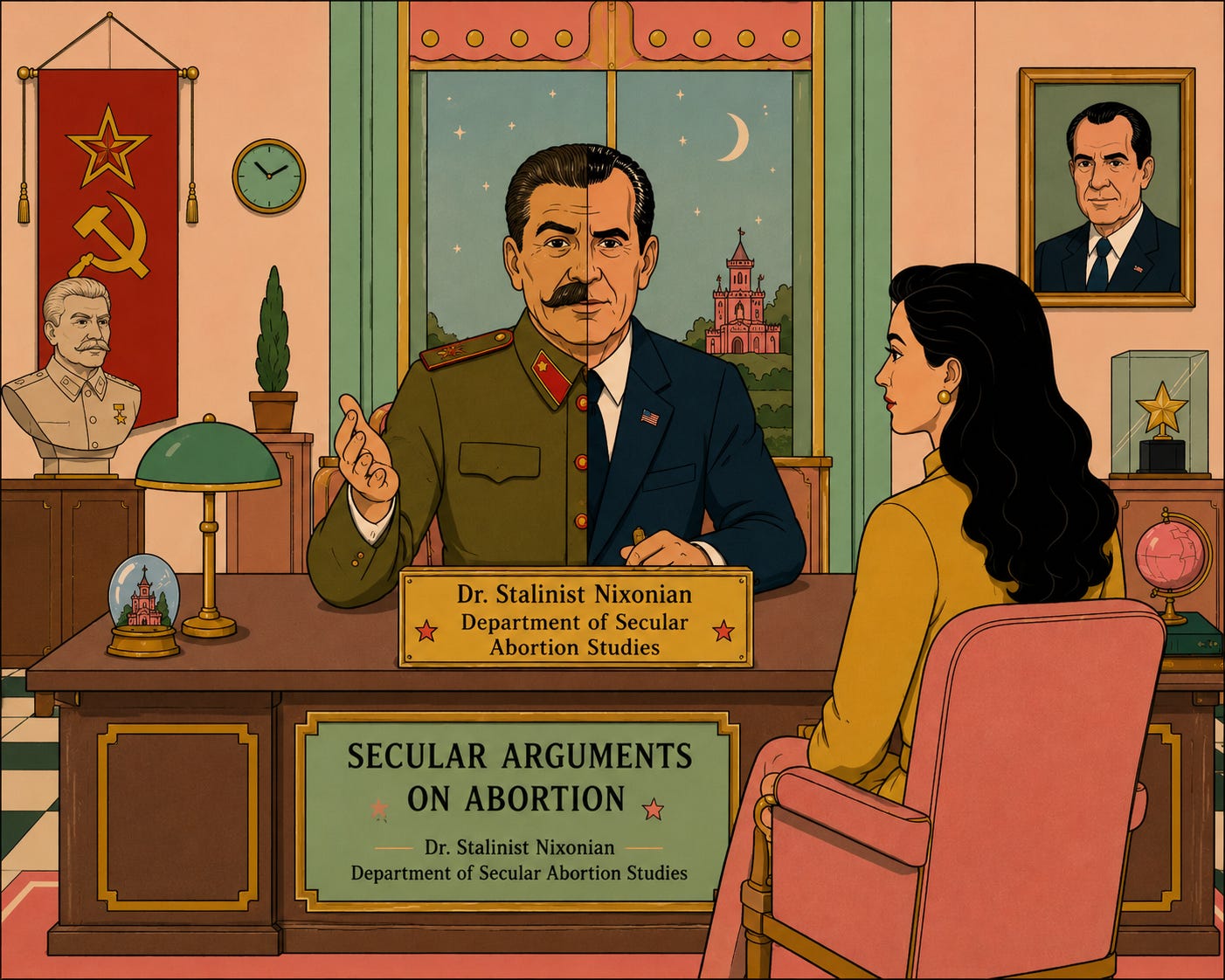
Whatever one may think of abortion at the individual level of choice, abortion, the limiting of some natural offspring in response to financial or personal constraints, has the effect of de-equalizing a social group.
Some people ultimately have more abortions than others. This creates an incongruence within a population, analogous to restricting some people from access to water while others possess an abundance. The demographic result is no longer equal. At the very least, it complicates any egalitarian project.
The end result, and this is a completely non-religious argument, is that equality becomes more difficult to achieve, not only for women, but especially across generations of men.
Abortions have the added effect of complicating labour dynamics.
If a region or country must continually replenish its labour force from elsewhere because domestic fertility has fallen, this further disrupts any project of equality. The bargaining power of workers, and particularly of men in many sectors, is diminished because society has permitted some segments of the population to exchange the natural rise and fall of fertility for an artificial trade-off driven by financial and personal considerations.
The consequences of that trade-off are not confined to those making the decision. They ripple outward, affecting wages, labour supply, migration, and the economic position of others who had no part in the original choice.
By maintaining a blanket position in favour of abortion without meaningful restriction, one also opens the door to broader questions about how society partitions the legal right over life and death.
If the principle that human life is ordinarily subject to legal protection is weakened, a precedent is established that can later be extended into entirely different areas. Someone may argue that the life of a sex worker is legally less valuable than that of a citizen engaged in another profession. Others may apply similar reasoning to different occupations, social classes, age groups, or biological categories.
The principle can be extended further still. Someone may conclude that a particular group is troublesome and therefore ought to experience higher abortion rates than the general population. At that point, the blanket “my rights” position is forced to confront the reality that rights have become conditional rather than universal. Once exceptions are accepted in principle, the debate shifts from whether unequal legal protection is permissible to which lives deserve less protection. This, too, is a secular argument. It concerns legal precedent rather than theology.
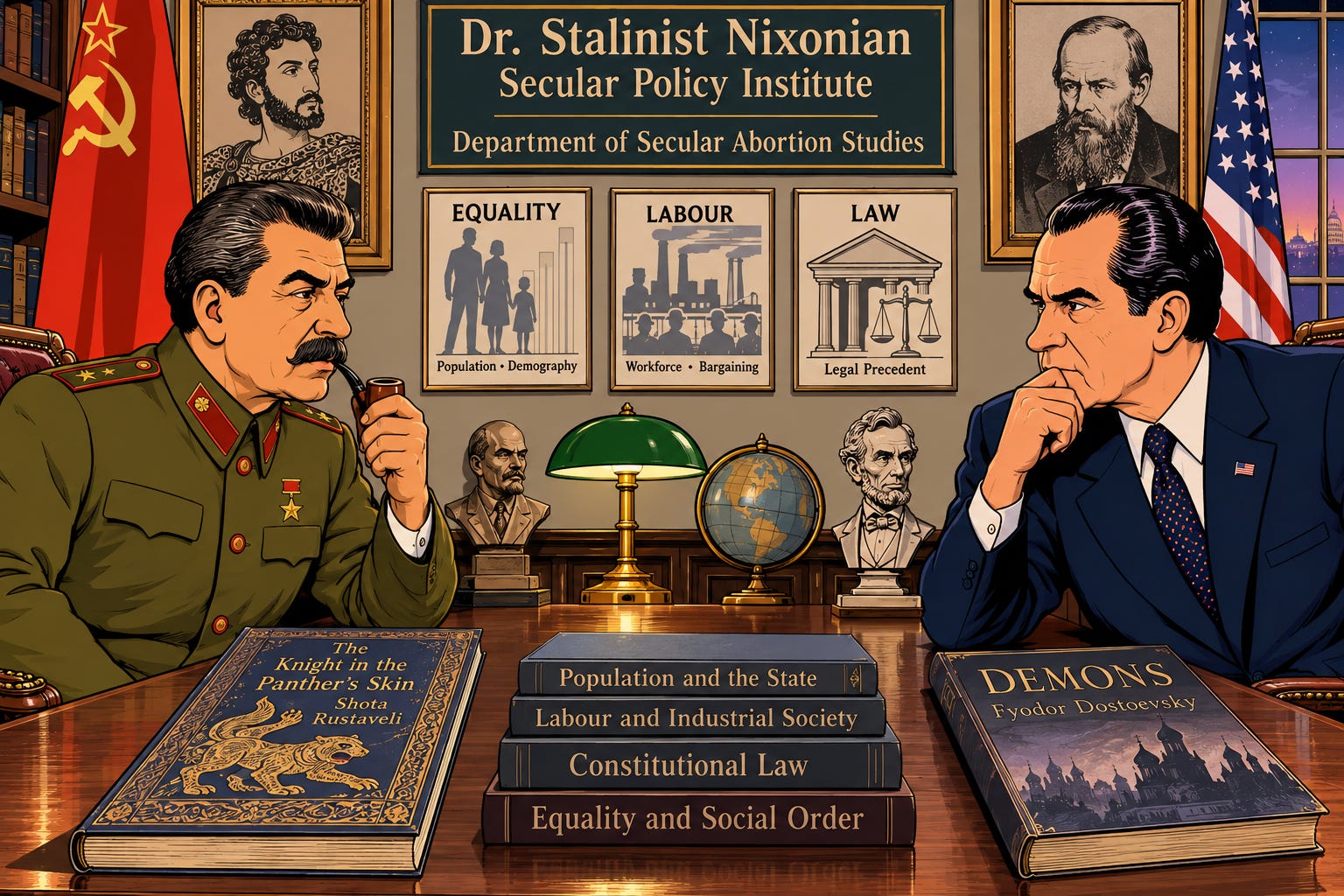
Whether these arguments ultimately persuade anyone is a separate question. My point is simply that it is incorrect to claim that opposition to abortion must be religious. One can oppose unrestricted abortion on demographic grounds, on labour-economic grounds, or on legal-philosophical grounds without invoking God or religion at all.
Those arguments may succeed or fail on their own merits, but they are recognizably secular arguments, and therefore they meet the challenge of providing non-religious objections to abortion. Ultimately, all three of my arguments are about “equality” and people who claim to believe in any “egalitarian” project. None of my arguments are appeals to hierarchy or tradition.

No posts
Comments
Nothing yet. Say the first thing.
Sign in to join the conversation.