
According to later Roman tradition, this ten-month calendar belonged to Rome’s earliest royal period, from the legendary foundation by Romulus around 753 BC until reforms attributed to King Numa around 700 BC. It contained 304 named days, beginning in March, followed by approximately 60 winter days that belonged to no named month. Because this account comes from much later Roman writers, it should be understood as Rome’s traditional reconstruction of its earliest calendar.
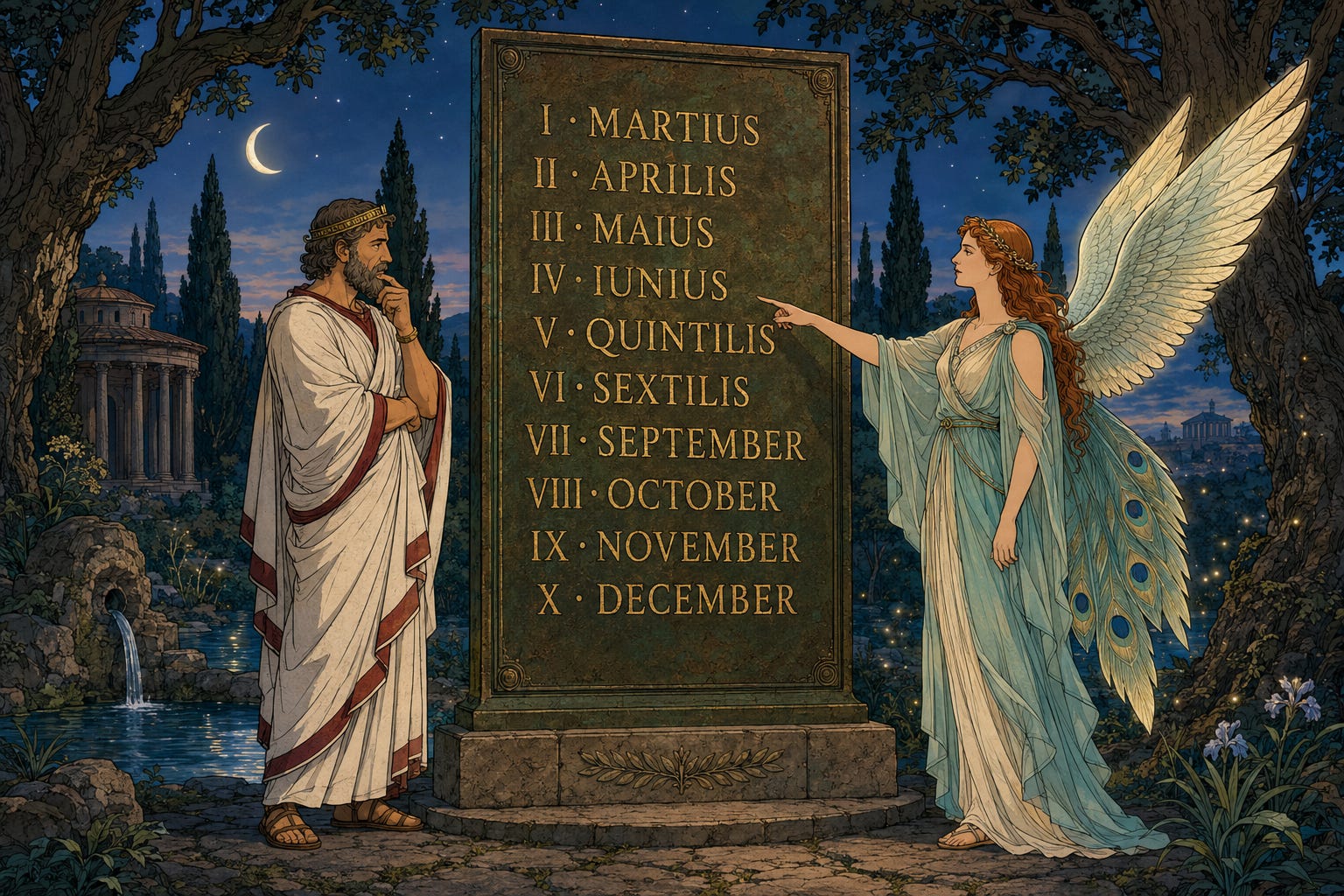
Martius — March — 31 days - Named for Mars, who was not merely the god of war but also a protector of fields and the Roman community. March opened spring, the agricultural year and the traditional military campaigning season.
Aprilis — April — 30 days - Its origin is uncertain. It may derive from aperire, “to open,” referring to the opening of flowers and the earth in spring. Another theory connects it with the Etruscan Apru, derived from Aphrodite and therefore associated with the Roman goddess Venus.
Maius — May — 31 days - Probably named for Maia, an ancient goddess associated with growth, increase and the fertility of the earth. The month represented the strengthening and expansion of spring life.
Iunius — June — 30 days - Probably named for Juno, queen of the Roman gods and protector of marriage, women and the Roman state. An alternative ancient explanation connected Iunius with the iuniores, the younger members of Roman society.
Quintilis — later July — 31 days - Literally the “Fifth Month,” from Latin quintus, “fifth.” It was not originally named for a god. After Julius Caesar’s death, it was renamed Iulius—July—in his honour.
Sextilis — later August — 30 days - Literally the “Sixth Month,” from Latin sextus, “sixth.” It likewise had no deity in its original name. In 8 BCE it was renamed Augustus—August—in honour of Emperor Augustus.
September — 30 days - From Latin septem, meaning “seven.” It was originally the seventh month. It was not named for a god, although later Roman September contained the great Roman Games, the Ludi Romani, celebrated in honour of Jupiter.
October — 31 days - From Latin octo, meaning “eight.” October originally marked the eighth month. Its later religious festivals were particularly connected with Mars and the ceremonial closing of the military campaigning season.
November — 30 days - From Latin novem, meaning “nine.” The name itself had no divine association. In the later Roman calendar, November contained the Plebeian Games, which were celebrated principally in honour of Jupiter.
December — 30 days - From Latin decem, meaning “ten.” It closed the sequence of named months. Its most famous later festival was the Saturnalia, honouring Saturn, the ancient god of agriculture, abundance and the legendary Golden Age.
The complete numerical sequence was therefore once perfectly logical: Quintilis was five, Sextilis six, September seven, October eight, November nine and December ten. January and February displaced this pattern by two positions; the later renaming of Quintilis and Sextilis then concealed the first numerical sequence.
King Numa Pompilius transformed Rome’s original ten-month calendar into a twelve-month lunar calendar. He added Ianuarius, January and Februarius, February, to the previously unnamed winter period. He also altered the lengths of the older months, producing a year of approximately 355 days, with an occasional intercalary month inserted to correct seasonal drift. Ancient sources disagree about the original position of January and February. The usual reconstruction places them after December until the Roman Republic made January 1 the beginning of the consular year in 153 BC.
That January shift displaced all the older months by two positions:
Martius: 1st → 3rd
Quintilis: 5th → 7th
Sextilis: 6th → 8th
September: 7th → 9th
October: 8th → 10th
November: 9th → 11th
December: 10th → 12th
This, not Caesar’s reform, created the mismatch between the numerical month names and their modern positions.
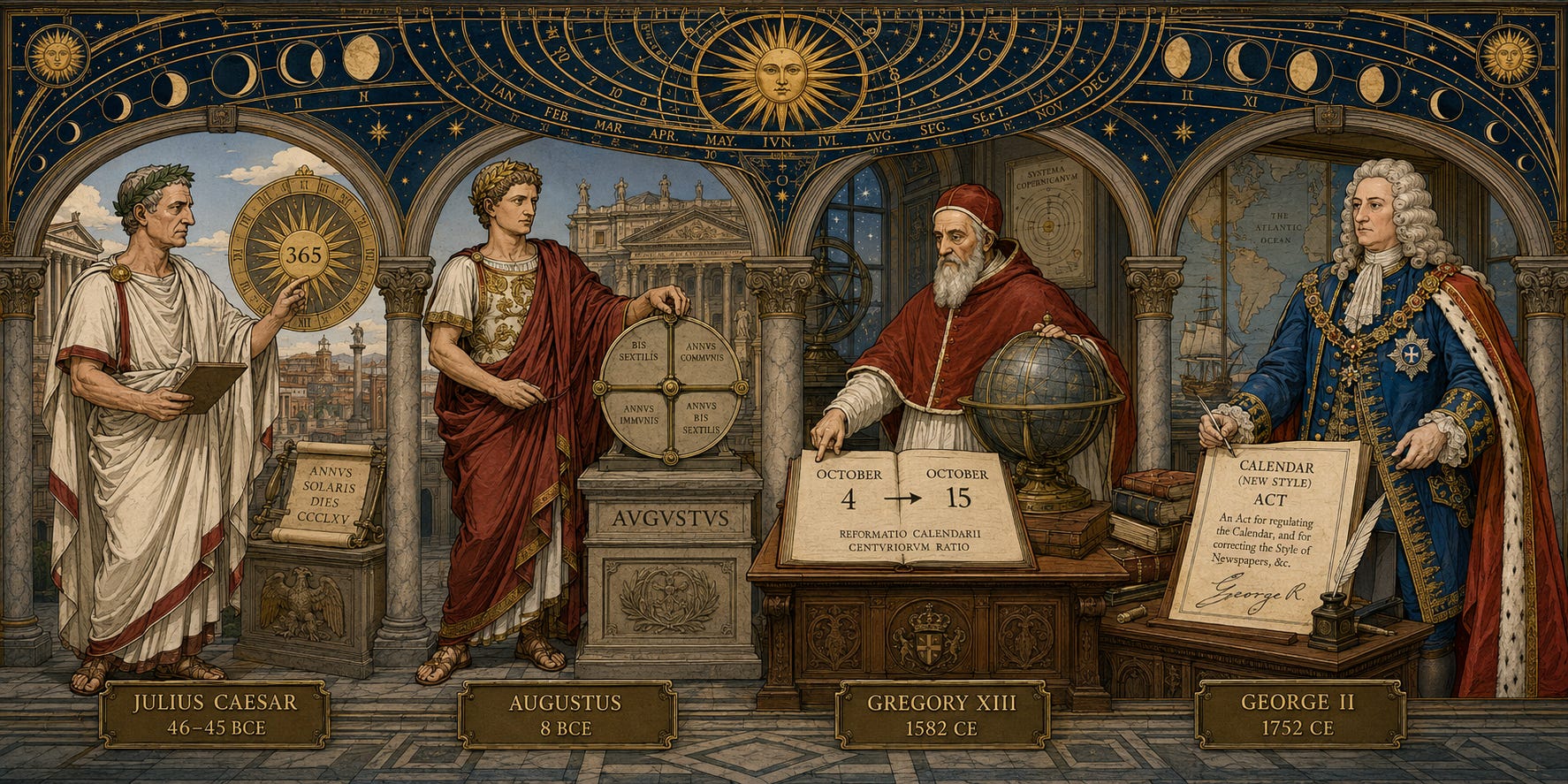
By Caesar’s lifetime, Roman priests had applied intercalation inconsistently, allowing the calendar to drift badly out of alignment with the seasons. Julius Caesar therefore replaced the old lunar system with a solar calendar. His reform was proclaimed in 46 BC and took effect on January 1, 45 BC. It established:
A normal year of 365 days
An additional leap day every fourth year
Regularized month lengths
January 1 as the beginning of the year
After his death in 44 BCE, Quintilis, the former “Fifth Month” was renamed Iulius, or July, in his honour.
Roman priests initially misunderstood Caesar’s leap-year instructions and inserted a leap day every third year instead of every fourth. Emperor Augustus corrected the error by temporarily suspending leap days until the calendar returned to its intended position. The proper four-year cycle was then restored. In 8 BC, Sextilis, the former “Sixth Month” was renamed Augustus, or August, in his honour. A popular story claims that Augustus stole a day from February to give his month 31 days. This story is almost certainly a later medieval invention: August already possessed 31 days under the Julian arrangement.
Caesar had calculated the solar year as exactly 365¼ days, but the real solar year is approximately eleven minutes shorter. That small annual error accumulated until the Julian calendar had drifted about ten days away from the seasons. In 1582, Pope Gregory XIII introduced the Gregorian calendar. The reform:
Omitted ten calendar dates to restore the traditional position of the spring equinox
Retained leap years in years divisible by four
Removed the leap day from century years unless the year was also divisible by 400
Parliament adopted the Gregorian calendar throughout Britain and its colonies, moved the legal New Year from March 25 to January 1, and omitted 11 days in September 1752 to bring Britain into line with most of Europe.
Consequently, 1600 and 2000 were leap years, while 1700, 1800 and 1900 were not. Pope Gregory changed neither the names nor the order of the months. Britain, under George II, King of Great Britain and Ireland, adopted the Gregorian calendar in 1752, by which point eleven dates had to be omitted. Our modern calendar is therefore Roman in its month names and order, Julian in its basic solar structure, and Gregorian in its leap-year correction.
No posts
Comments
Nothing yet. Say the first thing.
Sign in to join the conversation.