

Before discussing abortion, I want to ask a more fundamental question: why does equality matter at all? For more than two centuries, beginning with the great democratic revolutions of the 18th century, equality has occupied a privileged place within Western political thought. The French Revolution proclaimed Liberté, Égalité, Fraternité. The American Revolution declared that “all men are created equal.” ( Englishmen, only ) The 19th and 20th centuries extended the principle to workers, religious minorities, women, racial minorities, people with disabilities, and countless others.
Modern progressive politics has, in many respects, become a continual project of expanding the circle of equality and inclusion. ( I am willing to grant two assumptions that are often made in contemporary debate. First, I will set aside religion entirely. I will not appeal to God, souls or divine commands. Second, I will set aside the claim that “what men think” should determine the rights of women. ) Yet a question remains. Why is Abortion the point at which egalitarian philosophy changes the direction of the burden of proof?
Why is equality regarded as such an important political principle in every other sphere of life? Why did the French Revolution seek to abolish inherited privilege and proclaim equality before the law? Why did later reformers insist that race should not matter, that religion should not determine one’s civil rights, that class should not determine access to justice, and that economic disadvantage should not determine access to education or healthcare? The thinkers are all different: Jean-Jacques Rousseau, John Rawls, and Ronald Dworkin each, treated equality as a foundational political value deserving serious justification and protection.
If equality is truly one of our highest political ideals, then it seems reasonable to ask where it begins, where it ends, and why. Why should the presumption in favour of inclusion, equal concern, and equal treatment apply so forcefully in questions of race, class, religion, nationality, disability, labour, and civil rights, yet apparently stop at birth? My purpose is not to argue that abortion should therefore be illegal. My purpose is to ask a simpler philosophical question: if equality is the principle, why is abortion the exception? The four arguments that follow demonstrate that tension without appealing to religion, patriarchy, or the moral status of the fetus.

Why is exclusion treated as morally suspect at the borders of a political community, while exclusion at the very threshold of existence is treated as an unquestionable right?
Firstly, a blanket right to abortion, or even a partial right, is, by analogy, remarkably similar to immigration restriction, a position that many progressives oppose. What do I mean by this? I mean that just as governments restrict the movement of people, as groups or as individuals, from one country into another, abortion restricts the movement of beings from non-reality into reality; from a non-world into this world. (Or, if you happen to be Mormon, from the premortal world into mortal life.) This presents an interesting problem for egalitarian thinking.
Why would one believe that “no one is illegal,” that all arbitrary lines on a map are morally suspect, and that borders ought not prevent people from entering a country, while simultaneously believing that the line between birth and non-birth is a boundary over which we possess a legal right of restriction? If we possess a right to restrict births, as many progressives maintain, then why is it inherently illegitimate to restrict the movement of migrants from one country to another?
If restricting the movement of migrants is wrong because “no one is illegal,” then, by the same egalitarian logic, restricting birth also appears problematic, because “no birth is illegal.” Conversely, if we acknowledge that society has a legitimate right to regulate who enters existence, then we have already accepted a broader principle: namely, that distinctions may legitimately be made regarding movement, admission, and membership. We have accepted that judgment may sometimes be exercised over who enters a community, under what conditions, and for what reasons.
We already accept that people are born into unequal circumstances, different citizenships, nations, advantages, disadvantages, wealth, poverty, opportunities, and obligations. Abortion adds another distinction: some births proceed, while others do not, because someone has judged that one outcome is preferable to another. In principle, I have no difficulty acknowledging this. Some births are expensive. Some involve severe hardship. Some will create greater social burdens than others. Some alter the political calculus; some births introduce sever social problems because of the nature of those born. Some are simply undesired by their parents for entirely practical or economic reasons.
Whatever the reason, however, this is no longer an argument from equality. It is an argument from distinction. It is an argument that some outcomes may legitimately be preferred over others. It is an argument that we possess a right to pass judgment. If “we,” as egalitarians, as “progressives,” as “nice people,” as equalists, believe it is wrong to pass such judgments when living people move from one state to another, it seems curious that we believe it entirely proper to pass judgments preventing an unborn being from entering the world itself. Do we believe in equality, or do we not?
If we do not, then we should explain where equality ends and legitimate distinctions begin, and why. But if we accept that distinctions may legitimately be made regarding birth itself, then it is no longer obvious why distinctions regarding migration, borders, citizenship, or admission into existing political communities are inherently illegitimate. Either we need a grounding for our “equalities” or equality as a principle is meaningless, by itself. This not a not a personhood argument, this is not a religious argument, this is not even a patriarchal argument. It's an argument about the internal consistency of a certain egalitarian worldview; if equality is important, the onus is on the restrictions to explain why “equality” ceases to matter at birth and the limitation of birth. Birth is the ultimate admission policy.

The reproductive-justice framework associated with SisterSong does not define reproductive freedom simply as the right not to have a child. They talk of three connected freedoms: the right to have children, the right not to have children, and the right to raise children in “safe communities.” This begs the question: what would equality between those three reproductive freedoms actually require? Surely they cannot be equal merely because all three theoretically exist.
If poverty, housing costs, lack of childcare, employment insecurity, or educational disadvantage make one choice vastly more difficult than another, then formal choice may conceal substantive inequality. If we are not at least willing to discuss the material requirements necessary to make all three choices genuinely available, to have, not to have, and to parent safely, then we have ceased to defend equality among choices. We have instead accepted social conditions that constrain at least one of them. If enormous political energy is devoted to protecting the ability not to have a child while comparatively little is devoted to making having and raising that child materially possible, one may reasonably ask, “Are we defending neutral choice, or expressing a political preference among the available choices?”
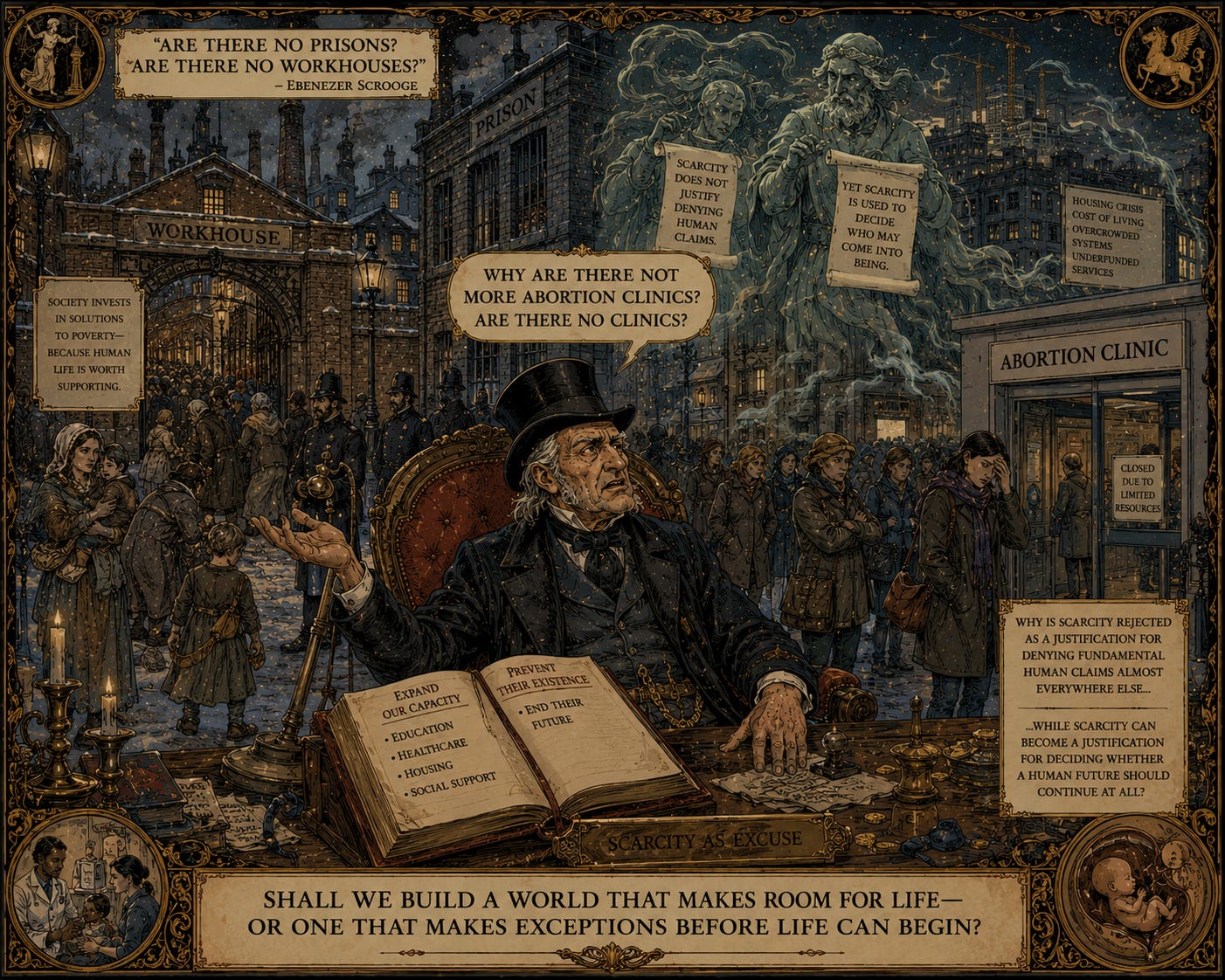
Why is scarcity rejected as a justification for denying fundamental human claims almost everywhere else, while scarcity can become a justification for deciding whether a human future should continue at all?
A second difficulty for egalitarian thinking is that abortion is difficult to reconcile with the principle of equal treatment because it necessarily involves selection. Every abortion is, in the broadest sense, a decision that one possible human future will continue while another will not continue. Regardless of the reasons involved, someone has exercised judgment over two possible outcomes. This does not make the decision immoral by itself, but it does mean that it cannot be described as morally neutral with respect to “equality.” Equality, at least in its strongest form, seeks to minimize distinctions between persons and to avoid assigning greater value to one life over another. Selection, by contrast, requires exactly such distinctions. One future is accepted; another is rejected. Even if the criterion is compassionate or practical, it remains a criterion. Making distinctions is not “egalitarian.” It is brutally hierarchal.
Notice that my argument does not depend upon religion, metaphysics, or even personhood. It is not an argument about whether the fetus possesses full legal rights given by some sort of “God” or gods. Nor is it an accusation or invitation towards the use of eugenics. It is simply an observation about the logic of equality itself. Genuine egalitarianism aspires toward impartiality, toward reducing arbitrary preferences and unequal treatment wherever possible. Abortion, however, cannot avoid the language of preference because it exists only where a choice has been made between competing possibilities. The act itself presupposes that some futures may be selected while others may be declined. Selection, even when understandable, is the opposite of indiscriminate equality.
This becomes even more apparent when one considers the common practical justifications for abortion. The reasons given are economic rather than philosophical, they assume inequality: there is not enough money, housing is unaffordable, education is expensive, healthcare is inadequate, employment is uncertain, or the future appears too difficult. Even personal humiliation or violation can be given as perfectly reasonable arguments for why abortions should be justified. In other words, scarcity, social proof, even feelings and preferences, become the justification for deciding that one potential life should not continue.
Yet all those things, are ordinarily rejected by progressives as a legitimate basis for restricting other “human claims.” If housing is a human right, then we are not ordinarily told that homelessness justifies denying people access to shelter. If healthcare is a human right, we do not conclude that limited hospital capacity means some people simply lose the right to treatment. Likewise, education is defended precisely because “equal access should not depend upon wealth or social circumstance.”
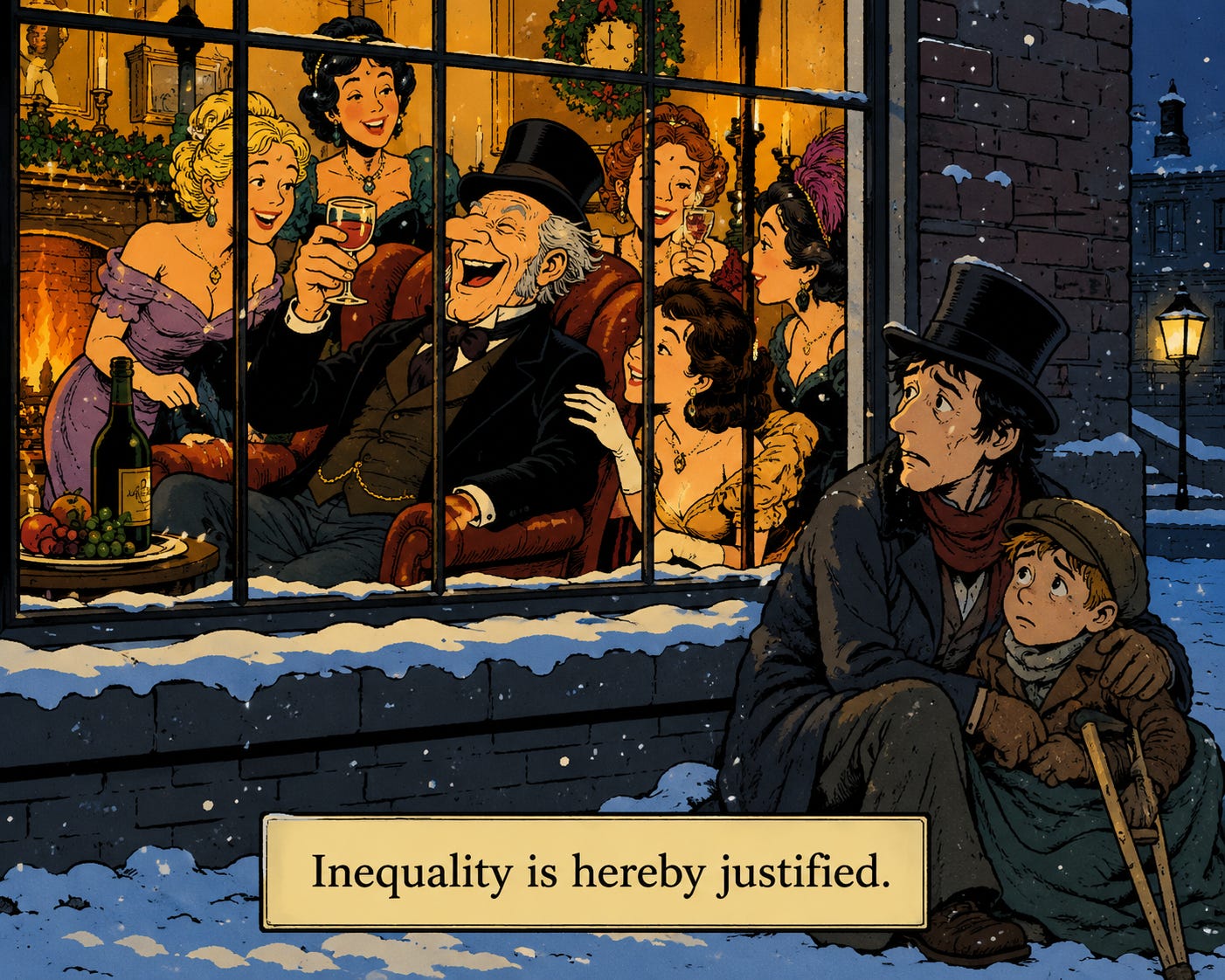
One is reminded of the words of Ebenezer Scrooge, of whom, I confess, I am a great fan, who famously asks, "Are there no prisons? Are there no workhouses?" In A Christmas Carol, Scrooge is interesting not merely because he lacks “empathy,” for children and the destitute, but because his assumption that scarcity and inconvenience justify withholding aid from those in need. Yet, when abortion is defended primarily on the grounds of insufficient housing, inadequate finances, or limited social resources, one might ask whether the same underlying logic is at play. Instead of expanding society's capacity to support another human being, the solution becomes preventing that human being from entering society at all.
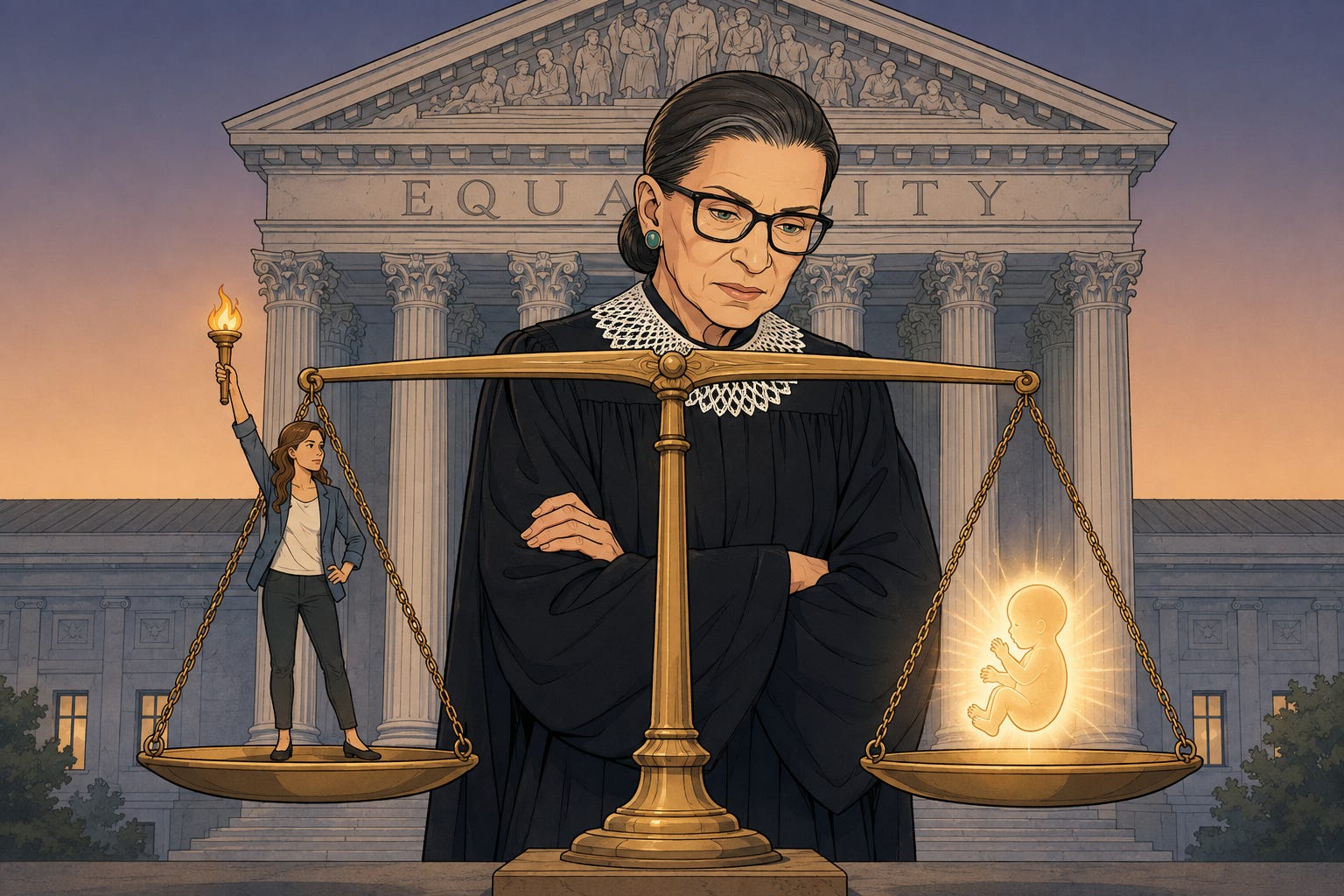
This presents a tension within egalitarian thought. If scarcity is not an acceptable justification for restricting movement across borders, denying healthcare, limiting education, or withholding housing, why does scarcity suddenly become a sufficient justification when the question is birth itself? The issue is not whether abortion should remain legal, but whether the principle being invoked is consistent. Either scarcity is a legitimate reason for limiting fundamental human claims, or it is not. If progressives reject scarcity as a justification everywhere else, then appealing to scarcity in the case of abortion appears to introduce precisely the kind of selective judgment that egalitarian philosophy ordinarily seeks to avoid. The result is that abortion sits uneasily within a worldview committed to universal equality, because it relies upon the very principles that egalitarianism resists in every other case.
Ruth Bader Ginsburg presents the problem from another direction, because she understood reproductive autonomy as an issue of women’s equality: control over reproduction affects a woman’s ability to determine the course of her life. I am willing to take that argument seriously. But doing so produces a harder question rather than ending the discussion: what happens when two claims of equality point in opposite directions? Why does egalitarianism assign priority to one equality claim when reproductive interests conflict?
Egalitarian politics does not ordinarily assume that the preferences or discomfort of one group automatically extinguish the claims of another. We do not ordinarily say that a person’s dislike of his neighbours determines whether those neighbours possess equal civil standing, or that greater abilities, wealth, power, usefulness, or desirability entitle one person to fewer constraints and fewer rights. Indeed, egalitarian politics claims to impose constraints upon what the powerful may do when their preferences collide with the interests of others. Why, therefore, is reproductive equality so frequently formulated in only one direction? If equality is doing the philosophical work, those reasons must be stated rather than smuggled into the definition of equality itself.
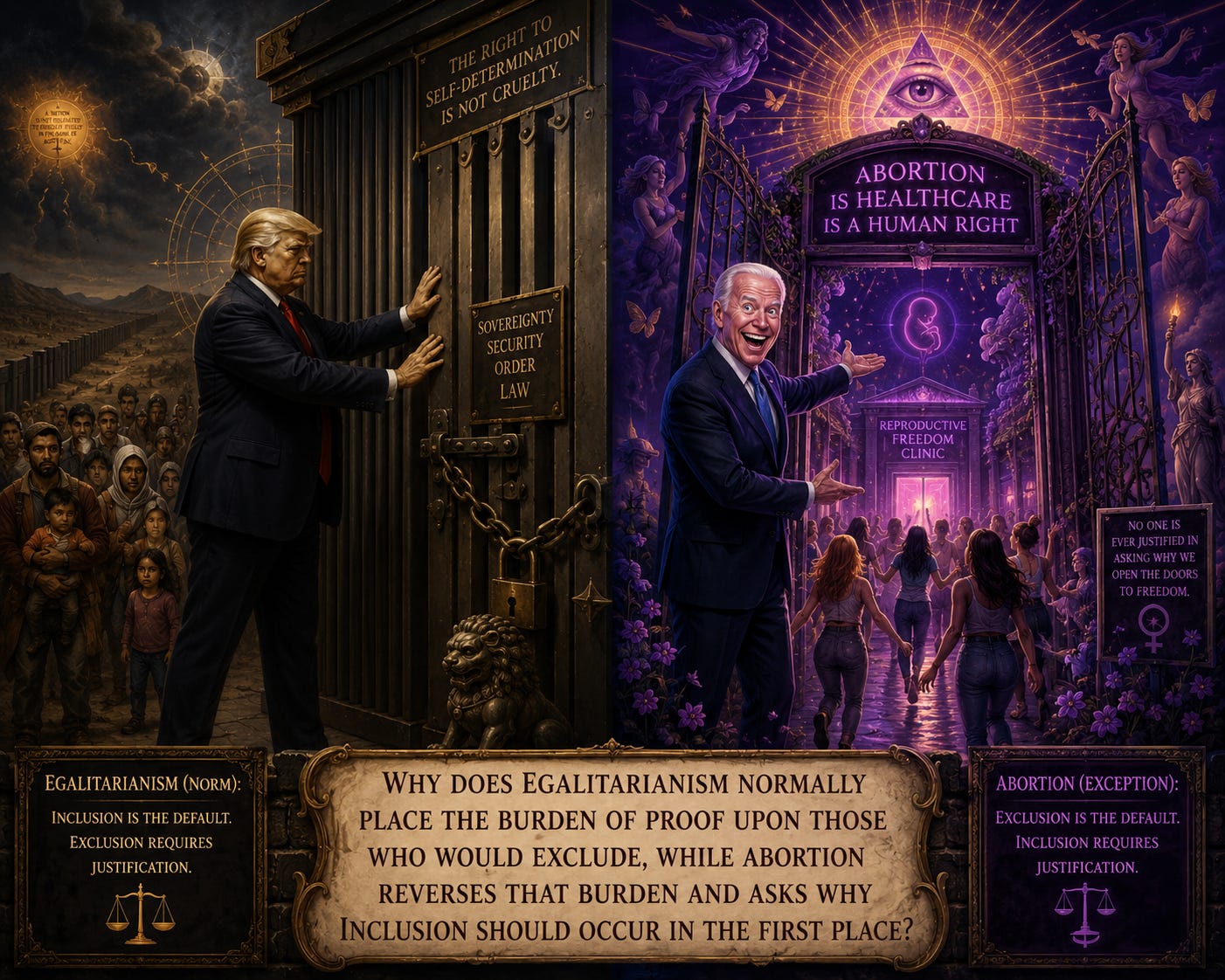
Why does egalitarianism normally place the burden of proof upon those who would exclude, while abortion reverses that burden and asks why inclusion should occur in the first place?
The deepest tension concerns the idea of conditional membership. Progressive thought is built around the expansion of inclusion. We are told that every person deserves inclusion rather than exclusion; that barriers to membership should be dismantled wherever possible. Whether the issue is race, religion, disability, nationality, sexual orientation, or economic class, the “moral instinct” is generally: widen the circle rather than narrow it. The burden of proof falls upon those who would exclude rather than those who would include. Yet abortion reverses that principle.
Abortion says that inclusion into existence is itself conditional. Before any other form of membership can exist, citizenship, civil rights, education, employment, or political participation, there is a prior decision about whether someone will be admitted into the human community at all. In every other sphere, progressives generally ask, “Why should this person be excluded?” In the case of abortion, the question becomes, “Why should this person be included?” This raises a broader question about why equality and inclusion, should even be “values” in the first place. After all, if the “rights of women” include the right to exclude “low value men,” ( And I do not object to this ) what exactly separates that from the right of governments to exclude “low value people?”
Why does the principle of unconditional inclusion appear to stop only at this one point? At nearly every other level of human society, progressives argue for inclusion rather than exclusion. We rejected segregated buses because everyone should have equal access to public space. We rejected separate water fountains because race should not determine membership in the civic community. We defend religious liberty because individuals should not be excluded on the basis of belief. We criticize unfair labour practices because workers deserve equal participation and protection within economic life. Again and again, the instinct is toward inclusion rather than exclusion, toward expanding membership rather than restricting it. Yet when the discussion turns to abortion, we stop. Here exclusion rather than inclusion becomes “the only final solution.”
My question is not whether there are reasons for that reversal. My question is why egalitarian philosophy regards this as the one sphere in which exclusion becomes morally preferable? Nor is this simply a matter of individual rights prevailing over the claims of larger political communities. Progressives generally accept that individuals sometimes owe obligations to others. Taxation is one clear example. The claim that “all taxation is theft” is usually laughed at, because public goods, infrastructure, education, and institutions require shared burdens. Individual autonomy is therefore not ordinarily regarded as absolute; why should individual autonomy over life and death be absolute either?
Yet in the abortion debate, bodily autonomy often becomes this decisive issue, similar to a blanket desire that all sexual rights be included without restriction. The philosopher Judith Jarvis Thomson famously argued that even if one grants significant moral standing to the fetus, no one may be compelled to sustain another person’s life through the use of their own body. Popular culture has echoed similar themes through films such as Alien, in which an unwanted life is portrayed as an intrusive parasite organism occupying another’s body and consuming another’s resources. Whether one accepts these analogies or not, they raise another question.
If intrusion into one’s body is sufficient to justify exclusion in this one instance, why should that principle remain confined to pregnancy? Why should we not also invoke it whenever another person’s existence imposes financial costs, emotional burdens, demands upon our labour, or unwanted obligations? What distinguishes this particular dependency from the countless other forms of dependency that society ordinarily expects individuals to tolerate?
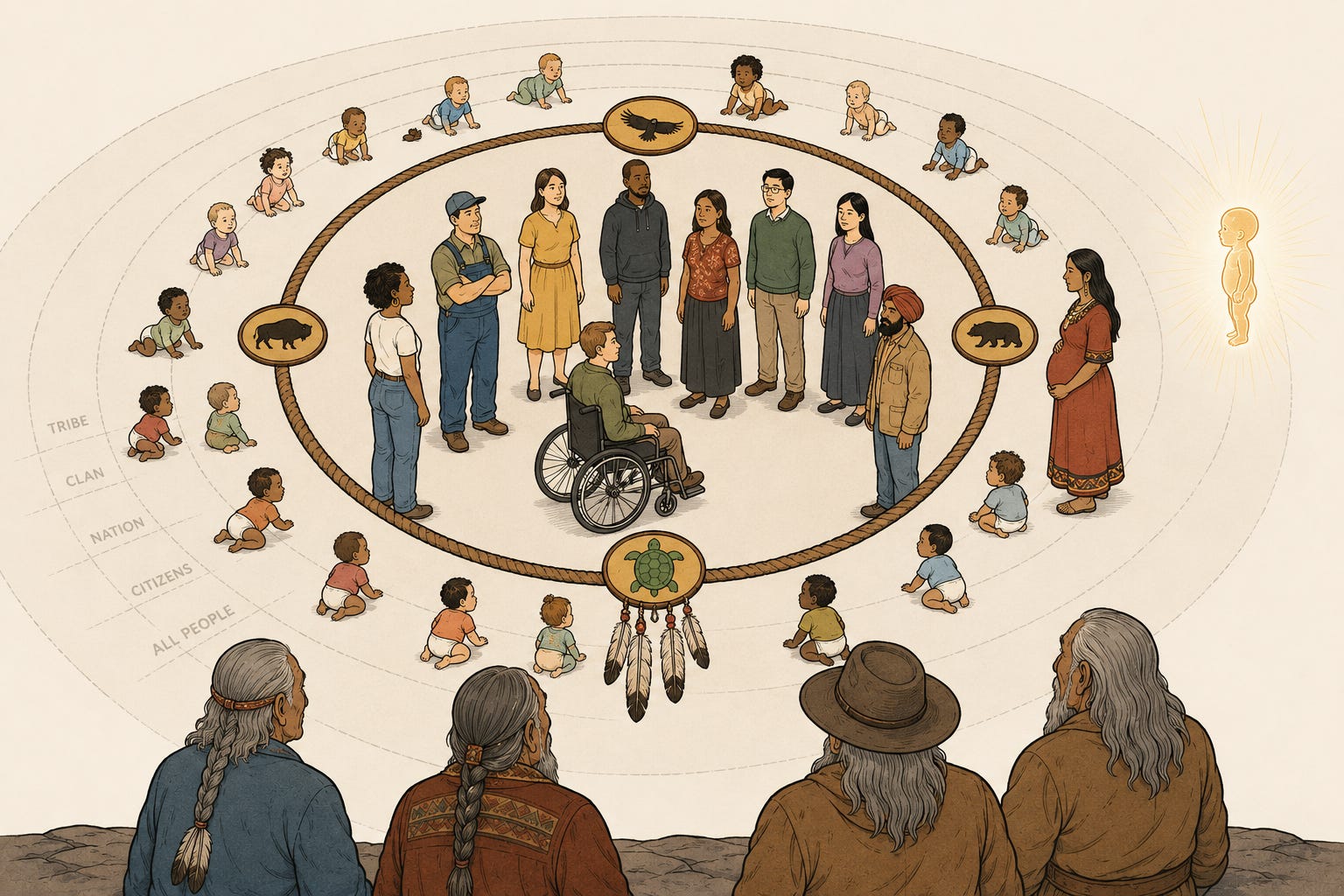
My point is not that these situations are identical. My point is that progressive political philosophy normally begins from a presumption in favour of inclusion, shared obligations, and expanding circles of membership. Abortion establishes the opposite presumption; abortion becomes an absolute Monarch, unchallenged. Here, for perhaps the only time, “equality” begins not by asking how another may be included, but by asking whether they should be admitted at all. That, to me, is the deepest egalitarian tension surrounding abortion.
Egalitarianism has historically widened its constituency by challenging the criteria previously used to keep existing people outside it: property, sex, race, religion, disability, nationality, were progressively declared insufficient grounds for unequal concern. We object strongly to discrimination among those already securely inside the circle while treating those who might otherwise enter it as categorically outside the egalitarian problem. Why are the potentially living the exception?
It is not enough simply to say that they are outside the circle, because the entire history of egalitarian argument consists of disputes over who was improperly placed outside the circle. To make potential members the exception therefore requires a principle explaining why this boundary, unlike previous boundaries, deserves a presumption in favour of exclusion. In doing so, progressives construct a peculiar inequality: those who already possess recognized membership receive the full vocabulary of autonomy, equality, protection, and choice, while those whose continued development depends upon those choices possess none. Perhaps that distinction can be defended. But an egalitarian philosophy should at least be required to defend it. Progressives never explain, why, inherently, someone belongs in existence.
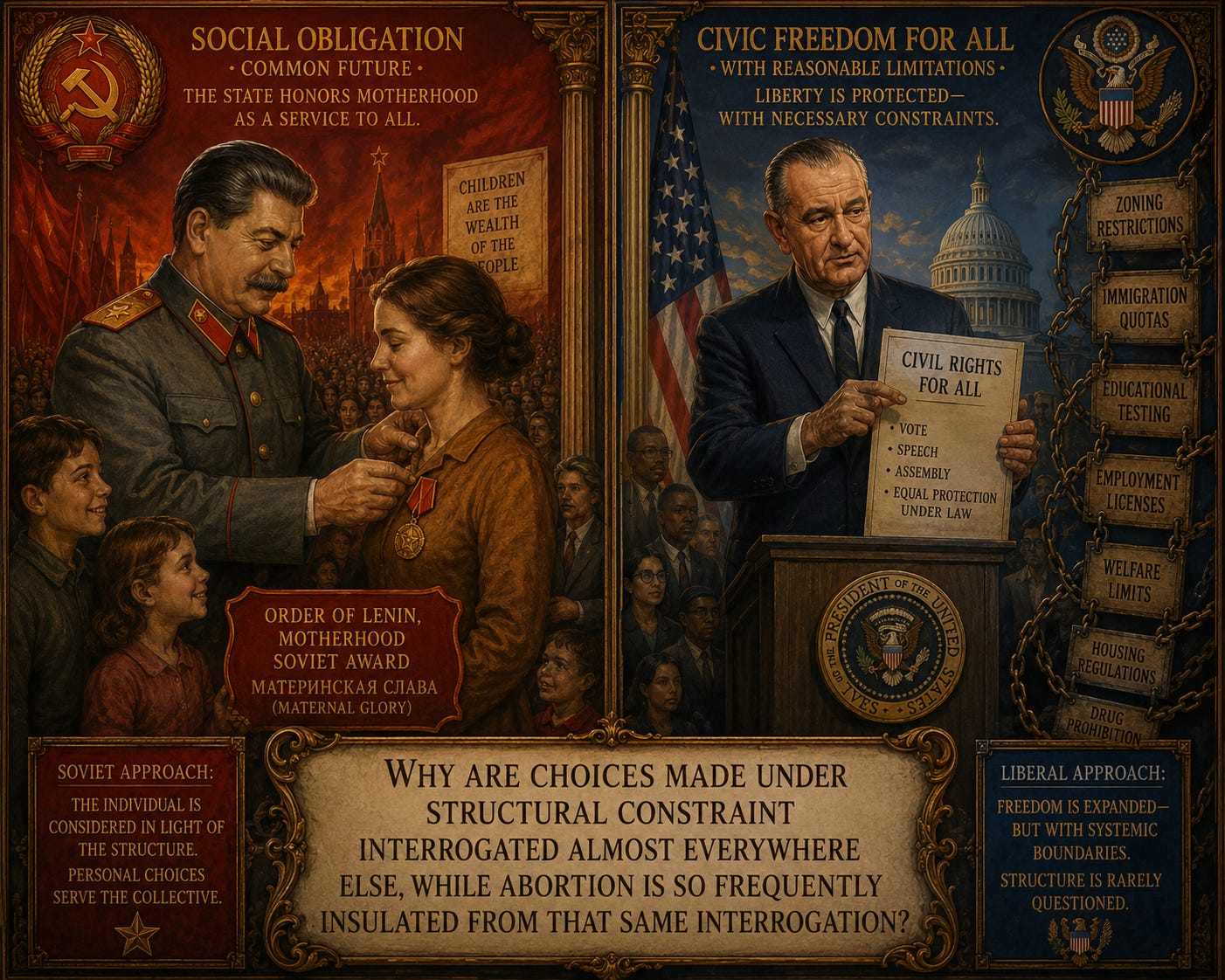
Why are choices made under structural constraint interrogated almost everywhere else, while abortion is so frequently insulated from that same interrogation?
One of the central ideas of progressive politics is that individuals should not be forced to bear the full weight of structural inequalities alone. If poverty, inadequate healthcare, unaffordable housing, discrimination, or unsafe workplaces create hardship, the usual response is not to tell individuals to adapt to those conditions. It is to ask why society has tolerated those conditions in the first place. In other words, the instinct is generally to reshape society rather than reshape the individual. Why, then, does this instinct appear to change so dramatically when pregnancy is involved?
Many of the reasons commonly given for abortion are not unique moral failings or acts of violence. They are social and economic realities: insufficient income, insecure employment, lack of childcare, interrupted education, unstable housing, inadequate medical support, or the fear that motherhood will permanently reduce one’s opportunities. These are precisely the kinds of structural disadvantages that progressive politics normally seeks to eliminate rather than accommodate. Therefore, I think one might have a right to at least ask, why do we not spend more time trying to accommodate “the mother” in the same way we accommodate immigrants, or the socially discriminated against, in every other case? Why does “progressive politics” suddenly shift, to regarding her choice to have an abortion made under constraints, as this great freedom and liberty? Why is the first question not, “Why have we built a society in which becoming a mother is so difficult?” Why is the emphasis so often placed upon adapting the woman to society rather than adapting society to the woman?
This seems to reverse the ordinary logic of progressive politics. Elsewhere we argue that society should change to accommodate workers, people with disabilities, religious minorities, racial minorities, and those facing economic hardship. We do not ordinarily conclude that the individual should bear the burden of adapting to unjust social arrangements. However, when pregnancy is involved, the burden frequently shifts back onto the individual, who is expected to resolve structural problems through a private decision. The same pattern appears in the precautionary principle. Progressives routinely argue that where uncertainty exists, we should proceed cautiously. We regulate environmental risks before irreversible ecological damage occurs. We impose workplace safety rules before workers are harmed. We adopt public-health measures before preventable illness spreads. In each case, uncertainty encourages greater social responsibility rather than less.
Why, then, should the response to the uncertainties and burdens of pregnancy be different? If our instinct elsewhere is to build safer, more supportive, and more equal institutions before asking individuals to bear irreversible consequences, why should pregnancy not inspire the same impulse? Why is the first solution so often the termination of the pregnancy rather than the construction of a society in which motherhood itself becomes less economically and socially burdensome?
I am deliberately avoiding questions of religion, personhood, or fetal rights. I am simply asking whether a political philosophy committed to collective responsibility, structural reform, and precaution should not first ask how society can make motherhood easier before concluding that abortion is the most egalitarian solution. If we say that things like housing and capitalism are problems that require “collective” solutions, and not merely individual choice; why therefore, does that presumption, stop, at abortion? If “capitalism” abolishes choice for the sake of other forces, it seems strange to me, that when it comes to the entrance or exit, from existence itself, we do not suddenly blame capitalism, and demand collective solutions for entrance.
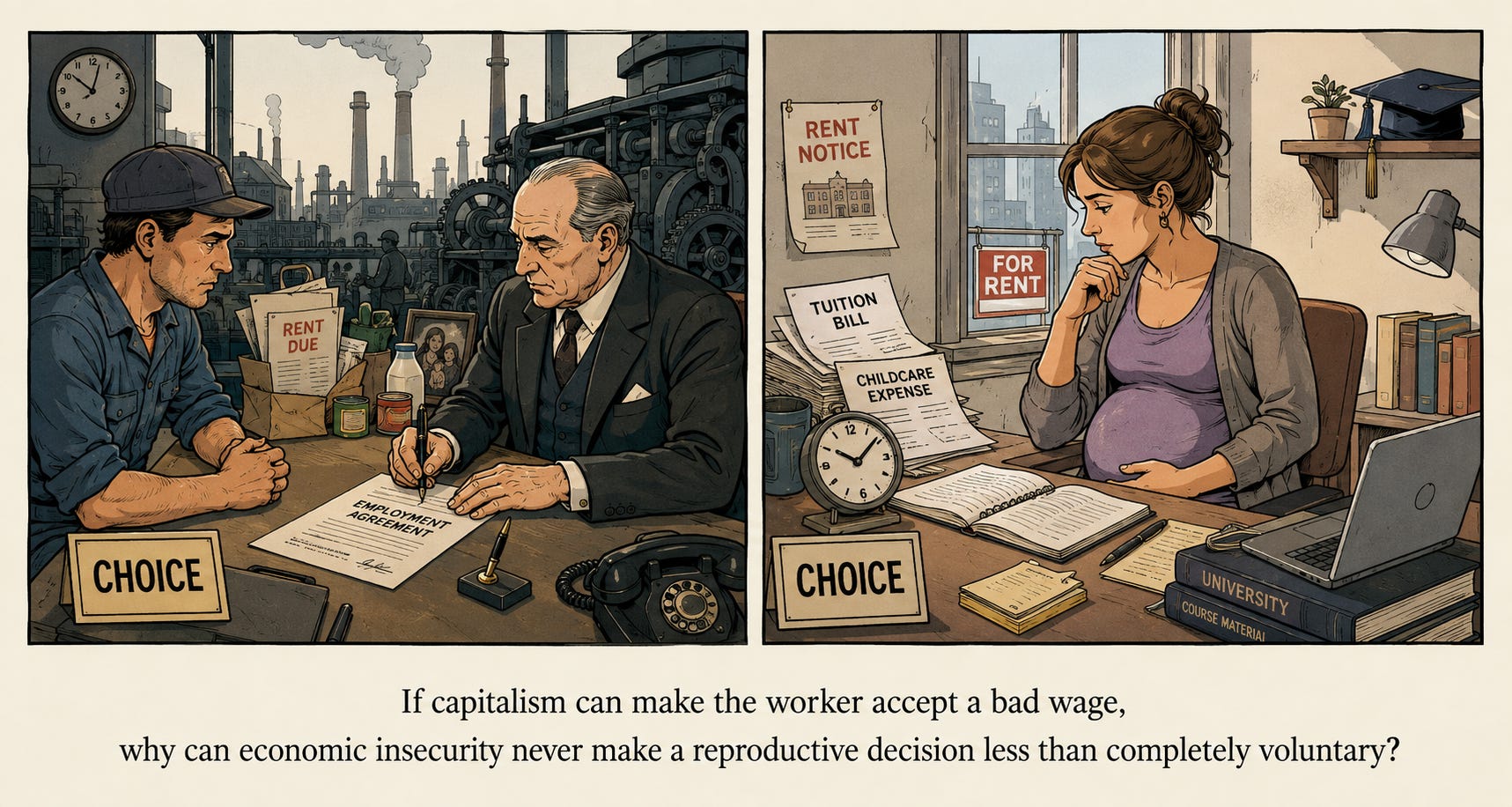
The problem becomes even worse from a socialist or Marxist perspective. One of the most powerful criticisms of capitalism is that a voluntary choice need not be substantively free. A worker may technically “choose” to accept a miserable wage, dangerous conditions, exhausting hours, or insecure employment, but socialists reply that “capitalism,” constrains that choice, on every other topic. The existence of consent does not magically erase the material circumstances producing it. If capitalism can make the worker accept a bad wage, why can economic insecurity never make a reproductive decision less than completely voluntary?
If a woman concludes that she cannot afford a child because her rent, her employment, her education, or her station in life, it seems remarkably un-Marxist simply to announce that her resulting decision represents autonomous choice and end the analysis there. The uncomfortable question for a materialist is therefore unavoidable: why does “material conditions determine consciousness” suddenly become “choice is choice” at precisely this boundary? A genuinely materialist reproductive politics would have to examine not merely whether the choice was legally available, but what economic structure made one choice appear possible and another impossible.
Feminism supplies an equally uncomfortable formulation. One of their claims is that “the personal is political;” that private decisions do not occur in a social vacuum. Marriage, domestic labour, sexuality, motherhood, and family life can all reflect wider distributions of what they consider “injustice.” If that is correct, then abortion cannot become mysteriously apolitical merely because it is personal. If the personal is political, why should the economic circumstances producing an abortion be regarded as politically irrelevant once the decision is described as “personal choice?” If a woman wants a child but cannot afford one; if she fears losing her social standing, or future prospects, then the progressive question should not end with “legal freedom.” It should ask what produced the termination as the only choice. Otherwise “choice” becomes the ideological stopping point: structural forces are interrogated when they constrain workers, minorities, the poor, tenants, but disappear at the very moment when those same constraints would complicate the politics of abortion.
I am deliberately setting aside questions of religion, God, men, souls, fetal consciousness, and personhood. I simply want to ask whether a political philosophy built upon the continual expansion of inclusion can consistently defend the one form of exclusion that precedes every other. If equality means widening the circle wherever possible, why does that principle appear to stop at the threshold of birth? Why are rights inclusive in all other cases, or regarded as something that should be inclusive in all other cases, but solidly and firmly, exclusive, only in this one case? In other words, my question is simple; why should people be allowed to live at all, why is equality invoked at all? It seems strange that in most cases, a progressive will rightly point out that the choices people make under structures are “unequal” and perhaps therefore, unfair, but when it comes to just this one thing, the subject of abortion, suddenly, we are all expected to agree, that the choice is made fully formed, inviolate.
It seems strange that, in almost every other context, progressives rightly argue that choices made under unequal social, economic, or structural conditions cannot simply be treated as fully free or morally self-justifying. We are reminded that poverty constrains choice, discrimination constrains choice, unequal access to education constrains choice, and that justice therefore requires society to change rather than merely celebrating the choices individuals make under those constraints. And yet, when the subject becomes abortion, this analysis vanishes into air like smoke. Suddenly, the decision is treated as fully autonomous, inviolate, and beyond further political or philosophical scrutiny. The very structural inequalities that are said to diminish genuine freedom everywhere else now become the background against which abortion is presented as the fullest expression of individual liberty. My question is not whether women should possess legal rights, but why the egalitarian concern with unequal conditions seems to stop at precisely this point.
Before we ask whether a particular life will be prosperous, healthy, productive, or desired, what if we first ask a more fundamental question: why should your life be allowed to begin? Curiously, almost every civilization has answered that question in the affirmative. Rhea hid the infant Zeus rather than surrender him to Cronus. We instinctively permit the story to unfold before passing judgment upon its ending. The same intuition appears throughout modern political thought. Equality is invoked precisely because we reject the notion that future worth should determine present existence. If we believe, as the French Revolution proclaimed, that all are born equal, then perhaps equality reaches its purest expression not after birth, but at birth itself. Before there are talents, wealth, class, intelligence, success, or failure, there is only one question: why should anyone be allowed to live at all? Every society answers that question somehow. I am merely asking whether our answer remains consistent with the principle of equality we claim to hold so dear. If equality is really your highest political principle, your genuine primary concern, why doesn't it govern this case?
There is therefore a final question egalitarians ought to answer. If equality is not your highest principle here, if inequality may be accepted when competing interests are at stake, then what precisely prevents the same reasoning from being invoked elsewhere? The answer cannot simply be that the interests on one side do not count, because deciding whose interests count is precisely the problem equality was supposed to solve. Even if the unborn possess no feelings, there remains a constituency whose interests cannot so easily be dismissed: women and men who want to become mothers and fathers but find that housing, employment, education, poverty, or social expectations have made parenthood materially impossible. Those constrained would have every reason to ask why their liberty counts for less.
Once we admit that equality is not self-justifying, the problem becomes larger than abortion. If inequality is an unavoidable feature of human existence regardless of capitalism, then the Left must explain why capitalist inequalities deserve condemnation while other inequalities may simply be accepted as the price of somebody else’s liberty. The landlord can invoke his property, the employer his freedom of contract, the nationalist his political community, and the privileged citizen his accumulated advantages. Each can say that equality imposes costs upon him. Each can complain that somebody else’s inclusion constrains his choices. “Egalitarians” have always answered by insisting that inconvenience, preference, property, power, or inherited advantage are not sufficient reasons to exclude others from equal concern.
If egalitarians condemn restrictions based upon race, class, property, sex, nationality, legal status, disability, or station, they need some principle explaining why exclusion at the threshold of life belongs to a fundamentally different moral category. Otherwise opponents of equality can demand the same privilege of distinction. They too have preferences. They too experience constraints. They too can claim that accommodating another person’s interests costs them money, freedom, security, comfort, or opportunity. Scrooge has constraints too. Scrooge has an interest in keeping his money too. What makes an inequality legitimate or illegitimate? If equality governs only when equality is convenient, it is not a principle. If it may be surpassed by autonomy, scarcity, competing interests, feelings, or personal preference, then egalitarians must explain why those same considerations do not justify inequalities elsewhere.
No posts
Comments
Nothing yet. Say the first thing.
Sign in to join the conversation.