
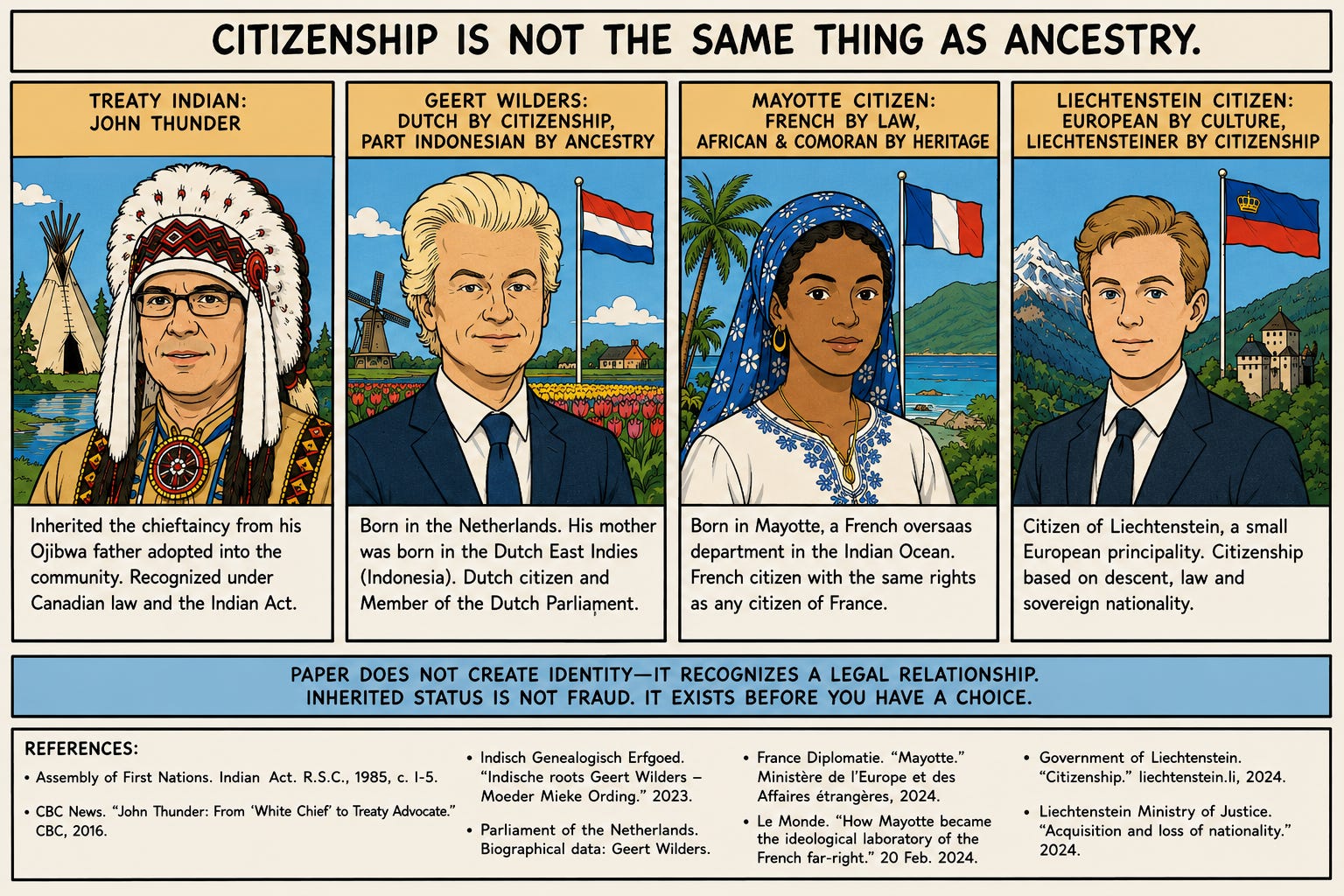
Why should a conservative be shocked that membership in an historic community can be inherited? Hereditary citizenship, property, family names, constitutional privileges, ancestral nationality, and inherited institutional obligations are hardly alien concepts to European civilization.
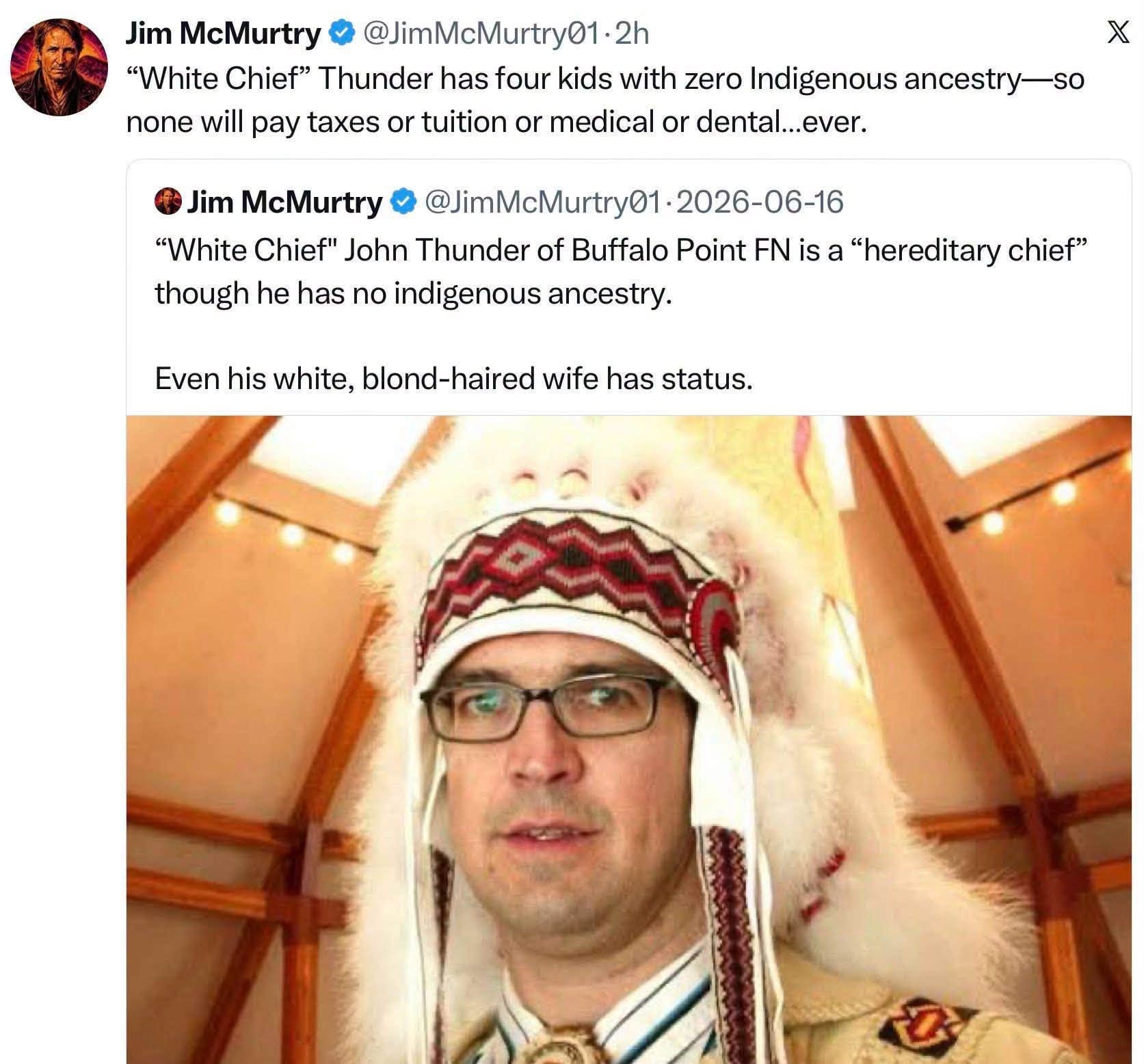
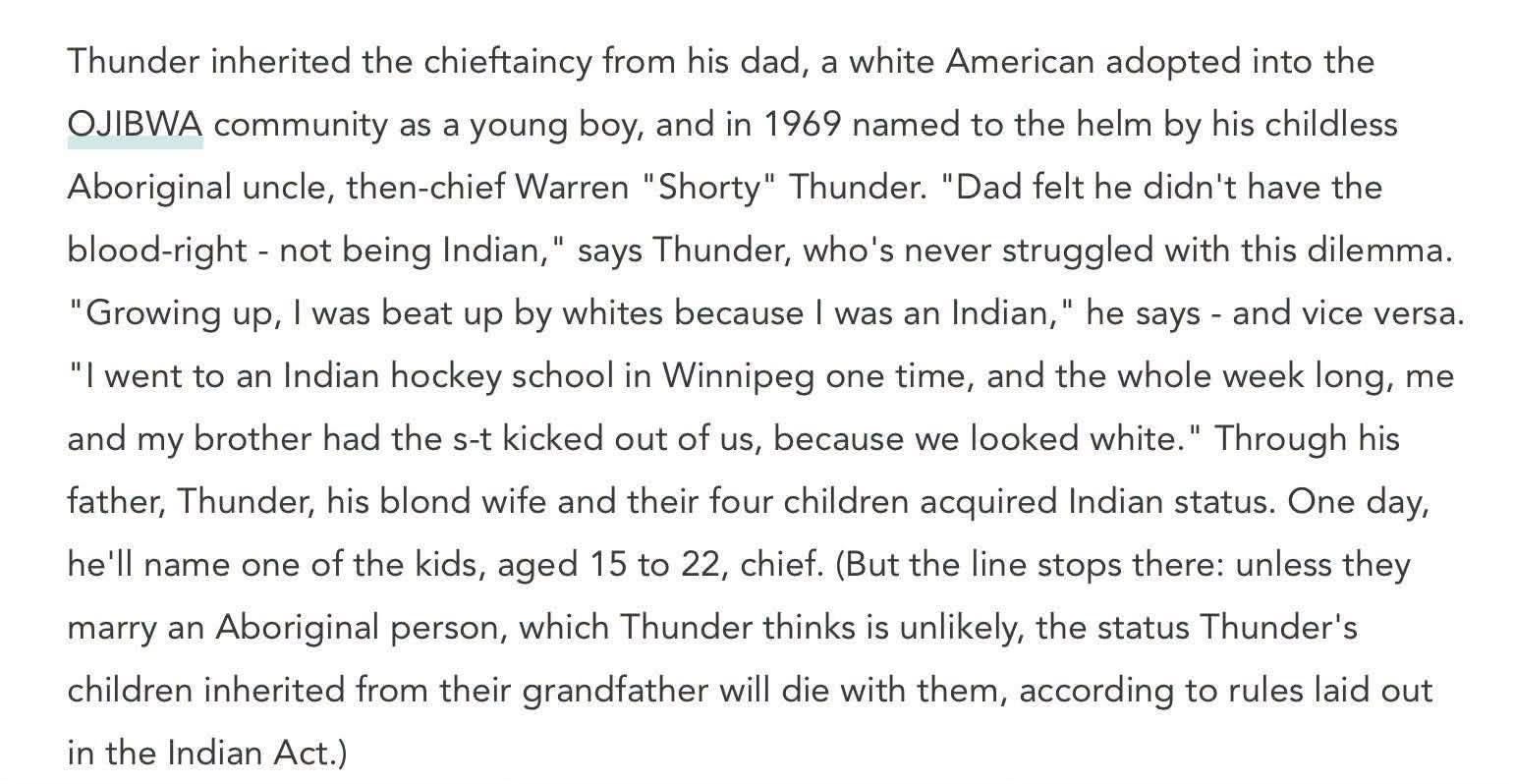
This is neither as extraordinary nor as scandalous, most people present it. Usually I have encountered this kind of envy, from recent immigrants, when they discover it. I can understand why it causes resentment. Because the one benefit of a separate tribal citizenship is that it puts some distance from the urban mono-culture that has been imposed on everyone. Indian status is not a racial-purity certificate or a DNA test; it is a legal status created by a complicated statutory history. For more than a century, the Indian Act determined who entered and left the legal category through rules involving descent, marriage, adoption, enfranchisement and, later, the restoration of people who had been excluded by discriminatory provisions.
( This is a small but notable category of that 0.2-0.4, of the 3% total “aboriginal” category, and I have met such people. ) In fact, not only would I say, more controversially, that the existence of such people is not a legal contradiction, but that it represents, yet another liminal group, who by how they are frequently treated demonstrates, that progressive society, absolutely does believe in some version of a non-legal or extralegal racial hierarchy, which penalizes only one group socially, “the hated Whites,” the minute, any visible “privilege” is perceived or detected. ( Notice, few liberals, apply the same standard to wealthy business dynasties, brahmin families, or minor nobility, who all may historically function in similar liminal ways. )
Before 1985, for example, some non-Indigenous women acquired status by marrying status men, while First Nations women could lose status by marrying non-status men. Parliament subsequently abolished both rules without simply erasing every legal relationship the old system had created. In other words, past rules have left many anomalies; and it is unfair to say that such people only benefit, they suffer many other issues with displacement and incongruence with those around them. As well as other issues, more subtle, I would not wish to discuss. Though usually it is the “immigrants” who exhibit the majority of the subtle racial envy.
Ancestry while important is not the only metric the rules ever considered; different tribes have different rules. In Quebec, the largest Mohawk tribe, has the strictest blood quantum rule in Canada at about half. By contrast, the Register is partly the accumulated legal history of Canada’s relationship with particular First Nations families. Modern sections 6(1) and 6(2) also place limits on transmitting status, meaning these unusual cases do not necessarily reproduce indefinitely. Nor does status mean that a person simply “never pays taxes, tuition, medical or dental”: each of those benefits or exemptions has separate legal eligibility rules. The more useful question is therefore not whether every registered person passes a racial authenticity test, but whether Canada should honour legal relationships inherited from its own previous legislation while maintaining coherent rules for future registration.
These topics also introduce a separate complexity that is frequently lost when Indian status, ancestry and First Nation citizenship are treated as interchangeable. Since the 1985 amendments to the Indian Act, a First Nation may, under section 10, assume control of its own membership list and establish its own membership code. Other communities remain under section 11, where the federal government maintains the band list, while self-governing First Nations may exercise still broader authority over citizenship or membership. Consequently, being legally entitled to registration under the Indian Act does not necessarily answer the separate question of whether a particular First Nation recognizes that individual as one of its members.
This distinction is important because First Nations themselves do not necessarily agree with Ottawa about where the boundaries of their political communities ought to lie. Kahnawà provides an unusually striking example. The Mohawk community has historically maintained much more restrictive ancestry-based conceptions of membership than the federal Indian Act, including the use of blood-quantum calculations and, in its membership-law development, requirements framed around Mohawk ancestry through one’s great-grandparents. Whatever one thinks of such rules, their existence demonstrates that Indigenous self-government can produce membership standards that are more restrictive, not merely more permissive, than federal status law.
This creates a distinction that critics of unusual status cases should take seriously. Canada determines entitlement to Indian registration; a First Nation may separately determine membership in its own political community. A person can therefore possess perfectly legitimate Indian status without necessarily satisfying the citizenship or membership requirements that a particular First Nation has chosen for itself. Alternatively, First Nation membership need not always correspond perfectly with federal registration. These are different legal relationships, governed for different purposes. And, indeed, many First Nations individuals and groups, have objected to these exceptions themselves. So it is possible McMurty is playing more than just gotcha here.
If we take Indigenous self-determination seriously, we cannot insist that First Nations possess the right to define their own communities only when their definitions produce outcomes that outsiders find inclusive. Kahnawà’s approach may strike some Canadians as unusually stringent, and there are legitimate internal debates about such rules. But the underlying principle matters: the federal government’s definition of an “Indian” and an Indigenous nation’s definition of its own people need not be identical. That difference is not evidence of fraud or incoherence. In important respects, it is precisely what political self-government means.
For a useful analogy: Italian citizenship law has historically allowed citizenship to be transmitted through descent, subject to important legal qualifications. This means someone born and raised in Argentina, Brazil, Canada, or the United States may qualify for recognition as an Italian citizen through an Italian ancestor, despite speaking no Italian and having spent little or no time in Italy. Meanwhile, an immigrant who has lived and worked in Italy for years may remain a non-citizen. Italy significantly tightened its descent rules in 2025, so you would want to acknowledge that if discussing present eligibility.
While I think McMurty has done good work on other topics, bringing this up as a “gotcha” does not make him look good. It is similar to dismissing the tribal citizenship already granted simply because the rest of Canada has made the mistake, or had the mistake imposed on them, of dismissing all inherent cultural characteristics that made it great. Both, should be defended. I would also ask McMurty to consider all the people of “American Indian” descent, sometimes full blooded who do not have legal “indian status” or “treaty indian status” here at all. I have met such people. There are full blooded Mohawks, visibly so, who for one reason or another, never had ancestors who were registered under the Indian Act. They receive absolutely no benefits of citizenship. They are yet another “liminal group” that gets completely ignored in any accounting of the subject.
The existence of unusual cases at the edges of Indian status does not invalidate the principle that First Nations constitute historical political communities whose inherited membership and legal rights deserve continuity. No inherited institution produces perfectly neat boundaries. Marriage, adoption, descent, changing legislation, and two centuries of Canadian policy inevitably produce people whose legal position looks anomalous when reduced to appearance or ancestry alone.
More importantly, there is something strange about conservatives attacking this principle. If one believes that peoples are more than interchangeable collections of individuals, that history, inheritance, family continuity, institutions, and collective memory matter, then First Nations are hardly an embarrassment to that argument. They are among its clearest Canadian examples. A political community does not cease to be legitimate merely because its boundaries contain exceptions, nor should every inherited right be dissolved simply because outsiders do not possess the same right.
Indeed, the better response to unequal cultural inheritance is not necessarily to abolish whatever inheritance remains. If Canada has weakened many of the institutions and cultural characteristics that once gave its own historic communities continuity, ( and I do believe it has, and that is wrong ) that is not an argument for demanding that First Nations surrender theirs as well. It is an argument for asking what forms of continuity Canadians themselves should have preserved. The levelling-down principle, “if we no longer have it, neither should you,” is a particularly destructive conception of equality.
I would rather defend both. First Nations should be able to preserve legitimate forms of inherited membership, treaty relationship, and political continuity, while Canadians more generally should be able to value their own historical institutions, traditions, and cultural inheritance. These claims need not cancel one another out. The existence of one enduring historical community does not require the cultural emptiness of another.
That is why pointing to an unusual status Indian and asking, essentially, “How can this person count?” misses the larger issue. Indian status was never a DNA certificate, and First Nation political continuity should not depend upon every member satisfying an outsider’s visual test of authenticity. If inherited communities are worth defending, we should be capable of defending them even when their boundaries are historically complicated, and without demanding that everyone else become culturally rootless in the name of consistency.
The irony is that Canada's problem may not be that First Nations have retained too much inherited political identity, but that Canadians increasingly understand too little of it. A people is not simply everyone presently occupying a geographical space, any more than a family becomes meaningless because adoption and intermarriage complicate its genealogy. Political communities inherit institutions, obligations, memories and boundaries. Those boundaries will always contain anomalies. The question is whether anomalies require us to abolish the inheritance; I would obviously say no.
There is a fundamental distinction between fraudulently claiming an identity to which one has no legal or communal connection and inheriting a legal status that existed before one was even born. These are not remotely the same phenomenon; though when someone falls afoul of progressive lights, they are obviously threatened with having their “citizenship+” status revoked. This is a hypocrisy I have always thought curious from the people of love and acceptance. A person registered under the Indian Act because of the legal history of his parents, grandparents, marriage lines, adoption, or the restoration of previously removed status has not deceived the Canadian government merely because his ancestry, appearance, or upbringing does not conform to what an outsider imagines an “Indian” should look like. He inherited a legal relationship created by Canadian law.
This distinction becomes particularly important in a country transformed by immigration. Someone whose own relationship to Canada is comparatively recent may understandably know very little about the peculiar history of the Indian Act. What becomes deeply offensive is when unfamiliarity turns into accusation: you don’t look Indigenous enough; your ancestry is too distant; therefore your status must be a scam. ( I have encountered this many times, and I understand it, yet it remains tantamount to a slander; since the accuser is essentially calling citizenship, fraud. ) The person being accused may have had absolutely no role in constructing the arrangement. His status may have preceded his ability to understand what the word meant. One cannot fraudulently inherit something by accident of birth. Fraud requires deception; inheritance requires neither deception nor even consent.
There is an additional irony here. Canada routinely accepts inherited legal relationships in other contexts. Children acquire citizenship from parents. Property and contractual rights pass between generations. European citizenship can sometimes descend to people born thousands of kilometres from the ancestral country. Nobody ordinarily demands that such people prove their authenticity by appearance before acknowledging that the law has conferred something upon them. However, Indian status is sometimes discussed as though the registered person personally approached the government, invented an Indigenous ancestor, and demanded benefits. There are many such people; usually on the Left, I might point out, and they never object in those cases. Ward Churchill is a good example. Furthermore, where status was lawfully inherited, that description is simply false.
For the individual involved, the accusation can be more than an abstract political disagreement. Calling someone’s inherited status fraudulent is effectively accusing him of dishonesty for circumstances over which he exercised no choice. A person cannot choose his grandparents, the legislation governing his parents, the historical marriages in his family, or the registration rules operating when he was born. We can debate whether Parliament designed those rules wisely. We can debate whether they should change. But criticism of the law should not casually become an accusation against the person who inherited a position under it. I have found it always does, and this is why I feel the need to write about it.
There is something particularly biting about a recent “immigrant” from Bangladesh or the Punjab who comes to Canada and expects “Anglo-Canadians” to see his citizenship as legitimate because it is legal, as magically making him both equal to, and perhaps even superior to, the native-born citizen whose ancestors may have fought in WWI and WWII, only to turn around and dismiss the citizenship of the “treaty Indian.”
The “immigrant” regards his own Canadian citizenship, a legal status represented and recognized through pieces of paper, as making him “equal,” and yet sneers at the “treaty Indian’s” relationship with the British Crown, which likewise rests upon legal instruments, inherited status, and solemn agreements recorded on pieces of paper. Why is their “paper” real and legitimate, while the “paper” of a treaty Indian is somehow less real, less binding, or less deserving of recognition than their own?
This is why I find the subject so deeply hypocritical and murderously offensive. The insult becomes sharper still when it comes from someone who treats the legal validity of his own citizenship as beyond question while casually suggesting that an Indigenous person’s inherited legal status is somehow fraudulent. And it becomes more galling again in cases where the person making that accusation has benefited from, participated in, or excuses actual immigration fraud. Legal inheritance and fraud are not the same thing. A person who inherited Indian status before birth did not manufacture that status, purchase it, or deceive anyone to obtain it. It existed before he had any choice in the matter. People coming from Bangladesh, the Punjab or the Caribbean, who trade citizenships regularly as a matter of convenience and engage in fraud quite shamelessly and exuberantly, should not be sneering at the imposed dual-citizenship of the “treaty indian.”
Indeed, critics should distinguish three very different cases: fraud, in which somebody knowingly misrepresents ancestry or entitlement; legal anomaly, in which unusual historical rules produce an unexpected result; and ordinary inheritance, in which somebody simply receives the legal status to which the existing rules entitle him. Collapsing all three into “Pretendian” or “fraud” doesn’t expose a loophole. It erases the very distinction between deception and lawful descent that any serious discussion of the subject requires.
Throughout history, we have had many such cases, going back thousands of years even. Cleopatra, famously, presents us with yet another fascinating case of a “liminal person” in matters of ancestry and religious inculcation. She had no Egyptian blood, being mostly Macedonian, with at least one Persian elite ancestor; making her Greek, Macedonian and Persian, but not Egyptian, by ancestry. Yet, her legal status, her “citizenship,” was “God-Empress.”
No posts
Comments
Nothing yet. Say the first thing.
Sign in to join the conversation.