
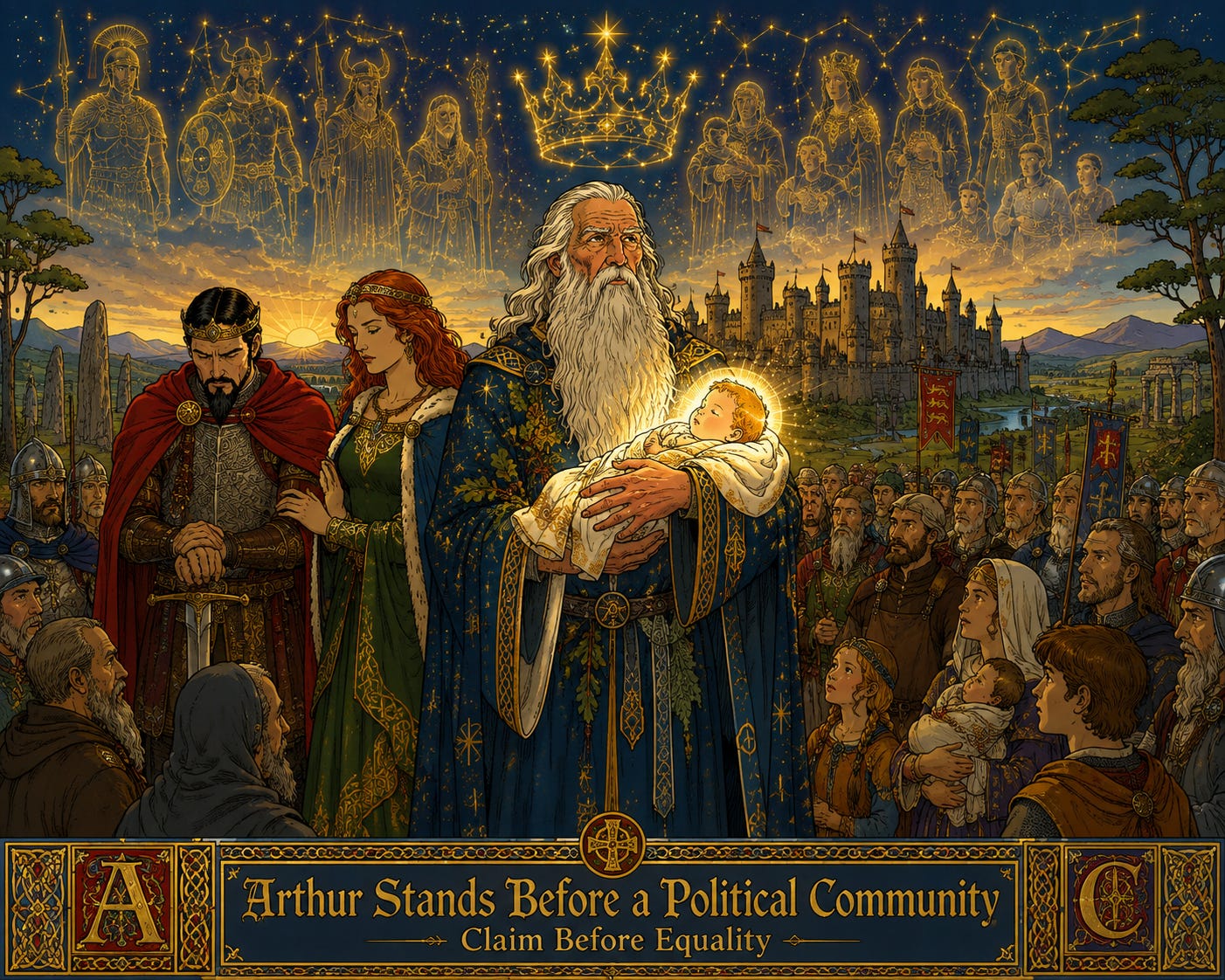
Long before liberalism, long before feminism, and long before modern debates about rights, stories often assumed that a child could stand at the centre of competing claims; that questions jurisdiction precedes all talk of civil liberties or “rights.” Ultimately, someone plants a flag, and decides. One of the oldest examples appears in the Arthurian legends; when Arthur is born, Merlin demands that Uther Pendragon honour his promise and surrender the child into his care. Modern readers may find the bargain unsettling, yet the story assumes something shocking: that more than one person may possess a legitimate claim upon a child’s future. Arthur is not understood as a purely private creation belonging exclusively to one individual. His existence already places him within a wider web of obligations, promises, identities, and expectations. Keep in mind, that his birth, was not even a matter of a man and a woman, but of magic itself ( an outside community ) deriving the man the ability to cause the pregnancy, however ill-conceived. ( “magical rape,” like most consensual dating ) Someone had to decide to claim land that was “terra nullius” before anyone could claim “rights” against another, or make complaints of oppression against another, that is not settled by war. My argument is not that these principles settle the abortion debate. It is simply that they precede equality. Before we ask whether all people should be treated equally, we must first ask who may claim a voice in creation, whose contributions deserve recognition, and what duties we owe to the inheritance entrusted to us by those who came before. If equality is not the foundation upon which we build our answer, then perhaps older questions deserve to be asked.
I have deliberately ignored religion. I have deliberately ignored souls. I have deliberately ignored personhood. However, there remains another argument, one older than liberalism itself. Human life is never the product of one will alone, on the contrary, both a mother and a father each contribute something indispensable to conception, but neither stands alone. Families contribute, ancestors contribute and whole political communities contribute. Entire civilizations contribute, and might well want a say against the presumed “rights of the individual.” Afterall, if many other people have contributed to my own pleasures and pains, if many other people, have set the stage for any license I might take, or any resource I might extract; they might well lay a claim, against my labor and my body. Human existence is always the culmination of many hands and many wills acting together across time.
No one enters the world as a purely private creation; every child is, in a sense, an inheritance. They are the living consequence of countless previous decisions made by people who could just as easily have chosen not to continue. We inherit not merely our bodies, but languages, institutions, identities, and an ongoing chain of existence stretching backward through history itself. This raises a question that should come before “equality.” If parents possess no meaningful claim over the continuation of the life they helped create, why should every other possible claim disappear as well? Why should society possess no interest? Why should grandparents, or even the promises and institutions upon which civilizations depend possess no interest? We recognize legitimate claims over countless things that no one literally “owns”: historic buildings, endangered species, public institutions, even works of art. Why should human life alone be regarded as existing entirely outside every relationship except one? The liberal language of exclusive individual autonomy appears to dissolve every competing claim at precisely the moment a new human life begins. That itself requires explanation.
Having set aside religion and personhood, I want to ask a different question altogether: whose contribution matters? Economists have argued over this for centuries. Marx devoted Das Kapital to the claim that labour creates value. Others insisted that capital, entrepreneurship, land, or organization were equally indispensable. Modern economics generally concludes that production is not the work of one input alone, but of many complementary contributions working together. Entire schools of thought have been built upon determining whose contribution deserves recognition, reward, or authority. Wherever many indispensable contributions exist, we normally recognize that there are competing claims worthy of consideration. We argue over them. We negotiate them. We balance them. Yet when the subject becomes the continuation of a newly created human life, the debate ends before it begins.
Human reproduction presents a similar problem. If human beings reproduced like amoebae, dividing from a single organism into two identical descendants, the question would scarcely arise. There would be only one biological contributor, and therefore only one obvious claimant. Mammals are different. Every child exists because two indispensable biological contributions meet. One contribution may continue for nine months while the other does not, but without either there would be no child to discuss. The question, therefore, is not whose contribution is greater, just as economists continue to dispute whether labour or capital contributes more to production. The question is why, when two indispensable contributions are required to produce a new human life, the authority over whether that life continues is so often treated as though it naturally belongs to only one contributor. My point is not that equal contribution necessarily implies equal authority. My point is simpler. The existence of multiple indispensable contributors disappears on the subject of abortion, replaced by the assumption that one contribution alone determines the fate of the whole.
One of the central assumptions of modern liberal and progressive politics is that we inherit certain things that deserve preservation. We inherit constitutions, civil liberties, scientific knowledge, universities, languages, works of art, public institutions, and legal “rights.” Many of these institutions emerged from societies whose values “nice progressives” would now criticize. They were built by monarchies, empires, aristocracies, and countless generations whose beliefs differed extremely from those thought “acceptable” today. And yet we do not ordinarily conclude that such inheritances should therefore be discarded because of their “controversial origins.” Instead, we preserve, reform, and pass them on.
We do not demolish the electrical grid because industrial capitalists helped build it. We do not abandon our water and sewer systems because many Victorian planners held views we now reject. We do not discard Roman law because Rome practiced slavery, nor do we abolish trial by jury or the common law because they emerged from feudal monarchies. We do not close our universities because many were founded under medieval Catholic institutions, nor do we dismantle Parliament because it evolved through aristocratic privilege. We continue to preserve museums and libraries, many of them endowed by controversial industrialists; we still use railways built under harsh labour conditions; we continue to drive on highways planned during the Cold War; and we continue to cherish national parks first championed by Theodore Roosevelt despite many of his political views being criticized today.
I have deliberately set aside religion, souls, personhood, and even equality itself. My purpose has been to ask if there are older, more fundamental principles that come before modern egalitarian thought. If equality is not the metric by which we judge the continuation of human life, then what is? The first is claim. Human life has never been understood as arising in isolation. From Merlin’s claim upon Arthur to the claims of fathers, families, and political communities, civilizations have always required that a child, “the boy who lived,” to quote Harry Potter, may stand within a wider network of obligations than those of a single individual. If human life is never the product of one will alone, why should every competing claim disappear at precisely the moment a new life begins? The second is contribution. Economists have spent centuries debating which contributions deserve recognition. Is value created by labour, by capital, by organization? Human reproduction is similar; no mammal reproduces alone. Every child exists because multiple indispensable contributions have been made, and countless previous generations have preserved the chain that made that child possible. If we recognize multiple indispensable contributors everywhere else, why should the authority to determine whether that contribution continues suddenly be treated as belonging to only one contributor? The third is stewardship. Confucian thought taught that every generation stands between its ancestors and its descendants, owing duties in both directions. Roman civic thought likewise regarded each generation as the temporary guardian of an inheritance rather than its absolute owner. We preserve languages we did not invent, institutions we did not build, liberties we did not establish, scientific knowledge we did not discover, and cultural achievements we did not create. If stewardship applies to our laws, our institutions, our traditions, and our civilization itself, why should it end only at the threshold between life and non-life? Why should the continuation of the human community become the one inheritance over which stewardship gives way entirely to exclusive individual discretion?
No posts
Comments
Nothing yet. Say the first thing.
Sign in to join the conversation.