
Why Current Ideological Labels are Misaligned
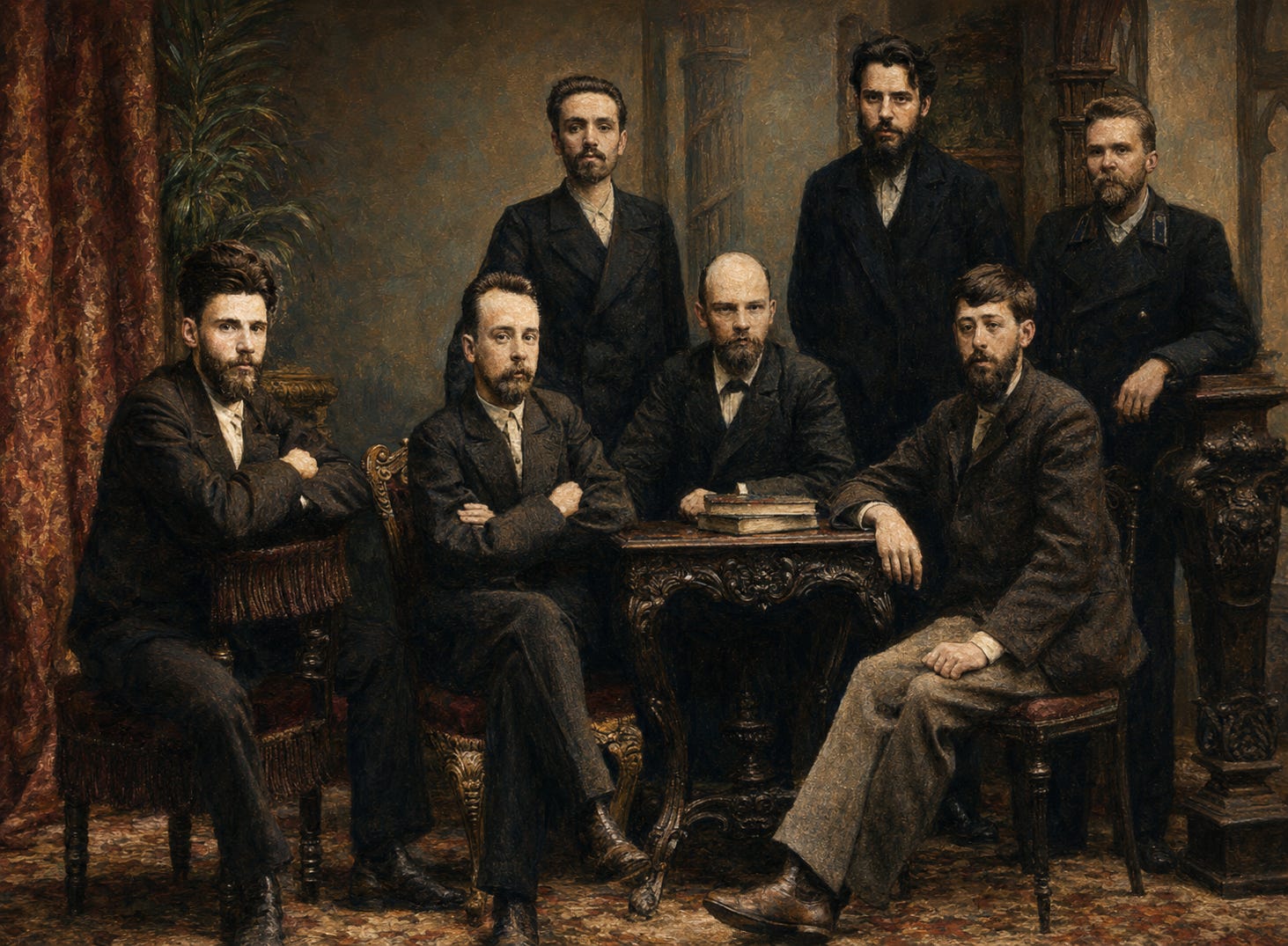
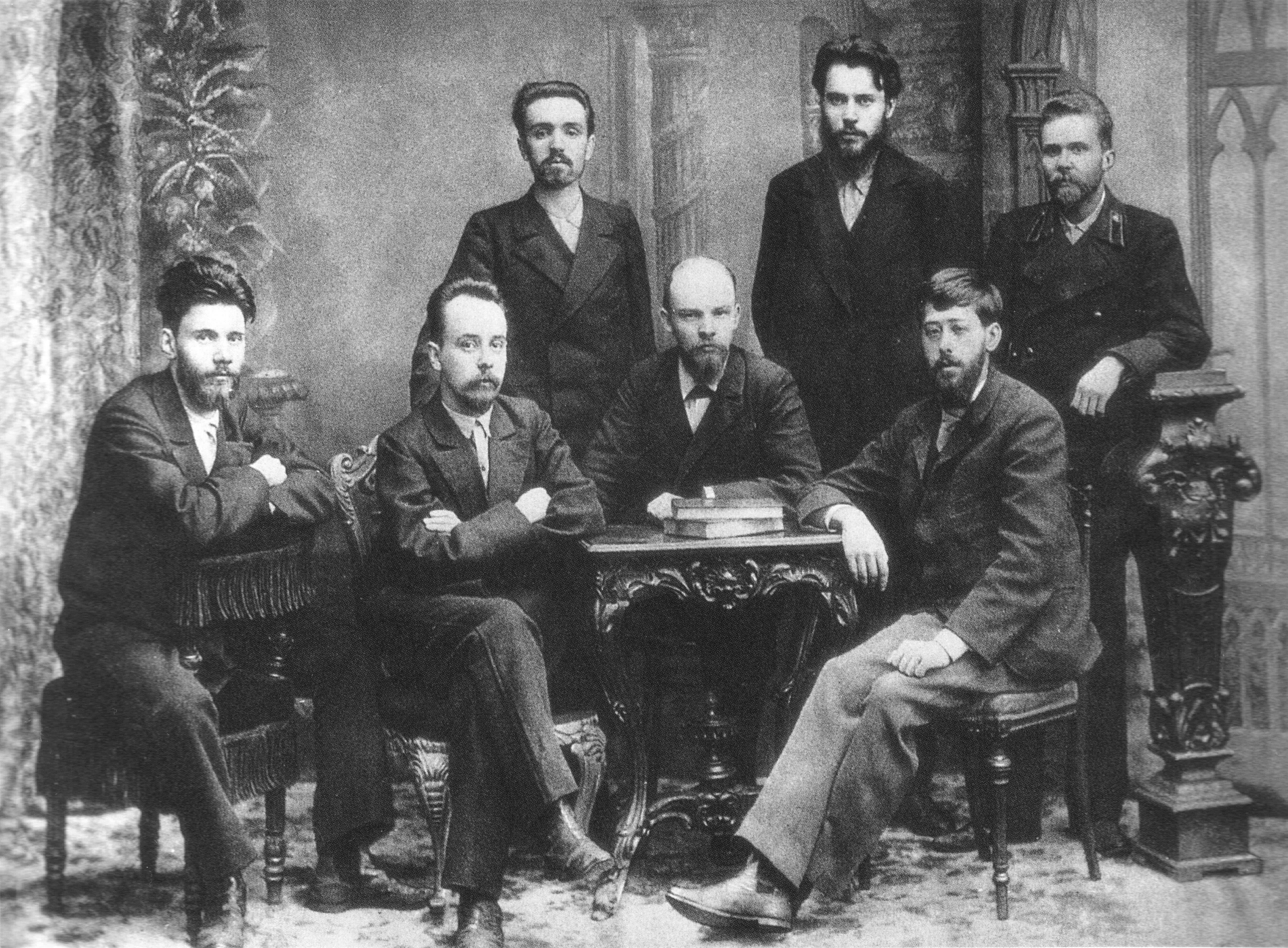
The original photo depicts the central circle of the St. Petersburg League of Struggle for the Emancipation of the Working Class, founded in 1895 to unite Marxist workers’ circles, organize factory labour, distribute political literature and connect immediate workplace grievances to a broader struggle against the tsarist autocracy. It was taken at the Wesenberg & Company photographic studio in St. Petersburg between February 26 and March 1, 1897, February 14–17.
From left to right, standing, are Alexander Malchenko, an engineer-technologist; Pyotr Zaporozhets, an engineering student; Anatoly Vaneyev, a technological student. Seated are Vasily Starkov, an engineer-technologist Gleb Krzhizhanovsky, an engineer who would later direct Soviet electrification and economic planning; Vladimir Ulyanov Lenin, the circle’s principal organizer; and Julius Martov, a journalist.
I find this photograph striking, inspiring, and, indeed, troubling for the modern Left because of what it signifies. I confess that, despite perhaps being regarded as an unacceptable, even evil “rightist” in 2025, in 1895 I probably would have belonged in this photograph, somewhere between Martov and Lenin, rather than among the reactionaries who would later compose the Black Hundreds. I would have felt more comfortable with him, at the time, than either with the Progressive Left or the Right of the time.
The men in this photograph possess the manners of conservatives, the seriousness of civil servants, and the intentions of revolutionaries. This is what I think the dissident right should be like today. Outwardly, tolerant, personable and accepting even. Inwardly, conservative, severe, and devoted to certain goals. That would be my intention if I ever had the ability.
Malchenko was a mechanical engineer from a Russian noble family, already employed in locomotive production. Zaporozhets was the Ukrainian son of a former serf and an engineering student who organized industrial workers. Vaneyev, the son of a poor Russian provincial official, was another technological student and the group’s underground printing technician. Starkov was a Russian, an engineer-technologist who would manage major electrical stations. Krzhizhanovsky was a Polish-descended electrical engineer who would eventually direct Soviet electrification and economic planning. Lenin was a legally trained organizer who approached politics as a problem of institutional power. Martov was a Jewish intellectual and journalist whose weapons were theory, argument and the printed word.
Here we have a relatively “conservative” friend group, not in its political objectives, but in its social form. I see no women in the frame, although women helped sustain the wider League; no advertised gender-queerness or sexual fluidity; no bohemian costumes, artistic performance of rebellion or self-conscious theatre of marginality. Nor, however, were these men ethnically or geographically uniform: Martov was Jewish, Krzhizhanovsky was Polish-descended, Zaporozhets was Ukrainian, and nearly all had come to St. Petersburg from elsewhere in the empire.
Their diversity existed, but it was subordinated to a common vocation rather than made into the vocation itself. What the photograph presents is a technically educated, professionally ambitious and organizationally disciplined circle of … “men,” … who sought to master law, machinery, printing, electrical power and political organization, and then use those instruments to reconstruct a state. Their radicalism was directed toward institutions and production, rather than inward, toward the perpetual public invention of the self.
I say this not because I would necessarily have accepted their entire doctrine, much less everything that later emerged from Bolshevism, but because theirs would have appeared to me, to be the camp of disciplined modernization, worker organization, popular education, industrial development, and opposition to a stagnant autocracy.
The reactionary Right, at the time, offered inherited privilege, arbitrary rule, clerical rigidity, and ethnic chauvinism; the young Marxists offered organization, production, intellectual seriousness, and the possibility of national transformation. That is what makes the photograph troubling for the modern Left: a person condemned today as a “rightist” may recognize more of his own producerist temperament in these austere young revolutionaries than in many of the people who now claim their inheritance.
My point is that these labels do not mean much in an environment, in which the social milieu of the Left, their coalition logic, and indeed even their claimed economic analysis has radically changed. At the time of the men in the photo with Lenin, the focus was on modernizing the territory of the Russian empire, securing its sovereignty, and rebuilding legitimacy. This was a radically different kind of “Left” from the inheritors who claim them. They were committed to a class consciousness and a planned industrial revolution; their identities, while “diverse,” Russian, Ukrainian, Polish, Jewish, Armenian, Georgian, Kazakh, Tatar, were subordinate to those ends. They were a conservative monoculture, not merely an assurgent migrant population with a resentful downwardly mobile progressive activist caste.
Members were expected to acquire useful knowledge, accept organizational discipline and work toward a common material objective. They were not a miniature human-resources department with a red flag hanging behind it, nor a parliament of carefully curated identities bargaining for recognition. This was the “kind of Left” I could have lived with; and this is precisely why I think the “old Left” is meaningless, and trapped, any time they invoke class. Precisely, because they have no way of seizing upon any real bipartisan class basis, to “reify” it, the way Marxists claim to want. The current, revolutionaries, have no “peasants” to transform; only productive citizens, to demean and replace, as far as the ascendant liberalism permits. Their material analysis is out of date; at the time of Lenin, while, “capitalism” was changing fast, they still at least had “the workers” as a legitimizing excuse. I could have lived with this.
The institutional Left is not interested in overturning the seating arrangement; only which identity receives which chair. It denounces universities, bureaucracies, media organizations, nonprofits and corporations as oppressive systems, yet repeatedly treats admission to their offices, fellowships, committees and administrative positions as liberation itself. Its rhetoric remains revolutionary while its practical ambition is frequently custodial: it wishes to administer the existing managerial “inclusively,” not replace it with a new productive order. It condemns hierarchy in the abstract while competing intensely for position within the hierarchy in practice. Class, labour and production therefore remain in the ceremonial language of the movement, while the active coalition is increasingly organized around credentials, institutional access, cultural recognition and the distribution of status among already protected groups. The contradiction is not that the modern Left notices ethnicity, sex or other identities; the old Left confronted national and ethnic questions constantly. The contradiction is that identity has increasingly become the organizing purpose, while class and production have become decorative historical credentials.
This is why ritual appeals to the “Old Left” generally go nowhere. Its vocabulary and symbols can be reproduced, but its original social base, developmental circumstances and conception of collective purpose cannot simply be summoned by displaying another portrait of Lenin. “Left” and “Right” are not permanent metaphysical species; they are coordinates produced by particular historical conflicts. The French distinction arose from a revolution fought over monarchy, inherited privilege, citizenship and popular sovereignty. The modern Left has no Tzar to overthrow; they confront a liberalism, most of their members, substantially already completely agree with. They just want more, more “rights,” more sex workers, more privileges for anti-majoritarian groups.
Premodern China did not organize its politics along that same French-derived axis that the Left, reflexively does: its conflicts were articulated through dynasty and rebellion, court and province, central authority and local power, landholding and peasant unrest, or competing conceptions of legitimate moral order. When modern ideological language entered China, “Left” and “Right” acquired meanings within a different political field and continued to change with that field. Lew Kwan Yew, for example understood, that outside an effective monoculture, class war becomes meaningless; people in a “multicultural environment” vote along lines of race and religion. Class and productivity become meaningless to them. Nothing can be “reified” as the Marxists would like.
The same realignment has occurred in the contemporary West. A person who emphasizes industry, borders, collective discipline, productive labour, social obligation and state capacity may now be classified as “Right,” while credentialed custodians of powerful institutions continue to call themselves “Left.” The labels remain in place even after the coalitions, temperaments and material programmes attached to them have changed. That is why I can reject the Communist conclusion while recognizing more of my own producerist temperament in this early Marxist circle than in either the libertarian market Right or the contemporary managerial-identity Left. In other words, it is completely possible for me to believe in a more distributive power structure for contributing citizens as a universalized principal, especially in a radically altered technologically and post-industrial situation; while not necessarily justifying every poor planning decision made under communism, and without even necessarily believing in the Marxist historicist inevitability.
Our understanding of capitalism, need no longer remain trapped within the nineteenth-century choice of domination by a narrow propertied bourgeoisie and the complete abolition of private property. The answer to an exclusive bourgeois class is not to exterminate it, but to distribute more widely the material independence it once monopolized. Workers generally do not crave universal “propertylessness.” They crave secure homes, savings, pensions, family inheritances, ownership in the enterprises to which they contribute, and some protection against being reduced permanently to renters of everything and owners of nothing. The proper response to concentrated capital is therefore not the destruction of property rights, but the extension and constitutionalization of property rights for all working sovereign citizens.
What I would favour is a state-directed distributive settlement: one that uses public credit, strategic investment, employee ownership, cooperatives, pension funds, anti-monopoly policy and support for independent enterprise to spread productive property throughout the population. Markets would remain where they transmit useful information and reward competence, but capital would no longer be regarded as exempt from obligations to the nation that protects it. Planning would not mean administering universal dependence upon the state; it would mean coordinating the conditions under which more citizens could become economically independent. The worker should not merely receive a wage from the national economy but possess a durable stake within it.
Such a programme would seek sovereignty and productivity together. It would protect domestic energy, food, infrastructure, technical knowledge and strategic industry while rewarding invention, investment, efficiency and skilled work. Communism erred by treating private property itself as the enemy; libertarian capitalism errs by assuming that whatever private capital chooses must somehow coincide with the national interest. A productive state must do neither; it needs to preserve property because ownership creates independent citizens, discipline capital because ownership carries obligations, and plan where long-term national survival cannot be entrusted to short-term private calculation.
While I do not accept the Communist conclusion, and have indeed been expelled from polite company for being less than perfectly obsequious toward progressive mores, I nevertheless retain a strong sympathy for the Leninist instinct for organization, institutional seriousness and collective utility. What should be emulated is not merely the one-party dictatorship, political repression or abolition of markets, but the recognition that no serious political project succeeds through personal expression, scattered resentment or slogans alone. It requires organizations, technical knowledge, strategic planning and a material programme capable of improving ordinary life.
This is what I believe the Dissident Right should offer in place of merely libertarian, and frequently culturally libertine, free-market capitalism. It should seek to make workers proprietors, bind capital to national development, recover the state’s capacity to plan and unite material security with political sovereignty. The worker should not be liberated from property but liberated into it; the nation should not be forced to choose between sovereignty and prosperity, but should organize property so that each sustains the other.
No posts
Comments
Nothing yet. Say the first thing.
Sign in to join the conversation.