
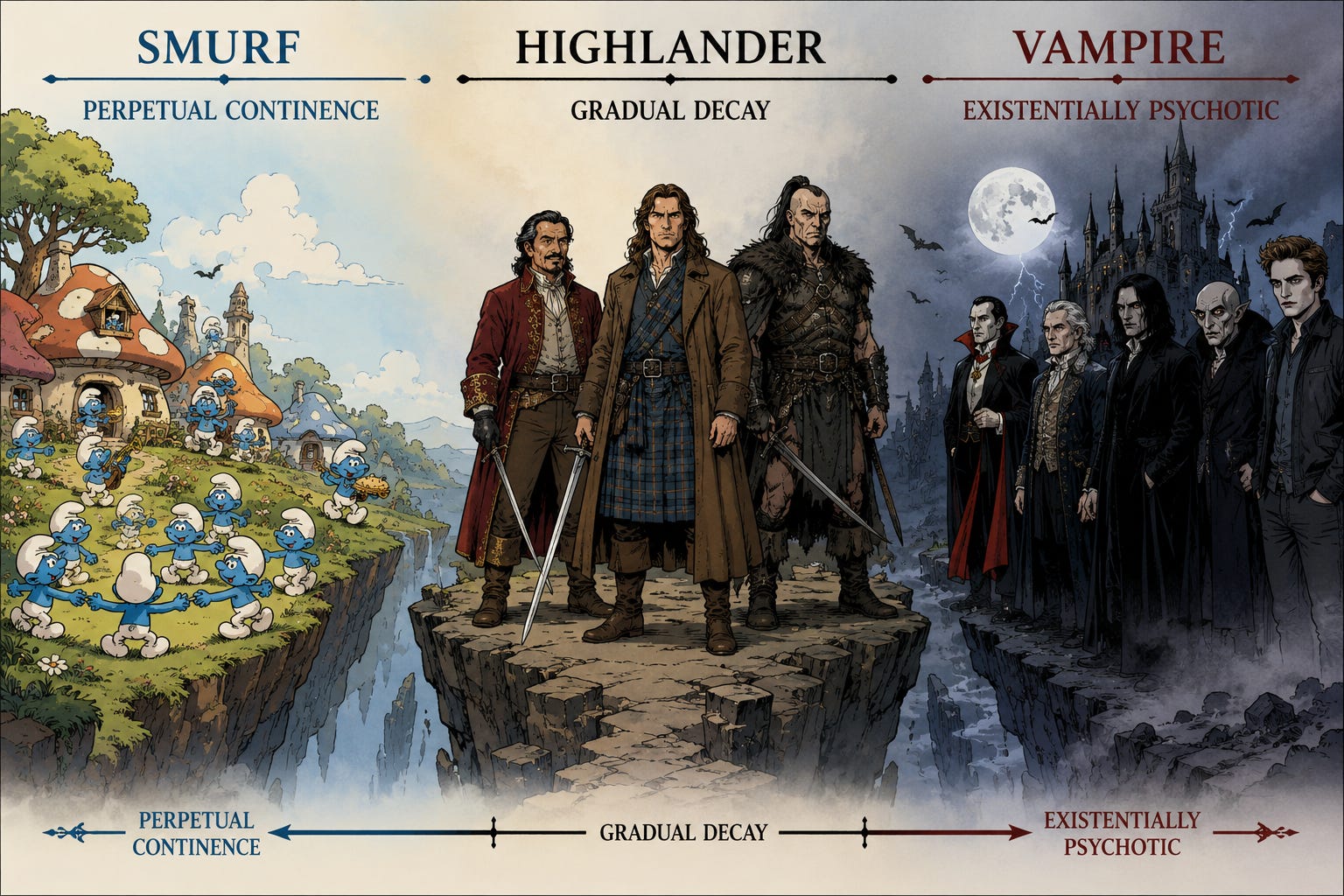
Gregory Widen’s original Highlander screenplay was darker and had an even more direct resonance to certain philosophical obsessions than the 1986 film that eventually reached us. The finished film remains a classic, but it shifted too much, toward action, romance and heroic adventure. Widen’s original conception treats immortality less as a fantasy superpower than as an existential burden; immortality threatens the identity of the immortals themselves.
Several characters differed in vital ways which give us an explanation, including the villain, The Kurgan, who we love, was originally called “the Knight,” and was envisioned less as an exuberant sadist than as a man worn down by centuries of existence; a depressed nutcase. The reason, we like him, is partly preserved in the film, when he is visited by a prostitute at the very beginning. This both tells us the audience, that while he is a sadist, is both utilitarian and has a certain permanent downward spiral muteness about him. He has no internal joy, or it is dying inside; when we learn why is he like that, it makes him much more sympathetic. He is brooding, not merely sadistic; he has a legible explanation for why he must kill. We see him as a character with distinct inner and outer worlds, with his inner world slowly receding and become small, fragmented, decayed and lost. Likewise, the character later known as Ramirez was originally a somewhat different figure; he was certainly portrayed as the wiseman, but less so in terms of an easily resurrected figure, or someone who has so much restraint, that while he does not play to “win the game,” the audience is given a premonition, later confirmed in the film that Ramirez will always “outlast the game.”
This provides us with some pre-explanation for why “the immortals” can be so different, from the Kurgan, Ramirez and Highlander, despite all suffering under the same existential condition. They are responding to existential torment in different ways. A lost immortal, who didn’t make it into the final movie, Mulet, embodied yet another psychological response to endless life; a leave me alone suspicion for anyone else who shares his condition. Rather than explaining the immortals’ origin in a physical way, as Highlander II accomplished, the original script left their condition mysterious and focused instead on its psychological consequences. I might have combined both; give it a physical explanation, give it an Alien ancestry, but combine that with the logical problems that emerge from having special powers.
The best way I can describe Widen’s immortals is that they exist somewhere between Smurfs and vampires. Smurfs are effectively ageless and psychologically stable, they resent the intrusion of other people’s rules into their lives, and yet live in perfect harmony with their own rules. They want nothing, desire nothing, and yet, they are eternally joyful in their non-human liminal state of being. Barely seen one minute, seen by all as bizarre in the next. Existential Fairies. They seem perfectly capable of living for centuries without becoming emotionally exhausted or morally distorted. Literary vampires, by contrast, are alienated, possessed, numb, cruel or outright insane under the weight of endless existence. Widen’s immortals occupy the middle ground, in that they are aimed at The Gathering, as if gods and men, aimed at Ragnarok. In the original script, there was no fantastic prize, but the ingathering was rather an opportunity leave immortality behind, and finally die. As immortals, where they come from, and their connection to others is less and less important. They cease to care. By becoming mortal, perhaps one may care again.
Though they begin as ordinary people, but the centuries slowly erode themselves in different ways, as immortality and their loss of human connection, breaks them down into something much less empathetic to mortals. The original Ramirez represents one answer: eternal kindness, curiosity and deliberate cultivation of others inferior to himself. Mulet represents another: an ancient immortal who has become detached and eccentric without descending into evil; he is the leave me alone type, the perfect Smurf. “The Knight,” or The Kurgan, represents yet another possibility: a man whose humanity has been worn away until conflict itself is the only thing that still gives his existence meaning; the only way out of conflict is through it. The only way he can end torment, is to fight to end all others. Effectively, ending the immortal reality. Becoming mortal again, becomes the prize.
Even if this idea had simply been added alongside the familiar concept of the Prize, I think it would have made Highlander an even stronger film. I might have prefered to have the final duel emerge from a contest over who wins a “heavenly reward” into a confrontation between two different destinies for the immortals; one that fights to remain human, and one that has quietly forgotten what they ever were, and where they came from.
No posts
Comments
Nothing yet. Say the first thing.
Sign in to join the conversation.