
There is presently no accepted pre-sapiens fossil that looks simply like a smaller-brained modern human. Neither Bodo nor Kabwe/rhodesiensis possesses our globular braincase. The modern human brain shape seems to have evolved relatively late. That is my own central objection.
I can clearly see a chain of relationships between Heidelbergensis, on the one hand, and Neanderthals and Denisovans on the other. I am even prepared to accept the theory of introgression and hybridization between those two derived populations and “us.” Small portions of Neanderthal and Denisovan ancestry remain in living human populations, and so there is at least genetic evidence that these were not completely sealed species.
The problem is that neither of those “Big-Brained” hominid skulls resembles ours. Nor do we possess an earlier, smaller-brained version of a Homo sapiens skull that clearly resembles us. We have plenty of large brains, but no continuous chain of skulls leading neatly toward our peculiar brain shape. We therefore have a mystery before, and during, the break.
This is what most people actually mean, when they use the unfashionable expression “missing link,” and ask for that link. I do not necessarily mean that there must have been one magical individual who was half archaic hominid and half modern human. I understand that, “evolution” does not work by producing one designated intermediary for our convenience. I mean that the actual morphological sequence is missing. We do not possess a sufficiently complete fossil series showing an archaic African skull changing, generation by generation or population by population, into the high, rounded and globular skull of Homo sapiens.
Scientists can propose the populations between which this transformation probably occurred. They can identify individual fossils possessing mixtures of earlier and later traits. But they cannot yet show us a continuous anatomical chain demonstrating exactly how our unusual cranial architecture developed.
I can understand and accept that the modern “human” anatomical package emerged piecemeal between approximately 350,000 and 100,000 years ago. That is the theory. It also parallels very well the idea that “intelligence” is itself a web of traits and tendencies emerging over time from many repeatedly practised skills. It is not something that arrives fully formed, or even something that necessarily requires an extreme evolutionary singularity to achieve. I can completely understand and accept that part of their theory.
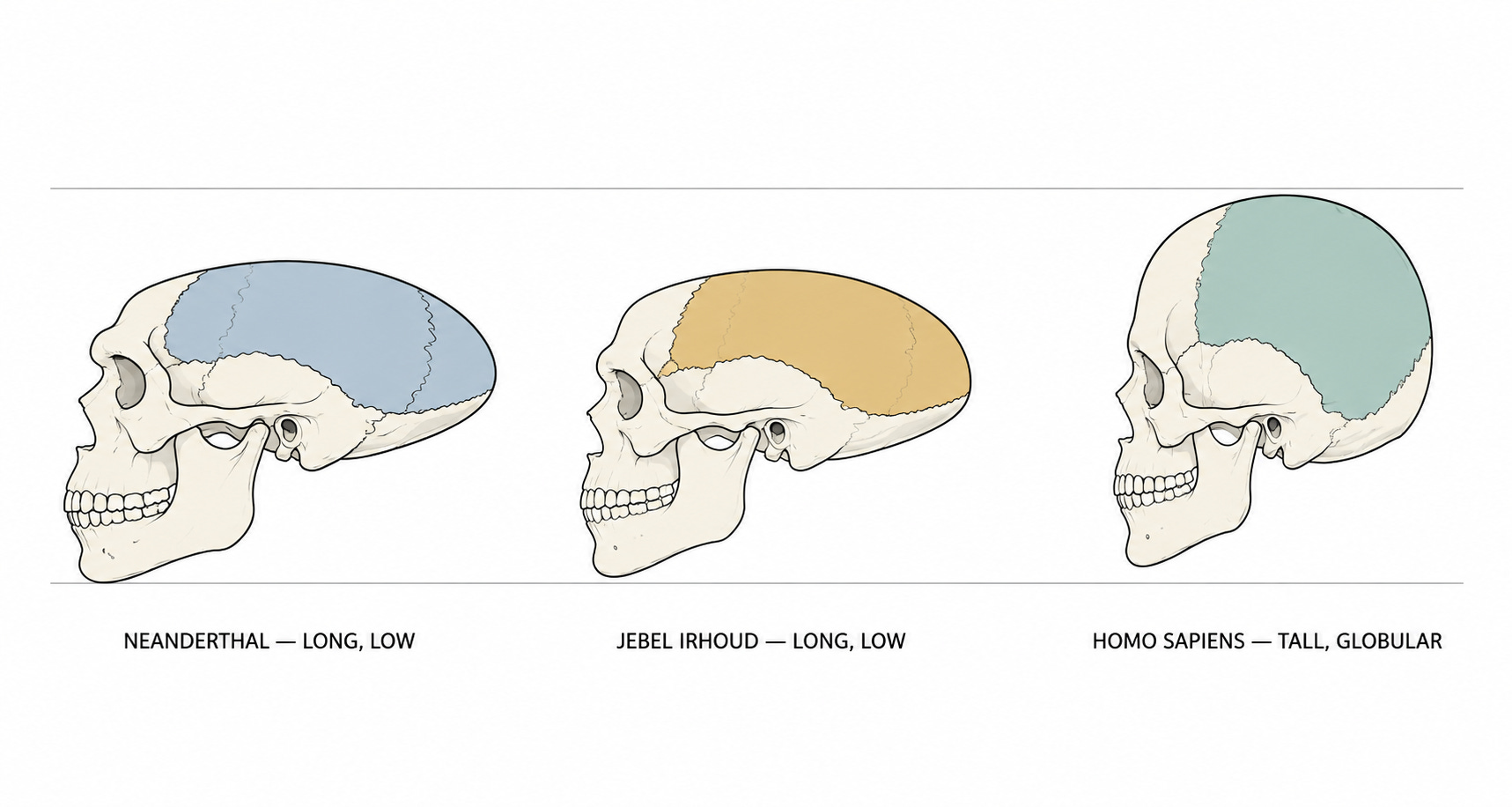
My problem is something much more specific: we cannot point to any one early piece, or, more importantly, any continuous series of pieces, that perfectly resembles a direct precursor to our odd anatomical variations. We possess several large-brained archaic hominids, but their skulls repeatedly follow a long, low, backward-projecting architecture. Then Homo sapiens appears with a conspicuously different, tall and globular cranial architecture. Where is the adequate fossil sequence demonstrating that transformation?
Brain size alone does not resolve the question. Neanderthals sometimes possessed brains as large as, or larger than, ours. Kabwe possessed a reasonably large brain. Jebel Irhoud already had a brain within approximately the modern range. What distinguishes us is not simply the quantity of brain tissue inside the skull. It is also the brain’s shape, organization and developmental pattern, and the corresponding architecture of the cranial vault.
Bodo does not satisfy our “shape test.” It has an enormous face, very thick brow ridges and a low, elongated cranial vault. Its brain was large, but its architecture was not anything we would call “us.” Its architecture is still archaic; still closer in general appearance to what has traditionally been called Heidelbergensis than to ourselves.
The Bodo skull was discovered in Ethiopia and is approximately 600,000 years old. It may represent some part of the broad African population from which later sapiens populations emerged. But it does not look like a smaller-brained modern human. Nor does it give us the rounded skull that requires explanation.
Kabwe satisfies the test even less. It has a reasonably large brain, but its skull is extraordinarily robust, broad and low, with one of the largest brow ridges in the human fossil record. It has traditionally been called Homo rhodesiensis or African Homo heidelbergensis, although neither classification is universally accepted.
I would not regard Kabwe as a convincing physical model of the immediate sapiens ancestor. It may have belonged to an archaic African population related to our ancestors. It may even have contributed something to later populations. But its known anatomy does not explain the origin of our globular skull. Naming Bodo or Kabwe as “ancestral” does not solve the shape problem. It merely places a taxonomic label over the missing transformation.
What we actually possess is a widely scattered collection of African fossils. We have robust, long-headed African archaic “humans.” Then we have “mosaic forms” such as Jebel Irhoud and Florisbad. After that, we have Omo I with a substantially more modern vault, followed by Herto and later sapiens populations with increasingly recognizable modern cranial organization. What we do not have is a complete sequence, particularly between approximately 400,000 and 250,000 years ago, showing exactly how the rounded sapiens braincase arose.
Jebel Irhoud in Morocco, dated to approximately 315,000 years ago, is perhaps the most interesting evidence supporting their theory. The Irhoud people possessed relatively flat and reduced faces that appear surprisingly sapiens-like. Their teeth and jaws also display important sapiens affinities. Their brains were already approximately within the modern human range in volume. But their cranial vaults remained elongated rather than globular. Their brains had achieved something approaching our size, but apparently not yet our distinctive shape.
Irhoud is therefore important because it catches what researchers think is “our lineage” in a strange intermediate condition: the face and brain size are approximately human, but the brain shape is certainly not yet ours.
It shows that part of the modern package had appeared by 315,000 years ago. It does not tell us precisely which earlier population produced it, or exactly how its descendants acquired the later globular braincase.
The Florisbad skull from South Africa is approximately 259,000 years old. It possessed a very large brain and a mixture of archaic and sapiens-like facial characteristics. Some researchers have classified it as early Homo sapiens; others have used the name Homo helmei or treated it as a transitional African form.
Florisbad may be one of the better candidates for a population standing somewhere near the transition. Unfortunately, the skull is incomplete. The very portions that might allow it to resolve the whole brain-shape question are not sufficiently preserved.
Omo I, found in Ethiopia and now known to be at least approximately 233,000 years old, possesses a much higher and more rounded cranial vault. It is substantially closer to later Homo sapiens than Irhoud is. If we ask, “Where is the earliest fossil that truly begins to satisfy the brain-shape test?” Omo I may be the strongest present answer.
But Omo I is already classified as Homo sapiens. It does not show us the entire transformation. It shows that the transformation was substantially underway by approximately 233,000 years ago. That for me is a problem. I would want to see precisely, some chain of groups, even if it is a hybridization between groups, bringing these “new traits” together in the resulting “humans” that burst forth into our fossil record.
The current explanation is not that Heidelbergensis mixed with some already globular, smaller-brained human species. No such population is presently known.
The current “going explanation” is that several African populations descended from earlier, broadly erectus-like or heidelbergensis-like humans. No single one of these populations necessarily possessed the complete modern anatomical package. One population might have developed a smaller, flatter face. Another might have carried different dental, developmental or cranial characteristics. Repeated population contact may then have combined these traits into what eventually became recognizably Homo sapiens.
Their proposed anatomical sequence is approximately this:
The face became smaller, flatter and more retracted.
The enormous projecting face of earlier hominids began to sit more directly beneath the braincase. This change is already visible at Jebel Irhoud.
The teeth and jaws became more sapiens-like.
Tooth size, root form, mandibular structure and the relationship between the face and jaw changed gradually. The fully prominent modern chin probably appeared later and was not initially universal.
Brain volume entered the modern range.
This happened before the brain acquired its completely modern shape. Irhoud is the strongest demonstration that modern size did not automatically mean modern organization.
The cranial vault became higher and more globular.
The parietal regions expanded and the rear of the skull became more rounded. Changes involving the cerebellar region may also have contributed to the characteristic sapiens form.
The brow ridges and general skeletal structure became more gracile.
This continued after the first recognizably sapiens populations had appeared. Early sapiens could still be much more robust than most living people.
The modern skull therefore did not appear as one indivisible mutation. The face seems to have become recognizably sapiens-like before the braincase. Brain size approached the modern range before brain shape did. Later changes produced the more completely globular, gracile skull familiar among living humans.
That is their current precise theory: these traits evolved gradually and unevenly, while the distinctive shape of the brain appears to have changed comparatively late, after large brain volume was already established. The globular braincase was a new, derived feature that evolved within early “sapiens” populations rather than something inherited fully formed from Bodo, Kabwe or a known smaller-brained precursor. This is an explanation of how the fossils may be arranged. It is not yet an explanation of why the decisive transformation occurred:
Why did a brain that was already large become globular? Why did the face retract before the braincase assumed its modern shape? Why did the parietal and cerebellar regions change in precisely the manner they did? Did the change result from altered childhood brain development, childbirth constraints, diet, language, tool use, social organization or some interaction among them? Did the critical changes arise principally in one African population and then spread, or were separate traits assembled through contact among several populations? Why did this particular anatomical configuration persist and expand while other equally large-brained configurations, Neanderthal, Denisovan, Kabwe-like and other archaic forms, eventually disappeared? And, finally: what changed inside the brain when the outside of the skull changed shape?
No posts
Comments
Nothing yet. Say the first thing.
Sign in to join the conversation.