
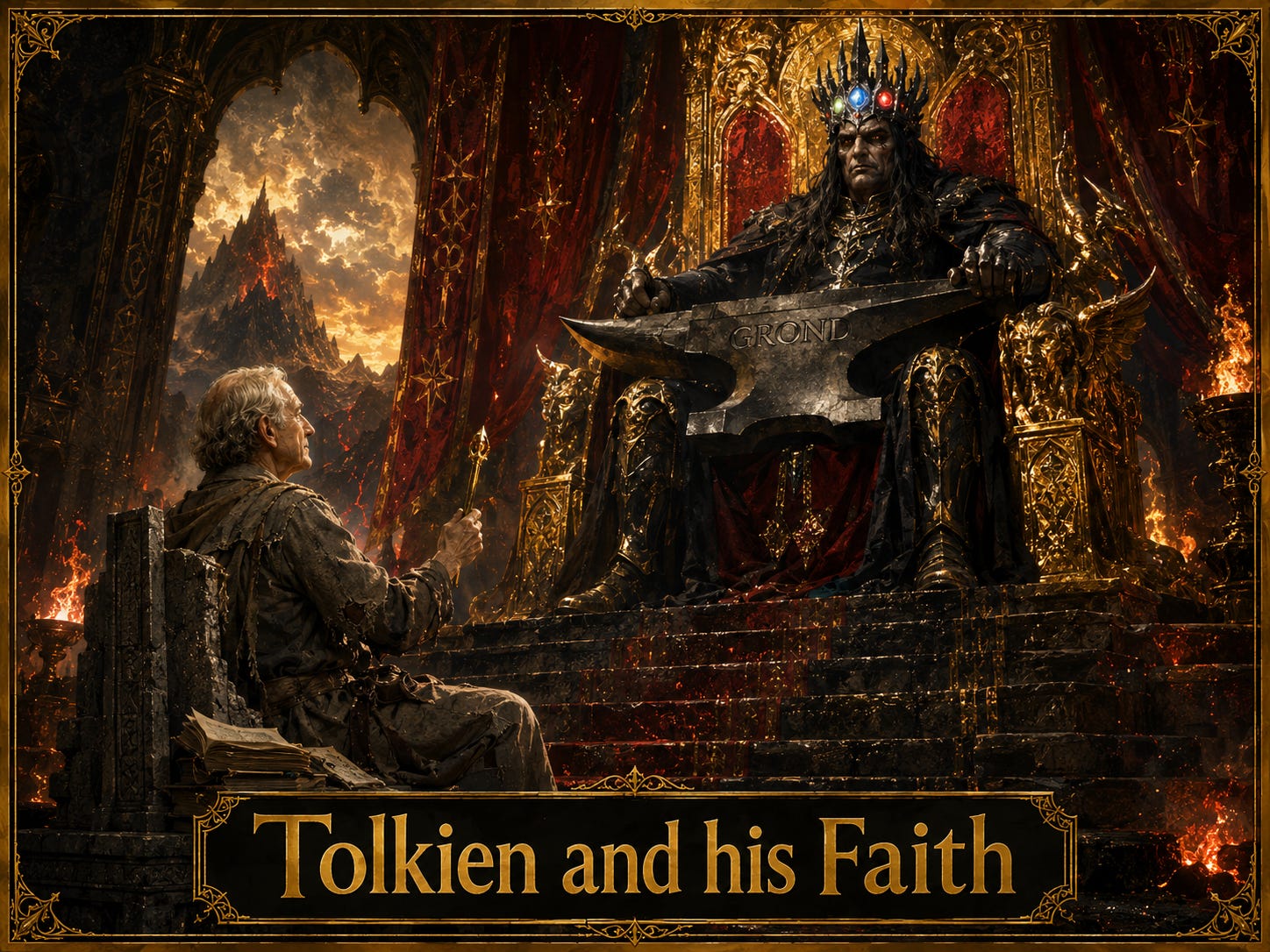
Tolkien’s poem is less about argument, and more about posture. He moves seamlessly, from a science to dismissal, from posture to wishes, from dreams defeating facts, to a faith statement repeated at least three times, to at least two statements of defiance, too observations about the flattening of the scientific materialist, to ultimately just re-stating his own version of the Apostles Creed/Catholic catechism disguised under his defense of myth itself, and his own aesthetic preference, and his escape through sub-creation. If modern audiences, were capable of understanding him at all, they will of course reject him. My purpose here is not to call him “wrong,” because that is impossible; it is simply to walk people through, what he is doing and why. Nothing in what Tolkien says, has anything in it that is guaranteed to “convince” Lewis “rationally.” Personally, I find the poem to be a mixture between EXTREMELY effective rhetoric, passionate emotional appeals, begging the question, and emotional blackmail or emotional wagering. Guaranteed, to please those who already agree with him; but unlikely to move those who already are not so disposed. Tolkien begins with the scientific material reality and then swiftly rejects its importance.
I am not arguing that Tolkien is stupid, dishonest, or even necessarily wrong. I am arguing something narrower: Mythopoeia is read as though Tolkien were making an argument for the truth of his Christian vision, when much of what he actually does is declare a posture toward reality, make several powerful observations about materialism, affirm the Christian anthropology he already believes, and finally refuse to surrender it. Those are not the same thing as demonstrating that Christianity is true. In effect, what Tolkien has done, and he wants to say the myth moves the heart in a way that reality never can. It especially moves the man who is in prison. He thereby asserts, that if something “moves” the man who is in prison, the man who feels he is in the gutter, if he is given the ability to create a sub-creation in the mind, discovering “elves.” This in itself, proves his “lordship” and his image in the creator. Such a belief does not follow; having meaning when you are in the lowest gutter, doesn’t mean, you have some spark of the divine. Nor will it make your jailer, free you, even if by this, you count yourself already “free.” My deeper objection is that Tolkien also tends to treat disbelief as surrender: as though the man who cannot see the distant King must therefore have bowed before the Iron Crown. I do not think that follows.
Tolkien's poem may magnificently express what the world looks like from inside a Christian moral imagination, but the beauty, coherence and psychological resilience of that imagination cannot by themselves establish the metaphysics that make it possible. Moreover, Tolkien risks confusing three radically different people: the man who loves evil, the man broken by evil, and the man who simply cannot believe. There are men who did find “elves in the mind” as he says, and then there are men, for whom, no fairies speak at all. The thing that really stands out to me above all the other moves Tolkien makes is how independent of reality, his credal declarations really can be. Tolkien, could speak the same words, under another name, in another universe, in another time, on another world, and it would remain, the same words, the same dispositions speaking, without any other detail of reality remaining the same. You could wipe his memory, call him Gandalf, and put him on a flat earth orbiting a double red star in the Porphyrion galaxy, and he could still hold the same view. At the same time, and this is the troubling thing for me, his disposition is context dependent; no one understands perception or love, without an extremely particular history, and such people, even if what they say is the same, “see” very different things as worthy of allegiance. The Tolkien mind, immersed in his own worldview, may not see that.
a star's a star, some matter in a ball
compelled to courses mathematical
amid the regimented, cold, Inane,
where destined atoms are each moment slain.
Tolkien begins by explaining to his audience that he understands the scientific method, and then, much like an unaffected magician, in the same breath, he dismisses it, as unimportant. Tolkien then shifts to instantly assuming telos. Not everyone thinks like that, or even has to consent to thinking like that. In many ways, Tolkien is himself, the living Tom Bombadil, from his very first verse in Mythopoeia, because his “move” is not a rational one, it is simply a refusal to grant the scientific primary importance to himself. While Tolkien has not yet at this point made either an argument or an assertion of belief, he has indicated “his posture.” He sees mathematics and sciences, he even seems to accept that it is the first thing you see, but he regards that reality, as uninteresting. This will be a recurring theme for Tolkien, he starts from posture, moves to a faith declaration, and then he makes an observation. He is less arguing, than positioning.
each alien, except as kin from one
remote Origo, gnat, man, stone, and sun.
God made the petreous rocks, the arboreal trees,
tellurian earth, and stellar stars…
Notice how rapidly uncertainty becomes theology. The “Will” is only dimly apprehended, but within a few lines Tolkien confidently identifies the author of rocks, trees, earth, stars and man as God.
At bidding of a Will, to which we bend
(and must), but only dimly apprehend,
great processes march on, as Time unrolls
from dark beginnings to uncertain goals;
For most people, especially those from a non-European non-Christian background, “meaning” has no “purpose” but their own personal survival. Tolkien, projects his own “humanity” onto his audience from the outset. The sexually successful charmer playboy, does not first ask the girl, if she believes in God, as a test for her; he uses God, as a stand in, for himself; the playboy becomes God, and so is attractive to her. The weakness and the meekness is conditioned the minute the playboy, is actually asked to reflect; the minute he does that and admits he is not God, he instantly becomes non-attractive to the millions of women who sleep with him otherwise. Tolkien, on the otherwise, makes a big ask. He thinks he can “be good” and still be winsome and attractive; he thinks his goodness in all places and in all times, will carry with it, the same effect. This makes him, easily believe a “good will” bids something; because he already thinks he is in complete harmony with it.
Tolkien is speaking to his audience, assuming that they are already “inherently good” and aware of being imprisoned by evil. Not everyone is like that. There is another kind of man whom Tolkien’s moral psychology seems unable to imagine: the man for whom vice does not feel like a prison in the first place. Some men do not experience cruelty, dishonesty, domination, or even sadism as humiliating compromises that must secretly be overcome. Their position in life may have taught them precisely the opposite. They have usually been stronger than the people around them, more socially successful, more desired, better protected from consequences, and more capable of imposing their preferences upon others. For such a man, there is no obvious prison from which virtue must liberate him. He already experiences himself as free. Tolkien’s freedom is profoundly interior: the freedom of the will that refuses corruption even when the world is hostile. But a man can also possess something much more tangible, material freedom. He can actually do what he wants. He can lie and suffer no penalty. He can behave badly and remain charming. He can injure someone beneath him and discover that his friends still laugh at his jokes, women still desire him, institutions still protect him, and weaker men still accommodate themselves to his wishes. Power itself can make him appear winsome. Not everyone will be moved by your interiority.
not for itself to be desired, but ill;
or else to strive or to subdue the will
alike were graceless; and of Evil this
alone is dreadly certain: Evil is
That is precisely why I hesitate when Tolkien projects his own moral disposition outward and treats it as though it were latent in mankind generally. Tolkien can imagine the imprisoned man who remains inwardly free. What I am less certain he understands is the man standing comfortably outside the prison, holding the keys, who has never felt imprisoned at all.
Evil it will not see, for evil lies
not in God's picture but in crooked eyes,
not in the source but in malicious choice,
and not in sound but in the tuneless voice.
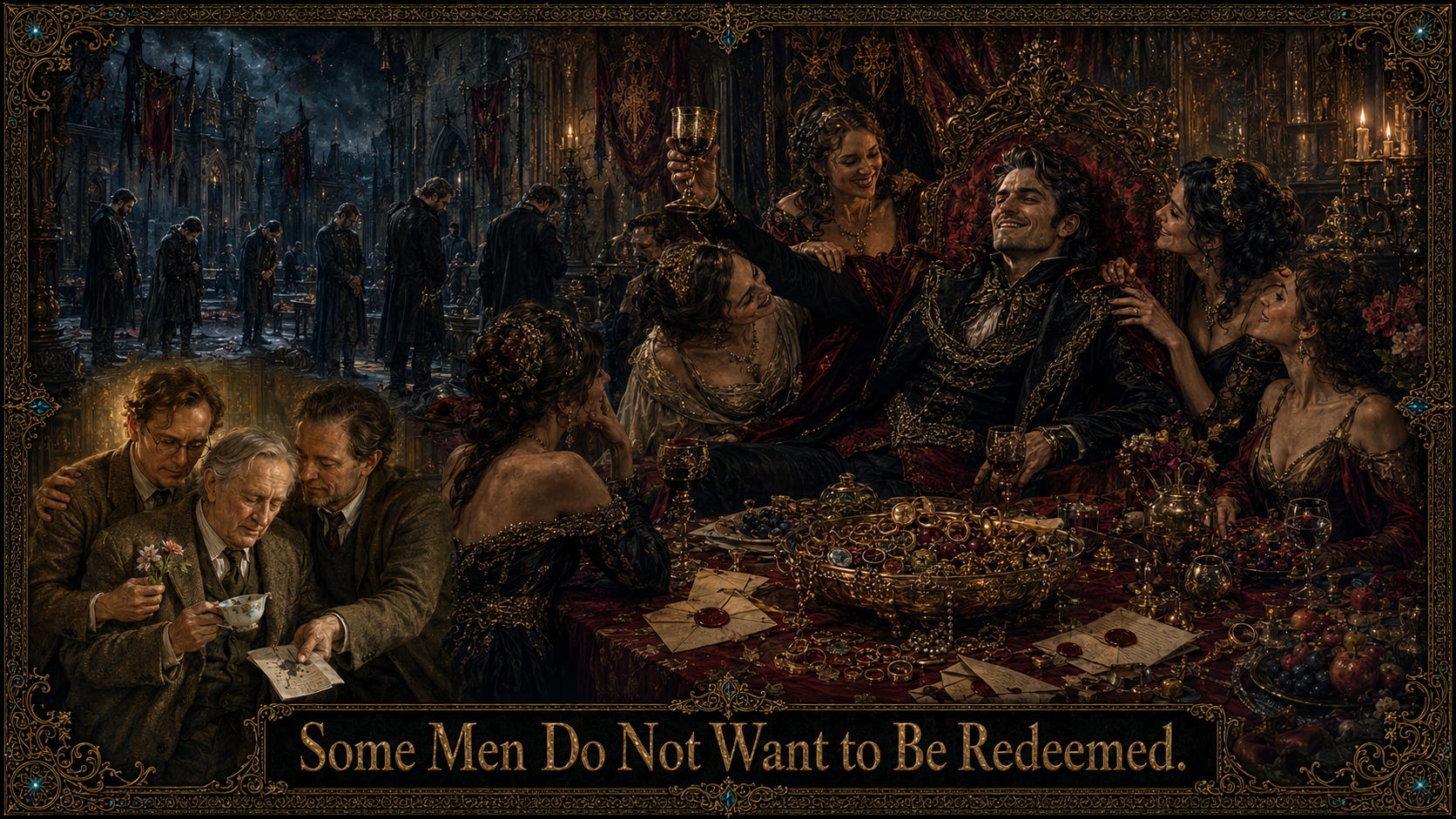
My chief criticism for men like Tolkien, who while I would not condemn him to prison for his views, is simply therefore, “Have you ever even met a true Orc, who likes being an Orc?” This is what I think, this kind of Unshakeable Unmovable “Catholic” cannot hear. My criticism before he begins, before he even starts alluding to God or to Evil, is to examine and doubt his posture. Yes, I know, this is very difficult to do in a debate format, but from a logical point of view, this confidence he projects, is what I would feel unearned and even risky. I want to say, “Tolkien, have you ever met evil people?” He speaks of goals and telos; something which when it comes to “conscious animals” differs, wildly. Few, people will automatically consent to Tolkien’s framework of “love.” But that is the posture, he is starting from. It is just to that, which I react, with skepticism. I want to say, Have you met evil people, Tolkien? Not frightened people who have mistaken the Good, not fallen men dimly remembering the Light,but people who know perfectly well that another person is suffering and enjoy the fact? What precisely does their imagination disclose about the structure of reality?
thunder and lightning, birds that wheel and cry,
slime crawling up from mud to live and die,
these each are duly registered and print
the brain's contortions with a separate dint.
The problem here is one of epistemic modesty. We have no idea why reality came to be or how it is or why we see what we see. Tolkien is describing the mysterious relation between an external world and subjective consciousness, but the mystery itself gives him no special right to infer his Christian explanation. “We don't know” is a legitimate stopping point. The unexplained character of consciousness is not positive evidence for anything.
but neither record nor a photograph,
being divination, judgement, and a laugh,
response of those that felt astir within
by deep monition movements that were kin
What Tolkien has plausibly established is that human language is not a photograph. To call something a tree is already to categorize it, abstract from particular instances, and impose a human concept upon experience. Fine. But then he makes a huge leap. He goes from the clinical art of categorizing, which most people do casually, by inference and judgment, anyway, to inserting, “reverence,” into that categorization. Your average “human” does not automatically include a reverence into a perception. Reverence is culture dependent. A South Asian, coming to Europe, Canada or America, has absolutely ZERO reverence, for the Founding Fathers, German Philosophers, Hengist and Horsa, Jesus Christ, or even necessarily, Newton and Einstein. What they have is a utilitarian conception of reality, alone. Tolkien starts with “science,” recognizes it, and then, dismissed it as the least important issue. He calls it “divination.” In other words, even possessing a disposition toward moral reverence requires certain cultural preconditions. A story must mean something to you before it can move you. A sacrifice must belong to an intelligible moral world before you can experience it as noble. A good deed must participate in some inherited or learned conception of the Good before it acquires the kind of symbolic weight Tolkien assumes. People are not born revering the same stories, heroes, symbols, or moral gestures. They have to be initiated into a world in which those things mean something. And my point is that this kind of shared moral and cultural formation increasingly can no longer simply be assumed. Increasingly, many people may recognize the symbol perfectly well while feeling no reverence toward it at all.
free captives undermining shadowy bars,
digging the foreknown from experience
and panning the vein of spirit out of sense.
Great powers they slowly brought out of themselves
and looking backward they beheld the elves
that wrought on cunning forges in the mind…
This is the decisive escalation. From the modest proposition that perception involves interpretation, Tolkien passes to “the foreknown,” “spirit,” inward freedom and finally elves. But none of these conclusions necessarily follows from the fact that language is not photographic.
Tolkien, begins his anthropology, by instantly inserting “love” into everything he sees, into everything his mind touches. That is not what “the humans” can be counted on to do; he starts there. The first “human” to distinguish one thing from another, likely only thinks: “Food. Predator. Hole. Shelter. Weapon. Mine. Yours. Mine. Female. Use. Throw away.” Human cognition is intensely instrumental. We notice things precisely because they are useful, dangerous, edible, sexually attractive, disposable, or obstacles to something else. Naming something does not entail loving it. Tolkien is starting from a posture of love, and is letting that be his argument. This would not impress anyone with a club, and an audience to play to. The “saintly” posture, depends on the good-will of the audience. And I have found all too frequently, that even the most “Christian” audience is composed of orcs; power and strength are always flexed without justification or reason. It is therefore amazing to me, how Tolkien does not budge from his posture. It is like he doesn’t even see “the orc.” Every interaction includes relations that are going to be non-reverential, the majority of the time. True love is fleeting and extremely exclusive.
He sees no stars who does not see them first
of living silver made that sudden burst
to flame like flowers beneath an ancient song
Here Tolkien makes his hierarchy too obvious. Myth does not merely add one possible layer of meaning for him; without the jewelled tent and the maternal earth, he says, there is “only a void.” His preferred imaginative perception has become the condition of possessing a world at all; his imagination is coming before the world as it is.
There is no firmament,
only a void, unless a jewelled tent
myth-woven and elf-patterned; and no earth,
unless the mother’s womb whence all have birth.
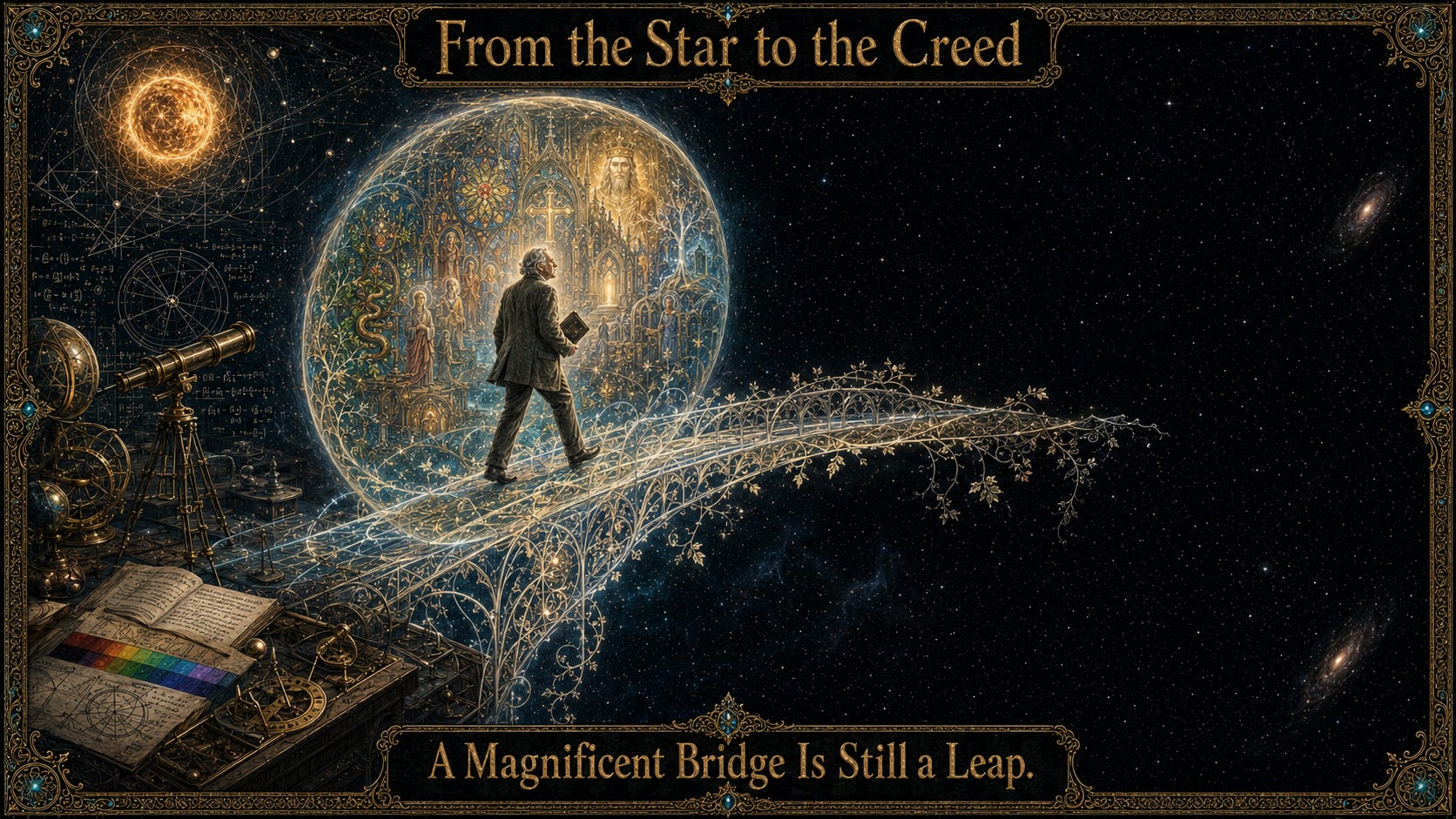
Tolkien turns a defensible observation into an extravagant one. Yes, we all have to admit that science cannot tell us “what a thing is,” only, what it does. What a thing does, how we perceive it, and what it is in itself are not identical. Our concepts are not transparent photographs of reality. Fine. That leaves us with uncertainty. But Tolkien then leaps from “our perception is interpretive” to “the truer perception is enchanted, an enchanted commandment, even.” That is a leap, not an argument. Tolkien does not merely defend metaphor here. He ranks metaphors. His own enchanted perception is treated as fuller, deeper, more truthful than the supposedly flattened perception of the scientific mind. But that hierarchy is asserted, not demonstrated.
The astronomer who sees plasma, gravity, fusion, mass, spectra and distance has not failed to see the star. Nor has the exhausted sailor who sees a navigation point, or the farmer who sees the hour, or the frightened man who barely notices it. Tolkien has taken one extraordinarily rich aesthetic response and promoted it into a criterion of genuine perception. Not everyone loves what he looks at. Most eyes are non-empathic. Tolkien, is counting on you the audience, having empathy, to bow to what he has put higher in importance. That works on some people, not on everyone. The intensity of feelings and pathos, is not epistemic priority.
The heart of man is not compound of lies,
but draws some wisdom from the only Wise, and still recalls him.
Though now long estranged,
man is not wholly lost nor wholly changed.
Dis-graced he may be, yet is not dethroned,
and keeps the rags of lordship one he owned,
This is the part of the poem, where Tolkien shows all his cards. In his seventh paragraph. He is essentially just quoting the Catholic Catechism at his audience, though in miniature, in just less than ten words even; whether they notice him doing it or not. Tolkien is versifying the Christian anthropology summarized by the Catholic Catechism. This is the point, where the posture of Tolkien changes from hearing a scientific statement, to refusing posture, to his repeated two or three repeated declarations of faith. It is impossible not to miss the point, where he actually comes the closest “turning and attacking” but this is the point, where he does it. Only the most dim-witted and unfamiliar, would not instantly recognize, what he is alluding to with this. Your average low-IQ atheist, will not know enough of the move he is making to understand, why it matters; Tolkien is attacking materialism itself in “Apostolic” terms directly, at this point. His posture, has moved into a “faith declaration.” First, slowly, and now quickly. Nothing in the preceding discussion of language or imagination demonstrates a Fall. Nothing about metaphor establishes original dominion. Nothing about human creativity establishes that we are disgraced heirs of a divine kingship.
This is where I must express to Tolkien my “lack of faith.” Tolkien starts from the posture of absolute “love.” He starts with love. Explicitly. Tolkien creates a “God,” and indeed a universe in his own image. He believes in a “God” that starts from “Love.” God, grants “the rags of lordship.” He lets you keep them. He does not take them away. That is “love.” Clearly and unmistakably. The “estrangement” is not a cold dark for Tolkien as it is for me. The “golden scepter” is clutched and possessed. But why must this be so. I do not see that. Surely, the con-man, the pornographer, the oath-breaker, the traitor, the envious, the murderer, the liar, the expropriator of the vulnerable, wears not the rags. He bears not the scepter. There is nothing in nature to suggest this. Only cold eyes look out from that man. Tolkien has warm eyes, and a warm voice. There is nothing to suggest that God creates and grants the love. I think the “love” is merely emanating from Tolkien himself. He creates a “God” in his own image. I see no “God” to guarantee the “rags of lordship” in the world. That is my “unbelief.” I see the “ring of Barahir,” on you Tolkien. Perhaps you are the unshakeable warrior Saint. I do not see that ring on any other hand. The “love” is coming from you; not from them, not from the outside. That is my “unbelief.” Tolkien encounters his own extraordinary moral disposition, his loyalty, tenderness, hope, reverence and unwillingness to surrender “human” dignity, and interprets that disposition as evidence about what reality itself is like.
his world-dominion by creative act:
not his to worship the great Artefact,
Man, Sub-creator, the refracted light
through whom is splintered from a single White
to many hues…
Tolkien has now completed his doctrine of creation: God creates man, and man creates derivatively because he bears the pattern of his Creator. The Apostles’ Creed supplies the Creator; Genesis and Catholic anthropology supply the divine image; Tolkien combines them into his notion of the “Sub-creator.” Again, he expresses the doctrine magnificently, but it does not derive the doctrine from anything previously demonstrated.
The right has not decayed.
We make still by the law in which we’re made.
Here the argument is no longer merely that human beings create. Tolkien tells us why they create: they are refracted divine light, exercising an inherited dominion according to the law in which God made them. That is the doctrine his discussion of language was supposed to establish, but he has simply announced.
Up to this point, Tolkien can claim to be dialoguing with reason, but at his seventh paragraph he stops completely. Suddenly we have an entire Christian anthropology already being imposed on us: man was once in proper relation to God; man fell or became estranged; he lost grace; he once possessed a divinely sanctioned lordship over creation; some remnant of that dignity survives. My question or objection is this: where the hell did any of that come from? The cruelty of material reality, and the endless chain of death from death in the circle of life, cruelty to cruelty, does not require the Catholic principal of a fallen man, who is still secretly loved by God, and is therefore “secretly good.” Tolkien is the ultimate Luke Skywalker, telling his Darth Vader, that “there is good in him.” That is an assertion, an accusation, not an argument, and not evidence.
Yes! ‘wish-fulfilment dreams’ we spin to cheat
our timid hearts and ugly Fact defeat!
Whence came the wish, and whence the power to dream,
or some things fair and others ugly deem?
It is right after this point, where Tolkien, turns to, really his first statement of defiance, and then to his various iterations of his central faith statement. That of “Feelings do not care about your facts.” Tolkien treats the existence of desire as though the desire's mysterious origin somehow protects its object from dismissal. But a wish establishes the existence of the wish, not the existence of what is wished for. Facts, do defeat, Tolkien. Facts defeat my dreams all the time. My ability to dream is easily dismissed. Who knows where my dream came from. I can desperately want good things for myself, but that does not mean, “reality” in any way has to grant those things, just because I wished for them.
All wishes are not idle, nor in vain
fulfilment we devise — for pain is pain,
not for itself to be desired, but ill;
or else to strive or to subdue the will...
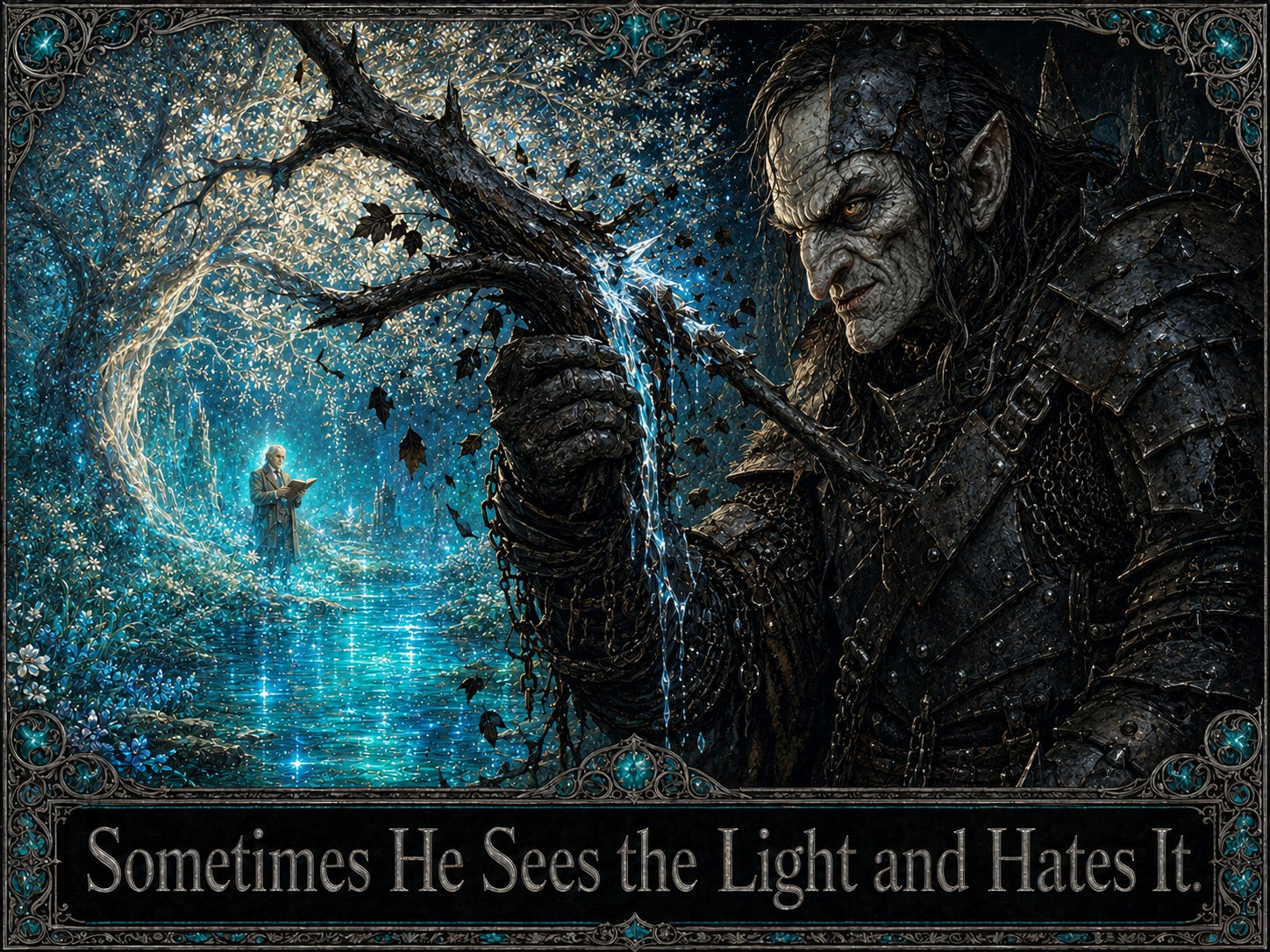
Tolkien distinguishes “good” wishes only after already assuming the Good, only after presumming his audience only wishes for the good. Evil people enjoy evil wishes all the time. There is nothing in the ability to wish or to will, that requires a Christian anthropology. Few people will bother to distinguish between good wishes and evil wishes. Evil people avoid pain for themselves too. “Have you met evil people, Tolkien?” Tolkien cannot simply say that our good desires disclose something true while our evil desires are corruptions. The sadist dislikes pain inflicted upon himself. The tyrant wants security. The torturer wants pleasure. Human aversion to one's own suffering does not establish Tolkien's Christian moral cosmology. If desire points beyond itself, what do evil desires point toward? If Tolkien answers, “Those are fallen or corrupted desires,” my response is again: Fine, but you are explaining human psychology through Christianity, not deriving Christianity from human psychology.
Then Tolkien says:
Blessed are the timid hearts that evil hate,
that quail in its shadow, and yet shut the gate...
weave tissues gilded by the far-off day
hoped and believed in under Shadow’s sway.
Faith statement. Tolkien is no longer demonstrating anything. He is blessing a psychological disposition: the person who preserves hope under darkness. The man who maintains hope may be magnificent. His magnificence does not make the hoped-for thing real. Then Tolkien writes:
They have seen Death and ultimate defeat,
and yet they would not in despair retreat,
but oft to victory have turned the lyre
and kindled hearts with legendary fire...
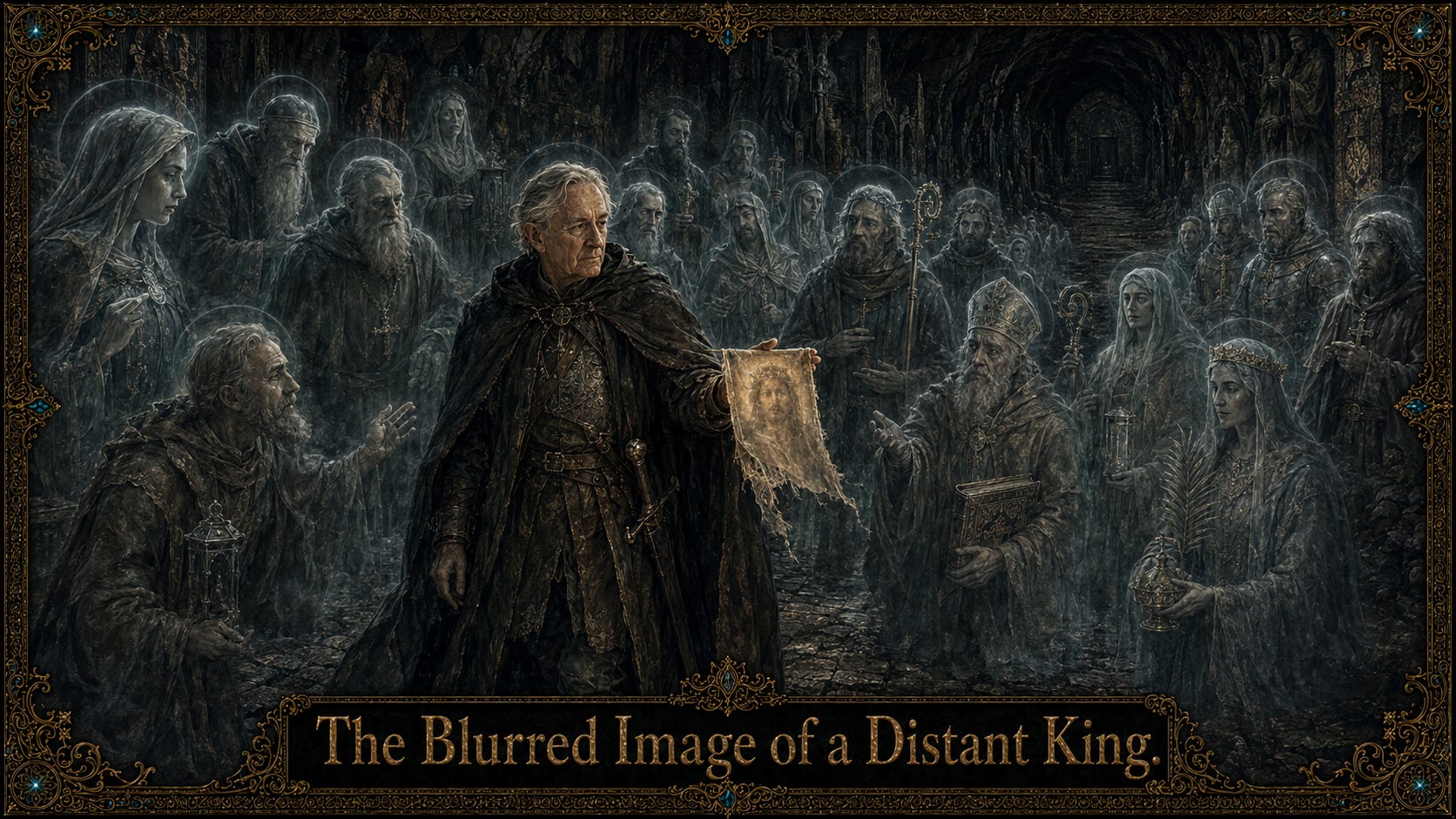
A belief in ‘Saints’ is a double myth. Tolkien is saying that good men never lost hope, so he won't. My problem? You don't know that. Tolkien selects the people who endured suffering without surrendering hope and makes them exemplars; to make matters worse, he selects them from dimily remembered history at best, from legend and from myth. But what about everyone suffering broke? Some people retain faith. Some abandon it. Some become cruel. The existence of a saint proves that a human being can preserve a belief magnificently under adversity. It doesn’t prove the belief. Make Tolkien a saint, by all means. He is your primary vocalized demonstration of it. But that is not evidence. We have blurred images for most of reality which we cannot see, and we are usually wrong.
I would with the beleaguered fools be told,
that keep an inner fastness where their gold,
impure and scanty, yet they loyally bring
to mint in image blurred of distant king...
Faith statement. Tolkien more or less admits that is all he is doing. The distant king is unseen. The image is blurred. The gold is impure and scanty. He is giving a magnificent description of persevering faith despite evidentiary uncertainty. Yes. Exactly. That is faith. And therefore it cannot simultaneously be offered as evidence demonstrating its own object. Here is the thing: no one will care. The “distant king” introduces the Christological centre of Tolkien’s creed without naming Christ directly. Like the ascended Christ of the Apostles’ Creed, who sits at the right hand of the Father and will return, the King is absent from ordinary sight but remains the object of allegiance. Tolkien acknowledges that the image is “blurred,” yet treats loyalty to the unseen original as a virtue.
Blessed are the men of Noah’s race that build
their little arks, though frail and poorly filled,
and steer through winds contrary towards a wraith,
a rumour of a harbour guessed by faith.
Tolkien’s own wording nearly concedes my entire point. The harbour is not demonstrated or clearly seen. It is a “wraith,” a “rumour,” and something “guessed by faith.” His subject is therefore not knowledge triumphing over materialism, but faith preserving its direction under radical uncertainty.
I will not walk with your progressive apes,
erect and sapient. Before them gapes
the dark abyss to which their progress tends...
Tolkien’s target has now become recognizable: not merely the atheist, but the modern organizer of counterfeit happiness, the man who promises economic bliss, mechanized pleasure and escape from tragedy. Here is the thing he has never demonstrated, which the Christian promises; an escape from tragedy. There is no escape. Just because the Utopian is lying, does not mean, that there is any such thing as a heaven. Tragedy, I know, escape, has not been demonstrated in any way. Furthermore, if a man suffering, he might well suffer more, dwelling on his suffering, but the imagination need not prove any higher reality. That it functions as a temporary respite from suffering I do not doubt. But a bottle of port, does that too.
It is not they that have forgot the Night,
or bid us flee to organized delight,
in lotus-isles of economic bliss
forswearing souls to gain a Circe-kiss
(and counterfeit at that, machine-produced,
bogus seduction of the twice-seduced).
And notice the wording, “I will not.” Not “You are factually mistaken because…” He has reached the poem’s purest declaration of allegiance. Tolkien increasingly speaks as though metaphysical skepticism were a moral-political camp one chooses to join. And this is the point in such discussions, where I start to feel offended. As if, by not having faith, or in having lost faith, or in having experienced and understood real “Orcs” that I therefore, in not having maintained said winsome posture, innocent posture, in not dismissing the matter of materialism, must therefore, be completely okay with “evil;” or that I have no preferences or tendencies or biases of my own on any question associated with the emotions and elevated ideals of which he prefers. Ultimately, Tolkien is not responding to argument with argument, he is responding with faith statements. Tolkien is just saying, “stop being a downer.”
I will not tread your dusty path and flat...
I bow not yet before the Iron Crown,
nor cast my own small golden sceptre down.
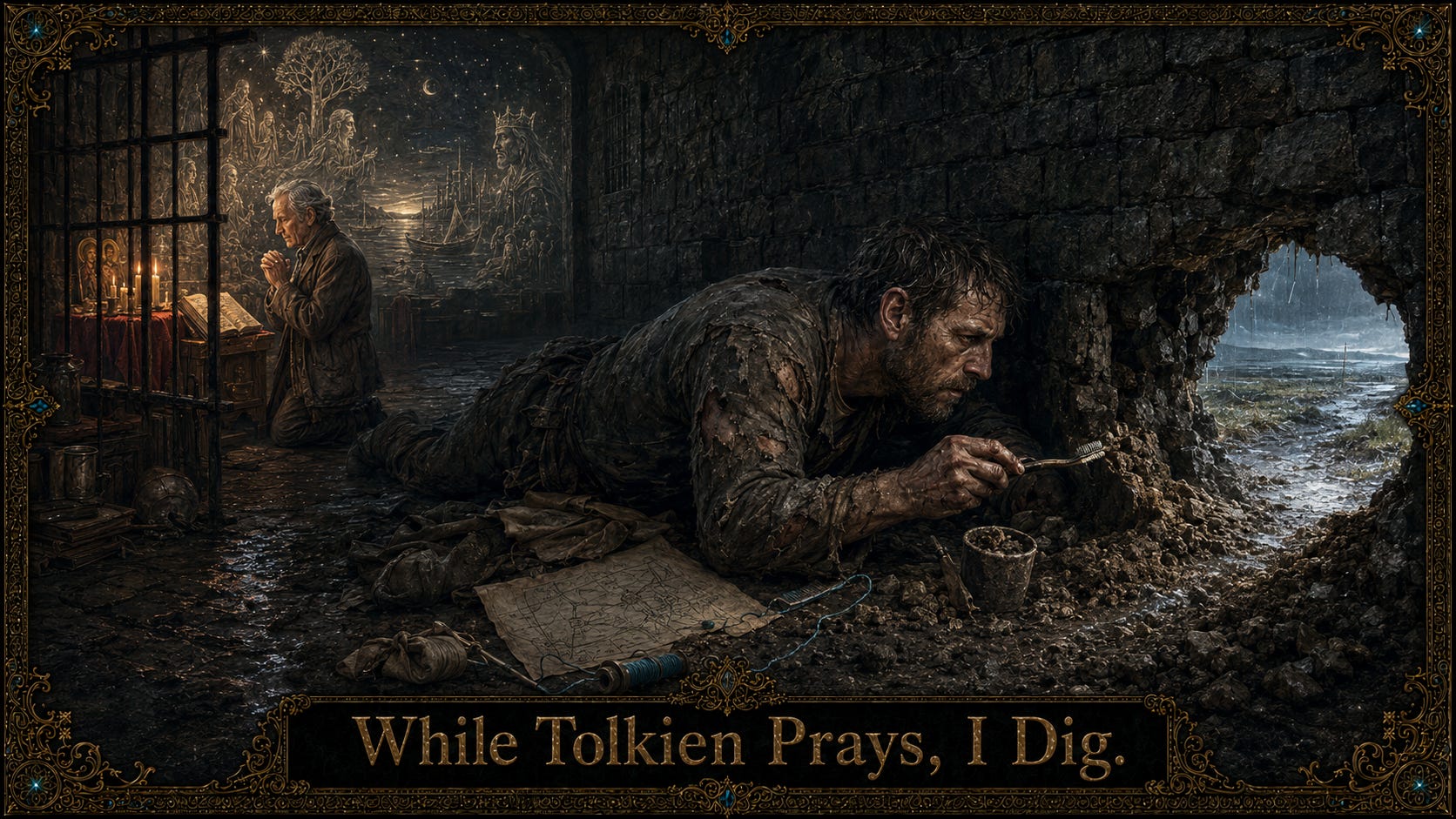
Tolkien presents unbelief rhetorically as bowing, almost an act of submission to the enemy. But someone can have belief beaten out of him by experience without ever consenting to the reality he fears. And this is where it gets intensely personal for me. This is where I feel insulted by Christians the most. You do not know how intensely I may feel my feelings, even while I am silent, even while I may feel forced to maintain absolute silence on those feelings, for all kinds of reasons, which in and of themselves, may be a torture. Tolkien treats or mistakes, or defines, inability to believe, for willingness to surrender. That is simply unfair. How much suffering must a person endure before losing faith ceases to be interpreted as cowardice, capitulation, spiritual poverty or “bowing”? A broken man hasn’t necessarily changed sides. This is possibly my primary objection to his poem. Again, Tolkien has moved completely from argument into Christian explanation from inside Christianity. God’s picture is “on one side,” and seeing God’s picture is already evidence for him, and proof of allegiance to God’s original design. God’s music; not seeing God’s picture, hearing instead the tuneless voice, is “on the other side.” In that he derives the tuneless voice, the crooked eyes.
Be sure they still will make, not being dead,
and poets shall have flames upon their head,
and harps whereon their faultless fingers fall:
there each shall choose for ever from the All.
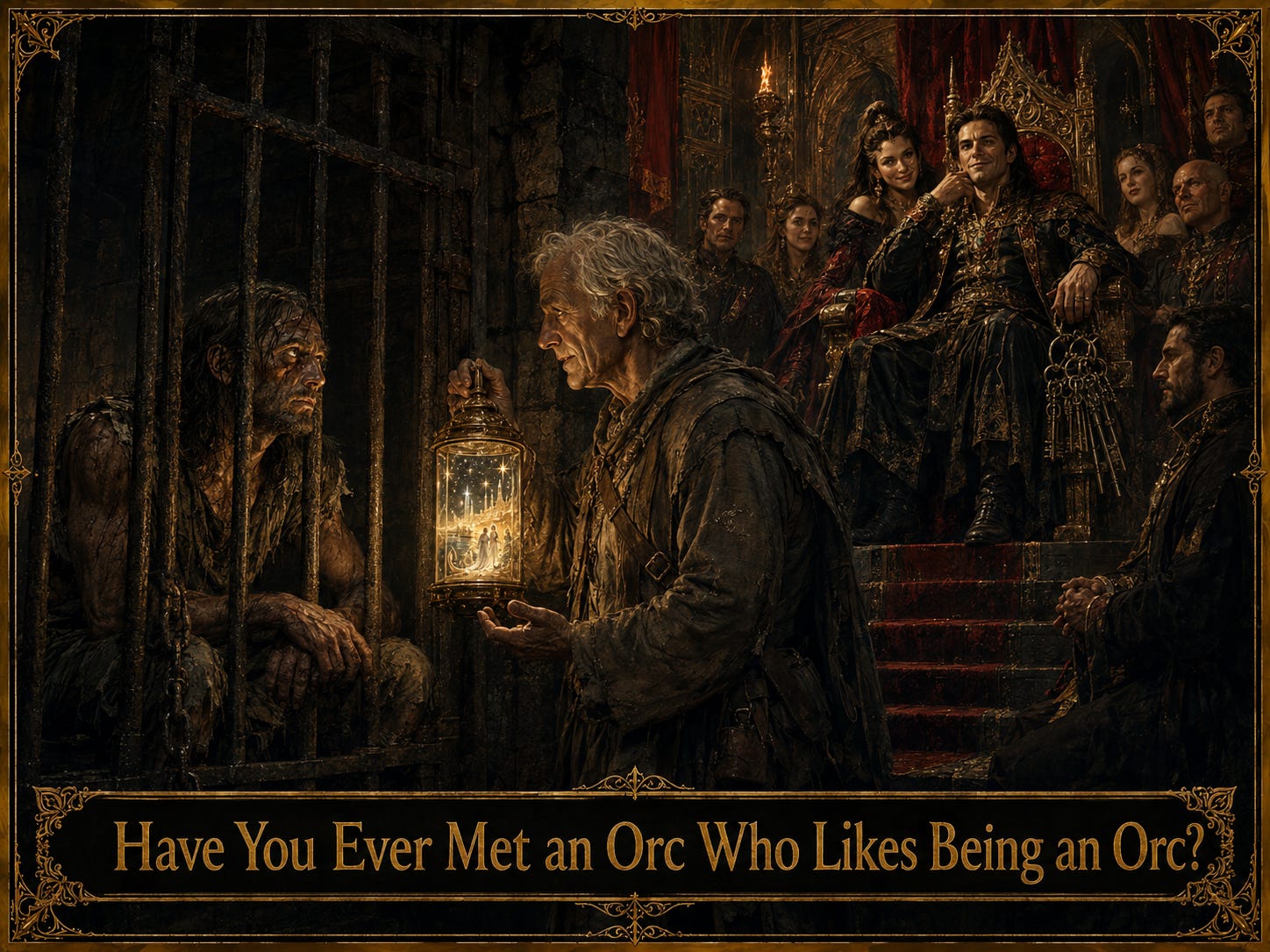
That's just your Faith, Tolkien. That's not an argument. That's just your pure faith. We began with stars, trees, words and stories. We have ended with immortal poets making art in Paradise. Somewhere between the two, Tolkien did not prove the Creed. He rewrote it beautifully and asked us to recognize it. Many academic types will read his poem and do not realize that this is all Tolkien was doing the whole time. Along the way he makes some sharp observations about the sterility of the “progressive apes,” about the flattening instincts of materialism, and about the poverty of a world that can describe everything while loving nothing. But these are observations and preferences, not demonstrations. Again and again he returns to the same moves: a declaration of faith, a renewed declaration of faith, and finally a declaration of defiance. I will not cast down my sceptre of being made in the image and likeness of God, and therefore, a “sub-creator.” Magnificent rhetoric. Still not an argument.
And this brings me back to my deepest objection. I do not think Tolkien really understands the Orc who rejects him. By “Orc,” I do not mean merely the stupid materialist Tolkien can easily caricature: the man who thinks beauty is chemistry, morality is convenience, and a tree is only so many board-feet of lumber. I mean the person who has looked at precisely the things Tolkien asks him to look at, beauty, suffering, longing, cruelty, myth, death, and still cannot make Tolkien’s leap. I mean the person who would like the King to exist, who would prefer the harbour not to be a rumour, who may desperately want the golden sceptre to signify something beyond his own hand, and yet cannot persuade himself that wanting it makes it true. Tolkien does not quote the Apostles’ Creed verbatim. He reconstructs its narrative architecture poetically: the Creator of heaven and earth; humanity made according to divine law but estranged from its source; fidelity to an unseen King; death transformed into victory; and, finally, perfected embodied life everlasting. His “posture” is therefore not from myth to proof, but from ordinary experience into an already Christian interpretation of ordinary experience. Very few people would move from ordinary experience to proving simply by restating the catechism, though that is all Tolkien is really doing. That will satisfy very few people.
Tolkien continually writes as though unbelief were an allegiance. The skeptic has joined the progressive apes, accepted the Iron Crown, and cast away his own inheritance. But my loss of faith is not my acceptance of what I fear may be true. Despair is not consent. Doubt is not worship. A man does not bow before the Iron Crown simply because he can no longer see the distant King. This is the hidden accusation Tolkien is making that I find so upsetting and offensive. And perhaps this is where I think, I understand the Orc better than Tolkien does. The Orc is not someone who has forgotten the Light. Sometimes he remembers it perfectly well and hates it. Sometimes he knows what goodness is and rejects it. Sometimes he sees suffering and enjoys it. Sometimes he is merely suspicious, and resentful of his place in reality and is therefore, incapable of making Tolkien’s act of faith. Human beings are not uniformly secret saints awaiting the right myth to awaken them. Some are cruel. Some are indifferent. Some are broken. Some simply do not believe. Make Tolkien a saint, by all means. He exemplifies the type magnificently. He kept his inner fastness. But the saint proves the durability of faith, not its object. That is what Mythopoeia finally gives us: not a proof that dreams defeat facts, but the portrait of a remarkable man who refused to allow facts, to defeat his dreams.
No posts
Comments
Nothing yet. Say the first thing.
Sign in to join the conversation.