
This is not a discovery, and I am not claiming proof. It is an original, deliberately “out there” hypothesis. I am riffing a construction around a real absence in the fossil record. My question is simple:
What if a presently unknown, deeply divergent “super-ghost” lineage contributed a small but anatomically decisive portion of the modern sapiens package?
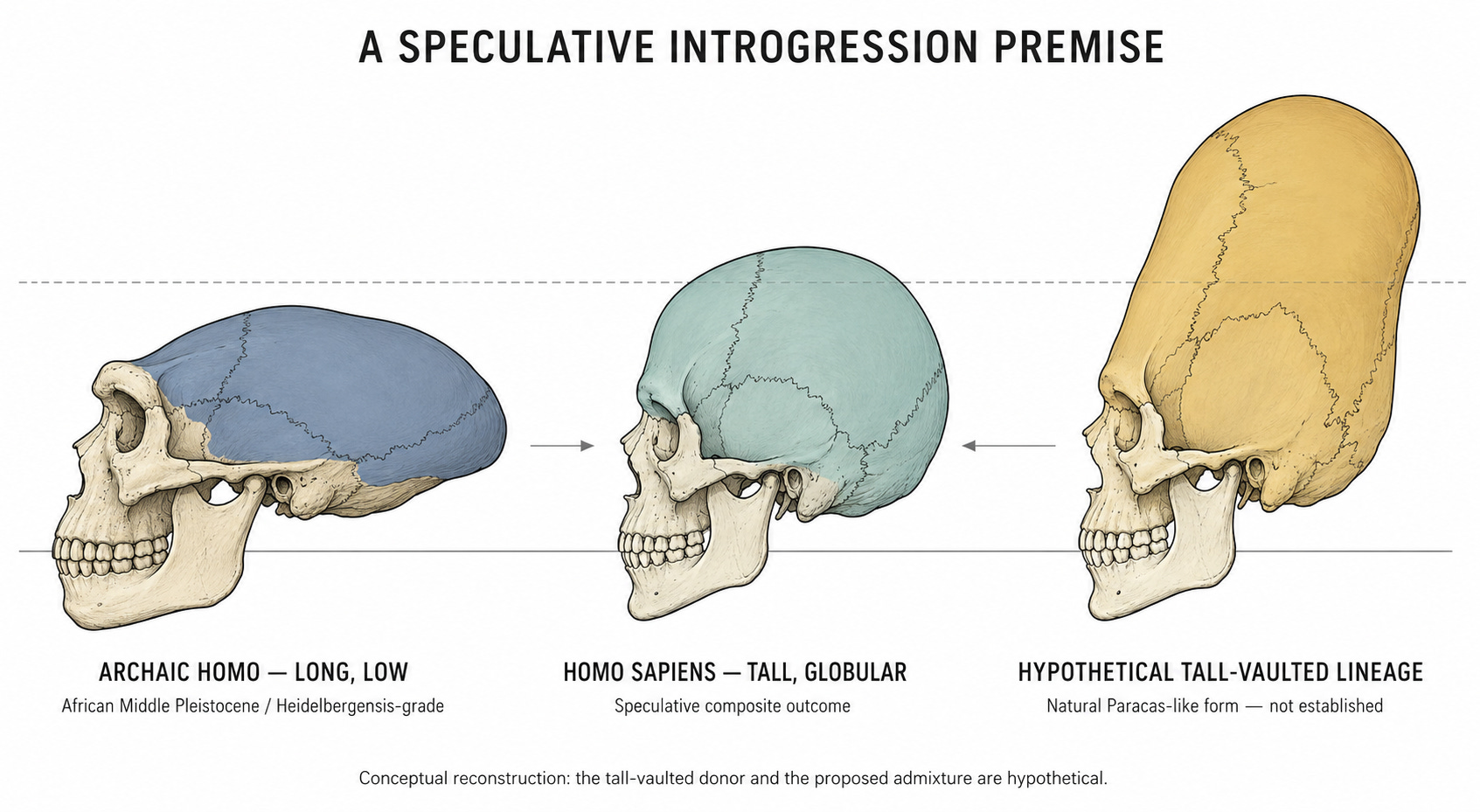
We possess several large-brained archaic hominids, but their skulls repeatedly follow a long, low and backward-projecting architecture. Neanderthals had enormous brains. Jebel Irhoud already possessed approximately modern brain volume. Yet these were not contained inside the tall, rounded and globular vault characteristic of modern Homo sapiens.
The conventional explanation is mosaic evolution among structured African populations. The face became smaller and more retracted first. Brain volume entered the modern range. The parietal and cerebellar regions then developed differently, producing the characteristically globular sapiens vault. That is entirely possible. But arranging the surviving fossils into a plausible order does not establish that we have identified every population that contributed to the transformation.
Human evolution is no longer understood as a clean tree. It resembles a web of diverging populations that repeatedly encountered one another and exchanged genes.
Neanderthals introgressed into sapiens. Denisovans introgressed into sapiens. Sapiens appears to have introgressed into Neanderthals. Denisovans themselves may have inherited DNA from a much more deeply diverged “archaic” population. Researchers have also reported genetic signals consistent with archaic introgression into West African populations.
One influential study produced model-dependent estimates extending as high as approximately 19% archaic ancestry in some West African populations; something most people would conventionally perceive as “less evolved,” being introgressed with the “more evolved” incoming homo sapiens. That estimate is not a measurement of an identified fossil species, and competing models can explain portions of the signal through long-standing African population structure. Nevertheless, the important point remains: serious geneticists already entertain substantial contributions from populations whose bones and genomes have never been identified. African ghost-introgression study
The ghost is inferred from what it left behind. Why, then, must every important contributor to the sapiens anatomical package already be represented in our fossil cabinet?
My proposed “super-ghost” would not merely be another regional population of familiar African Middle Pleistocene Homo. It would be a more deeply divergent and morphologically unusual lineage: perhaps descended from an earlier branch of the hominin radiation, perhaps evolving for many hundreds of thousands of years in geographical isolation; perhaps, even a million years prior to our lesser hominids.
I am imagining a population with a naturally high and vertically developed cranial vault, something much more extreme than modern sapiens, and radically unlike the repeated long, low configuration found among known large-brained archaic hominids. The resulting modern human skull would not be a miniature copy of this hypothetical donor. It could be a composite developmental result:
the large brain volume and broad cranial architecture of existing African Homo;
the reduced face and teeth appearing among early sapiens populations;
a small collection of introgressed variants affecting vertical brain growth, parietal expansion, cranial-base development or postnatal globularization.
In a primitive visual blending model, an extremely tall donor might need to contribute something like one-third of the ancestry of the original hybrid population to move a long, low skull toward the modern intermediate form. While I realize that genetics does not operate like mixing paint, this is essentially the idea. An initial hybrid population might have carried 10% or as much as 30% donor ancestry, while repeated backcrossing eliminated nearly all of it. Natural selection could preserve only a few regulatory regions with disproportionately large developmental effects. The result today might be less than 1% in us today.
Thus my hypothesis does not require modern humans to be one-third “ alien other.” It requires only that an original mixture introduced a few consequential variants that survived while almost everything surrounding them disappeared. Call it one percent divine, if you like.
We normally describe introgression horizontally: Neanderthals meet sapiens, Denisovans meet sapiens, one neighbouring population contributes to another. By “introgression downward through time,” I do not mean that anything literally travelled through time. I mean introgression from a deeply surviving branch: an ancient lineage persisted alongside later hominids long enough to encounter them, contributed a small portion of its DNA, and then disappeared while fragments of its biology continued within the resulting population.
Its complete form then in almost Lovecraftian fashion “disappears,” but selected fragments of its biology continue within descendants who look nothing like the original donor. This is not as conceptually strange as it initially sounds. If Denisovans contained genetic material from a “super-archaic” population, then something resembling this already occurred. An ancient lineage persisted, encountered a later lineage, contributed DNA and vanished as an independently recognizable population.
My speculation is simply that one such contribution might have affected the developmental system producing sapiens globularity. There is presently no genetic evidence connecting a ghost lineage specifically to our rounded braincase. That is why this remains a hypothesis rather than a conclusion. But neither do we possess ancient African DNA from the period and populations required to exclude it decisively.
The exceptionally tall skulls associated with Paracas naturally provoke this thought in my imagination. The known Paracas remains are recent Homo sapiens, and their extreme forms are generally attributed to intentional modification during infancy. They therefore cannot themselves be the ancient donor proposed here. My thought experiment is different:
Suppose an ancient population existed whose natural, inherited anatomy resembled the vertically exaggerated Paracas form.
The recent skulls would not prove that population existed. They merely provide a useful visual model of the morphology I am imagining: not the Neanderthal braincase extended backward, but a vault directed dramatically upward.
My hypothetical donor might have possessed a naturally tall but narrow vault. Hybridization with broader, large-brained African populations could then have produced something neither parent population possessed independently: the moderated, rounded and globular sapiens condition. Again, I am merely proposing “an undiscovered species,” an undiscovered phenotype, not an identified species.
This next association is mythopoetic rather than scientific and contributes no evidence to the “genetic hypothesis.” Here my hypothesis acquires a mythological echo. The Epic of Gilgamesh describes Gilgamesh as two-thirds divine and one-third human. This is not genetics. It does not correspond neatly to one divine parent and one mortal parent, which would produce halves rather than thirds. Nor can an ancient poem serve as biological evidence.
The mythological formulation is intriguing to me; the way everyone was claiming to be “part god” in the ancient world, sometimes even with a precise number to go along with the claim. Gilgamesh was not merely blessed by the gods or descended from them. He was imagined as possessing a quantitatively mixed constitution: one order of being combined with another.
Could such myths preserve an extremely distorted cultural memory of encounters between visibly different populations? Possibly. Could “two-thirds divine” simply express royal power, exceptional strength and proximity to the gods? I am leaving the first possibility open without pretending that mythology proves it.
One need not invoke Zecharia Sitchin, or Lloyd Pye, or the Anunnaki, or a complete extraterrestrial engineering programme to ask this question. My hypothesis does not require them.
The unknown donor could have been entirely terrestrial: a relic population from an ancient hominin radiation, isolated somewhere in the Levant, Central Asia or another poorly sampled region. It might have been no more “alien” than Denisovans appeared before their DNA was recovered from a fragment of finger bone. An extraterrestrial origin belongs at the extreme outer edge of logical possibility. My hypothesis works without it.
A deeply divergent and presently unidentified terrestrial lineage may have contributed a small amount of developmentally important ancestry to emerging Homo sapiens. Most of that ancestry may subsequently have disappeared, leaving perhaps 1%, or much less, concentrated in selected regions affecting cranial and neurological development.
The hypothesis would require evidence. We would need to identify unusually deep genetic segments associated with cranial development; demonstrate that they entered sapiens through admixture rather than ordinary ancestral variation; estimate when and where that admixture occurred; and, ideally, discover fossils or ancient DNA belonging to the donor population.
Of course, I understand this “Super-Ghost” is just my own speculation. But speculation is not the opposite of science when it clearly identifies itself and proposes evidence that might decide the question. It is the beginning of a question.
We already know that the history of humanity contains populations we discovered first as statistical shadows. We know that lineages could disappear while fragments of their genomes survived inside other people. We know that brain volume became approximately modern before brain shape did. What we do not know is whether the decisive change came entirely from within the populations we have already named.
What if it did not? What if there was someone else? What if there was someone, we do not know anything about?
I am not repeating the Ancient Aliens conclusion; I am extracting its underlying hybrid-origin intuition, removing the spaceships, monuments and presumed engineering, and restating the remaining possibility as a testable hypothesis of deep-lineage introgression. As a literary analogy, my speculation resembles a Lovecraftian “great lost race” theory: an ancient, radically unfamiliar lineage disappears, while some minute biological inheritance survives inside the species that follows it. I invoke Lovecraft not as evidence, but because his fiction supplies an unusually vivid imaginative form for the hypothesis.
“The sons of God saw that the daughters of men were beautiful; and they took wives for themselves, whomever they chose.”
- Genesis 6:2
“The angels, the children of the heaven, saw and lusted after them.”
- 1 Enoch 6:1
No posts
Comments
Nothing yet. Say the first thing.
Sign in to join the conversation.