
When people ask for a “missing link,” they are often treated as though they expect one magical creature, half ape, half human, to step obligingly out of the ground.
That is not what I mean. I understand precisely what mainstream science is arguing. I am not the intellectually inferior religious simpleton they have assumed me to be. I understand how complex their standard model is.
I accept that evolution operates through populations, that different anatomical traits can change at different times, and that no individual announces the birth of a new species. My objection is much more precise:
We do not possess a sufficiently complete fossil population showing the principal transformation from the long, low archaic braincase to the high, rounded and eventually globular braincase of modern Homo sapiens.
We possess evidence on either side of the change. What we lack is an adequate record of the change itself.
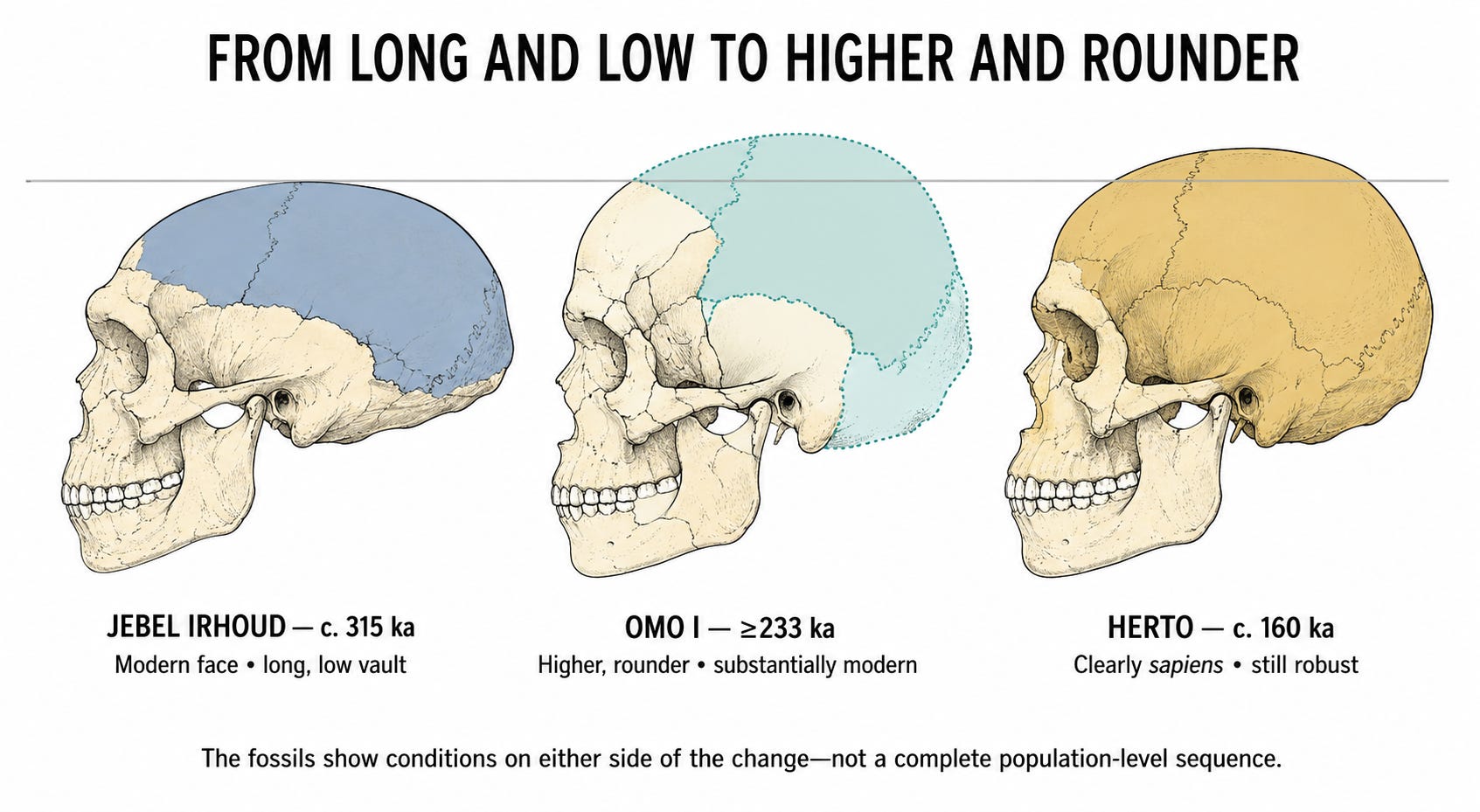
Jebel Irhoud in Morocco, approximately 315,000 years old, is one of the earliest fossils assigned to the sapiens lineage.
Its face is surprisingly modern. It is relatively small, flat and retracted. Its teeth and jaws possess important sapiens characteristics. Its brain volume was already approximately within the modern range.
But its cranial vault was still long, low and extended backward. It did not possess our high, rounded and globular braincase. Irhoud therefore demonstrates something extraordinarily important:
Modern brain volume appeared before modern brain shape.
It gives us a large-brained early sapiens population before the decisive cranial reorganization was complete.
Omo I, discovered in Ethiopia, is securely older than approximately 233,000 years. It possesses a substantially higher and rounder cranial vault, as well as a chin and other unmistakably sapiens characteristics.
Herto, approximately 160,000 years old, is extremely robust but clearly human. By this stage we are no longer looking at something that appears halfway between an archaic hominin and ourselves. We are looking at archaic variations of Homo sapiens. Ultimately, I think those are just homo sapiens.
Omo is also incomplete, meaning that portions of its reconstructed skull cannot supply the continuous anatomical evidence that a well-preserved fossil population would provide.
Using the central dates, the apparent interval between Jebel Irhoud and the minimum age of Omo I is 82,000. But this is not a securely established 82,000-year evolutionary sequence.
Omo I is older than approximately 233,000 years. The volcanic layer provides a minimum age, not its exact birthday. Omo could be substantially older. Jebel Irhoud’s date also carries uncertainty, and the two fossils come from opposite ends of Africa rather than one demonstrably continuous population.
Therefore, if Irhoud represents the condition before the major shift and Omo represents the condition after it, then the principal transformation may have occurred within no more than approximately 82,000 years, and possibly much less.
That is the narrow window that interests me.
Somewhere around this interval, a large brain contained inside a long, low vault began assuming a higher and rounder configuration. Yet we do not possess a densely sampled population demonstrating the intermediate geometry.
Where is the skull that is unmistakably midway? This is the question many “skeptics of evolution” are actually trying to ask, but popularizers of science always condescend to them for asking it. My intention is not to treat people as inferior rubes, but to explain what scientists are actually saying. This is how I wish they had spoken to me: admitting clearly what they know, what they do not know, what they infer, and how their theory is derived from the available evidence.
I am not asking for the impossible. I do not expect a fossil from every generation or one theatrical specimen divided perfectly between “archaic” and “modern.” To satisfy a reasonable skeptic, however, I would only ask for at least, several securely dated fossils from the critical period, preferably representing related or geographically connected populations, showing intermediate degrees of backward elongation, cranial height and globularity. Enough individuals would be required to demonstrate an inherited population tendency rather than individual variation or speculative reconstruction. If such fossils cannot be recovered, then developmental and genetic evidence should independently demonstrate how the transformation occurred within the sapiens population. That would not give us an impossibly complete chain, but it would give us a testable, evidence-based account of the missing transition.
Where is the vault that has stopped extending so far backward but has not yet risen into the Omo condition? Where are several members of the same population showing that this was an inherited developmental transformation rather than individual variation or an uncertain reconstruction?
The first major change did not immediately produce the average brain shape of what we now call “human.”
Research comparing fossil endocasts suggests that globularization continued within the sapiens lineage, with fossil brain shapes entering present-day human variation somewhere between approximately 100,000 and 35,000 years ago.
This gives us two distinct time frames:
The narrow early window: between Irhoud and Omo, during which the major shift toward a higher, rounder vault appears to have become visible, no more than about 82,000 years and possibly much less.
The longer completion window: extending from early sapiens toward approximately 100,000–35,000 years ago, during which the braincase continued developing toward the fully globular range characteristic of living humans.
The process was therefore neither completely instantaneous nor completely uniform. A major early reorganization appears to have been followed by a much longer period of refinement.
The mainstream explanation is that globularity evolved within a structured African sapiens population network.
Different populations possessed different combinations of traits. Faces became smaller and more retracted. Teeth and jaws changed. Brain volume entered the modern range. Changes in postnatal development then altered the parietal, occipital and cerebellar regions. Periodic contact among African populations distributed and recombined these characteristics.
That explanation may be correct. It is presently the most economical explanation.
But if it is correct, then the decisive developmental transformation must have occurred somewhere within the sapiens stem or population network represented only very incompletely by Irhoud, Florisbad, Omo and related fossils.
The missing fossils have to exist somewhere, or have existed before geology destroyed them.
The alternative is more extreme:
One or more important developmental variants may have entered emerging sapiens through introgression from a presently unknown, deeply divergent lineage.
That lineage might have been another terrestrial hominin population absent from the known fossil record or, in the most extreme version of the hypothesis, something genuinely alien. It might have contributed only a small amount of ancestry, most of which subsequently disappeared through backcrossing while selected developmental variants survived.
I am not claiming that the absence of an intermediate skull proves this “super-ghost.” It does not. Missing evidence cannot identify the thing that is missing.
But the present fossil arrangement leaves a real question with two broad possibilities:
the decisive change developed within the structured sapiens population network, as mainstream models propose; or
some part of it entered that network from a population we have not yet identified.
The first explanation predicts that future fossils, developmental evidence or genetic signatures may demonstrate the change occurring within the sapiens stem. The second predicts unusually deep genetic regions associated with cranial development, or fossils belonging to an unexpected contributor.
This is where I introduce my more extreme hypothesis, and why, however much one might laugh, I remain willing to lend an ear to people operating outside the scientific consensus. It is not because I cannot “follow the science,” but because status-chasing popularizers and institutional gatekeepers have repeatedly blurred the distinction between evidence, inference and authority, causing me to distrust academic certainty across a multitude of subjects. I distrust them not because I cannot understand their model, but because I understand enough to recognize when a model is being presented as an observation and uncertainty is being concealed behind status.
The missing link is not one theatrical half-man. It is the missing population-level sequence inside the critical early window.
We have Irhoud: approximately modern face and brain volume, but a long, low vault. We have Omo: substantially higher, rounder and already recognizably sapiens, to my eyes. We have Herto: robust, but clearly sapiens.
What we do not have is the population that allows us to watch one condition becoming the other.
The mainstream explanation may be entirely correct. But if it is, the principal transformation happened within a surprisingly narrow and poorly represented interval. If future fossils or genomes fail to locate that transformation within the known sapiens network, then more extreme possibilities—including deep-lineage introgression—deserve examination.
Something happened inside that window. What population did it happen to—and who else, if anyone, was there?
No posts
Comments
Nothing yet. Say the first thing.
Sign in to join the conversation.