
My previous article explained precisely what I mean by the “missing link.” I am not demanding one theatrical creature divided perfectly between ape and man. I am asking for the missing population-level account of how the long, low braincase visible at Jebel Irhoud became the higher, rounder braincase visible in Omo I and later Homo sapiens.
The apparent interval between them is approximately 82,000 years, and possibly less. That is enough “evolutionary time,” but saying that sufficient time existed is not the same as demonstrating what happened inside it. What does the standard model require? What do we actually know? What remains unknown? And was the available time sufficient for the proposed transformation?
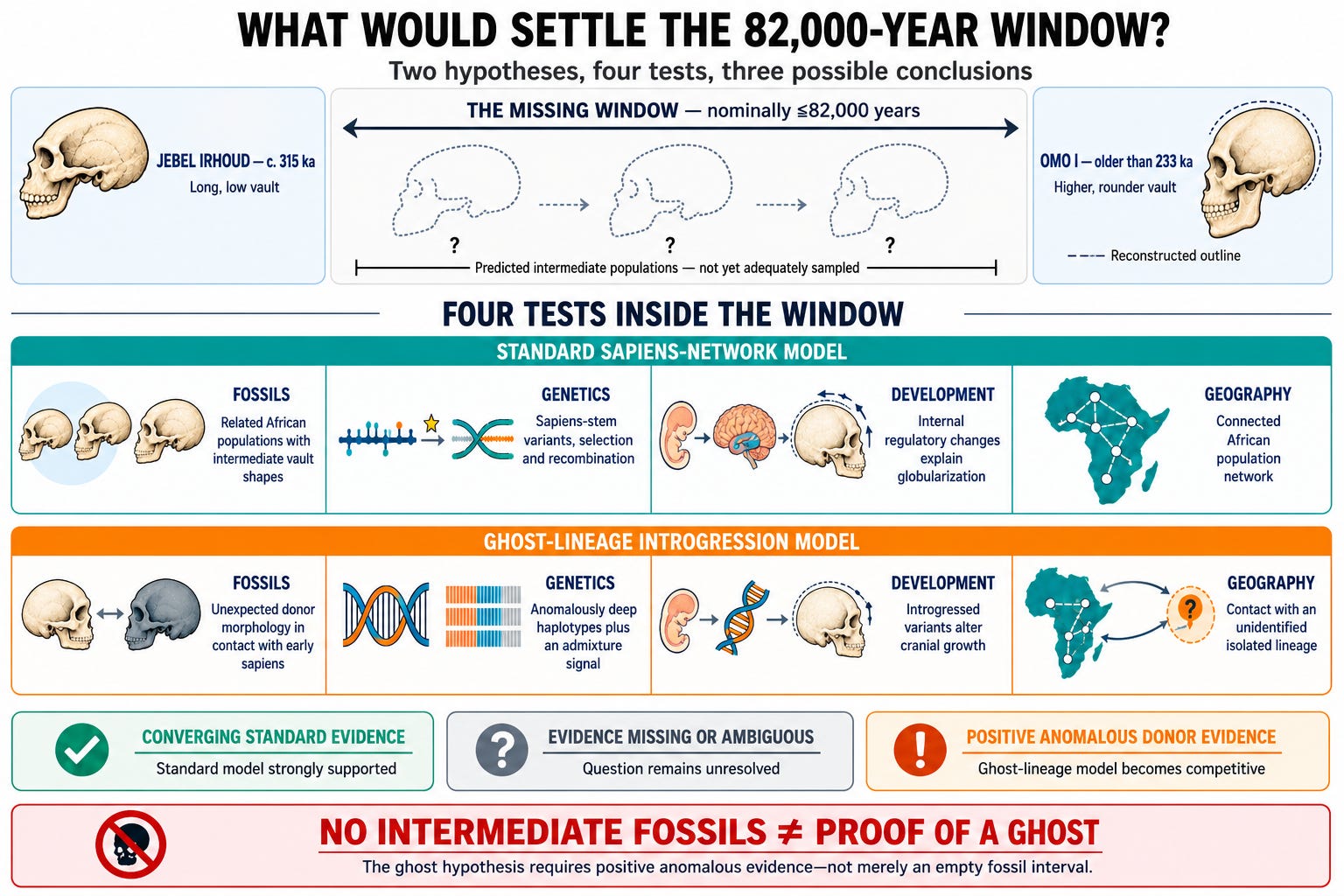
The standard model proposes that modern human globularity emerged within a structured African sapiens population network. Different regional populations carried different combinations of facial, dental, cranial and developmental characteristics. Periodic migration and interbreeding recombined those traits until the recognizable sapiens package emerged. This model doesn’t require an isolated place or one perfectly linear population replacing another.
If this explanation is correct, the intermediate populations necessarily existed, although their remains may never have fossilized or may have been destroyed. Ideally, we would discover several securely dated fossils from the critical period, preferably representing related or geographically connected populations, showing intermediate degrees of backward elongation, cranial height and parietal rounding. Enough individuals would be needed to establish an inherited population tendency rather than individual variation, pathology or uncertainty introduced through reconstruction.
Genetics should identify sapiens-derived variants affecting brain and cranial development, estimate when those variants arose, and determine whether they spread through selection or population contact. Developmental biology should then explain how those variants altered postnatal growth, the parietal and cerebellar regions, the cranial base or the relationship between the shrinking face and expanding vault. A list of genetic differences is not sufficient unless those differences can be connected to the anatomical result requiring explanation.
The standard model therefore does not owe us an impossibly complete chain. It does owe us clear predictions and an honest distinction between observation and reconstruction. Fossils should, if recovered, fit the proposed trajectory. Genomic evidence should be consistent with change occurring within the sapiens population network. Developmental evidence should demonstrate a plausible mechanism. Together, those independent forms of evidence could establish the transition even if no perfect “midway skull” is ever found.
Jebel Irhoud in Morocco is approximately 315,000 years old. Its face is relatively flat, small and retracted. Its brain was already approximately within the modern volume range. Its cranial vault, however, remained long, low and extended backward. Irhoud demonstrates that modern brain volume and a substantially modern face appeared before the fully globular braincase. Jebel Irhoud fossil study
Omo I in Ethiopia is securely older than approximately 233,000 years. It possesses a higher, rounder vault, a chin and other unmistakably sapiens characteristics. Yet Omo I is incomplete: significant portions of its complete appearance depend upon reconstruction. Its present age is also a minimum derived from volcanic material above the fossil, not an exact date of death. Revised minimum age of Omo I
Herto, at approximately 160,000 years old, is exceptionally robust but clearly sapiens. Here we are examining an archaic variation of Homo sapiens. Florisbad in South Africa, approximately 259,000 years old, may belong somewhere near the transition, but the skull is too incomplete to settle the decisive question about the complete vault.
We also know that the issue did not end with Omo. Comparisons of fossil endocasts indicate that brain shape continued changing within the sapiens lineage, entering the range of present-day human variation sometime between approximately 100,000 and 35,000 years ago. This leads them to see it in terms of an early major shift followed by a much longer period of refinement. Study of modern-human brain-shape evolution
We do not know which population underwent the principal transformation. Irhoud comes from Morocco; Omo comes from Ethiopia; Florisbad comes from South Africa. Chronological ordering does not prove genealogical succession. We cannot simply arrange geographically scattered fossils on a table and assume that the older individual begat the younger population. The fossils may represent interacting branches, parallel experiments, local dead ends or differently mixed members of a continental population network.
We do not know how many populations contributed. The phrase “structured African population network” could conceal dozens or hundreds of local breeding groups joined intermittently through larger regional metapopulations. A demographic model using two or three ancestral sources is necessarily a simplification. We have not identified the actual communities that carried the flatter face, the large brain, the altered cranial base or the developmental pattern producing increased globularity.
We also do not know the responsible genetic mechanism. The transformation might have resulted from new mutations, selection acting upon much older standing variation, recombination of traits from separated African populations, or developmental consequences of facial reduction. It might have involved hundreds of variants of individually small effect or a few regulatory changes with disproportionately large consequences. We do not know whether globularity was itself adaptive or whether it accompanied selection for some other neurological, obstetric or developmental characteristic.
Finally, we cannot yet exclude some contribution from an unidentified lineage. One or more relevant variants might have entered emerging sapiens through introgression from a deeply divergent population absent from the known fossil record. Missing fossils do not prove this “super-ghost”; missing evidence cannot identify the thing that is missing. My own hypothesis becomes competitive only if positive evidence appears, such as unusually deep genomic regions associated with cranial development, a dated admixture signal, or fossils belonging to a morphologically unexpected contributor.
Using the central dates, the apparent interval between Jebel Irhoud at approximately 315,000 years and the minimum age established for Omo I at approximately 233,000 years is about 82,000 years. Because Omo is older than its overlying volcanic layer, the actual separation may have been considerably shorter. Nevertheless, even 82,000 years represents approximately 3,000–3,400 human generations, assuming an average generation of 24–27 years.
Three thousand generations are not evolutionarily trivial. Every individual carries dozens of new mutations, while large populations collectively generate enormous quantities of variation. Selection acting on an advantageous existing variant can alter its frequency over hundreds or thousands of generations. Recombination and contact among structured populations can assemble combinations much faster than a model requiring multiple entirely new mutations to arise and fix sequentially.
The time would become problematic only if modern globularity required numerous precisely coordinated new mutations, if none existed previously as standing variation, if each had to fix before the next became useful, and if the changes supplied little selective advantage. That would be a much slower and less plausible sequence. But the mainstream model does not presently claim that this is what happened. Regulatory change, polygenic selection and recombination among populations could produce large developmental effects within the available generations.
The honest conclusion is therefore not that 82,000 years was too short and a super-ghost must be invoked. The honest conclusion is that the interval was genetically sufficient but historically underspecified. “Science” has enough time for its model. What it has not yet supplied is the complete account of which populations, variants and developmental processes used that time to produce the visible transformation. The super-ghost remains possible, but it becomes more plausible only if future evidence fits introgression better than ordinary change within the sapiens network. The question is no longer whether evolution had enough time. The question is: what, exactly, happened during those three thousand generations?
No posts
Comments
Nothing yet. Say the first thing.
Sign in to join the conversation.