
The Mosaic Law does not abolish property or inequality, but it repeatedly restricts interest, permanent indebtedness, land concentration, and the accumulation of unchecked political wealth. The economic legislation of Moses is neither communist nor laissez-faire. Private property, inheritance, wealth, trade, and social distinctions all remain. Despite this the Torah places clear limits upon the mechanisms by which credit, land, and political power can become permanently concentrated.
“If thou lend money to any of my people that is poor by thee, thou shalt not be to him as an usurer, neither shalt thou lay upon him usury.”
— Exodus 22:25“Take thou no usury of him, or increase: but fear thy God; that thy brother may live with thee.”
— Leviticus 25:36“Thou shalt not give him thy money upon usury, nor lend him thy victuals for increase.”
— Leviticus 25:37“Thou shalt not lend upon usury to thy brother; usury of money, usury of victuals, usury of any thing that is lent upon usury.”
— Deuteronomy 23:19“Unto a stranger thou mayest lend upon usury; but unto thy brother thou shalt not lend upon usury.”
— Deuteronomy 23:20
The prohibition is not a universal ban upon every imaginable interest-bearing transaction. It is specifically directed against turning lending into a mechanism of exploitation and dependency.
The Jubilee: property cannot simply accumulate upward forever
“In the year of this jubile ye shall return every man unto his possession.”
— Leviticus 25:13“The land shall not be sold for ever: for the land is mine.”
— Leviticus 25:23“And in all the land of your possession ye shall grant a redemption for the land.”
— Leviticus 25:24
The principle is that economic misfortune may temporarily separate a family from its productive inheritance, but it is not supposed to create an irreversible process by which a handful of owners eventually acquire everything.
“At the end of every seven years thou shalt make a release.”
— Deuteronomy 15:1“Every creditor that lendeth ought unto his neighbour shall release it; he shall not exact it of his neighbour, or of his brother.”
— Deuteronomy 15:2
Creditors therefore cannot indefinitely compound claims against fellow members of the community.
“But he shall not multiply horses to himself…”
— Deuteronomy 17:16“Neither shall he multiply wives to himself… neither shall he greatly multiply to himself silver and gold.”
— Deuteronomy 17:17
Even the sovereign is subject to an explicit restriction against accumulating military resources, dynastic connections, and treasure without limit.
“So shall not the inheritance of the children of Israel remove from tribe to tribe: for every one… shall keep himself to the inheritance of the tribe of his fathers.”
— Numbers 36:7
Whatever you think of Moses, his God, or the Hebrews, it is clear that they did not believe in either socialism or unrestricted capitalism. Property is legitimate; permanent dispossession is not. Wealth is legitimate; unlimited accumulation of coercive power is treated with suspicion. Lending is legitimate; transforming necessity into permanent debt-subordination is not. The Mosaic answer to inequality was not to abolish ownership, but to place barriers around the processes by which ownership, debt, and political authority could become permanently concentrated in the same hands.
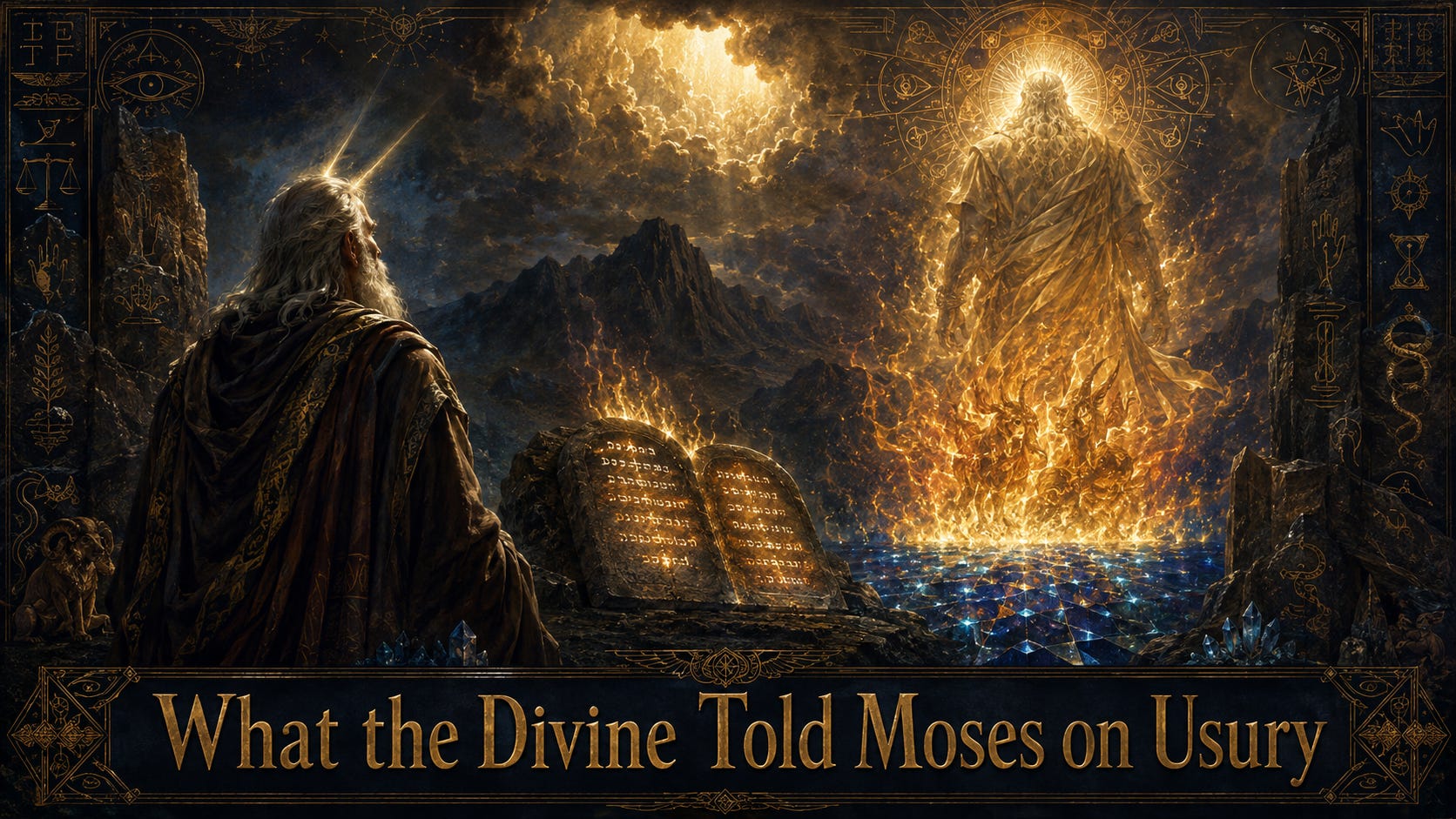
My A.I. prompt for “Moses, before the Back of God” ( His back, fire, at his feet, sapphires. As it famously says in the text. )
“under his feet as it were a paved work of a sapphire stone….”
— Exodus 24:10
“I saw as the colour of amber, as the appearance of fire round about within it….”
— Ezekiel 1:27
“…thou shalt see my back parts: but my face shall not be seen.”
— Exodus 33:23
No posts
Comments
Nothing yet. Say the first thing.
Sign in to join the conversation.