
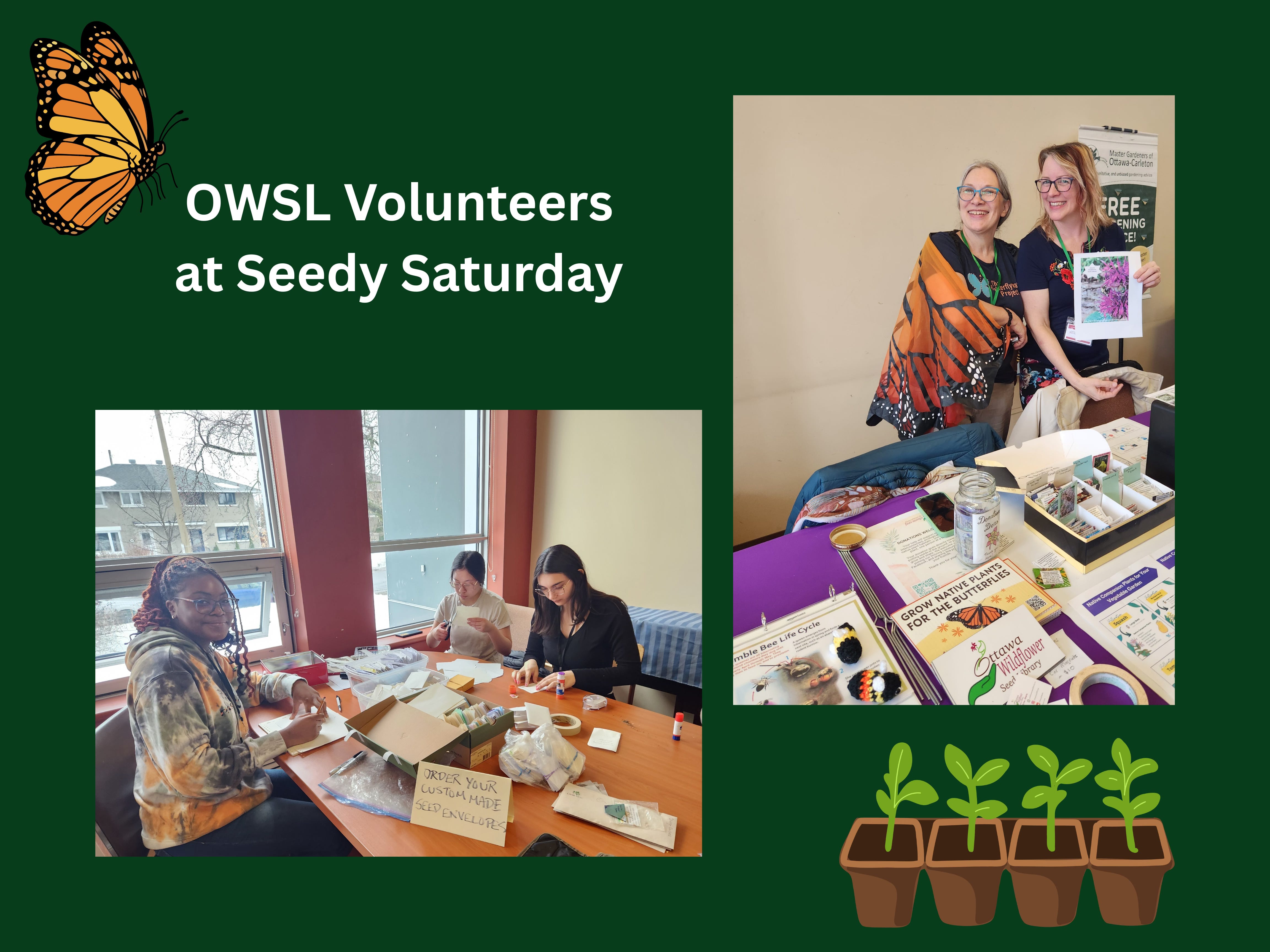
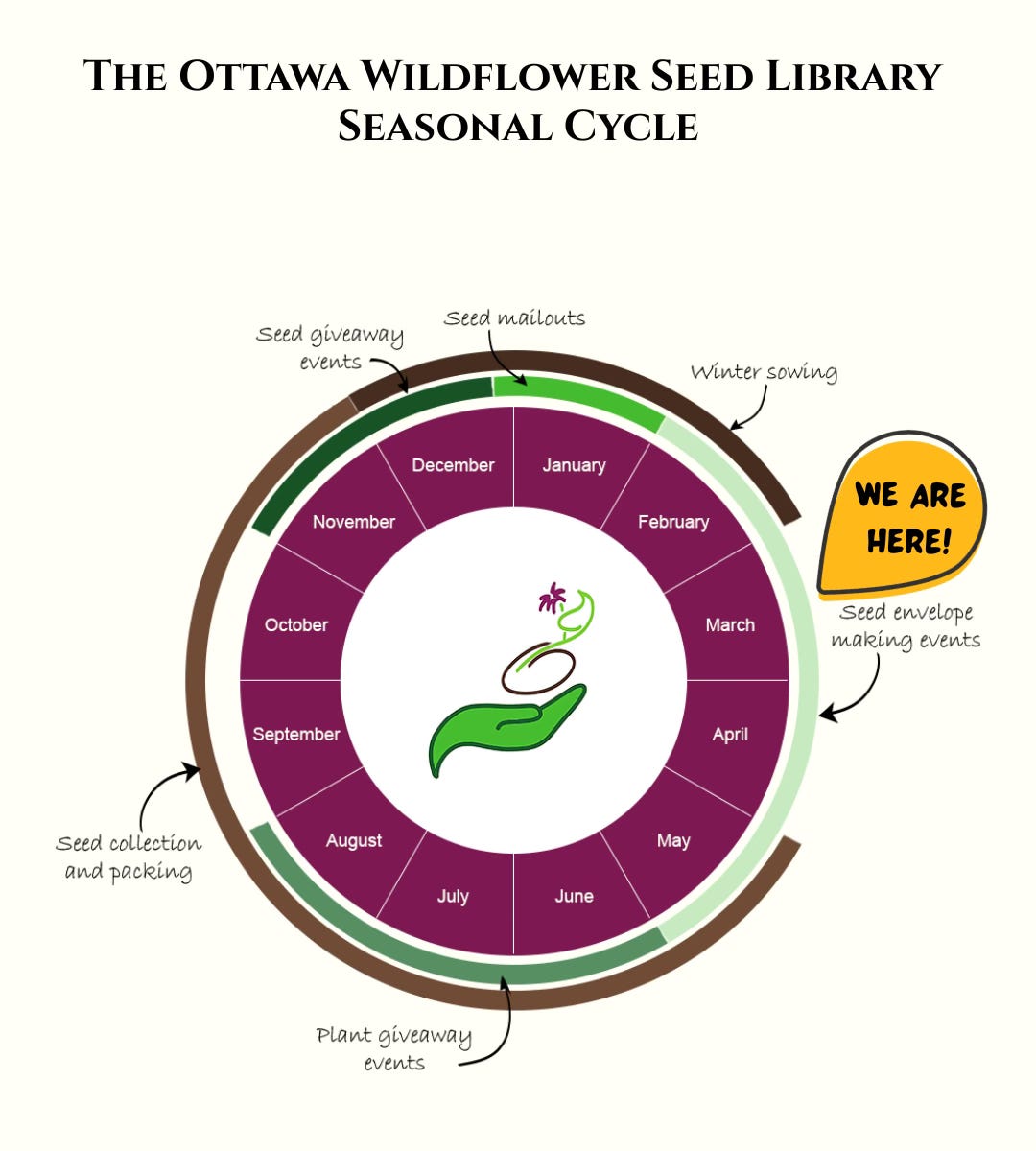
This month, our busy bee volunteers have been attending many Seedy Saturdays in the region and other events to raise awareness of the Seed Library and give away free seeds! We also hosted an envelope-making event, where 46 of you showed up to help - thank you so much! We will use these envelopes in the fall when we start packing seeds.
The work on our online native plant catalogue is progressing well and our volunteers are writing descriptions of plants. If you are interested in helping, please send an email to volunteer@wildflowerseedlibrary.ca.
Finally, we released our new Indigenous Seed Policy, to proactively disclose what we will do with sacred seeds. You can read more about our policy here!
Workshop: Planning Your Garden
When: April 16, 2026 at 6:30pm
Where: Ottawa Public Library – Greenboro Branch, 363 Lorry Greenberg Dr., Ottawa, ON K1T 3P8
About: Join a volunteer from the Seed Library for tips and guidance on how to plan a native plant garden.
Workshop: Spring Gently
When: April 23, 2026 at 6:00pm
Where: Ottawa Public Library – Elmvale Branch, 1910 St. Laurent Blvd, Ottawa, ON, K1G 1A4
About: Join a volunteer from the Seed Library for guidance on how to care for gardens in the spring.
Full Moon Date: April 1, 2026
Canada Anemone (anemonastrum canadense)
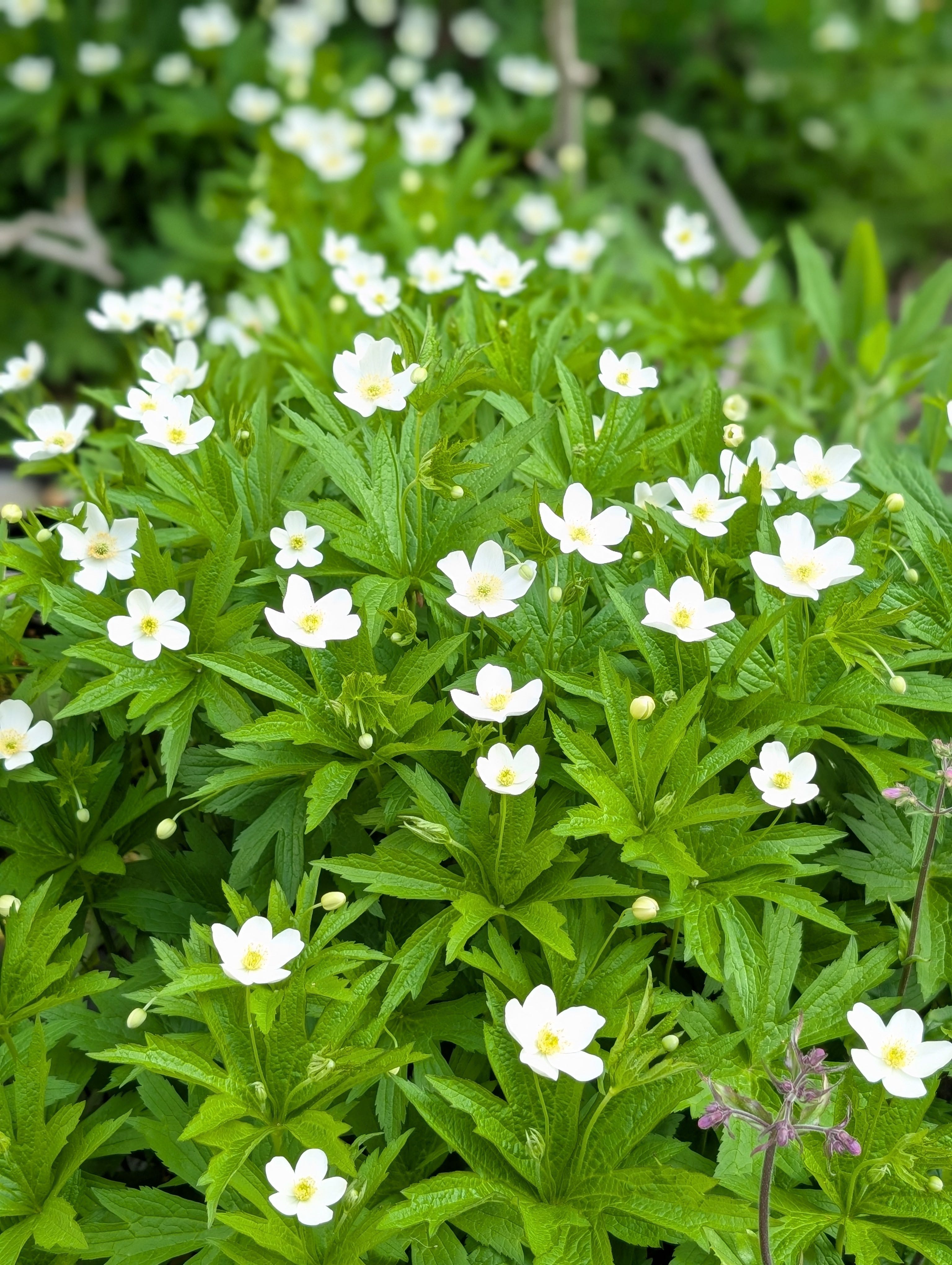
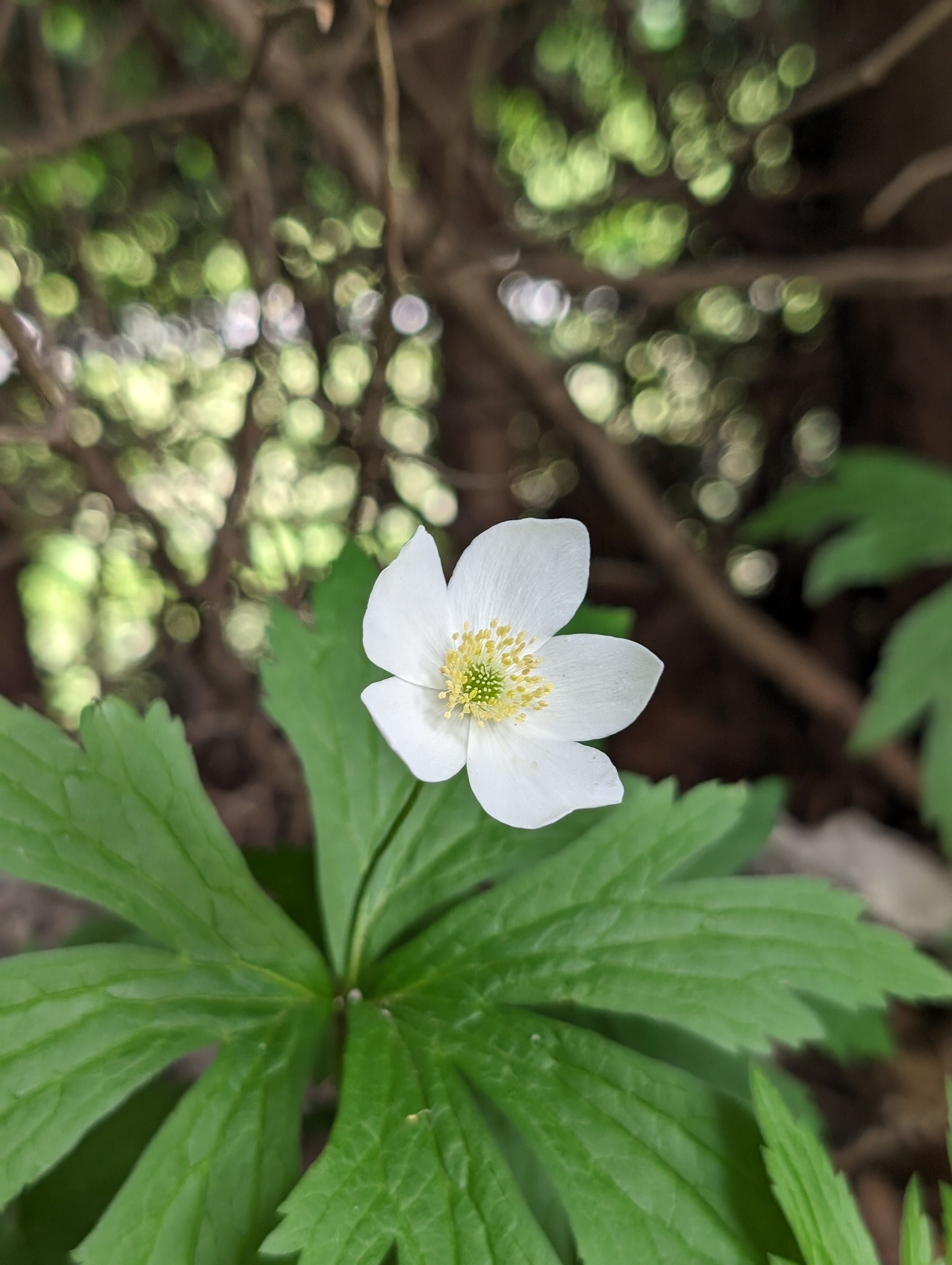
Windflower, is a reliable and low-maintenance native plant that makes for excellent ground cover in the garden. A member of the Buttercup family, this plant has lobed basal leaves and is crowned with a solitary, ivory flower with five petals and a cluster of yellow anthers. Blooming from mid-spring to summer, the delicate flowers are known to sway in a spring breeze, therefore getting the nickname “windflower”. It’s a resilient plant that thrives in part-shade to full sun and can also tolerate full shade.
Propagation of Canada Anemone can be difficult to achieve by seed as they require a double dormancy. Double dormancy is when seeds must undergo a period of cold, moist stratification followed by a warm, moist period and then a second cold, moist stratification phase. The plants spread readily by rhizome and cuttings can be taken for propagation in the spring. In optimal conditions the plant can grow vigorously, so be aware that it may quickly take over some areas of a garden.
A common term that you may have heard in relation to seed starting and germination is “dormancy”, but what is it and how does it affect germination?
Dormancy refers to being “dormant” which is defined as a state of inactivity. When applied to seeds, “dormancy” is the absence of germination in a viable seed under conditions that are suitable for germination. This means a seed that is in a state of dormancy will not germinate even if it is healthy and in optimal growing conditions. In order for it to begin the germination process, its dormancy must be broken.
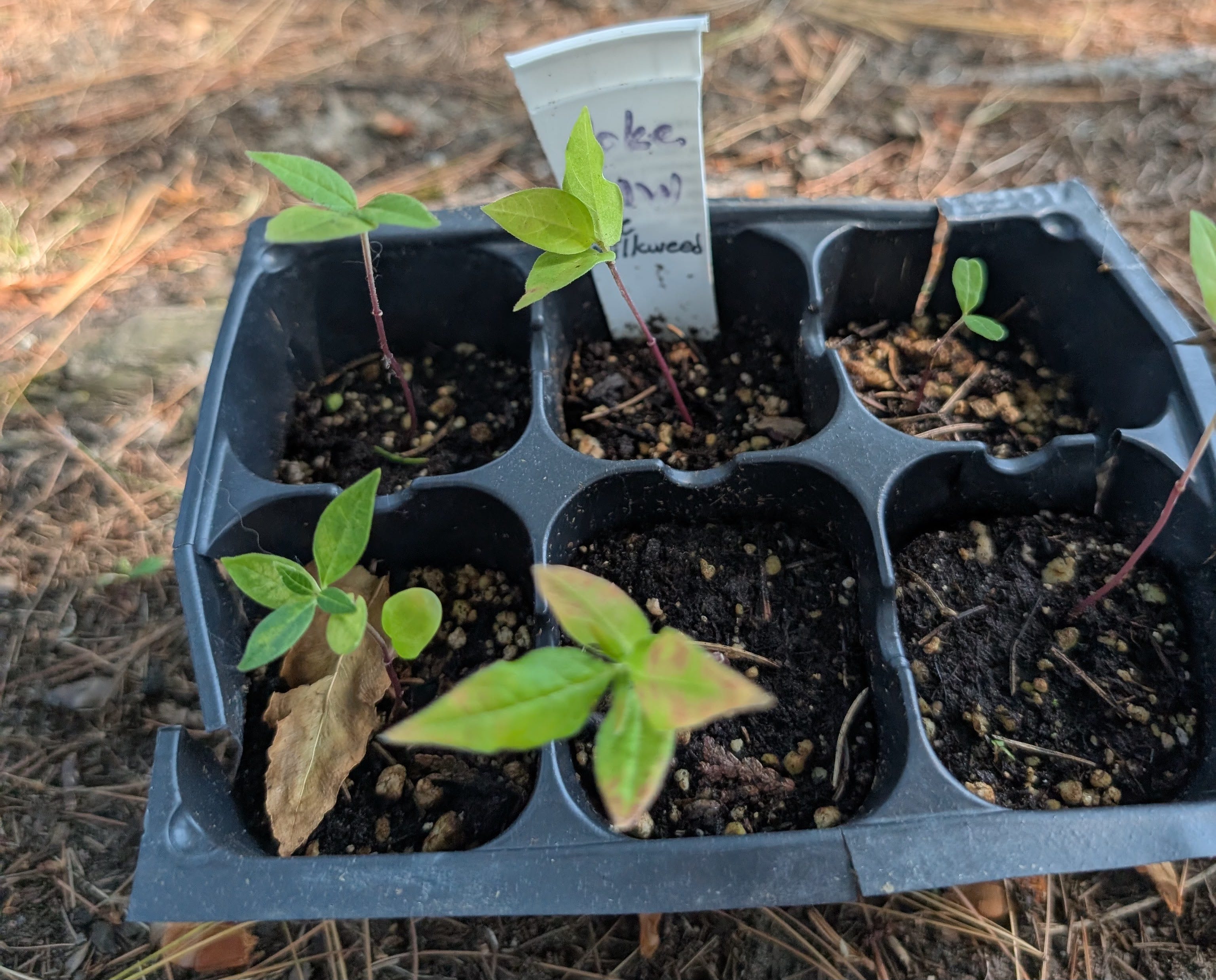
Why do seeds have dormancy?
Seeds have developed dormancy as a clever survival mechanism, allowing them to delay the germination process until ideal conditions have been met, providing the plant with the best chance at survival.
This can help prevent seeds from germinating on a mild winter day, only to be met by harsh cold the next. It can prevent seeds in an area from germinating all at the same time and therefore beginning a competition for water and nutrients. It even helps seeds that are in the dispersal process, hitching a ride on the wind, water or an animal, from beginning germination before they have found a suitable location to grow. Additionally, not all seeds have the same type of dormancy and not all seeds remain dormant for the same length of time.
Types of dormancy
Seed dormancy can be divided into two main categories: exogenous and endogenous dormancy.
Exogenous dormancy is when germination is blocked due to conditions outside the seed’s embryo. An example of this can be seeds with thick, durable coats that don’t allow in any moisture. These protective coats need to be broken before germination can occur. There are also seeds that contain chemicals in their shells that must be leeched out with water prior to beginning germination.
Endogenous dormancy is when dormancy is blocked due to conditions inside the seed’s embryo. An example of this are seeds that have a metabolic block which prevents the embryo from growing until chemical changes occur in the seed, often spurred by changes in temperature.
Because different seeds have different types of dormancy, gardeners wishing to grow these seeds must learn which type of dormancy the seed has and then apply the proper methods to break that dormancy.
How to break dormancy
For seeds with thick coats that block out water, scarification is a useful method for breaking dormancy. This can be done by creating an opening or a “scar” on the seed’s coat that allows water to enter the seed and hydrate the embryo. In nature, the breaking down of the seed’s coat can occur through water exposure, being eaten away by bacteria or even through digestion by other animals. This process can be mimicked by humans by nicking the seeds with a knife or other sharp object prior to sowing.
For seeds that need specific temperature exposure to trigger embryo development, stratification can break the seed’s dormancy. In nature, many seeds would be exposed to snow over the course of winter which provides the seed with the cold and moisture it needs to break dormancy. Humans can mimic this process in various ways, one of the easiest being winter sowing (which you can learn more about in this previous Bloom & Buzz newsletter).
While at first glance dormancy may seem like a problem, something that a gardener must overcome in order to grow seeds, it is actually a natural part of the plant’s lifecycle and a truly fascinating survival tactic that plants have evolved over millions of years. This process allows them to delay the germination process until they have the best odds of surviving and thriving!
This month’s volunteer spotlight highlights the work of Jean-Philippe Gagnon:
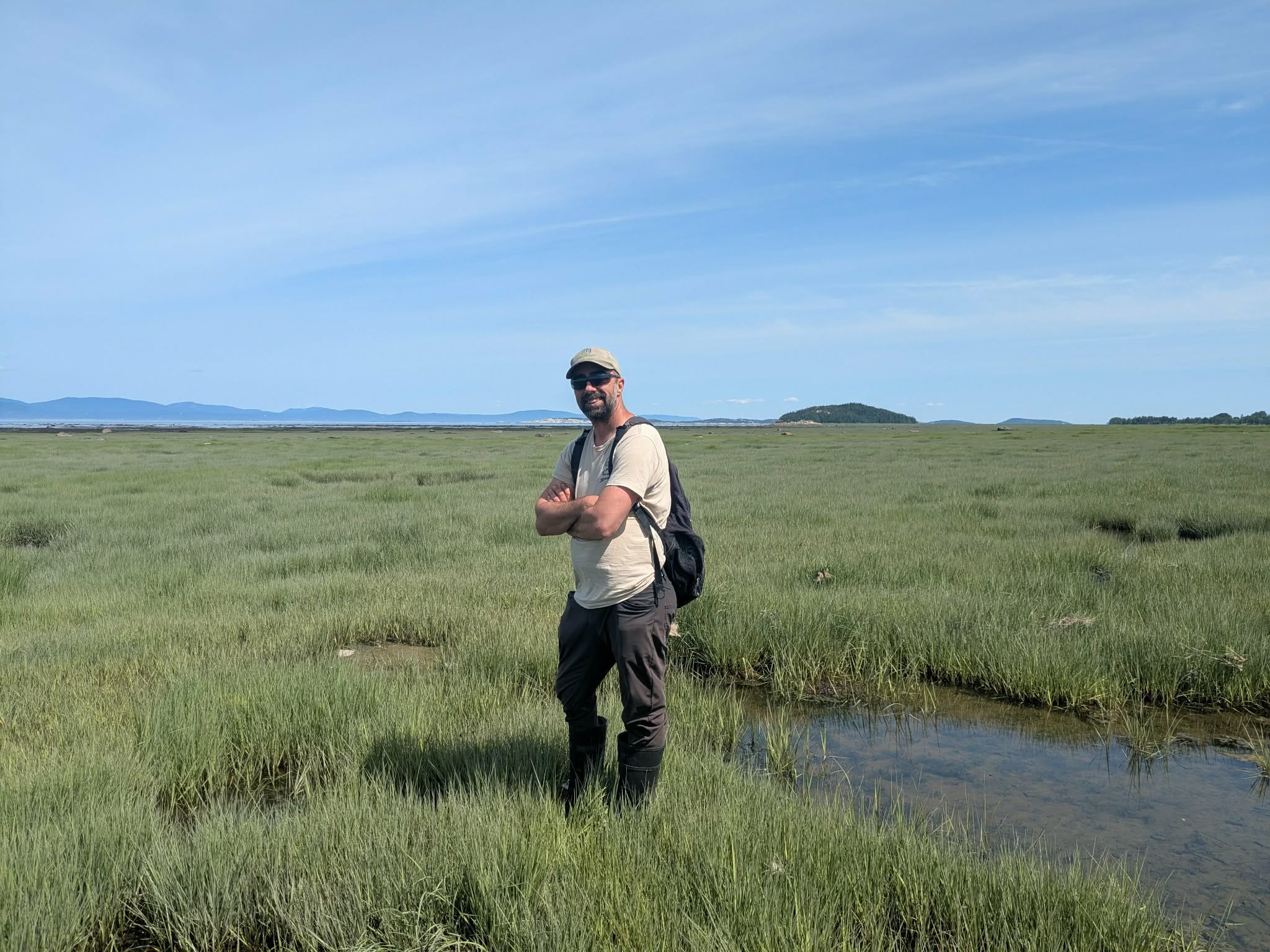
Jean-Philippe’s interest in native plants began in his early years. While taking walks in the forest he noticed beautiful plants that he hadn’t seen before and weren’t available commercially.
He recognized that his knowledge of native plants was limited so he connected with botanists, joined groups and enjoyed excursions with other likeminded people – his knowledge growing exponentially over time. He began volunteering with the Seed Library in 2022 and through that volunteer work he has been able to connect to those with similar philosophies and objectives regarding native plants.
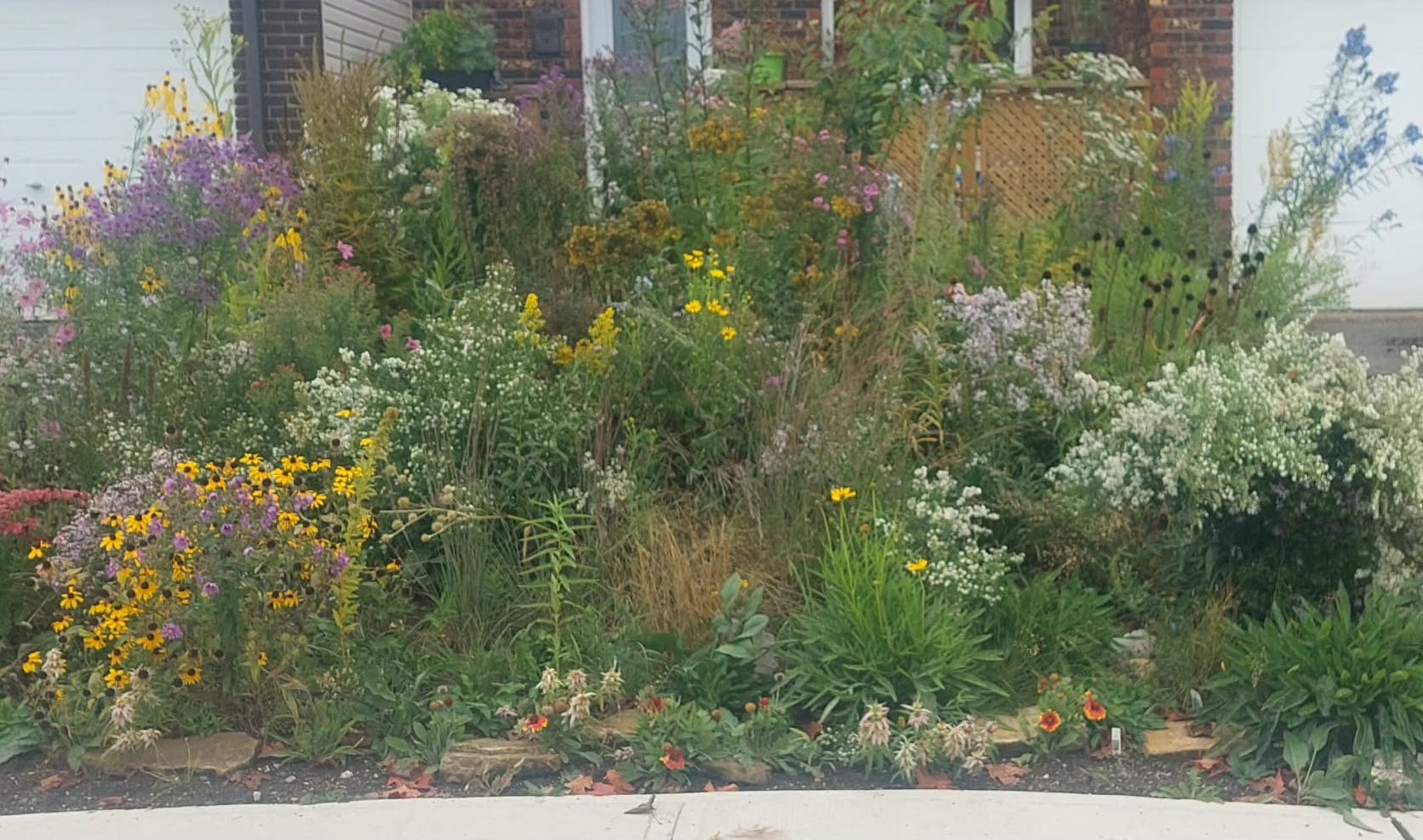
When asked if he had a favourite plant, he stated that it depended on the seasons and noted that plants that attract pollinators, produce nectar and act as host plants are some of his favourites. Some of these include mountain mint, hydrophyllum, Joe Pye weed and asters.
His work has ranged from presenting at daycares and school as well as helping to build a community garden. Jean-Philippe also works at restoring habitats that are at risk of being destroyed. He looks forward to continuing his native plant journey!
Sources:
Rick Gray and Shaun Booth, The Gardener’s Guide to Native Plants of the Southern Great Lakes Region (Ontario: Firefly Books, 2024)
“Germination: Seed Dormancy”, Oregon State University. https://agsci.oregonstate.edu/mes/sustainable-wildflower-seed-production/germination-seed-dormancy
Agriculture.Institute, “Understanding and Breaking Seed Dormancy”, Plant Propagation and Nursery Management, 2025. https://agriculture.institute/plant-propagation-nursery-mgt/understanding-breaking-seed-dormancy/
Science Facts, “Seed Dormancy”, 2023. https://www.sciencefacts.net/seed-dormancy.html
Strain, Kyle, “Stratification and Scarification: A Seed’s Path to Germination”, Wellfield Botanic Gardens, 2024. https://www.wellfieldgardens.org/post/stratification-and-scarification-a-seed-s-path-to-germination
Harankhedkar, Meenal, “Botanist’s Lens: Seed Dormancy: ‘Surviving the Adverse’”, Historic London Town & Gardens, 2019. https://www.historiclondontown.org/post/2019/08/23/botanists-lens-seed-dormancy-surviving-the-adverse
No posts
Comments
Nothing yet. Say the first thing.
Sign in to join the conversation.