
This month, the Library has been working on developing descriptions of plants for our online catalogue. Our volunteers have also been busy bees – promoting the Seed Library and distributing seeds at events across the city, especially around Earth Day. If you are interested in volunteering with the OWSL, there are several positions open:
Community Representative: Want to spread the joy of native plant gardening across the city? Do you enjoy interacting with members of the public? Then consider volunteering to represent the Seed Library at events for adults and/or children.
Native Tree Volunteer: Do you enjoy being outside and making a difference in your community? Are you interested in planting native tree species locally? Then join our group working on expanding our tree offering!
Content Creator: Are you creative and have experience designing compelling content for social media? Then helping us create content for our social channels might just be the role for you!
If any of these volunteer positions are of interest to you, please contact us at volunteer@wildflowerseedlibrary.ca.
Tree Planting Event
When: Saturday, May 2, 2026, starting at 9:00am
Where: 1754 St. Joseph Blvd, Orléans, ON, K1C 7C6
About: Ottawa Wildflower Seed Library volunteers will be handing out seeds at this event.
Tree Giveaway Event
When: Saturday, May 2, 2026, from 12:00pm - 2:00pm
Where: Carlsbad Springs Community Centre, 6020 Piperville Rd, Carlsbad Springs, ON, K0A 1K0
About: Ottawa Wildflower Seed Library volunteers will be handing out seeds at this event.
Tree Planting Event
When: Saturday, May 9, 2026, from 9:00am – 12:00pm
Where: Hintonburg Community Centre, 1064 Wellington Street West, Ottawa, ON, K1Y 2Y3
About: Ottawa Wildflower Seed Library volunteers will be handing out seeds at this event.
Full Moon Date: May 1, 2026
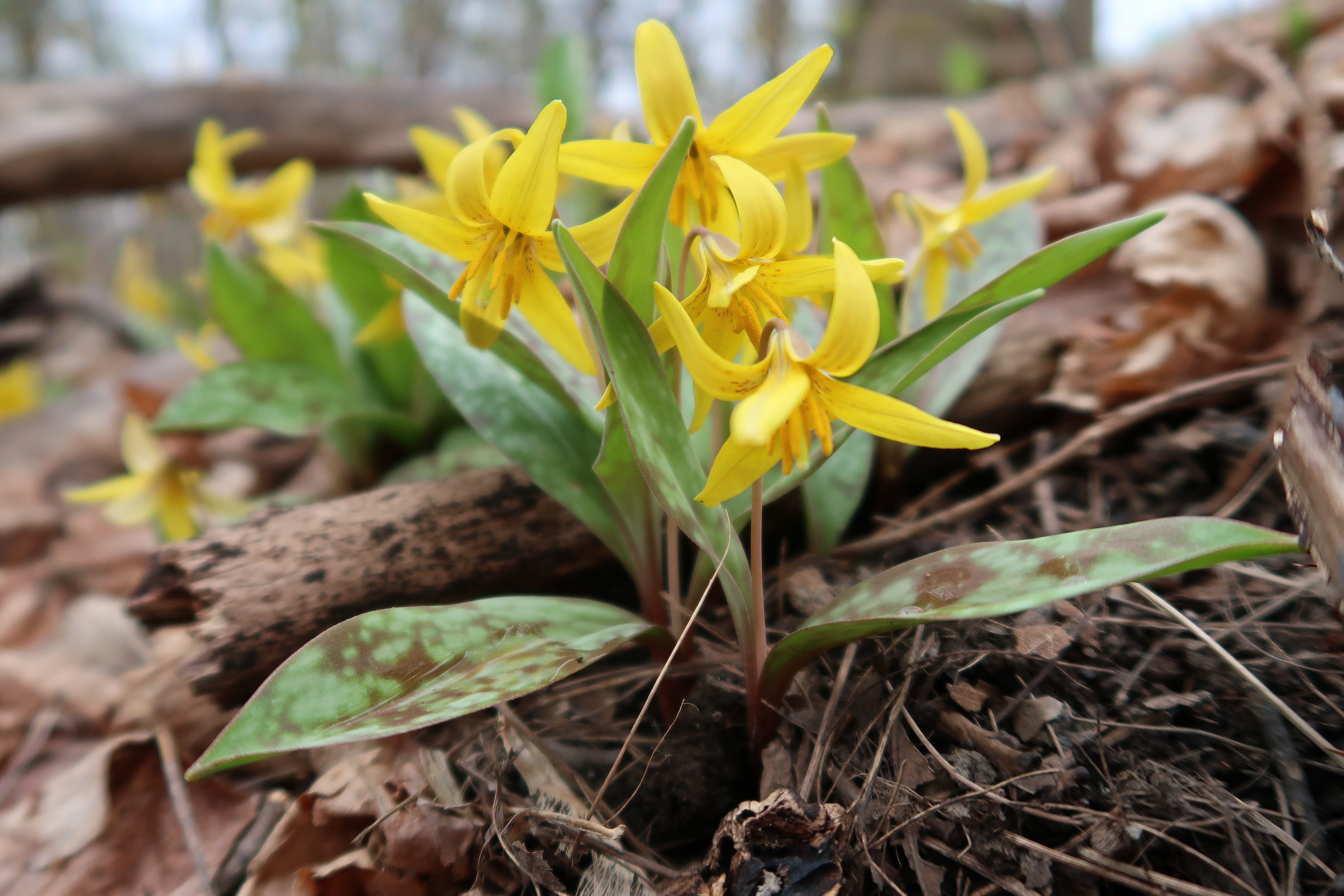
Yellow Trout Lily (Erythronium americanum)
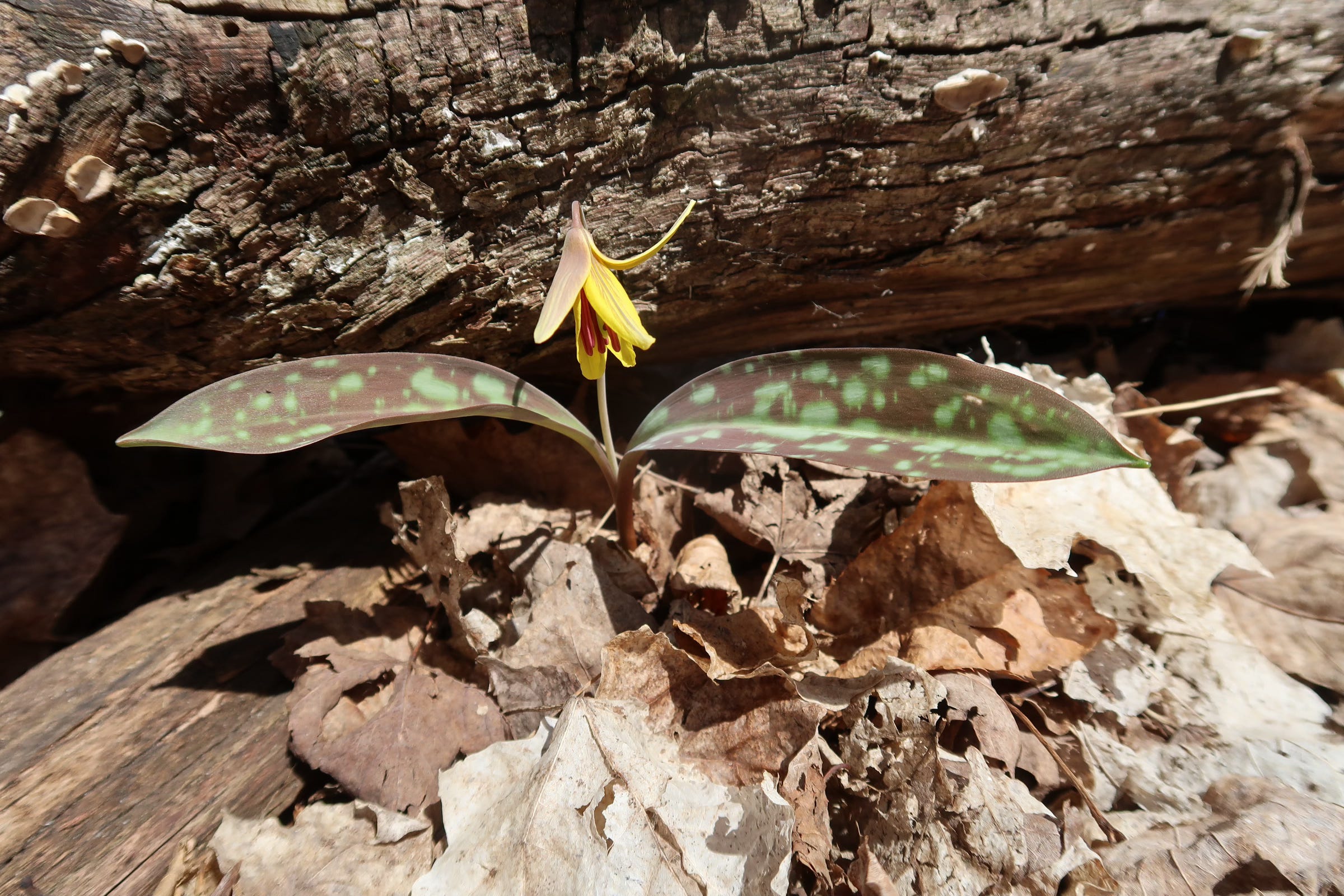
Yellow Trout Lily, also known as Adder’s Tongue, Dog’s-tooth Violet and Yellow Fawn Lily, is a spring ephemeral that blooms for a brief period of time in April and May. It has two leaves which are mottled shades of green and brown,resemble a brown brook trout, thus the name “Trout” Lily. The plant produces a single, golden-hued flower that is bell-shaped with prominent reddish-brown stamens. As the flower ages, the yellow petals curl backwards, giving it a distinct lily-like silhouette.
As a spring ephemeral, the flowers only stay in bloom for a few days before the plant goes dormant, putting all its energy towards building its root system. Like many ephemerals, it prefers shady areas and due to its early blooms, provides a much-needed food source for native bees. It also has a symbiotic relationship with ants, through a process known as myrmecochory (to learn more you can read the February 2026 issue of The Bloom and Buzz.
Yellow Trout Lily spreads slowly, forming small colonies of plants over time. It can often take several years before the plant produces its first bloom – so don’t be discouraged if you don’t see any flowers right away! If you choose to collect seeds from a Yellow Trout Lily, then they will need to either be sown right away or kept in a cool, moist environment as they require moisture to remain viable. Additionally, Yellow Trout Lilies do not transplant well, so they should not be dug up from any wild environments where they have established themselves.
The newsletter has referred to some plants as being “spring ephemerals”, but what does this classification mean? The word “ephemeral” comes from the Greek word ephēmeros meaning “lasting only one day”. It is an apt name for the flowers that bloom for short periods of time in the spring and then go dormant for the remainder of the year. But a short bloom time is not the only criterion for being classified as a spring ephemeral.
Spring ephemerals are highly specialized perennials that have evolved to take advantage of specific growing locations underneath deciduous trees. Deciduous trees are those that lose their leaves annually, so come springtime, light passes directly to the forest floor – this is what spring ephemerals take advantage of. Their strategy is to emerge, bloom and produce seeds before the leaves of the tree above them unfurl and shade the area. Additionally, there are many pollinators in spring that are looking for food sources. As fewer flowers are in bloom during this period, they are an appealing choice for many pollinators. Some spring ephemerals don’t even bother producing nectar to lure in pollinators, knowing that they are one of the only food sources available to pollinators early in the season.
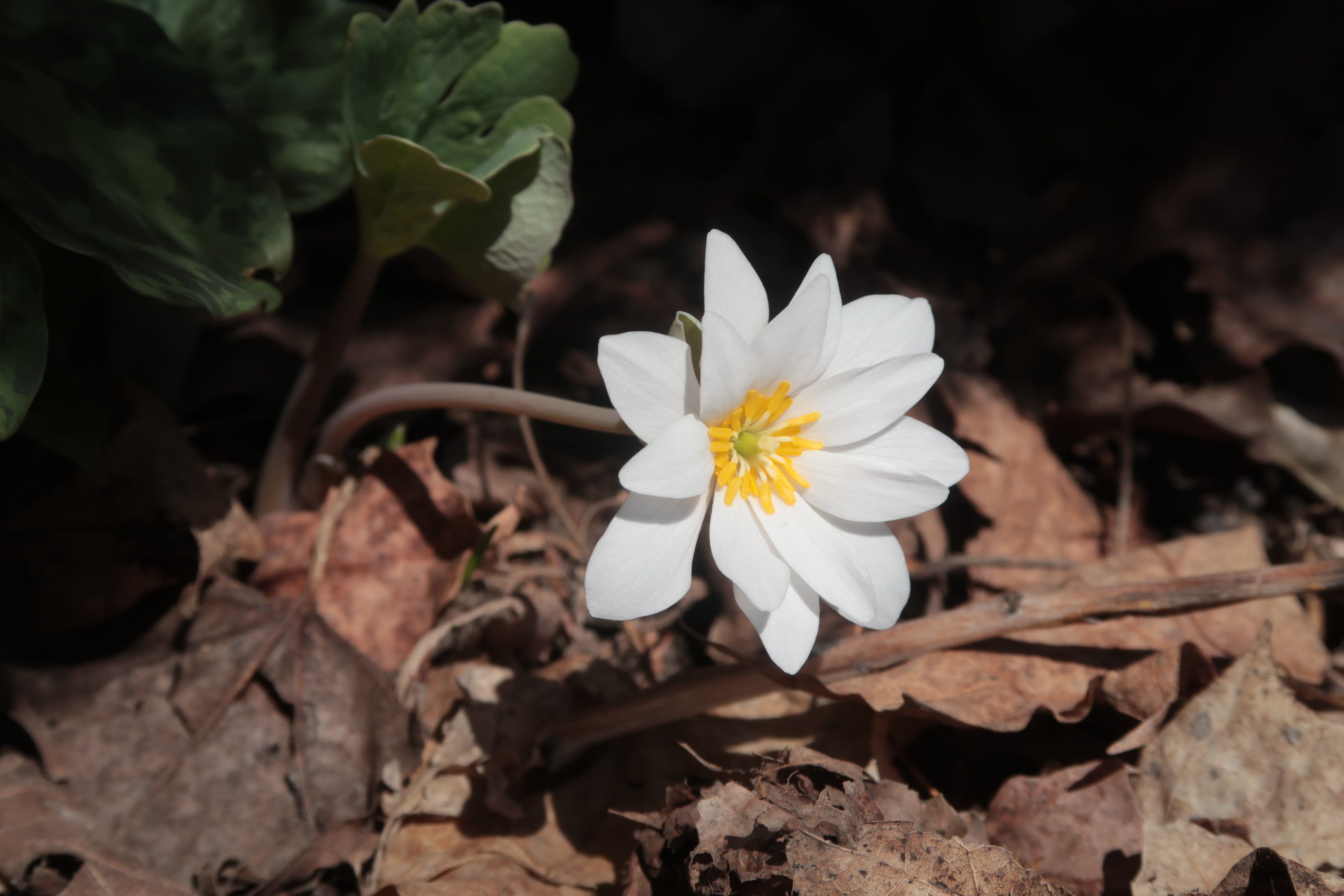
So, if you are planning on adding native spring ephemerals to your garden, try to select locations that align with how the plants evolved – full to partial sun in the spring, followed by shade for the remainder of the season. Some native spring ephemerals include: Jack in the Pulpit, Hepatica, Dutchman’s Breeches, Virginia Bluebells, Bloodroot and many more.
This month’s volunteer spotlight highlights the work of Hazel Gabe:

Hazel joined the OWSL first as a member of the Facebook group in 2020, met other members in person in 2022 and then volunteered with seedling giveaways and seed mailouts in 2023.
Her interest in native plants was sparked by caring for her bunnies. In order to provide them with tasty weeds (bonus points if they happen to belong to invasive plants!), Hazel had to develop her plant identification skills.
Nature has always been a home and refuge for Hazel – from spending time growing up in her favourite crab apple tree to examining (and tasting!) all the things that grew in the lawn – she is fascinated by how an ecosystem works!
Biodiverse ecosystems are much more engaging than a simplified lawn and individual trees. She strongly remembers the barren wasteland of boredom that was a schoolyard versus the paradise of “the woods” (a patch of trees, bushes, and burdock under some power lines where the older kids were allowed to play at recess). The warrens of paths, bushes, and tall grasses were never boring!
One of her favourite aspects of volunteering with the Seed Library is meeting others who are interested in native plants, getting involved with community events, and sharing all the beauty and bounty that the library provides.
Hazel’s favourite native plant is wintergreen, which holds a special place for her after helping soothe a stomach ache.
Sources:
Rick Gray and Shaun Booth, The Gardener’s Guide to Native Plants of the Southern Great Lakes Region (Ontario: Firefly Books, 2024)
“Gardening with Native Spring Ephemerals: Fleeting plants with a lasting impression”, In Our Nature. https://www.inournature.ca/gardening-with-spring-ephemerals
Meikle, Jennifer, “Native Plant Spotlight: Trout Lily”, https://www.woodcocknaturecenter.org/april-25-trout-lily
No posts
Comments
Nothing yet. Say the first thing.
Sign in to join the conversation.