
If you're like a lot of people, you may have heard the words but never really knew what they meant. Or maybe you didn't even know Disability Pride Month existed. That's okay. A lot of people don't.
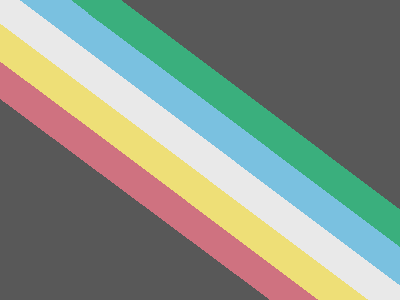
Alt text: The Visually Safe Disability Pride Flag, featuring diagonal stripes in green, light blue, white, pale yellow, and muted pink on a dark gray background.
When people hear the word pride, they sometimes assume it means disabled people are saying disability is wonderful or that we're celebrating the challenges that come with it. Trust me, nobody wakes up thinking, "You know what would make today extra exciting? A broken elevator, an inaccessible website, and a stranger talking to the person standing next to me instead of me."
That's not what Disability Pride Month is about.
Disability Pride isn't about celebrating barriers or pretending disability is easy. It's about recognizing that disability is a natural part of the human experience and that disabled people deserve the same dignity, respect, opportunities, and sense of belonging as everyone else. It's about rejecting shame and embracing the truth that our disabilities are part of who we are-not something to hide, apologize for, or overcome before we're worthy of being seen.
It also means rejecting the idea that we need to be fixed before we can belong. Too often, disability is viewed as a problem to solve or something to cure before a person can fully participate in life. But what most of us want isn't to become someone else. We want to be included, respected, and valued for who we are. We don't need to be "fixed" to deserve a seat at the table. We deserve to belong exactly as we are.
For me, it's about something even simpler.
It's about accepting ourselves exactly as we are while continuing to fight for a world that's accessible, inclusive, and built with everyone in mind.
As someone who is blind, I know disability isn't always easy. There are frustrating days. There are barriers that shouldn't exist. There are moments when other people's assumptions become bigger obstacles than the disability itself.
But I'm not ashamed of being blind—well, not anymore. If I'm honest, I was when I was much younger.
Over time, I've come to realize that my blindness has shaped how I experience the world. It's taught me patience, creativity, resilience, problem-solving, and the importance of advocating-not just for myself, but for others. I wouldn't choose every challenge that comes with it, but I also wouldn't erase the person I've become because of it.
That's what Disability Pride means to me.
There's another reason July matters.
Disability Pride Month is celebrated in July because it marks the anniversary of the Americans with Disabilities Act (ADA), which was signed into law on July 26, 1990.
The ADA was one of the most significant civil rights laws in American history. Before its passage, discrimination against people with disabilities was commonplace and often perfectly legal. Millions of Americans were denied jobs, excluded from schools and public spaces, unable to use public transportation, and shut out of everyday life simply because society wasn't designed to include them.
The ADA changed that.
It established that people with disabilities have the right to participate fully in society by prohibiting discrimination in employment, government services, public accommodations, transportation, telecommunications, and many other aspects of daily life.
Its impact is everywhere-even if many people don't realize it.
Curb cuts that parents pushing strollers also appreciate. Ramps and elevators. Accessible buses and trains. Workplace accommodations. Closed captions that help not only Deaf viewers but anyone watching in a noisy room. Better access to schools, businesses, parks, restaurants, and public buildings. The ADA didn't just improve accessibility for people with disabilities-it made our communities better for everyone.
But here's the thing.
The ADA wasn't the finish line.
It was the beginning.
More than three decades later, we still have work to do.
As a blind person, I still run into websites that seem to have been designed by someone who thought accessibility was an optional upgrade. Buttons without labels. Images without descriptions. Online forms that simply refuse to cooperate. Technology is wonderful...until it decides it isn't.
And accessibility challenges don't stop with blindness.
Wheelchair users still encounter buildings with steps but no ramps or elevators. Deaf and hard of hearing individuals often find events without interpreters or captions. People with mobility disabilities continue to face inaccessible transportation. Individuals with autism or sensory disabilities may struggle in environments that offer little or no accommodation. People with invisible disabilities are still too often told, "But you don't look disabled."
Different disabilities.
Same message.
We all deserve to participate fully in our communities.
Disability Pride Month is also a reminder that disability is incredibly diverse. Some disabilities are visible. Others are invisible. Some people are born with disabilities, while others acquire them through illness, injury, military service, accidents, or simply aging. Disability is part of the human experience, and chances are it will touch every one of us-or someone we love-at some point in our lives.
That's why inclusion matters.
It's not about charity.
It's not about pity.
And it's not about fixing people.
It's about recognizing our shared humanity and building communities where everyone belongs. It's about designing schools, workplaces, neighborhoods, websites, transportation, and public spaces with everyone in mind from the very beginning-not expecting disabled people to change in order to fit into a world that wasn't built for them.
It's about civil rights.
It's about creating communities where accessibility isn't treated as an afterthought but as a basic expectation.
One of the things I hope people remember this month is that disabled people aren't looking to be inspirational simply because we exist. We want to be seen as whole people—with careers, families, hobbies, dreams, talents, bad days, good days, and yes...occasionally a stubborn website that deserves a time-out.
We're not defined solely by our disabilities.
They're one part of our story-not the entire story.
And like everyone else, we want what most people want: the opportunity to contribute, to connect, to be respected, and to belong-not because we've overcome our disabilities or hidden them well enough, but because every person has inherent value exactly as they are.
Before I wrap up, I'm going to do something I never do on this blog.
If Disability Pride Month inspires you to make a difference, consider supporting an organization whose mission is to build a more inclusive community, create meaningful programs, and help people with disabilities live full, independent lives.
There are many wonderful organizations doing this important work, and I encourage you to find one that speaks to your heart.
Of course, if you're looking for a recommendation, you may already know where I'm going to point you.
For me, that organization is Keshet www.keshet.org. I've seen firsthand the difference they make by creating opportunities, building community, supporting independence, and making sure people of all abilities have the chance to learn, grow, work, play, and belong together. Their mission isn't just about providing services-it's about creating a community where everyone truly has a place.
Whether you choose to donate, volunteer, advocate, or simply learn more, every bit of support helps move us toward a more inclusive world.
Happy Disability Pride Month.
Let's celebrate because every person deserves dignity, opportunity, accessibility, inclusion, and the chance to belong just as they are.
Written By Michelle Friedman
Michelle Friedman, Keshet immediate past board chair in Chicago, a member of Disability Lead and has been a disability advocate for 40 years. She has written two children’s books and is a frequent speaker for elementary and high school-age students. #AllInForAllAbilities
No posts
Comments
Nothing yet. Say the first thing.
Sign in to join the conversation.