
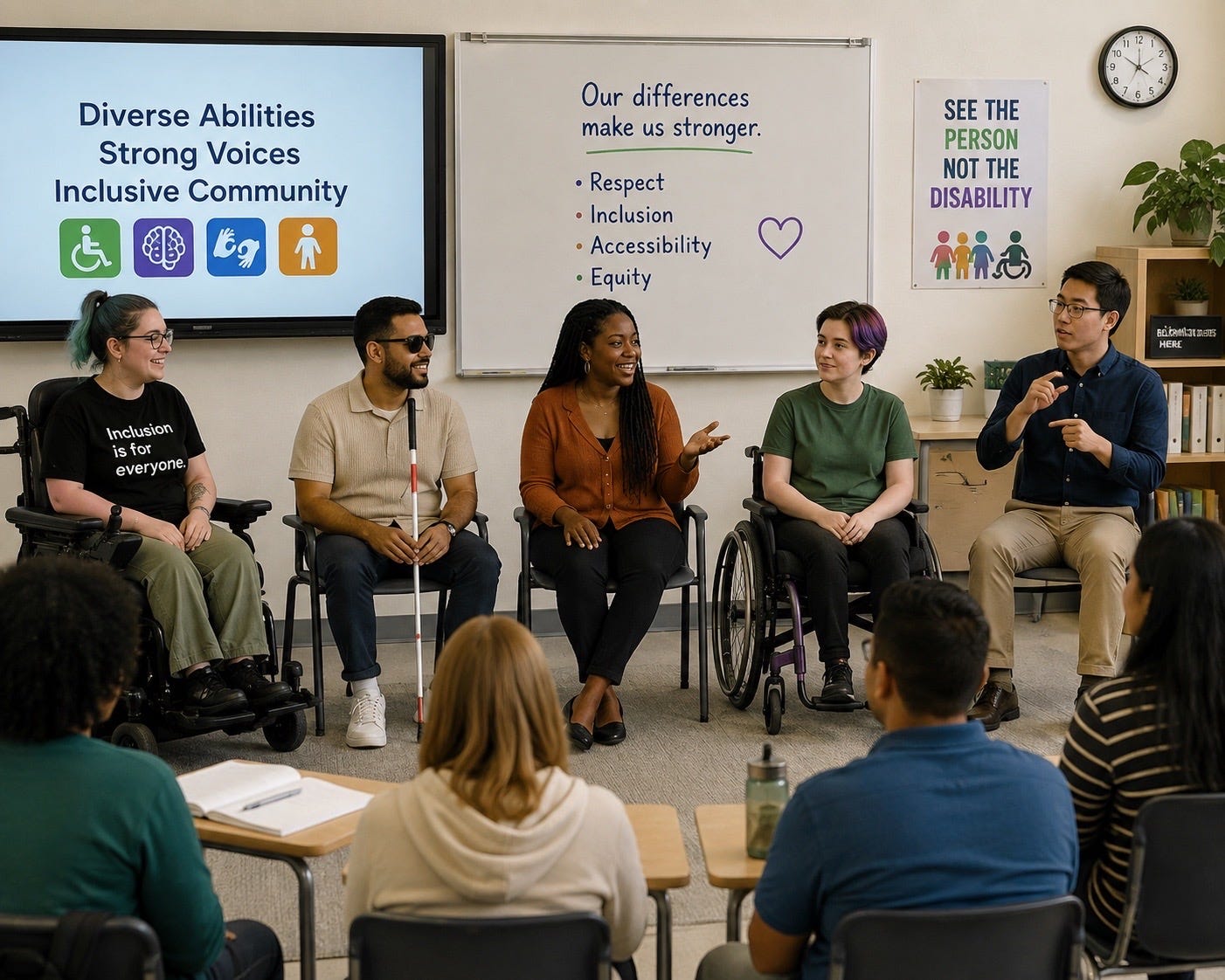
ALT TEXT: A diverse panel of five people with disabilities sits at the front of a classroom speaking to an audience. The panel includes wheelchair users, a blind person using a white cane, and a Deaf person communicating with sign language.
Like many disability awareness programs at the time, the idea was to help students understand what it was like to be blind. Schools have done similar activities for other disabilities. Students might spend an hour using a wheelchair, wear gloves to simulate limited dexterity, or try completing tasks while pretending to have another disability. The goal has always been the same: to build empathy and awareness.
When I led these programs, I genuinely believed they were helping.
Today, I see them differently.
The biggest problem with disability simulations is that they don't actually simulate disability.
They simulate confusion.
A blindfolded student isn't experiencing blindness. They're experiencing the sudden loss of a sense they've depended on their entire life. They haven't learned orientation and mobility skills. They don't know how to use a white cane effectively. They haven't developed confidence, problem-solving strategies, or the countless techniques blind people acquire over months and years.
What they're feeling is fear, uncertainty, and frustration—not blindness.
The same is true when someone spends a few minutes in a wheelchair. They're not experiencing life as a wheelchair user. They're experiencing life as an able-bodied person suddenly placed into unfamiliar equipment with no training or experience.
When students walk away saying, "Being blind must be terrible," or "I could never live like that," the activity hasn't built understanding. It has often reinforced the very stereotypes we were hoping to eliminate.
But there was another reaction I witnessed over the years that was even more concerning.
Sometimes students would finish the activity and proudly announce, "That wasn't so hard!" or "That was actually fun!"
At first glance, those comments might seem positive. But they're another example of how simulations can backfire.
Those students weren't experiencing blindness either.
They were participating in a short activity where they knew the blindfold would come off in a few minutes. It felt like a game or a challenge. They weren't trying to navigate unfamiliar environments independently every day. They weren't reading with a screen reader, organizing a kitchen, traveling to work, or solving the hundreds of small problems that come with living in a world designed primarily for sighted people.
They also weren't encountering many of the barriers that actually shape daily life. They weren't using a screen reader only to discover that a website couldn't be navigated because buttons weren't labeled or forms couldn't be completed independently. They weren't trying to access online banking, register for classes, schedule a medical appointment, or fill out an application only to find that the technology wasn't designed to work with the tools they rely on.
The same is true of other disability simulations. Someone using a wheelchair for a few minutes isn't experiencing life as a wheelchair user. They're unlikely to encounter the frustration of arriving at a medical office only to find the restroom inaccessible, discovering that a building has steps but no usable entrance, or realizing that something as routine as getting through a doorway requires planning because accessibility wasn't considered.
These experiences highlight one of the biggest flaws in disability simulations. They focus on the disability itself while leaving out the barriers created by society. In reality, many of the greatest challenges disabled people face don't come from blindness, wheelchair use, deafness, or any other disability. They come from inaccessible websites, buildings, transportation, communication, and assumptions that exclude us.
When a student concludes, "Being blind isn't a big deal because I did it for ten minutes," they've misunderstood disability just as much as the student who concludes, "Being blind must be awful."
Both reactions miss the point.
A disability is not defined by a five-minute simulation. It's shaped by a lifetime of learning skills, adapting, and navigating a world that is sometimes welcoming and sometimes unnecessarily inaccessible.
As a blind person, I don't spend my life stumbling around in darkness or constantly feeling helpless. But neither is blindness a game that can be fully understood through a temporary challenge.
Blindness is a way of living that includes learning skills, adapting, using technology, developing confidence, and finding countless ways to accomplish everyday tasks. It's not about pretending you can't see for a few minutes.
So what does good disability awareness look like?
I believe it starts by replacing simulations with conversations.
Instead of blindfolding students, let them meet blind adults. Let them ask honest questions. Show them how a white cane is actually used. Demonstrate screen readers, Braille displays, accessible smartphone apps, and other technology that makes independence possible.
Talk about orientation and mobility training instead of asking students to wander around blindfolded. Explain the barriers society creates and how accessibility helps remove those barriers.
Most importantly, let students see disabled people living ordinary, successful lives.
Let them see us working, raising families, traveling, laughing with friends, using technology, pursuing careers, and participating in our communities. Those experiences challenge stereotypes far more effectively than any simulation ever could.
I've come to realize that disability awareness shouldn't ask people to pretend to have a disability.
It should help people understand the lives of people who actually do.
I don't regret the programs I presented years ago. They were created with sincere intentions, and I truly wanted students to leave with greater empathy and respect.
But learning doesn't stop. Just as I hope students continue to learn and grow, I've had to do the same.
When I design disability awareness programs today, I don't ask students to imagine losing something. Instead, I invite them to gain something: a deeper understanding of disability through authentic conversations, lived experiences, and honest questions.
We explore the disability rights movement and the progress that has been made toward inclusion and accessibility. Students meet people with diverse disabilities and backgrounds, hear their stories, and see the many different ways disabled people navigate the world. We talk about the skills, resilience, creativity, problem-solving, and independence that develop through lived experience-not because disability is something to celebrate or fear, but because it is one part of a person's life.
Most importantly, I encourage students to ask questions. Curiosity, when paired with respect, is one of the most powerful tools for building understanding. I want students to leave feeling comfortable replacing assumptions with conversations and stereotypes with genuine knowledge.
I also challenge them to create new, more positive assumptions. Instead of assuming disability means limitation, dependence, or tragedy, I hope they'll begin to assume competence, possibility, and belonging. I want them to see disability not as something that defines a person, but as one aspect of the human experience-one that exists alongside our talents, relationships, ambitions, personalities, and dreams.
Real disability awareness isn't about creating fear.
It isn't about creating false confidence, either.
It's about replacing assumptions with understanding.
Because the goal isn't for students to walk away believing they know what it's like to be blind.
The goal is for them to walk away knowing that disability is part of human diversity-and that the people they meet are always more than their disabilities.
Written By Michelle Friedman
Michelle Friedman, Keshet immediate past board chair in Chicago, a member of Disability Lead and has been a disability advocate for 40 years. She has written two children’s books and is a frequent speaker for elementary and high school-age students. #AllInForAllAbilities
No posts
Comments
Nothing yet. Say the first thing.
Sign in to join the conversation.