
Welcome to the Energy Impacts Podcast, where we cut through the noise on America's energy sector. Join host David Blackmon, Stu Turley, and Former Texas State Representative Jason Isaac as we expose the policies destroying your wallet, threatening national security, and potentially crippling American energy independence. From windfall profit taxes to grid failures to Chinese equipment in our power lines—we're asking the questions Washington won't answer. Because affordable, reliable energy isn't a luxury. It's the foundation of prosperity, security, and freedom.
This podcast is going out on both the Energy News Beat, and Energy Impacts Podcast and we highly recommend following Jason Isaac on his LinkedIn https://www.linkedin.com/in/jasonaisaac/, and also his website: https://americanenergyinstitute.com/
Also check out David Blackmon's Substack https://blackmon.substack.com/, and The Energy News Beat Substack https://theenergynewsbeat.substack.com/
Enjoy the show:
Run of Show:
1. Oil & Gas Pricing & Market Dynamics
The hosts debate President Trump's comments about oil companies "price gouging" on gasoline. They explain the "rocket and feather effect"—how prices spike quickly when supply concerns arise but take longer to fall. They note current gas prices are actually lower than during the Biden administration and lower than historical averages, despite public frustration.
2. Windfall Profit Tax Concerns
Discussion of proposed Democratic legislation (Ro Khanna and Bernie Sanders) to impose windfall profit taxes on oil companies. The guests argue this would ultimately harm consumers by raising costs and reducing investment, citing Texas as an example of how lower business taxes attract companies and economic growth.
3. Data Centers & Critical Digital Infrastructure
A major focus on the AI race against China and the importance of data centers. They contrast Governor Hokel's ban on data centers in New York with Governor Abbott's measured approach in Texas—a temporary halt to review environmental impacts. Key points include data centers' economic benefits (jobs, tax revenue, $1 billion to Texas education last year) and the need to protect water resources through responsible practices like desalination.
4. Energy Grid Reliability & Market Reform
Extensive discussion of Texas's grid challenges, including:
Poor market design that doesn't reward reliability
Over-reliance on intermittent wind and solar (53 GW added vs. only 3 GW of natural gas in 5 years)
Rate payers bearing billions in costs to keep thermal plants on standby
Launch of "Rate Payers First" coalition to advocate for consumer protection
5. Supply Chain & National Security Issues
Concerns about Chinese equipment in the U.S. electrical grid, including:
Chinese-made solar components and battery storage systems
Remote communication devices pinging back to China
The incident at Camp Lejeune where a battery storage system was remotely restarted after being shut down
Need to bring manufacturing back to the U.S. and allied nations
6. Wind & Solar Infrastructure Problems
Environmental and practical concerns about renewable energy installations:
Wind turbine graveyards in Sweetwater, Texas with disposal challenges
Oil leaking from turbine bases contaminating farmland
Massive concrete foundations making land unsuitable for future farming
Potential future "superfund sites" from damaged installations
7. LNG & Energy Exports
Celebration of U.S. LNG production and exports as "freedom fuel" helping allies globally. Discussion of how American LNG is more affordable than alternatives and helps lift people out of poverty worldwide. Mention of major investments like Amazon's 7-gigawatt natural gas facility.
8. Jones Act & Fuel Supply
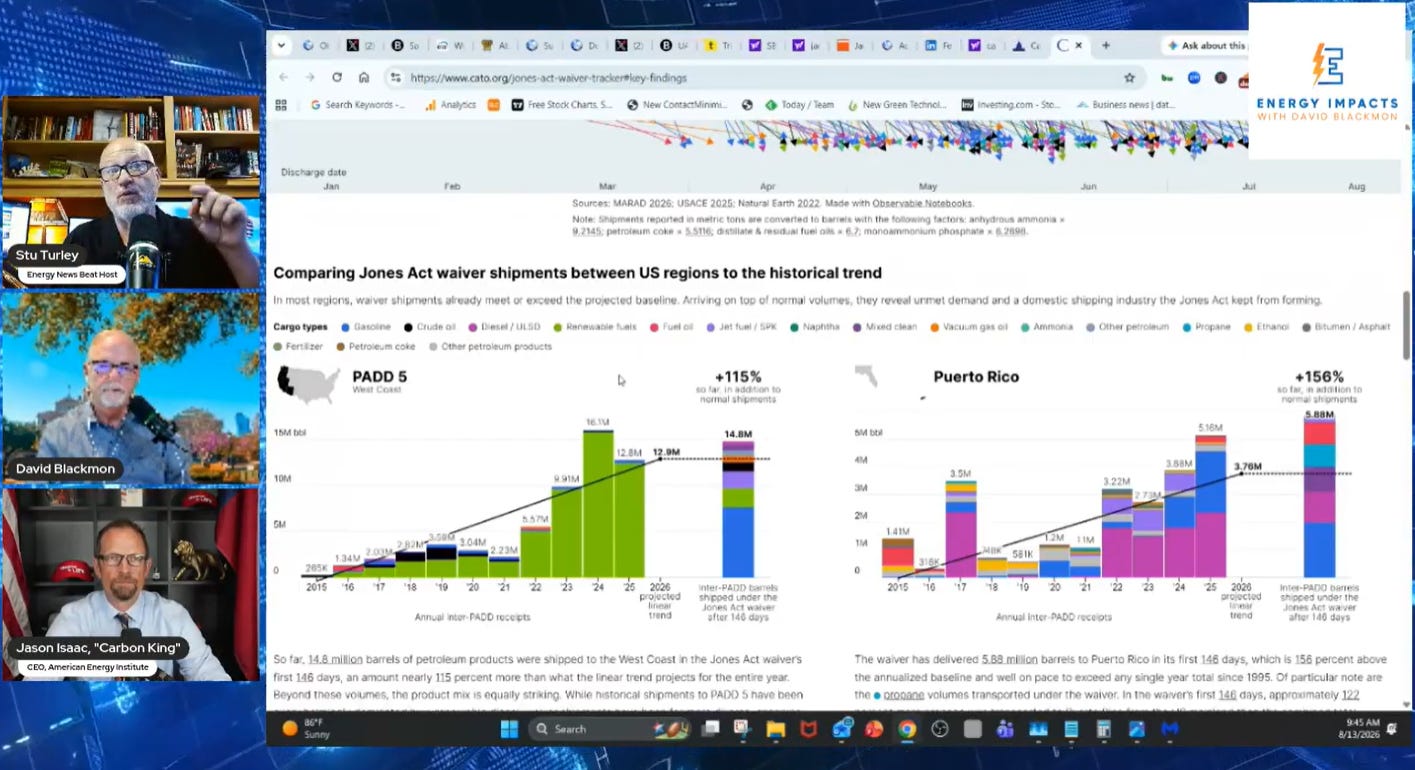
The importance of suspending the Jones Act (Merchant Marine Act of 1920) to allow cheaper fuel transport to California, Hawaii, Alaska, and Puerto Rico. Discussion of how the antiquated law drives up energy costs in these regions and harms industries like pharmaceuticals in Puerto Rico.
9. California's Energy Crisis & National Security
California's closure of refineries (down to 7 from 40) creates vulnerability for military bases and national security. The state's opposition to increased oil production threatens fuel supply for strategic military installations.
The overarching theme is that affordable, reliable American energy is essential for economic prosperity, national security, and global stability—and that misguided policies (windfall taxes, renewable subsidies, Jones Act restrictions) undermine these goals.
Comments
Nothing yet. Say the first thing.
Sign in to join the conversation.