
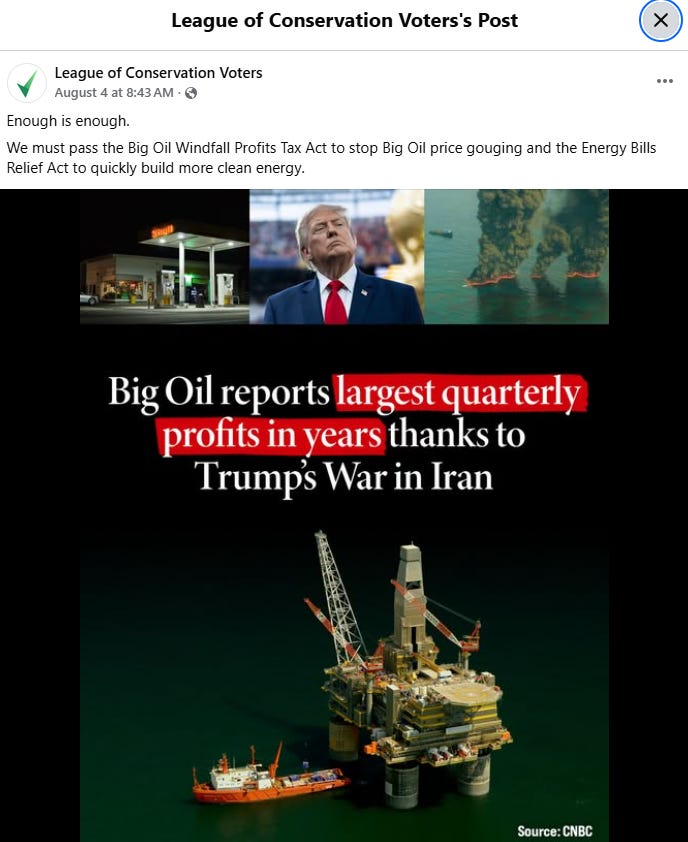
The politics of envy on display by the far-left League of Conservation Voters.
I’ve detailed this story several times in various podcasts, but today it bears laying out here, in writing.
My first job out of college in the summer of 1979 was going to work as an accountant in Houston for Coastal States Oil & Gas Company, led by legendary oilman Oscar Wyatt. Having arrived in the immediate wake of the federal court order requiring Wyatt and Coastal to spin off Lo-Vaca Gathering Company in the Wood v. Coastal States Gas Corp. case, my initial assignment was to handle the accounting for the initial company created out of that case to house Coastal’s side of the spinoff, Border Exploration Co.
On January 1, Valero was created from that Lo-Vaca spinoff as a regional midstream company. Of course, Valero now exists as one of the nation’s biggest standalone refining companies.
Anyway, that initial assignment lasted until January, 1980, when it became obvious that - thanks largely to the tacit support of Texas Sen. Lloyd Bentson - the Senate was going to enact the idiotic Windfall Profit Tax to satisfy Jimmy Carter and his politics of envy which drove the law to completion. Carter needed a “win” in the runup to his contest with GOP nominee Ronald Reagan, and this was going to be it: Punishing “Big Oil” companies for reaping in big profits during the Arab oil embargoes of the 1970s, thanks to their refining arms.
I was given the juicy assignment of analyzing the legislation and figuring out what it was going to take for Coastal to comply with it. Within a week or so, I had concluded that this braindead tax was structured in such a way that the vast majority of the money it took in would come not from majors like Coastal States, ExxonMobil, Chevron, Texaco, Amoco, Marathon, Conoco, Phillips Petroleum, and Standard Oil of California, but from royalty owners and independent producers.
Thanks to their fully integrated corporate structure, the big boys would be able to preserve most of their profits behind various deductions, exemptions and price inflation factors contained in the bill, and I helped some of them do it. That knowledge of the details of this ridiculous law served me well over the next 6 years and helped the companies I worked for during that time save millions of dollars.
Of course, the WPT was such a legislative atrocity and abject failure to raise the billions of dollars promised by its fans that congress, thanks to Ronald Reagan’s shaming and prodding, finally repealed the damn thing in 1987. By then, I was quite happy to see it go.
One troubling fact I took in during those years was the fact that no one in congress proposed to enact a Windfall Refunds Reverse Tax law during 1984-86, when all those “Big Oil” companies lost their asses and were forced to lay off more than 100,000 employees during the most destructive price collapse and downturn in the industry’s history. Funny how that works, huh?
True fact: I was one of those employees who was laid off in June 1986. I found a good job in Austin by September, but those two months out of work were the only time I’ve been out of a job since I was 14 years old. Needless to say, that experience had a lasting impact on me and my views.
I bring all this up because the ugly specter of a potential windfall profit tax is rearing its awful head again in our society, and yet again it is based in the same economic vapidity and politics of envy which drove the Carter-era law. This latest effort is sponsored by Ro Khanna - who I wrote about in a different context today over at my Campaign Update Substack - and Rhode Island dimwit Senator Sheldon Whitehouse, with support from Khanna’s old Bolshevik mentor, commie Bernie Sanders.
As I detailed in a piece here in March, this version of the WPT would impose a 50% tax on the difference between current oil prices and last year’s average on companies which import 300,000 barrels per day or more. That would include integrated majors like Exxon, Chevron, Shell, BP, and Aramco, and would also hit some of the larger independent refiners like Valero and Phillips 66.
To satisfy the politics of envy, Khanna, Whitehouse and Sanders propose to refund the proceeds of the tax to “consumers” below a certain income level via quarterly rebates. Because they must discriminate in everything they do in order to tailor their envy politics to those most likely to feel said envy.
And we can always count on a compliant segment in the media to amplify the messages of any attack on “Big Oil.” That’s true even at Oilprice.com, where pro-fake green energy writer Felicity Bradstock has a piece up today headlined, “Oil Majors Reap $93 Billion Windfall From the Iran War.” That headline kills two bogeymen with a single stone, going after both “Big Oil” and Donald Trump, who of course kicked the war off to begin with.
How biased is this piece? Check out this two-paragraph excerpt parroting the talking points of the Democrat party and climate alarm activists:
Eight of the largest oil firms achieved combined profits of over $90 billion in the three months from April to June, following the U.S.-Israeli attack on Iran and the subsequent war. Iran’s decision to close the Strait of Hormuz, the waterway between Oman and Iran that connects the Persian Gulf with the Gulf of Oman and the Arabian Sea, has led to the biggest disruption of fossil fuel supplies in the market’s history. As a few oil majors from the United States, Europe, and the Middle East step in to fill the gap and oil prices are pushed higher, a few companies have come out on top.
The phenomenon has also demonstrated that the world remains overly dependent on fossil fuels, with countries willing to pay a premium to secure their oil and gas supplies in the face of major global shortages. Environmentalists are concerned about what this reliance means for climate change, as greenhouse emissions remain high. The lack of energy diversification and the heavy dependence on fossil fuels also poses a threat to energy security for many countries.
[End]
Felicity assures us that these “windfall” profits have “demonstrated that the world remains overly dependent on fossil fuels…”. Not that the profits “imply” or “support arguments by activists that” that’s the case - “demonstrated.”
According to whom? Welp, Felicity answers that question with the first word in her next sentence: “Environmentalists,” i.e., the prophets for the Global Church of Climate Alarm™, that’s who. I’ve no doubt Ms. Bradstock is a perfectly nice person, but this stuff is so utterly tiresome and sadly predictable.
Yes, oil companies reported record profits during the 2nd quarter - they always do tend to make profits during times of elevated commodity prices, after all. And yes, a lot of those profits for the big integrated companies came from their refining and retail units, which is why those companies are fully integrated to begin with.
But here’s the thing: Big tech companies like Apple and AI developers and Big Pharma companies regularly rake in gigantic profits that dwarf the entirety of “Big Oil” and nobody ever utters a peep about “windfalls” or a “windfall profit tax.” That particular attack is 100% the province of “Big Oil.”
The reason is simple and pretty obvious: Because drivers have no choice but to buy gasoline for their cars, and because gasoline is literally the only commodity in U.S. society whose retail price is prominently displayed on a million giant signs on roadsides across the country.
We resent the hell out of it when the price of gas goes up, because we know we have to pull into the station anyway and buy it. It’s simple human nature.
I experienced it myself on Sunday when the QT Market station where I fill up had regular priced at $3.72, 30 cents per gallon more than it was priced two days before. The price of oil hadn’t budged across those two days, so why did the price jump 8%, I wondered, fuming that I hadn’t had the insight to stop in and fill up on Friday. All that went through my mind in about 2 seconds even though I know there are dozens of possible factors that might have led to that price shift.
So, the resentment is normal, and it’s human.
But that doesn’t make it right. And it doesn’t justify cynical, self-serving political hacks like Khanna and Whitehouse and the old commie buying votes on the politics of envy.
Just say no to anyone who asks for your support for a windfall profit tax. It’ll be good for your soul.
That is all.
Comments
Nothing yet. Say the first thing.
Sign in to join the conversation.