
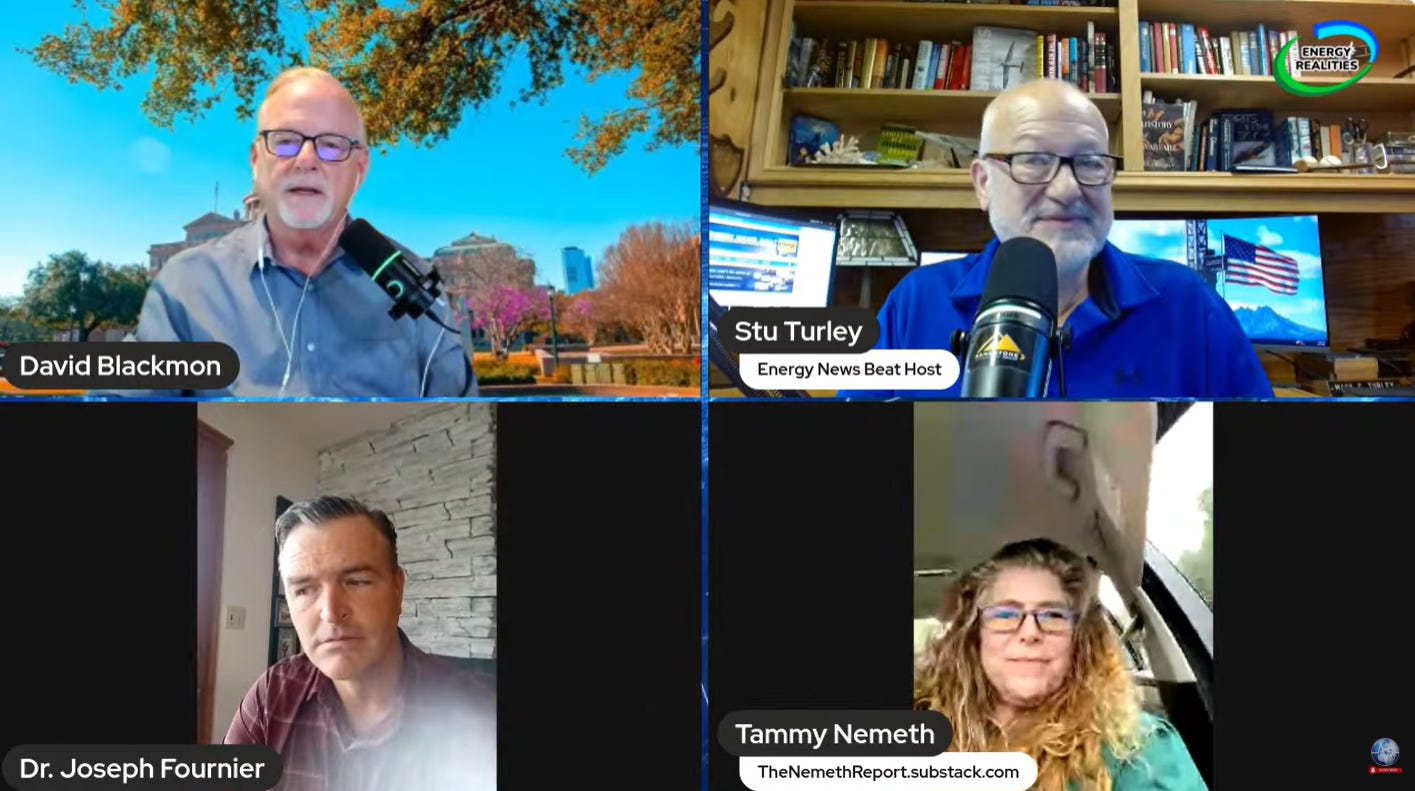
A news making day on the Energy Realities Podcast with Dr. Tammy Nemeth, David Blackmon and Stu Turley!
In this episode of the Energy Realities Podcast, host David Blackmon and panelists Dr. Joseph Fournier, Dr. Tammy Nemeth, and Stu Turley challenge the prevailing Western narrative around energy transition and expose a stark geopolitical reality: while North America and Europe have abandoned coal in pursuit of net-zero commitments, China is aggressively expanding its coal mining and consumption capacity as a deliberate strategy for energy sovereignty and military power. Drawing on Joseph Fournier, Ph.D. recent reports—"Beijing's Excalibur: Coal as China's Weapon of Sovereign Power" and "North American LNG Won't Displace Asia's Coal"—the discussion reveals how Western climate policies have inadvertently strengthened China's position, transferred critical supply chains and manufacturing to Beijing, and created vulnerabilities that threaten North American security. The panelists argue that the "clean energy" transition narrative obscures uncomfortable truths about resource consumption, grid costs, and geopolitical strategy, and they make a compelling case that energy policy must be reframed around national security and sovereignty rather than climate ideology.
Follow Dr. Fournier on his Substack:
Enjoy the show:
Run of Show:
1. China’s Coal Strategy as a Geopolitical Weapon 2. Energy Sovereignty vs. Global Interdependence 3. LNG Cannot Displace Coal Scale mismatch: By 2030, only ~190 million tons of LNG will be produced annually, while coal consumption is 10x that Control over coal pricing and supply chains There is no such thing as “clean” or “renewable” energy—all consume finite resources 7. Historical Parallels to WWII and Imperial Japan China’s coal expansion and military buildup to 1930s Germany securing oil for war Chinese influence in Western institutions (universities, WEF, political campaigns) Thank you for all of the great comments, and we highly recommend subscribing to Joseph Fournier, Ph.D. Check out for Stu Turley on The Energy News Beat Substack:
The central theme is China’s deliberate expansion of coal mining and consumption—not a transition away from it. Dr. Fournier explains that China’s 14th Five-Year Plan mandates a 25% expansion of coal mining capacity by 2030, positioning coal as “Excalibur”—a weapon of sovereign power. This is framed as existential to China’s energy independence and national security.
The discussion emphasizes how China and India prioritize energy sovereignty over climate commitments. After Russia’s invasion of Ukraine and the end of globalization, countries are securing domestic energy sources they can control. Coal provides this security because these nations have abundant domestic supplies, unlike LNG which depends on global supply chains vulnerable to geopolitical disruption.
Dr. Fournier argues that North American LNG cannot replace Asia’s coal due to:
Price advantage: Most Chinese coal is cheaper per gigajoule than spot LNG
Geopolitical risk: China restricts LNG dependence due to vulnerability through the Strait of Malacca
4. Western Hypocrisy and China’s Strategic Advantage
The panelists argue that Western nations abandoned coal while China strategically expanded it, giving China:
Dominance in rare earth minerals and critical supply chains (80% globally)
Manufacturing control of renewable energy components (wind, solar, batteries)
Wealth transfer from West to China funding military expansion
5. The “Clean Energy” Narrative is Misleading
Dr. Fournier challenges the terminology:
Wind and solar consume critical minerals at rates comparable to fossil fuels
Levelized cost of energy (LCOE) metrics are manipulated and don’t account for grid complexity, land reclamation, or decommissioning costs
Renewable infrastructure costs are exploding for consumers while generation costs decrease
6. Energy Return on Energy Invested (EROI)
Coal has the highest EROI ratio of any technology—meaning it produces far more energy than it consumes to build and maintain. This is critical for affordability and inflation, yet is largely ignored in policy discussions.
The panelists draw parallels between:
China’s coal shortage trajectory (depleting reserves by 2050) to Imperial Japan’s resource-driven invasions
The risk of military conflict in the Indo-Pacific if China seeks to secure coal and mineral resources
8. Western Policy Failures and Chinese Influence
Key concerns raised:
Regulatory capture: Western environmental agencies benefit Chinese interests
Canada’s vulnerability: Chinese police stations, security agreements with Beijing, MPs with CCP ties
Lack of domestic mining and processing capacity leaves the West dependent on China
For David Blackmon
For Tammy Nemeth
Comments
Nothing yet. Say the first thing.
Sign in to join the conversation.