
I shuffled towards the tent lines, sweating in the 45°C heat, my eyes squinting against the glare and blowing sand. In the distance loomed a small building, one that hadn’t been there a few hours earlier. As I grew closer, I realized that it was trimmed in bright red, the colour brilliant amidst the tans of the desert. I circled the building to what was obviously the front. There, above wide, sliding serving windows, was a familiar sign: Pizza Hut. The Americans, seemingly out of nowhere, had dropped a Pizza Hut smack in the middle of camp.
I share this little anecdote because it vividly illustrates the American way of war: unparalleled logistics, virtually limitless resources, cultural isolation, and sometimes odd planning decisions. It’s grounded in history and initially served the United States well. However, as I’ll attempt to show, American strength is not always effective. Indeed, it has become a significant weakness and has led to strategic decisions that have had grave consequences for both the United States and the wider international community. For Canada, the danger is not merely that the American way of war fails; it is that dependence on American capabilities steadily pushes us into adopting it.
Generally speaking, American employment of military power is characterized by a number of traits that can trace themselves back to the Second World War: unparalleled industrial capability, incredible logistics, the use of airpower as a panacea, allies as a tool rather than a partner, cultural isolation, technological solutionism, firepower as the first solution to tactical problems, and not a little amount of hubris and exceptionalism. We see all these being applied now during Trump’s war against Iran, but their threads run through most US military actions since 1945, including during “my” war in Afghanistan. In many ways, the United States is still attempting to apply the lessons learned during World War II to conflicts that are dramatically different in nature or scale.
Before we begin, I would like to stress a couple of points. First, this essay aims to describe systemic attitudes that I have observed, not the attitudes found amongst individual military personnel. The US military is a large and diverse organization, and there are many, many professionals who are well aware of the traits I’m describing and how they affect military policy. Furthermore, I’ve written about my personal experience elsewhere, and attempted to explain the relationship between Canadians serving with the US and the American armed forces.
Secondly, there are minor exceptions to the norms I outline below. Arguably, airpower forced a solution in the Balkans and in Libya, and the first Gulf War vividly illustrated how effective the American way of war can be in a conventional setting. But I think that these are exceptions, and the track record is hardly spotless.
The United States emerged from the Second World War as the world’s preeminent military power. It leveraged its industrial potential and population to create a military establishment capable of operating at a global scale. American logistics capability was unparalleled and the movement of troops and materiel between continents became a matter of routine. US industrial capacity meant that nothing was ever in short supply and that equipment was normally of the finest quality. The mass use of strategic airpower contributed significantly to the defeat of both Germany and Japan, while carrier aviation became central to victory against the latter. The force was so large that training could be focused on specialists, rather than on teaching personnel to be “jacks of all trades”. Allies became junior partners at best and an annoyance at worst. And all this led to the United States convincing itself that it alone won the war.
The Americans applied these lessons in both Korea and Vietnam. Both conflicts saw the United States employ strategic bombing as a primary means of forcing tactical decisions and the use of mass firepower as a means of keeping American casualties to a minimum. In Vietnam in particular, the US operated with a certain level of cultural insensitivity and became used to conducting operations without the input of allies, most of whom relied on the Americans for support anyway.
This eventually translated into what I believe is the underlying tendency of the American way of war: to find the most technically or operationally convenient solution to problems, no matter how complex. Thus we have a reliance on airpower and firepower, the extensive use of special operations forces, a strategic inability to adapt to local situations, extreme efforts to avoid casualties, leading to a suspicion that American lives are somehow more valuable than others, and a tendency to regard allies as a “bolt-on” or as part of a political kabuki theatre.
The Gulf, 2002. The ramp was littered with aircraft — as many as nine huge C-17s and over 20 C-130s at any given time. C-17s arrived virtually on the hour from the US and Europe, along with enormous C-5 Galaxies direct from the States. Unseen, but supporting it all, was a fleet of air-to-air refuelling tankers, ensuring US aircraft could fly with no interruption. The scale was gigantic. All of Canada’s air force in one place. And it was one of five such installations.
The United States Armed Forces have an unequalled ability to move forces anywhere on the planet. US Air Force aircraft operate daily around the globe and the Americans have a far-flung system of bases and support hubs on virtually every continent. Much of this is a legacy of the Second World War and the Cold War, but it means that the US is capable of doing things that no other country can. Air strikes can be launched within hours of being ordered — anywhere on the planet — and carrier strike groups can be moved between continents within a matter of days. Land forces can be airlifted directly into action. The knock-on effect is that US dominance in logistics means that American leadership always has access to a military option.
This makes the United States virtually unbeatable in a conventional conflict — i.e., state-on-state warfare. The issues arise when situations aren’t so clear-cut, or where nuance and restraint are called for.
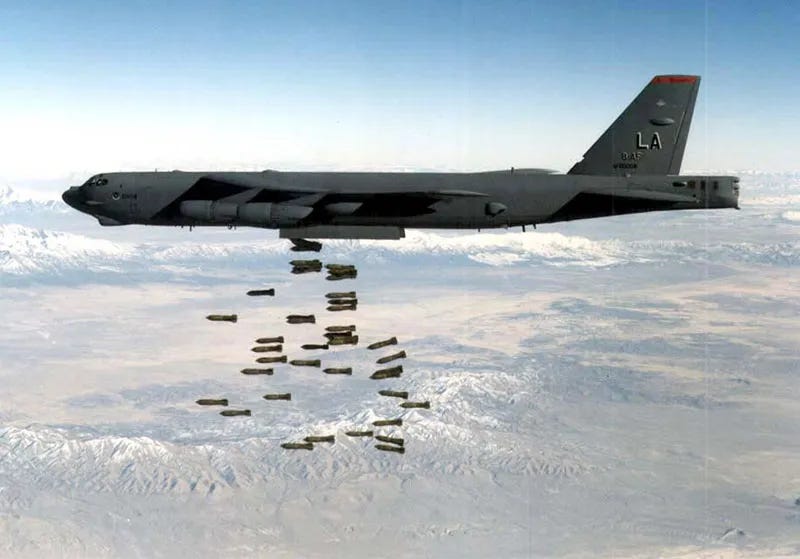
The US Air Force is, in many ways, the service that most reflects the lessons of the Second World War. The ghosts of Curtis LeMay and memories of the Strategic Air Command stalk the halls of the Pentagon. This is translated into a very large constituency within the American armed forces that believes that airpower is the solution to most military problems and that conflicts can be won using airpower alone. The liberal use of aerial firepower is enormously attractive to the political leadership. It has the benefit of appearing decisive, holds the promise of forcing a solution, and, most importantly, is of very low risk. American technological dominance ensures that US airpower can operate with virtual impunity and, if an aircraft or two are lost, that plays better in the domestic press than thousands of land-based casualties.
The problem with airpower is that all it can do is break stuff. It doesn’t take into account the human factor. This should have been a lesson learned in 1945, when airpower alone wasn’t sufficient to force Germany’s final surrender. Nor did mass raids in North Korea, the bombings of Hanoi and Haiphong, or “shock and awe” over Baghdad create conditions for an American victory. Even firebombing Japan didn’t force a surrender; it took atomic weapons and a submarine campaign to do that. Yet this lesson doesn’t appear to have been learned, as we see vividly illustrated in Iran today. In Iran, air strikes have destroyed infrastructure and conventional military capability, yet the regime remains intact and Iran’s capacity to wage unconventional war still exists. Bombing has not forced a victory, Donald Trump’s claims to the contrary.
“Proximo” led the Presidential Protective Detail, supported by contractors using, in a surreal yet very American touch, fast-food names as pseudonyms. All claimed service in one special forces unit or another, sometimes without any real proof; wildly inflated resumes were the norm. “Proximo” earned a reputation for driving through the capital, siren blaring, .50 calibre machine gun pointing at all and sundry. The final straw came when the Detail physically assaulted the Minister of Transport at an event.
The American special forces community is larger than most countries’ entire armed forces. There are so many units with so many names that it is difficult for the uninitiated to keep track. The US Air Force has special operations aircraft and helicopters, there are US Marine Corps special operations units, the US Navy famously has the so-called SEAL teams, the US Army has Rangers, the Green Berets (the original “special forces”), “Delta Force”, and everyone has secretive aircraft of their own. This is all supported by a massive intelligence and support infrastructure.
Because all these units operate without public knowledge, the temptation to use them is very great. Moreover, because some operations have been successful — thinking here of the effort to support the Northern Alliance in Afghanistan and the killing of Osama Bin Laden, to name two — confidence in the special forces community as a whole is very high. On the face of it, SOF is the perfect solution.
Except that it isn’t. SOF is very expensive and is suitable for exquisite, surgical operations. Bin Laden is a good example. However, to conduct a campaign or to achieve strategic effects, conventional forces are virtually mandatory. This hasn’t stopped the United States from trying to leverage SOF capabilities at the strategic level, with little success. The result is a very large force structure that leans into the mythology created by US media. How many “SEAL” television programs are there? Books? Movies? Plenty. None of this is to deny the quality of many SOF personnel; the problem is the strategic mythology built around them. But none of this demonstrates a war-winning capability.
The American way of war leans heavily on technological solutions. This is the belief that sensors, networks, precision weapons, “fusion”, and information dominance can solve problems that, in reality, require political solutions. There is a tendency to disregard the human element in favour of the technological, including in scenarios where technology is limited or ineffective. That belief runs from strategic bombing to “shock and awe”, drones, and AI-enabled targeting. It’s the Pentagon version of “there’s an app for that,” except the app costs $80 billion and requires three congressional districts to maintain.
American attitudes towards allies are grounded in history, exceptionalism, and not a little hubris. To begin with, we must understand that Americans, generalizing here, of course, believe that allies bring nothing to the table. The United States possesses every capability that any ally could possibly provide. Indeed, most allies — the major ones included — are often reliant on US logistics and intelligence support. They become a burden and a liability. Worse, as we’ve seen in Pete Hegseth’s various rantings, allies bring different rules of engagement and national caveats that can serve to hamstring American operational flexibility. At best, then, allies are a “bolt-on”, a means of increasing US capability under American direction and leadership, and woe betide anyone saying differently. Even with this, allies are part of a hierarchy, with the British at the top, and Canada and Australia just behind. Everyone else is left out of the equation entirely.
The first problem with this is that while the US is strategically unmatched, allied forces at the tactical level can be as good as, or better than, their American counterparts. For example, I was mocked online for suggesting that the Danes could give the US a bloody nose should the United States attempt an occupation of Greenland. American commentators, in a bout of hubris, regarded the idea of Danish military resistance as a joke. This level of exceptionalism could have resulted in disaster. After all, the Danes — at the unit level — are easily a match for the US. They have extensive combat experience, fantastic soldier skills, good, modern equipment, and well-trained leaders operating under a Royal Decree ordering immediate resistance to an invader. Reports soon emerged of Danish plans to crater Greenland’s runways and to cause American casualties. The Trump Administration would surely have shrugged this off, wildly misreading the capabilities of one of America’s oldest NATO allies.
The second issue is that the US tends to use its predominance to impose its way of war on allies — big and small. The “host nation” becomes a very junior partner pushed to the side, and countries with differing rules of engagement find themselves shut out completely. The result is the Americanization of those forces within the “inner circle”, with its reliance on firepower, “kinetic” action, special operations, and airpower. US direction becomes the default setting and allies wishing to have any influence at all are forced to adapt, essentially submerging themselves in the US system. But they’ll always be outsiders and there is never any doubt as to who is running the show. After all, NOFORN classifications apply to virtually everything and allies can’t really be trusted to do things “properly” anyway.
Finally, the United States tends to employ local forces as a combat multiplier rather than as a true partner. We saw this in Vietnam, Afghanistan, and Iraq. Like other allies, local forces — fighting in their own countries — are expected to take US direction and adopt US practices even as they receive inferior training and equipment. In two instances, Vietnam and Afghanistan, local forces were eventually abandoned in cynical displays of US self-interest. Such things do not inspire confidence or loyalty, something that was continually demonstrated with the Afghan National Army.
Afghanistan. Picture military personnel and civilian contractors, all armed to the teeth, lined up at the Burger King or shopping at the North Face store. Want a latte? Green Beans is right there. The AAFES is promoting a contest for a new Chrysler and has stereos on sale. Grab a movie to play in your shack. It’s like you’ve never left home, aside from the dust and occasional scorpion. And the Afghans? Well, I saw a “detail” cleaning the shitters this morning.
Systemic exceptionalism is rife across the entire American way of war. The organization is utterly convinced that it will prevail, that it is right, and that there is little room for learning or change. Thus we saw the United States repeating the same mistakes over and over in Afghanistan for almost two decades; after all, there’s nothing wrong with the way America fights, is there? The issue is that this exceptionalism creates an environment that is entirely counterproductive, an environment that manifests itself as in the anecdote above. Cultural insensitivity is pervasive. What other army would permit — for a while at least — a unit to hand out translations of the Bible in deeply Muslim Afghanistan? Imagine allowing a reprobate like Pete Hegseth, with all his prejudices and hubris, to instruct local forces. Crusaders don’t play well in Kandahar.
The issue with systemic exceptionalism is that it breeds contempt. Contempt for allies, contempt for those you’re purportedly helping and, worst, contempt for your enemy. The enemy, after all, has a vote, and war is a fluid and unpredictable thing. Having contempt for it leads to recklessness, poor planning, and failure.
We see all of this in full display right now, with Trump’s war with Iran. The United States launched extensive airstrikes against Iranian infrastructure and decapitation strikes against its leadership. Conventional Iranian military capabilities were wiped out and Trump himself was quick to claim a resounding victory. Yet the enemy has a vote and the American way of war was ill-suited to bring Iran to heel without an extensive, risky, and potentially expensive ground operation. Hubris and exceptionalism, personified by a strutting Pete Hegseth, waded in and failed to account for the Iranian regime’s resilience and ability to conduct unconventional warfare. Consequences and second- and third-order effects were obviously disregarded as Trump watched video of airstrike after airstrike. Today, though, “victory” seems far off.
This is because US strategy cannot work. Bombing alone has rarely, if ever, produced the clean political surrender American planners seem to expect from it, and the United States seems to have developed few other options. Iran has become the master at creating unintended consequences, both with its drone and missile strikes and with small-scale operations in the Strait of Hormuz. The United States has alienated its usual allies — allies that possess minesweeping capabilities beyond those possessed by the US Navy — and is left virtually alone confronting Iran. Those minesweepers would have come in pretty handy in clearing the Strait and providing close-in naval support to shipping, capabilities that were discarded due, in my opinion, to sheer arrogance.
Canada, of course, developed its own way of war, one grounded originally in British tradition and modified by our own lessons from the First and Second World Wars, Korea, service with NATO, and a variety of peacekeeping missions: reliance on small units, a wide scope of training, managed resources, and a more discriminating use of both force and firepower. Over the past couple of decades, these have been subsumed into the American way of thinking because we have played the role of junior partner on several American-led operations. On these, we relied on US logistics, strategic transportation, and combat enablers. We shared camps and conducted joint operations. Canada conformed and we will continue to conform as long as we rely on the United States to provide basic military capabilities. An army without air defence cannot operate independently in the 21st century. We don’t need a deployable Tim Hortons; we need sovereign resources that permit Canada to operate the way it sees fit, and not be beholden to another country’s agenda.
This article has attempted to describe what I see as systemic issues with US military strategy and its “way of war”. Of course, as mentioned at the start, there are many Americans both within and outside the US military establishment who don’t subscribe to the traditional US military view of operations. I have no doubt, for instance, that many officers warned of the repercussions of attacking Iran, of limiting those attacks to airstrikes, of the resilience of the Iranian regime, and of the consequences to global shipping and to the world economy. Yet the Administration’s hubris and confidence in doing things the same old way prevailed. And the Strait remains closed.
Comments
Nothing yet. Say the first thing.
Sign in to join the conversation.