
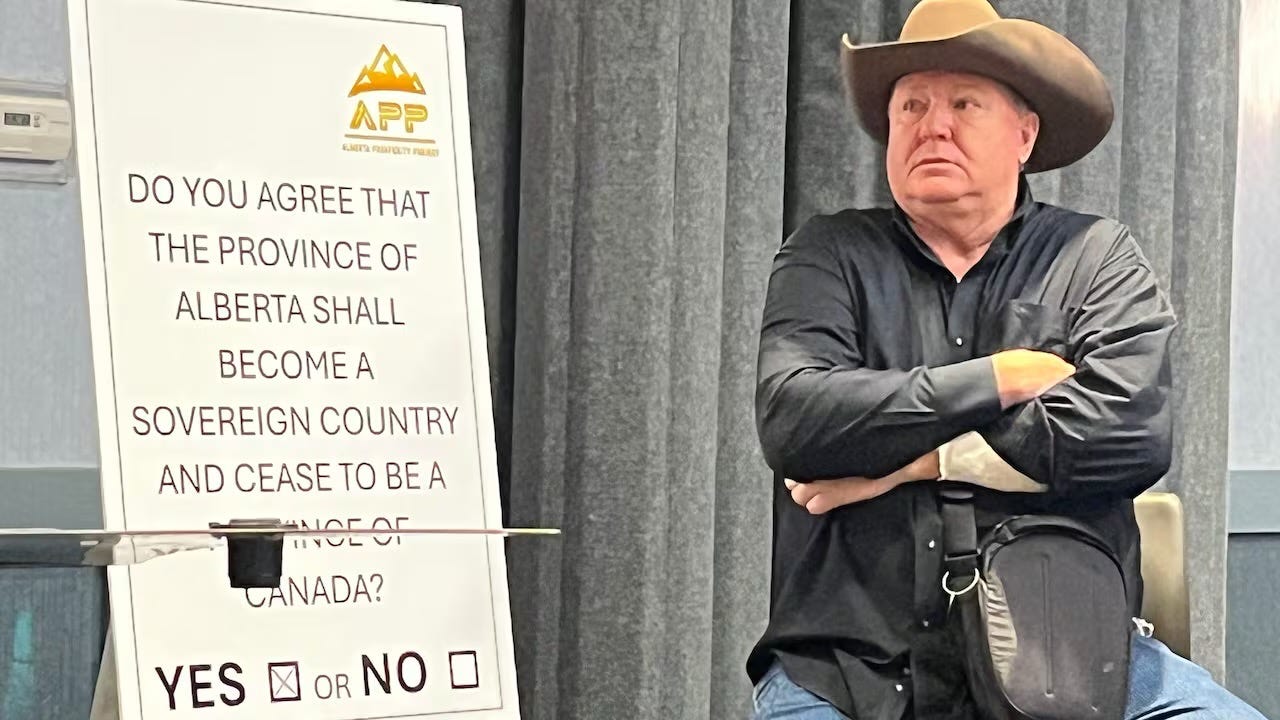
Before we start, I should make something perfectly clear. I have no time or sympathy for Alberta separatists. Indeed, I regard the entire movement as one that is assisted in no small part by Russian and American disinformation campaigns, with the former government-sponsored and the latter nurtured in the MAGA-verse. The separatists are guilty of misleading supporters, spreading disinformation, and indulging in delusional magical thinking to wave away any roadblocks to what I believe is, for at least some of its leading voices, the real objective: eventual absorption into the United States.1
With that out of the way, this article will focus on one of the major roadblocks facing separatists, one barely acknowledged in the midst of a sea of utterly delusional thinking: defence — a major issue that they wave away with the jauntiness that only a true believer can muster. Except that should they get what they want, defence will instantly become a major — if not the major — issue, much more so than equalization, pipelines, pensions, or the economics of separation. Having spent much of my career inside the machinery of defence planning, I find this particular bit of magical thinking almost breathtaking.
Contrary to popular belief, Ottawa can’t just send the armed forces into whatever province it wishes. Instead, a written request from the provincial Attorney General is needed to launch Canadian Armed Forces in the province. No formal request from Alberta’s Attorney General? No Canadian Armed Forces dispatched into Alberta.2
We can start with this howler from the Alberta Prosperity Project — the leading proponent for separation and purportedly the most organized — because it is dangerous and horrifically wrong. Moreover, it is indicative of the misinformation and wishful thinking being fed to sovereignty supporters. The Canadian Constitution gives exclusive responsibility for defence and all defence-related issues to the federal government. Provinces have no role in military activity whatsoever.
This extends to such mundane matters as health care for military members, taxes, vehicle registration, and driver’s licences for military vehicles. Much more importantly, the Canadian Armed Forces can be deployed anywhere in Canada for any defence or military purpose — full stop. The only time a province gets involved is to request assistance in the event of a situation that is beyond the capabilities of that province. This is almost always a natural disaster or policing matter. This is the only time an Attorney General becomes involved in this specific scenario. Aid to the Civil Power is not the same thing as federal command over CAF assets or its ability to deploy those assets.
In a hypothetical, apocalyptic situation involving the attempted rupture of the country, the federal government would not be helpless. It would retain command over the CAF, control over federal defence assets, and the constitutional authority to act in defence of the Canadian state. And make no mistake: in a domestic setting, the CAF is an incredibly powerful tool, the ultimate one available to Ottawa.
I begin with this point because the assumptions the Alberta Prosperity Project’s misinformation leads to could — in extremis — be incredibly dangerous. They are basically telling Albertans that there can be no “worst case” response from Ottawa, which is patently untrue.
Constitutional issues are the separatists’ weak spot; they completely fail to understand the division of powers within the federal system or they twist the meaning of the Constitution to suit their own purposes. There is no small element of thinking imported from the United States that separatist elements have attempted to apply to Alberta and Canada. This may account for the claim made above: that Alberta is already “sovereign” under a weak federal government and has some sort of jurisdiction when it comes to military affairs.
If this is the case, the APP and the rest of the separatists are in for a rude awakening. Aside from the ability to deploy forces anywhere in the province for any purpose, Canada possesses extensive defence infrastructure supporting a good portion of the Canadian Armed Forces’ combat capability. None of this would — or indeed can — belong to the province in the event of separation. Ottawa is not likely to surrender 1 Canadian Mechanized Brigade Group in Edmonton, Canada’s major fighter base in Cold Lake, Wainwright, Suffield, or the classified systems and munitions that support them. These are not Alberta assets. They are instruments of Canadian sovereignty.
All of this would be pulled out of Alberta — with a separatist Alberta footing the bill for any residual infrastructure. With it would go all the classified systems, munitions storage facilities, the munitions themselves, and all the training infrastructure, including the computerized systems. After all, these are Canadian assets and a “Republic of Alberta” would be required to recreate any defence capability from scratch. Apparently, there is talk of $1 to 2 billion being allocated for this purpose, a figure that is patently ridiculous.
Much is made of Alberta’s landlocked status, an issue that separatists wave away by stating that Canada would be “required” to give Alberta access to the sea or by saying that the United States would charitably provide Alberta with export routes through its territory. Virtually nothing is said about another issue — one that directly impacts Canada’s defence posture and national security.
British Columbia would not become an exclave in the strict legal sense, but its principal overland connection to the rest of Canada would run through a foreign state. Yukon and the Northwest Territories would also find their southern access and support routes complicated. No sovereign country would willingly accept that kind of strategic vulnerability without ironclad guarantees.
Canada would almost certainly demand military overflight authority, authority to transit armed troops through Alberta, and a guarantee that military installations — including the home of Canada’s Pacific naval fleet — could be supported. There are far too many hypotheticals to go into in a short article such as this one, but imagine a scenario where B.C. requests troops to assist with fighting forest fires. How do they get there? Even with paper guarantees, a Canada playing hardball could easily insist on Canadian forces being located within Alberta proper to ensure transit rights.
An independent Alberta would not be party to the treaties governing the North American Aerospace Defence Command, or NORAD, or the North Atlantic Treaty Organization. Admittance to the former would have to be negotiated with both Canada and the United States, while admittance to the latter would likely be a non-starter.
NORAD, then, becomes a major issue. Neither Canada nor the United States would tolerate a “black hole” in NORAD’s coverage right in the centre of the continent. This would give Alberta two choices: develop an independent air identification and interception capability or give up sovereignty over Alberta’s airspace. The former would be incredibly expensive, even assuming that Alberta could take over existing Canadian defence infrastructure.
F-35 fighter aircraft — and Alberta would almost certainly want F-35s — are not cheap and could well be beyond the capability of a landlocked petrostate to manage. By my rough estimate, even a small squadron of 12 F-35s, with supporting infrastructure and an initial weapons package, could easily run $4.5–6.0 billion. Separatists would need to explain how they would address this air defence gap, who pays, who commands, who has access to classified systems, and what Canada and the United States are expected to trust.
Separatists will likely shrug this off. While one can imagine their having issues with Canadian aircraft intercepting targets over Alberta, one doubts that they would have the same quibbles should it be the United States Air Force. Another issue waved away. Easy, isn’t it?
Given these issues, any defence negotiation would be brutal and unforgiving. Defence is a central pillar of sovereignty and this is one area where Canada would be incentivized to play hardball. To do otherwise would be to compromise the security of the rest of the country, including the security of those finding themselves suddenly cut off from Canada.
Separatists operate under the delusion that a win in a referendum would automatically result in a friendly division of defence assets. It almost certainly would not. To the contrary, Canada would not be constitutionally forced to give anything on the defence issue, and a referendum would certainly not force Canada to surrender bases, divide up assets, ignore treaty obligations, accept de facto isolation of B.C., provide air defence, or tolerate a strategic gap in the middle of the country.
A successful referendum might get Alberta to the table. It would not put Alberta at the head of it.
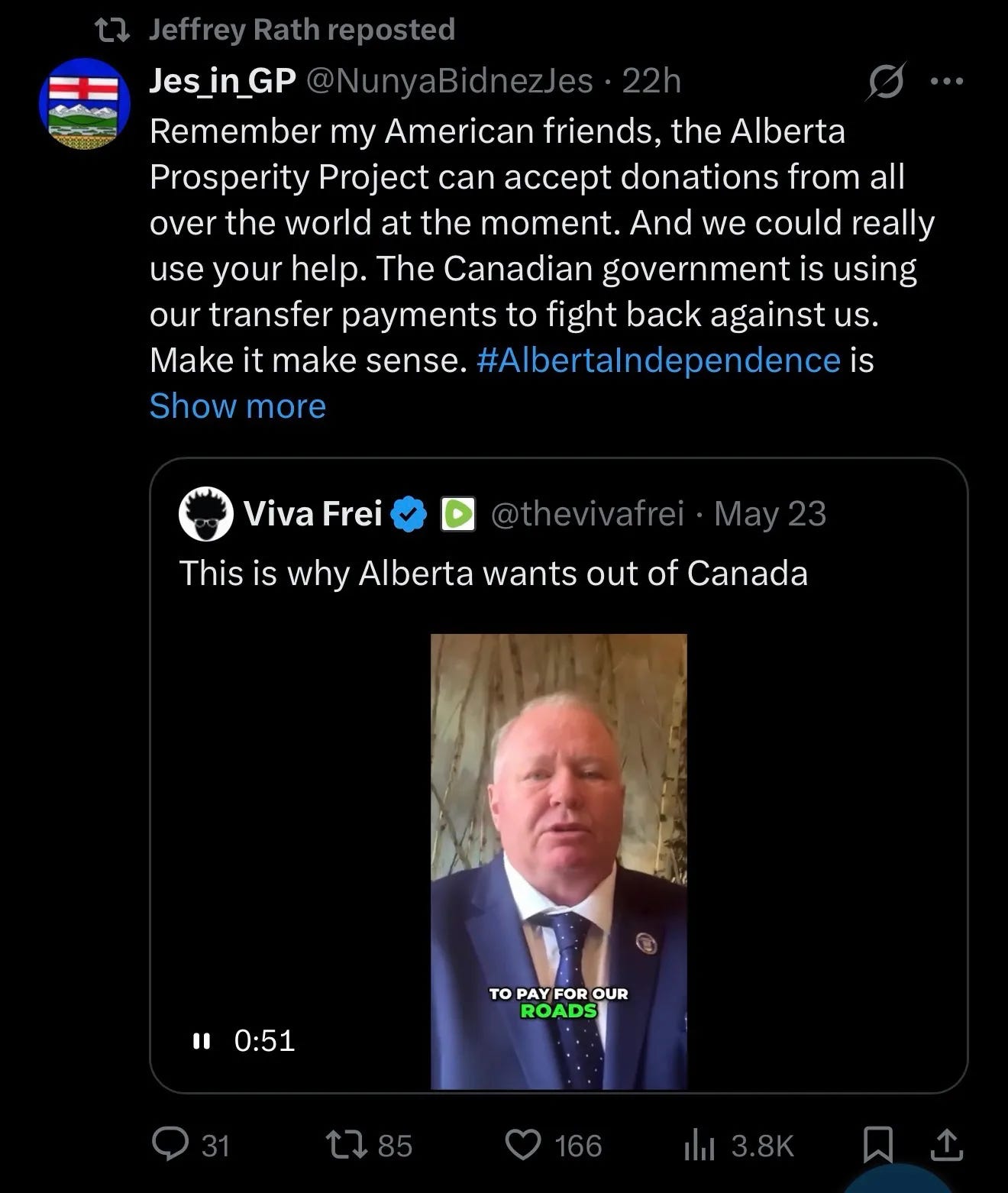
I will close with this. The post below was reposted by one of the leaders of this independence charade — one of the same people who has been to Washington and claimed American financial backing. It asks “American friends” to donate to Alberta separatism.
You can imagine what I think.
I initially wrote on Alberta here:
Make Alberta Great Again?
·
May 23, 2025

I was desperately trying to avoid this, but I feel the need to write about Alberta. After all, the threat of separation is a threat to Canada’s national security, so remains slightly “in bounds” of my original intent for this newsletter. Moreover, as I’ve explained a few times, I write as a cathartic experience and as a way to formulate my thoughts — an…
https://albertaprosperityproject.com/ufaq/will-canada-try-and-stop-alberta-from-separating/
Comments
Nothing yet. Say the first thing.
Sign in to join the conversation.