
Every time I discuss Canada’s military relationship with the United States, it comes up: Canada’s military is too pro-American and too likely to side with the United States as Canada attempts to pivot away. Usually, accusations like these have little evidence to support them and lean heavily on the commentator’s somewhat jaded view of the military in general. That being said, there is some truth here, and it is fair to say that the Armed Forces are generally pro-American. However, there is good reason for this, as this article will attempt to explain.
First, my usual caveats. I was never posted to the United States myself. However, I did conduct an entire operational tour with the Americans, served alongside them with NATO, and participated in extensive planning with USNORTHCOM as part of the Bi-National Planning Group. I wrote about my personal experience with the US military in my article “My Drift into Quiet Anti-Americanism”, which you can find here.
Canada’s military has been pro-American because we wanted it to be. Beginning in the late 1950s, Canada made strategic policy decisions that deliberately placed us firmly in the US orbit and made us militarily dependent on the United States. We stopped producing most items of military equipment and dismantled much of our defence industrial capability. We also decided that the Armed Forces could dispense with many core capabilities because we would “always” operate as part of an American-led coalition. Thus, things like attack helicopters, long- and medium-range air defence, deep-strike weapons (both air- and land-based), and many other weapons are not found in the Canadian arsenal. Our entire defence policy was, for decades, predicated on having an incredibly close relationship with the United States. It allowed us to eliminate “extravagant” defence spending — Canadians were largely uninterested in the military anyway — and focus on other priorities.
There was, of course, a trade-off. Canada became incredibly dependent on and integrated with the US after about 1965. We eliminated huge swaths of our defence industrial capability with the assumption that we could simply purchase what we needed from the United States. The North American Air Defence (later Aerospace) Command (NORAD) came into being in 1958 and completely integrated continental air defence, with operations commanded from Colorado Springs, Colorado.
Thus, Canada deliberately decided to abandon some elements of sovereignty in the defence realm. In return, we received security and the ability to spend the bare minimum on defence. And it worked as long as the relationship was benign. It is this assumption — that our defence relationship with the United States will always be benign — that drives many of the CAF’s attitudes towards the US, and these attitudes reflect the policies set by the political leadership.
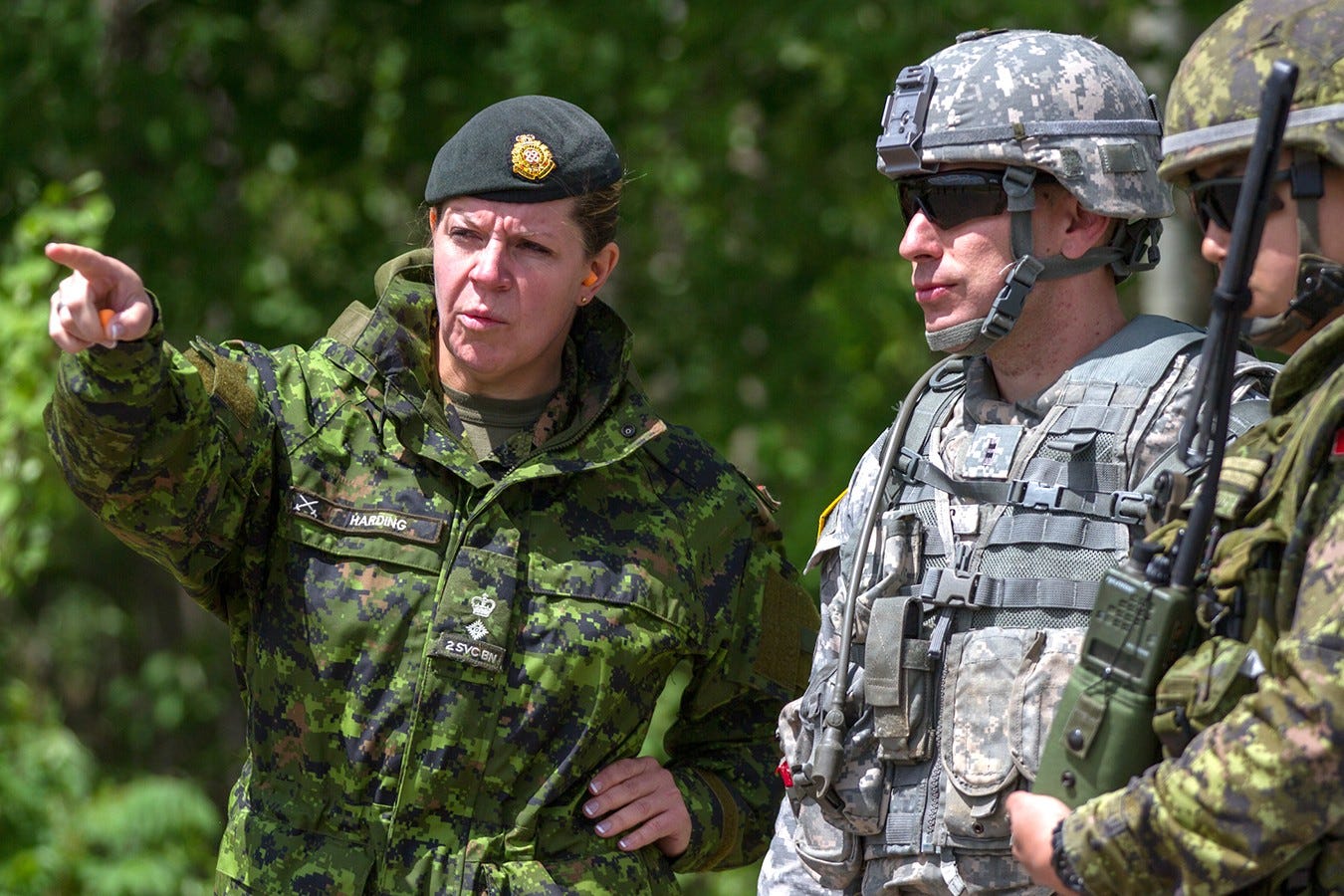
The result is that, at any given time, there are some 700 Canadians serving in the United States, most with NORAD. Canada is one of the very few countries that the Americans have permitted to command US forces. For instance, the Deputy Commander of NORAD is a senior Canadian general. Another RCAF general serves as deputy commander of the US NORAD region, based in Florida. Canadian generals serve in senior leadership roles with the US Army; Canada has a slot on the much-vaunted US Army Ranger course. Even when Canadians aren’t permanently assigned to duty in the United States itself, the working relationship is — as I can attest — very close. I know from experience that there are Canadians working in highly sensitive parts of the US military system, including alongside US Special Forces. More are assigned to US CENTCOM HQ in Qatar, flying with US Air Force squadrons, and Canadian ships routinely sail as part of US Navy task forces. They do all of this because that is what the Government of Canada wants them to do.
You can imagine what happens at a personal level. Working with the United States can be very professionally rewarding. For example, Canada doesn’t have an Army Corps HQ or an operational division, yet our commanders can gain experience operating at that level by working with the US. The Americans can be overwhelmingly welcoming and hospitable. Deep and lasting friendships are formed. If Canada decides that its personnel cannot support a US operation — as Ottawa made clear that Canadian personnel were not to be involved in the US attack on Iran, for instance — this is typically tolerated with some grace, even if there is private grumbling. Within NORAD, Canadians are assigned real operational roles critical to the defence of the continent and are found throughout the organization at every level. The Americans have resources that cannot be found anywhere else, and Canada is one of the few countries trusted enough to work directly with them.
It obviously isn’t perfect, and the pressure to “go along” is immense. The odd slight gets ignored, as do the jokes and weird cultural differences. The NOFORN caveats and paranoia become background noise and are sometimes disregarded because “you’re one of us anyway”. But overall, most Canadian personnel working with the US find it a rewarding and positive experience and come away with an affinity for the US military. That permeates the entire Armed Forces; the US has been our closest and most trusted ally for decades, and a large percentage of Canadian military people have trouble viewing the Americans as an adversary or a threat. Again, this reflects decades of deliberate government policy.
None of this is to say that our Armed Forces have been brainwashed; they are composed of individuals, after all, and many share the view that I expressed in the article mentioned abovd. But those views are usually expressed in eye-rolling or sideways-glance terms rather than in anything concrete. If you’ve seen The Office, a good analogy would cast the US as Michael Scott and Canada as Jim Halpert. Jim might have issues with Michael’s antics, but still finds him endearing in the end and finds it difficult to break free.
Canada, for good reason, is attempting to break free from dependence on the United States. As part of that, our entire defence policy is shifting and major adjustments are being made. However, our commitment to NORAD remains the same, and Canada still has exchange personnel in the United States at all levels. This deliberate closeness remains a policy of the Government, despite the re-emergence of Trump and his almost continuous threats to Canada. That translates into activities and attitudes that Canadians, reacting to these threats, find off-putting.
Thus, the RCAF recommends the F-35 because that was (and is) Government policy. An Army unit exercises in Alaska as Trump threatens Greenland because that is Government policy. An RCN ship sails with a US task force because the Government of Canada wants it to. The Armed Forces follows orders and takes its policy direction from our elected officials. There’s no pro-American conspiracy here: the military will shift if and when it is told to, personal attitudes notwithstanding. In fact, we just did exactly this when Ottawa ordered our personnel serving with the Americans to have nothing to do with the US attack on Iran.
If you’re looking for a sea change in the CAF’s stance towards the US, it will not come from the people in uniform. Instead, it has to come from our elected officials, and those officials are attempting to walk a tightrope wherein they maintain a viable continental defence relationship with the US (because we have to) while pivoting our relationship to reduce our dependence and increase sovereignty. These are political decisions, and in a democracy, militaries respond to political direction. My gut feeling is that the CAF writ large gets it, despite memories of good times in Colorado Springs.
Comments
Nothing yet. Say the first thing.
Sign in to join the conversation.